
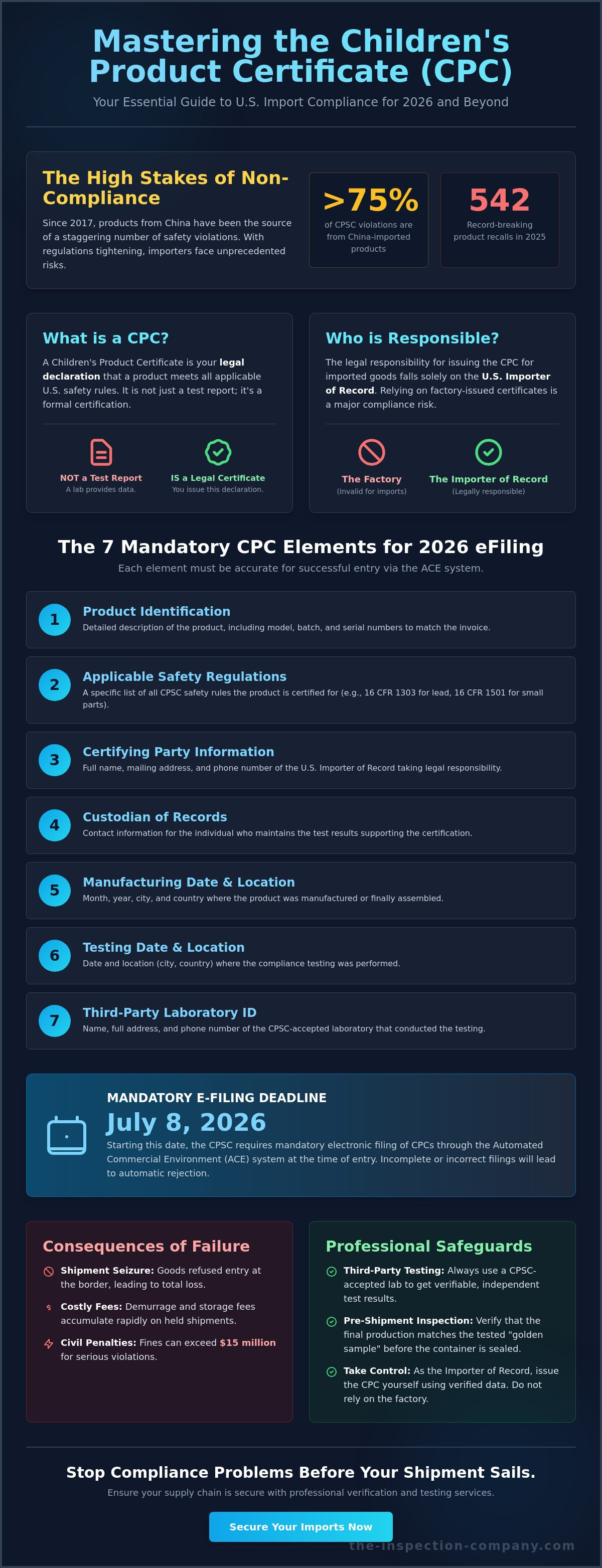
Did you know that since 2017, products imported from China have accounted for over 75% of all consumer product violations identified by the CPSC? This statistic highlights why mastering children's product certificate requirements is no longer optional for serious importers. You've likely felt the anxiety of a potential shipment rejection or the frustration of deciphering vague factory test reports. It's a high-stakes environment where a single compliance error leads to costly storage fees or a total refusal of entry at the border.
As of July 8, 2026, the CPSC requires mandatory electronic filing of these certificates through the ACE system at the moment of entry. This guide will help you master the 7 essential elements of a CPC and secure your Asian supply chain against the 542 record-breaking recalls seen in 2025. We'll provide a clear checklist to verify factory claims and ensure you have total peace of mind before your next container leaves the port. By following this process, you can stop compliance problems before your shipment sails.
Key Takeaways
- Identify your legal obligations as the Importer of Record to ensure you aren't relying on invalid factory-issued documents.
- Master the seven specific children's product certificate requirements mandated for electronic filing with U.S. Customs in 2026.
- Learn how to coordinate third-party testing with CPSC-accepted laboratories to verify the safety of your Asian-manufactured goods.
- Implement professional safeguards like Pre-Shipment Inspection to prevent "golden sample" traps and ensure production matches tested standards.
What is a Children's Product Certificate (CPC) and Who is Responsible?
The CPC is the legal bridge between your Asian production line and the American consumer. Under 16 CFR Part 1110, this document serves as your official declaration that a product complies with all applicable safety rules. Many importers mistakenly believe their factory in China or Vietnam handles this paperwork. In reality, the "Importer of Record" is the only party legally responsible for issuing the certificate for goods manufactured overseas. This distinction is vital because failing to meet children's product certificate requirements leads to immediate shipment seizures at the border.
A common error is confusing a test report with a certificate. A third-party laboratory provides the test report, which contains raw data and pass/fail results. You then use those results to draft the CPC. It's your signature, not the lab's, that guarantees the product's safety to U.S. Customs. Relying on a lab report alone without a corresponding certificate is a major compliance gap that results in costly delays.
Defining 'Children's Products' Under CPSC Rules
The CPSC classifies a children's product as any item designed or intended primarily for children 12 years of age or younger. Officials determine "intended use" by examining the manufacturer's statement, packaging, marketing materials, and recognized age grading. If your marketing features a child under 13, you must comply with these regulations. This rule applies even if the product is also used by adults, provided the primary audience is children.
The Legal Risk of Using Factory-Issued Certificates
Using a certificate provided by your supplier is a massive liability. The Consumer Product Safety Improvement Act (CPSIA) requires importers to verify compliance through independent, verifiable means. If you use a factory's CPC and the underlying data is fraudulent or outdated, you're legally liable for civil penalties. In 2025, these penalties exceeded $15 million for some violators. Taking control of children's product certificate requirements ensures you aren't gambling your business on a factory's word.
The 7 Mandatory Elements of a CPC in 2026
To remain compliant with the July 8, 2026 eFiling mandate, every Children's Product Certificate (CPC) must contain seven specific data elements. Missing even one detail can trigger a red flag in the Automated Commercial Environment (ACE) system, leading to a rejected entry. Understanding children's product certificate requirements means more than just filling out a form; it requires precise data management across your entire supply chain.
- Element 1: Product Identification. Describe the finished product with enough detail to match it to the shipping invoice. Include model numbers, colors, and batch identifiers.
- Element 2: Applicable Regulations. You must cite each safety rule individually. For example, a plastic toy might require citations for lead paint (16 CFR 1303) and small parts (16 CFR 1501). Identifying the correct citations for complex toys is a common stumbling block for new importers.
- Element 3: Certifying Party. Provide the name, full mailing address, and telephone number of the U.S. importer. This entity takes legal responsibility for the goods.
- Element 4: Custodian of Records. List the contact information for the person maintaining the test results that support the certification. This individual must be able to provide the raw data upon request.
Documenting Dates and Locations
Element 5 requires the month and year of manufacture along with the city and country of the factory. Element 6 demands the date and location of the actual testing. These dates must align with your production schedule. If you're unsure if your supplier's documents are authentic, our independent sample testing services can verify the materials before you finalize the paperwork.
Identifying the Third-Party Laboratory
Element 7 requires the name, address, and telephone number of the CPSC-accepted laboratory used for testing. You can't use just any lab. It must be a facility registered with the CPSC. Always cross-reference the lab's registration number on the official CPSC website to avoid fraudulent reports. Using a non-registered lab is one of the fastest ways to fail children's product certificate requirements and face a total shipment seizure.
How to Obtain a CPC for Products Manufactured in Asia
Securing a valid certificate requires a methodical approach that starts long before the goods reach the port. To meet Children's Product Certificate (CPC) requirements, you must first identify every safety rule applicable to your specific product category. This includes mechanical hazards, flammability, and chemical limits. Once identified, you'll submit production samples to a CPSC-accepted third-party laboratory. After receiving passing results, you draft the CPC using the seven elements discussed in the previous section. Always verify the report's authenticity directly with the lab's online database to ensure the data hasn't been tampered with.
The Critical Role of Independent Sample Picking
Never allow the factory to select the samples sent to the lab. This "Golden Sample" trap is a common cause of compliance failure where factories send high-quality prototypes that don't represent mass production. Instead, hire an independent inspection company to pull random samples directly from the production line. Integrating this step with your First Article Inspection (FAI) ensures that the materials used in the initial run actually match the safety standards you've promised. It's the only way to be certain that what's being tested is what's being shipped.
Coordinating with Asian Laboratories
Managing lead times is essential for maintaining your shipping schedule. Chemical testing for lead and phthalates typically takes 5 to 7 working days, while mechanical testing for toys might add another 3 to 5 days. Ensure the lab issues the final report in English, as required by 16 CFR part 1110. If the report is only in a local language, U.S. Customs will reject your filing. This leads to costly delays and storage fees that can quickly erode your profit margins.
Avoid shipment rejections by ensuring your testing is handled correctly from the start. Book a professional sample testing service today to secure your supply chain.
Risk Mitigation: Preventing CPC Failures and Customs Issues
Securing your supply chain requires a proactive approach to risk management. Even if you've met all children's product certificate requirements on paper, the physical goods must match the lab-tested specifications. The "Golden Sample" trap remains a major threat to importers. This occurs when a factory uses compliant materials for initial testing but substitutes cheaper, non-compliant components during mass production. To prevent this, a Pre-Shipment Inspection (PSI) acts as your final safeguard. It verifies that the actual batch matches the quality and safety standards established during the sampling phase.
Amazon FBA frequently rejects shipments when CPC data is incomplete or when the traceability link required by the April 30, 2026 guidance is missing. Integrating these compliance checks into your supplier management process ensures that safety is prioritized before the goods leave the factory. This systematic approach reduces the risk of costly surprises when your goods reach the U.S. border.
What Happens if Your CPC is Incomplete?
If Customs and Border Protection (CBP) finds your certificate lacking during the mandatory eFiling process, they'll detain the shipment. This leads to immediate storage fees and potential refusal of entry. You'll receive a "Notice of Violation" from the CPSC, which requires a detailed response and proof of compliance. In 2025, civil penalties for failing to report safety issues exceeded $15 million in several high-profile cases. Proactive verification is always cheaper than a customs detention.
Best Practices for 2026 Importers
Maintain a digital compliance folder for every SKU. This folder should contain the CPC, the third-party lab report, and your inspection records. You must issue a new CPC whenever there's a material change in the product or manufacturing process. You can leverage our Quality Platform to track these documents and inspection results in real-time. This gives you total transparency and ensures that you're always ready for a CPSC audit or a customs inquiry. One day of inspection can truly save months of trouble.
Secure Your Compliance Future in 2026
International trade is shifting toward total transparency and digital enforcement. By July 8, 2026, your ability to navigate children's product certificate requirements will determine whether your business thrives or faces costly border seizures. You now understand that you're the legal issuer of the CPC. You also know that independent verification is the only way to avoid the 'Golden Sample' trap. This knowledge is your best defense against the record 542 recalls issued in 2025.
Don't leave your compliance to chance or trust a factory's unverified word. Our European management team applies Western quality standards to every project. We're supported by a network of over 700 inspectors across Asia. As an ISO 9001 certified organization, we provide the meticulous oversight needed to stop problems before your shipment sails. Take control of your supply chain today. Secure your supply chain with professional inspection services and ship with total confidence. Your brand's reputation and financial health depend on the precision of your quality control.
Frequently Asked Questions
Do I need a CPC for every single product I import?
You must issue a certificate for every unique SKU intended primarily for children aged 12 or younger. This applies to every shipment entering the U.S. under the July 8, 2026 eFiling mandate. If you import a toy in three different colors, each variation requires its own documentation to meet children's product certificate requirements. Failing to provide SKU-specific data leads to immediate ACE system rejections and costly terminal storage fees.
How much does it cost to get a Children's Product Certificate?
Issuing the actual CPC document is free because it's a self-certified statement you draft yourself. However, the mandatory third-party lab testing required to back that statement carries significant costs. Estimates for simple products range from $500 to $1,200 per SKU. These expenses are a necessary investment to avoid the civil penalties that exceeded $15 million in 2025 for companies failing to report safety issues properly.
Can a factory in China issue a CPC for me?
A foreign factory cannot legally issue a CPC for you. As the importer of record, you're the only party legally responsible for certifying that the goods comply with U.S. safety standards. While your supplier provides production samples, you must coordinate with a CPSC-accepted lab and draft the final certificate yourself. Relying on a factory-provided document is a major compliance risk that often results in immediate shipment seizure.
How long is a CPC valid before I need to re-test?
A CPC remains valid as long as the product and manufacturing process stay exactly the same. However, industry best practices and major retailers often require annual re-testing to ensure ongoing compliance. If your factory changes a paint supplier or a plastic resin, you must conduct new testing and issue an updated certificate immediately. Material changes invalidate your previous children's product certificate requirements and require fresh laboratory verification.
What is the difference between a CPC and a GCC?
The primary difference lies in the target audience and the testing stringency. You issue a CPC for products intended for children 12 and under, which requires mandatory third-party testing at a CPSC-accepted lab. A General Certificate of Conformity (GCC) is for general-use consumer products, such as adult mattresses or power tools. Unlike the CPC, a GCC doesn't always require third-party laboratory verification, though the importer must still certify compliance with all applicable safety rules.