A "face-saving" fix from a supplier is often more expensive than the original defect itself. You've likely received the standard email claiming the issue is resolved, yet you still find an 8% defect rate in your latest shipment. It's frustrating to watch your revenue disappear due to unsellable inventory and delayed launches. You know that superficial promises won't protect your brand or your bottom line. One day of inspection can save months of trouble, but only if it's backed by a systematic response to failure.
Implementing a rigorous corrective action plan for suppliers is the only way to stop problems before your shipment sails. We understand the high stakes of international trade and the need for absolute transparency. This guide will help you master the strategic process of identifying, fixing, and preventing quality failures to secure your 2026 supply chain. You'll learn how to establish a standardized process for accountability that ensures long-term performance. We'll examine the specific steps to move from recurring errors to a permanent state of quality recovery.
Key Takeaways
- Learn the vital distinction between immediate fixes and systemic prevention to stop recurring quality issues before they damage your brand.
- Discover how to leverage data from pre-shipment inspection reports to build a high-performance SCAR framework that targets root causes rather than symptoms.
- Master a strategic five-step corrective action plan for suppliers to resolve non-conformities and secure your 2026 supply chain against costly disruptions.
- Understand why on-site verification and professional re-inspections are essential to confirm quality recovery, ensuring you never have to rely solely on a supplier's word.
- Transition from reactive crisis management to a proactive culture of continuous improvement that safeguards your international trade investments.
What is a Corrective Action Plan (CAP) for Suppliers?
A corrective action plan for suppliers is a formal, documented path designed to resolve non-conformities identified during a factory audit or product inspection. It serves as a professional roadmap for recovery when a shipment fails to meet quality standards. Without a structured plan, importers risk receiving recurring defects that drain capital and damage brand reputation. This process typically begins with a Supplier Corrective Action Request (SCAR). This document serves as the official trigger for the factory to investigate and resolve the issue under strict deadlines.
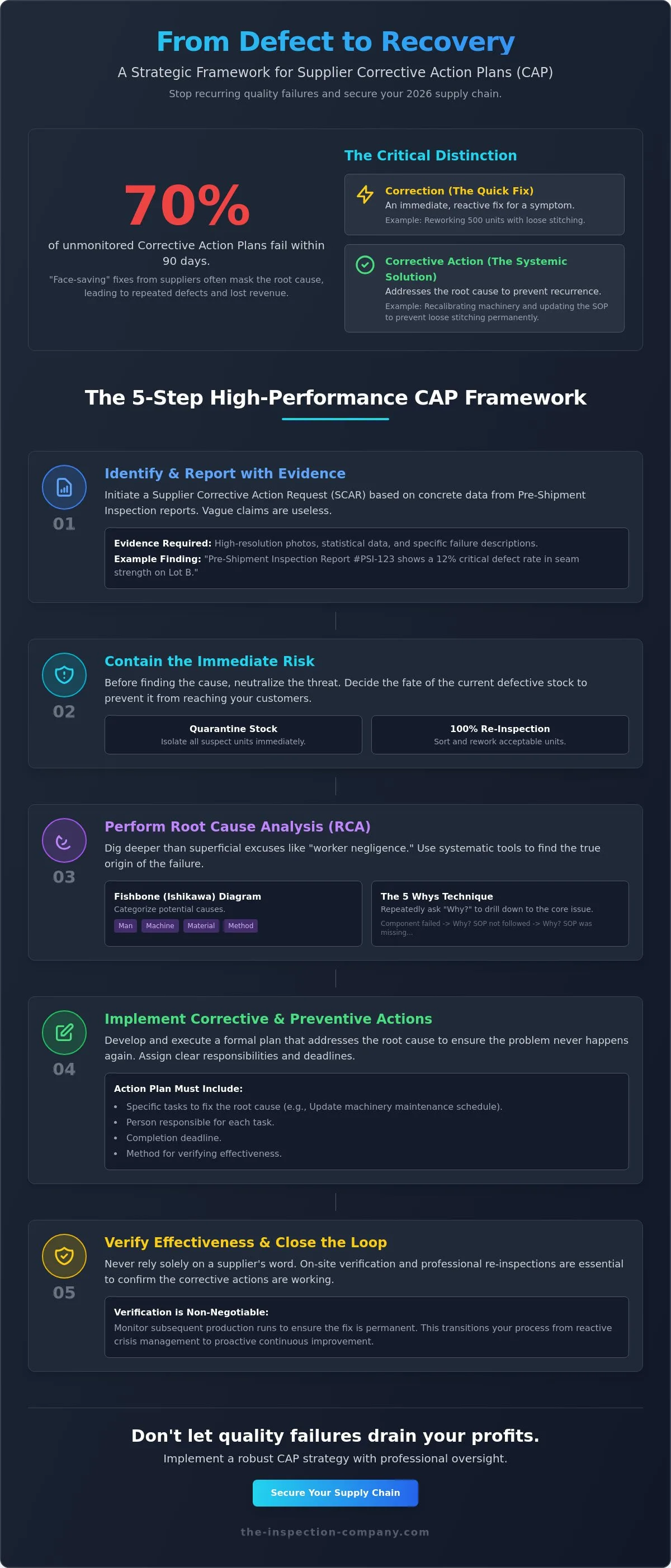
Understanding the difference between a "correction" and a "corrective action" is critical for effective risk management. A correction is an immediate, reactive fix, such as reworking 500 units with loose stitching. In contrast, a corrective action addresses the root cause to prevent the error from happening again. This systematic approach is rooted in the broader framework of Corrective and Preventive Action (CAPA), which ensures that quality improvements are permanent. At The Inspection Company, we operate on the principle that one day of inspection saves months of remediation trouble. Investing in professional inspection services early avoids the high costs of shipping defective goods or managing a total product recall.
Why Generic CAPs Fail in Asian Manufacturing
Many suppliers in Asia operate within a face-saving culture. They'll often agree to a corrective action plan for suppliers they cannot technically execute just to avoid conflict. This leads to Band-Aid fixes that mask symptoms without fixing the machinery or training gaps responsible for the defect. Our internal data suggests that 70% of unmonitored CAPs fail within the first 90 days of implementation. European-managed oversight provides the necessary bridge to ensure quality standards are communicated clearly and enforced strictly on the factory floor.
The Anatomy of a High-Performance SCAR Framework
A Supplier Corrective Action Report (SCAR) functions as the structural backbone of your corrective action plan for suppliers. It's not a mere formality; it's a technical document that stops quality bleed. Effective recovery begins with evidence. You must use the high-resolution photos and statistical data found in your Pre-Shipment Inspection reports to pin down exactly where the batch failed. If a report shows a 12% critical defect rate in seam strength, the SCAR should reference those specific findings to prevent the factory from offering vague excuses.
Containment is your first line of defense. Before discussing long-term fixes, you must decide the fate of the current defective stock. This often involves a 100% re-inspection or immediate quarantine to ensure zero sub-standard units reach the shipping container. Once the immediate risk is neutralized, you shift toward preventive actions. This involves updating your Supplier Management Process to include stricter milestone checks or revised material specifications. These steps ensure that a one-time failure doesn't become a recurring financial drain.
Mastering Root Cause Analysis (RCA) Tools
Root Cause Analysis is the process of isolating the 'DNA' of a quality failure. To move beyond superficial excuses, use tools like the Fishbone (Ishikawa) diagram. This method helps you categorize failures into man, machine, material, or method. For example, if a batch of electronics fails a voltage test, the Fishbone might reveal that the soldering iron temperature was set 20 degrees too low, pointing to a 'method' failure rather than 'human error.'
The '5 Whys' technique is equally vital. If a component fails, don't accept 'worker negligence' as the answer. Ask why the worker failed. Was the SOP missing? Why was it missing? By the fifth 'why,' you'll usually find a systemic gap. You also need to determine if the issue is a functional Product Defect caused by poor assembly or a fundamental raw material non-compliance, such as using 201-grade stainless steel instead of the specified 304-grade. Identifying these specifics allows your corrective action plan for suppliers to target the true source of the trouble. You can review our full range of inspection services to see how we provide the data needed for these deep dives.
Implementing Your CAP: A Strategic 5-Step Framework
Executing a corrective action plan for suppliers requires a disciplined approach to prevent recurring defects. You can't rely on verbal promises or vague commitments. You need a structured roadmap that forces accountability and tracks progress in real-time. This framework turns a failed inspection into a roadmap for quality recovery.
- Step 1: Issue the SCAR immediately. Send a formal Supplier Corrective Action Request within 24 hours of a failed inspection. Speed is critical. If you wait 72 hours, the factory might have already started the next production run using the same flawed processes.
- Step 2: Collaborative Review. Don't just dictate terms. Review the root cause with the factory management. If they don't understand the "why" behind your quality standards, any fix they implement will be temporary.
- Step 3: Define SMART Milestones. Establish targets that are Specific, Measurable, Achievable, Relevant, and Time-bound. (Detailed below).
- Step 4: Resource Allocation. Identify what the factory actually needs to succeed. This might mean installing 500-lux lighting at QC stations or providing specialized jigs to eliminate manual alignment errors during assembly.
- Step 5: Documentation. Record every process change and equipment upgrade. This data creates a baseline for future Factory Audits to ensure the supplier doesn't revert to old habits.
Setting SMART Remediation Milestones
Generic deadlines fail. Your corrective action plan for suppliers must include milestones that leave no room for interpretation. For example, instead of asking for "better quality," require the factory to reduce the Major Defect rate from 5.5% to under 1.5% within 14 days. This gives the factory a clear target and you a metric to track.
Transparency is your best tool for risk mitigation. Use a centralized Quality Platform to monitor these milestones. When every stakeholder sees the same data, there's no room for "lost" emails or misunderstood requirements. This visibility stops problems before your shipment sails.
Closing the Loop: Verification and Continuous Improvement
A supplier's promise to improve is a starting point, not a guarantee. Relying on verbal or written assurances alone often leads to a 30% recurrence rate of the same defects in the next production cycle. A successful corrective action plan for suppliers requires physical evidence of change. Importers must move beyond trust and demand on-site verification to ensure that new processes are actually in place on the factory floor.
Re-inspection serves as the ultimate filter. It confirms that the specific corrective actions were applied to the new batch before it leaves the warehouse. When you integrate these CAP results into a supplier performance scorecard, you transform a one-time fix into a long-term strategy. Tracking these metrics allows you to identify which partners are committed to growth and which ones pose a recurring risk to your brand. Consistent enforcement of these standards builds a culture of quality. Over time, this discipline reduces long-term inspection costs because the factory begins to self-correct before errors reach the final assembly line.
The Role of Third-Party Inspections in CAP Validation
Independent inspectors act as your eyes and ears during the remediation process. They don't just look at the final product; they verify that the factory updated its machinery settings or retrained its staff as promised. We link the success of your corrective action plan for suppliers directly to AQL standards for the subsequent shipment. If the batch fails to meet these rigorous limits, the remediation is deemed incomplete.
- Inspectors provide unbiased photographic evidence of process changes.
- Validation prevents the shipment of "reworked" goods that may have hidden structural damage.
- Independent audits verify that root causes, such as poor raw material storage, are permanently resolved.
Don't leave your supply chain to chance. Contact The Inspection Company to manage your supplier remediation today and ensure your quality standards remain non-negotiable.
Transform Quality Failures into Operational Resilience
A corrective action plan for suppliers isn't just a response to a bad batch; it's a strategic investment in your brand’s future. By applying a structured SCAR framework, you move past temporary patches to address the root causes of production errors. This systematic approach ensures that once a problem is identified, it's permanently resolved through rigorous verification and process adjustments.
Managing this recovery process from thousands of miles away presents significant risks. The Inspection Company bridges that gap with European management and Asian quality control experience since 2007. Our team of 700+ inspectors operates under ISO 9001 certified standards to provide the transparency you need. We stop problems before your shipment sails, because one day of inspection can save months of trouble. You'll gain the confidence that your factory is actually following the agreed-upon improvements.
Secure your supply chain with expert factory audits and inspections. You've built a great business, and with the right oversight, your supplier relationships will only grow stronger and more reliable.
Frequently Asked Questions
What is the difference between a CAR and a SCAR?
A CAR is an internal document used to fix non-conformities within your own company, while a SCAR is an external request sent directly to your manufacturer. The SCAR process formalizes the corrective action plan for suppliers, requiring the factory to identify root causes and implement permanent fixes. It ensures that 100% of the responsibility for quality recovery stays with the party that produced the goods.
How long should a supplier have to respond to a corrective action request?
You should require an initial acknowledgment within 24 hours and a completed plan within 10 business days. For critical safety defects that halt production, this timeline usually shrinks to a 48 hour window for a full resolution strategy. Setting these firm deadlines prevents communication gaps that can lead to 30 day shipping delays or missed seasonal retail windows.
What should I do if a supplier refuses to sign or implement a CAP?
Stop all pending payments immediately and issue a formal notice that their status as a qualified vendor is at risk. A refusal to cooperate is a high-risk signal that often precedes a 25% increase in defect rates in future batches. If the factory doesn't comply within 5 business days, you must begin the process of moving your tooling to a backup manufacturer to protect your supply chain.
Can a Corrective Action Plan be used for social compliance violations?
A corrective action plan for suppliers is the standard tool for resolving labor or safety violations found during Sedex or BSCI audits. If an audit shows that 15% of workers lack proper safety gear, the CAP outlines the specific equipment purchases and training dates required for compliance. It's a mandatory step for maintaining your brand's ethical standing and avoiding costly legal trouble in your home market.
How do I verify that a root cause has actually been addressed?
Verification requires a follow-up inspection on the factory floor to confirm that new processes or machinery are actually in place. You should also monitor the next 3 consecutive shipments to ensure the specific defect doesn't reappear in your AQL samples. Reviewing 500 individual unit test results provides the statistical confidence needed to prove the factory's changes are working effectively.
Which KPIs should I track to measure supplier performance?
The most useful are the inspection pass rate, the defect rate per order, on-time delivery, the time taken to close corrective actions, and how often the same defect comes back. Track them per supplier over several orders rather than judging on one shipment.
Is it better to improve a poor supplier or find a new one?
Improve them if they respond to corrective actions and the problems are fixable, such as process control or packing. Replace them if the same failures keep returning, they refuse corrective actions, or the issue is fundamental, such as missing equipment or capacity, or serious compliance problems.