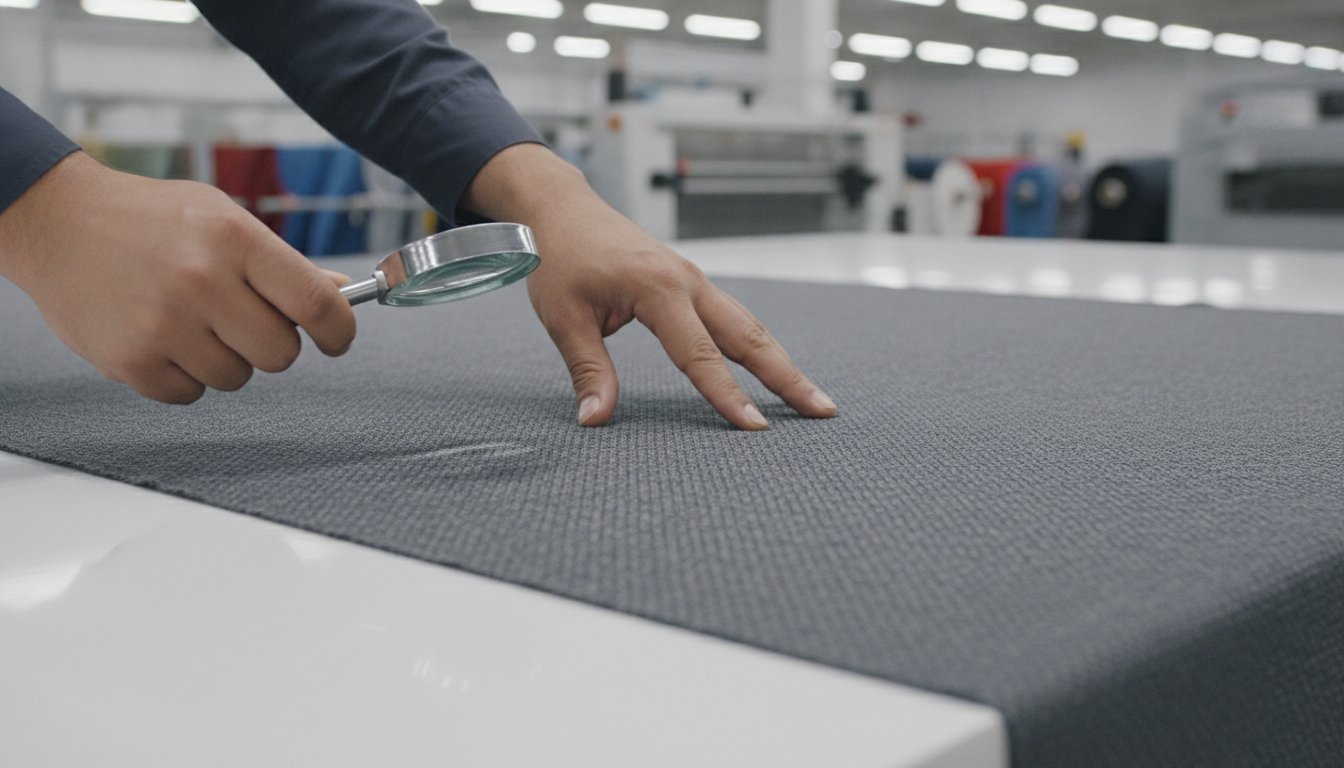

Could your next shipment survive a two-day deadline from an EU marketplace authority, or will it end up as a permanent entry on the "Safety Gate" alert system? You likely feel the pressure of the updated eu product safety requirements, especially since the General Product Safety Regulation (GPSR) became fully applicable on December 13, 2024. It's a common concern for importers who worry that a supplier's verbal promise won't match the physical reality of the goods. One labeling error or a missing risk analysis can lead to costly customs seizures and destroyed stock.
This guide provides the clarity you need to navigate these complexities and verify compliance at the factory level in Asia. You'll learn exactly what the new law demands and how to secure your investment before any cargo sails. We'll provide a checklist for your technical documentation and a practical strategy to prevent non-compliant products from ever reaching European shores.
Key Takeaways
- Understand the critical shift from a Directive to a Regulation and how this "safety net" impacts your legal liability across all EU member states.
- Learn why your technical documentation and risk analysis must be finalized before production to meet eu product safety requirements and avoid customs seizures.
- Discover how a First Article Inspection (FAI) validates your product design at the source, stopping compliance errors before mass production begins.
- Master the use of Pre-Shipment Inspections and AQL sampling to statistically prove batch safety, acting as your final defense against "Safety Gate" recalls.
Table of Contents
Understanding the EU General Product Safety Regulation (GPSR)
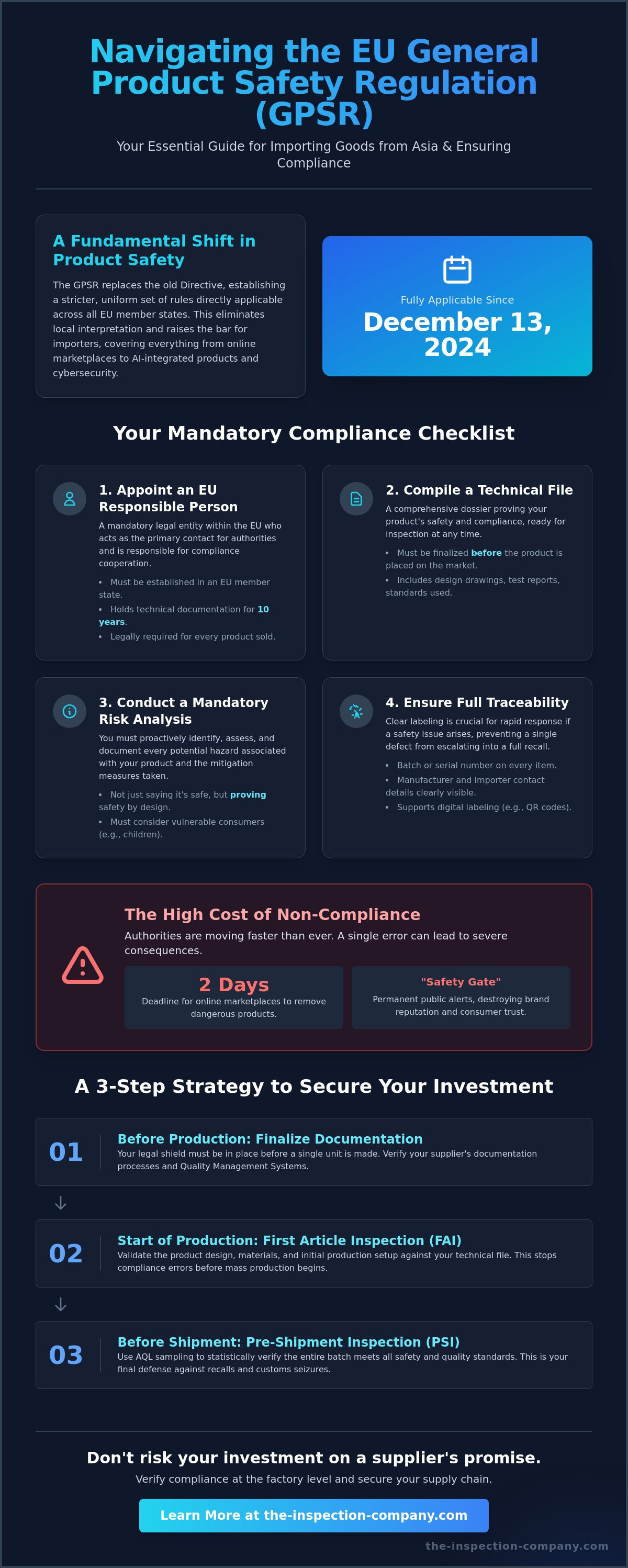
The General Product Safety Regulation (GPSR) serves as the essential safety net for consumer goods in the European Union. Since it became fully applicable on December 13, 2024, it has set a much higher bar for eu product safety requirements. Unlike the previous Directive, this Regulation is directly applicable across all EU member states. There's no room for local interpretation; the rules are uniform, strict, and immediate. If you import goods from Asia, you face a landscape where safety isn't just about physical durability. The scope now covers online marketplaces, AI-integrated products, and even reconditioned goods.
For 2026, enforcement authorities are prioritizing digital labeling and cybersecurity-related safety risks. The EU's shift from a reactive to a proactive model means market surveillance is faster than ever. Online marketplaces now have only two working days to respond to authority orders to remove dangerous products. This increased speed of enforcement makes it vital to verify every claim your supplier makes before the goods leave the factory. Relying on outdated certificates is a risk you can't afford to take.
Key Changes from the Old Safety Directive
The definition of a "safe product" has evolved significantly. It now accounts for software updates and connectivity factors that could compromise physical safety. Risk assessments must specifically address vulnerable consumers, including children and the elderly. You can't rely on generic safety claims anymore. Every product feature, including its digital components, must be scrutinized to prevent a "Safety Gate" recall. One day of professional inspection can save months of legal trouble and financial loss.
The Role of the EU Responsible Person
Every product sold in the EU must now have a designated "Responsible Person" established within the union. This is a mandatory requirement. This person, whether an importer or an authorized representative, must hold the technical documentation for 10 years. They act as the primary contact for market surveillance authorities and are legally responsible for cooperating with safety notices. If your designated person can't produce the required technical file on demand, your products will be pulled from the market immediately.
Mandatory Documentation: Technical Files and Risk Analysis
Paperwork isn't just a formality anymore; it's a legal shield. Under the current eu product safety requirements, your Technical File must be fully compiled and ready before your products even hit the water. Authorities won't wait for you to call your supplier when they request documentation. You need a comprehensive dossier that includes detailed design drawings, validated test reports, and a full list of the harmonized standards applied during manufacturing. This file must be kept for 10 years after the product is placed on the market, ensuring long-term accountability for every item sold.
The most significant addition under the GPSR is the mandatory risk analysis. This document must identify every potential hazard associated with the product and detail the specific measures taken to mitigate those risks. It's no longer enough to say a product is safe; you must prove the safety was designed in from the start. For many importers, this level of detail is difficult to extract from Asian suppliers without a professional factory audit to verify their internal documentation processes and quality management systems.
Traceability is equally vital for risk mitigation. Every item must bear a batch or serial number, along with the manufacturer's and importer's contact details. This ensures that if a safety issue arises, the specific production run can be identified and isolated quickly. Clear labeling prevents a single defect from turning into a full-scale market withdrawal of your entire inventory.
Proving Compliance with RoHS and REACH
Chemical safety is a core pillar of the EU's General Product Safety Regulation for importers. You must ensure your goods don't contain restricted substances that could harm consumers or the environment. Understanding the RoHS compliant meaning is essential for anyone importing electronics, as it dictates strict limits on heavy metals and flame retardants that intersect with general safety standards.
Digital Labeling and User Instructions
As we move into 2026, digital labeling via QR codes is becoming the standard for user manuals and safety warnings. This shift allows for easier updates, but the fundamental rules haven't changed. Instructions must be provided in the official language of the country where the product is sold. A manual in English won't suffice for a shipment headed to France or Italy; the local language is a non-negotiable requirement for compliance.
Verifying EU Safety Requirements at the Source
Legislative compliance is often a paperwork exercise, but true safety is a manufacturing reality that you must verify on-site. You can't simply trust a supplier's verbal promise or a scanned document sent via email. To meet the eu product safety requirements, you need a "trust but verify" mindset. Start with a First Article Inspection (FAI) to validate the design safety of the very first unit off the line. This prevents mass-producing a fundamental design flaw that could lead to a total batch rejection.
Following the FAI, you should implement lab testing for critical safety parameters like flammability, mechanical strength, and chemical limits. Even if the initial design is sound, factory environments change. Monitor the middle of your production run with During Production Inspections to stop "quality fade" before it ruins your shipment. The European Commission's official GPSR guidance emphasizes that the importer bears the ultimate burden of proof. Don't let a supplier's shortcuts become your legal liability.
Common Deficiencies in Supplier Documentation
Our teams frequently encounter expired or outright fake CE certificates in Asian manufacturing hubs. A supplier might show you a "golden sample" that passes every test, but the mass-produced reality often differs. Without independent verification, you're essentially gambling with your brand's reputation. We've seen cases where 15% of a batch failed safety markings simply because the supplier switched to a cheaper adhesive mid-run.
On-Site Safety Testing Protocols
On-site testing provides immediate, undeniable data. For electronics, we conduct Hi-pot tests to ensure insulation integrity and prevent electrical shocks. For toys or consumer goods, tension tests verify that small parts won't detach and become choking hazards. We also verify that mandatory safety markings and warning labels are permanently affixed and legible. Secure your supply chain with our expert on-site inspections to avoid costly surprises at the border.
The Pre-Shipment Inspection: Your Final Safety Gate
Once your goods are loaded onto a container, your window for correction slams shut. A Pre-Shipment Inspection (PSI) is the only reliable way to ensure your batch adheres to eu product safety requirements before it leaves the factory. This final check stops non-compliant goods from ever reaching the border, protecting you from the nightmare of a "Safety Gate" recall. One day of inspection can save months of legal trouble and millions in potential recall costs. Don't leave your brand's reputation to chance.
We use AQL sampling to statistically prove batch compliance. This method allows our inspectors to examine a representative sample of your production run, identifying defects and safety hazards with mathematical precision. Beyond catching errors, a detailed inspection report serves as critical evidence of "due diligence" for EU authorities. If a market surveillance officer requests proof of your safety checks, a professional, independent report is your primary line of defense.
What an Inspector Checks for EU Compliance
Our inspectors perform a rigorous physical comparison against your "Approved Sample" and the technical file. We don't just look at the product; we scrutinize the packaging and labeling. This includes verifying that correct symbols, mandatory safety warnings, and accurate importer information are all present and permanently affixed. In 2026, even a minor labeling omission can trigger a marketplace rejection. We ensure every detail matches the legal requirements of your destination country.
Integrating Safety into Your Quality Platform
Managing compliance across multiple suppliers in Asia is a complex task. You can use the TIC Quality Platform to centralize your compliance data and track inspection results in real-time. Our system allows you to set up automated alerts for recurring safety defects, helping you identify high-risk suppliers before they cause a crisis. By digitalizing your quality control, you gain a transparent, top-down view of your entire supply chain's safety status. Book your inspection today and avoid costly surprises before your shipment sails.
Secure Your Supply Chain Against New Regulatory Risks
The transition to the GPSR is no longer a future event; it's a current legal reality that demands a proactive approach to eu product safety requirements. Success in the 2026 market requires more than just meeting administrative deadlines. You must bridge the gap between factory floor production in Asia and the strict safety standards enforced by EU member states. By combining robust technical documentation with on-site verification, you eliminate the guesswork that leads to "Safety Gate" recalls and customs seizures.
The Inspection Company provides the independent oversight you need to trade with confidence. Backed by European management and over 700 inspectors across Asia, we ensure your goods meet EU standards before they sail. Our ISO 9001 certified quality control processes are designed to mitigate risk and protect your investment. Don't let a single shipment jeopardize your business. Avoid costly safety surprises—book your Pre-Shipment Inspection today. You've built a strong brand; let's work together to keep it safe.
Frequently Asked Questions
What is the difference between GPSD and GPSR?
The primary difference is that the GPSR is a Regulation, making it directly applicable across all EU member states without the need for national laws. It replaced the older GPSD on December 13, 2024. This update introduces stricter eu product safety requirements for online sales and digital products. It shifts the legal burden to the importer, requiring mandatory risk analyses that weren't previously required under the Directive.
Who is considered the 'Responsible Person' for EU product safety?
A Responsible Person is a designated economic operator established within the EU who ensures a product’s technical documentation is available for authorities. This can be the importer, an authorized representative, or a fulfillment service provider. Every product sold in the EU from a non-EU manufacturer must have this contact's information clearly labeled. Without a designated person, your goods face immediate seizure at customs or removal from online marketplaces.
Does a CE mark guarantee that a product is compliant with GPSR?
No, a CE mark doesn't automatically guarantee compliance with the GPSR. The CE mark only applies to products covered by specific EU legislation, such as toys or electronics. The GPSR acts as a safety net for all consumer products, including those that don't require a CE mark. You must still verify that your product meets the broader eu product safety requirements, including conducting a comprehensive risk assessment and maintaining a technical file.
What happens if my product is listed on the EU Safety Gate?
Being listed on the Safety Gate means your product is identified as dangerous, triggering an immediate EU-wide recall. National authorities will order you to pull the product from the market and notify all consumers who purchased it. This results in significant financial loss and permanent damage to your brand's reputation. Online marketplaces must respond to these notices within three working days, ensuring non-compliant listings are deleted rapidly across the union.
Can I use digital manuals instead of printed ones in 2026?
You can use digital manuals via QR codes, but essential safety information must often still accompany the physical product. The GPSR encourages digital labeling to reduce waste, yet it mandates that instructions remain accessible to all consumers. Crucially, all safety warnings must be provided in the official language of the destination country. Relying solely on a digital manual in English for a product sold in Spain or Poland is a common cause of non-compliance.