
What if the 30% deposit you just wired to a new supplier in Ho Chi Minh City is actually funding a middleman with no factory floor of his own? It's a risk many importers face when they don't account for the factory audit vietnam cost early in their procurement strategy. You understand that Vietnam offers incredible manufacturing potential, yet the anxiety over low-quality production or unexpected travel fees often causes costly delays. It's difficult to scale when you're uncertain about the legitimacy of your partners.
This 2026 guide provides full transparency on auditing expenses to help you protect your investment before your shipment sails. We'll show you how to identify a reliable partner and avoid the hidden charges that often inflate a low initial quote. You'll learn exactly how man-day rates work and get a clear framework to compare audit providers. We're providing a roadmap to ensure your chosen supplier can actually deliver, backed by our experience since 2007 in European quality management.
Key Takeaways
- Master the industry-standard "Man-Day" rate to accurately forecast your 2026 sourcing budget and avoid overpaying for supplier evaluations.
- Discover the transparent factory audit vietnam cost range for standard evaluations and how these fees compare to the high price of a rejected shipment.
- Distinguish between baseline vetting and deep-dive QMS audits to ensure your supplier meets both ISO 9001 standards and your specific production capacity requirements.
- Uncover the "Cost of Quality" and why hiring professional management oversight is a critical investment to prevent costly manufacturing surprises and "freelance" risks.
- Learn the essential steps for booking a professional audit, from defining your custom checklist to coordinating factory logistics for maximum on-the-ground efficiency.
Decoding Factory Audit Vietnam Cost: The Man-Day Rate in 2026
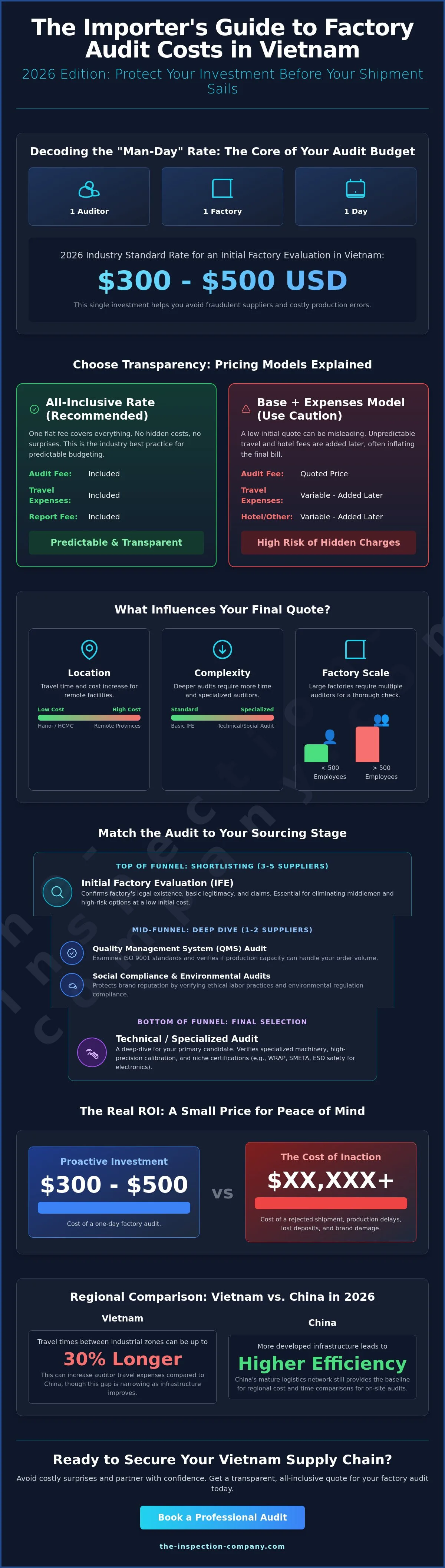
Understanding your factory audit vietnam cost starts with the "man-day" rate. A man-day is the standard unit of work for one auditor per factory per day. In 2026, the industry standard for a third-party Initial Factory Evaluation in Vietnam typically ranges between $300 and $500 USD. This investment helps you avoid costly surprises before your shipment sails.
Transparency is essential when comparing quotes from different providers. Most reputable firms offer an "All-Inclusive" rate. This covers the audit fee, travel expenses, and the final report in one flat price. In contrast, some agencies use a "Base + Expenses" model. This often leads to unpredictable bills for hotel stays or long-distance transport. Choosing an all-inclusive model ensures you don't face hidden charges. You can review our comprehensive quality control services to see how these pricing structures apply to different audit types.
What Factors Influence the Final Quote?
The total factory audit vietnam cost depends on three primary variables:
- Geographical Location: Auditing a supplier near Ho Chi Minh City or Hanoi is generally more affordable. Remote facilities in northern provinces often require higher travel budgets.
- Audit Complexity: A standard Technical QMS audit focuses on production capacity. However, a deep dive into social and ethical performance requires more time and specialized expertise.
- Scale of Facility: Large-scale plants with over 500 employees often require two or more auditors to complete a thorough assessment in a single day.
Vietnam vs. China: Pricing Differences in 2026
While Vietnam is a primary sourcing hub, its infrastructure still trails behind its neighbor. Travel times between industrial zones in Vietnam can be 30% longer than in China. This often increases the auditor's travel expenses. Even so, China inspection services still provide the baseline for regional cost comparisons. By 2026, Vietnam's expanding highway network is expected to narrow this gap, making on-site inspections more efficient and cost-effective for international buyers.
Types of Audits and Their Impact on Your Sourcing Budget
The specific type of inspection you choose directly influences the total factory audit vietnam cost. Different stages of the sourcing journey require varying levels of scrutiny. An Initial Factory Evaluation (IFE) serves as the primary filter for new suppliers. It confirms the factory's legal existence and basic legitimacy. You don't want to send a deposit to a middleman posing as a manufacturer.
- Quality Management System (QMS) Audits: These examine ISO 9001 standards and actual production capacity. They ensure the facility can actually handle your order volume.
- Social Compliance Audits: These focus on ethical labor practices. They protect your brand reputation by verifying the absence of child labor or unsafe working conditions.
- Environmental Audits: These assess waste management and compliance with local Vietnamese regulations, such as Decree No. 08/2022/ND-CP.
Choosing the Right Audit for Your Funnel Stage
Efficiency requires matching the audit depth to your sourcing progress. Use a basic IFE to shortlist 3 to 5 potential partners. This keeps initial expenses low while eliminating high-risk options. Once you identify a primary candidate for high-precision manufacturing, invest in a Technical Audit. Aligning these checks with your supplier management process ensures long-term growth. It's the best way to stop problems before they reach the shipping container.
The Cost of Specialized Industry Audits
Vietnam's diverse manufacturing hubs require different expertise. Electronics manufacturing in provinces like Bac Ninh requires technical audits with specialized testing equipment for ESD safety. Garment factories in the south often demand specific social compliance certifications like WRAP or SMETA. These specialized requirements often increase the factory audit vietnam cost because they require senior auditors with niche technical backgrounds. If your product requires high-precision calibration, expect to pay for the extra time needed to verify specialized machinery. You can explore our full range of audit services to find the specific protocol that matches your product category.
The Real ROI: Why 'Cheap' Audits Can Cost You Thousands
Choosing a partner based solely on the lowest factory audit vietnam cost often leads to catastrophic financial outcomes. Independent freelance auditors usually lack professional management oversight and standardized reporting protocols. This creates a vacuum where "factory-friendly" reports become common. When an auditor accepts a bribe or overlooks a critical defect to maintain a relationship with the manufacturer, the importer pays the ultimate price. One day of inspection can save months of trouble.
Consider the Cost of Quality (CoQ). While a professional audit requires an upfront fee, the cost of a rejected shipment is significantly higher. A single container of 5,000 defective units can result in a total loss of investment, wasted freight costs, and destroyed retail reputation. It's a high-stakes gamble that professional agencies eliminate through rigorous, independent oversight. We stop problems before your shipment sails, ensuring your capital isn't tied up in unsellable inventory.
Avoiding Hidden Fees and Surcharges
Many low-cost providers lure importers with a base rate only to add unexpected expenses later. You'll often encounter report revision fees, weekend surcharges, or inflated travel receipts that double the initial quote. To ensure transparency, verify that your audit partner follows European management standards. This ensures a process where the auditor is accountable to the agency, not the factory. You can view examples of transparent TIC services to see how professional reporting should look without hidden surprises.
Protecting Your Brand from Social Compliance Risks
The financial impact of a factory audit goes beyond product specs. Discovering child labor or severe safety violations after a product hits the shelves can trigger multi-million dollar PR disasters and legal penalties. Since 2023, global supply chain transparency laws have increased the legal liability for importers. Spending approximately $500 on a professional audit is an essential insurance policy against these brand-killing risks. It's the difference between a secure supply chain and a public relations nightmare that could end your business.
How to Book a Professional Factory Audit in Vietnam
Securing your supply chain starts with a methodical approach to verification. To manage your factory audit vietnam cost effectively, follow these four strategic steps to ensure your investment yields actionable data and mitigates long-term risk.
- Step 1: Define your checklist. Don't settle for generic audits. Specify requirements based on your product category, such as electronics safety or textile durability, to ensure compliance with ISO 9001 or social responsibility standards.
- Step 2: Provide logistics details. Share the factory address in industrial hubs like Binh Duong, Bac Ninh, or Hai Phong. Our team handles the coordination with the supplier directly. This reduces your administrative burden and prevents communication errors.
- Step 3: Review the 24-hour report. Analyze the findings immediately. Focus on 'Major' or 'Critical' non-conformities that could jeopardize your brand reputation or lead to product recalls.
- Step 4: Align with your inspection strategy. Integrate audit results into your final pre-shipment inspection strategy. If the factory shows weaknesses in specific production lines, your final inspection should focus heavily on those areas.
Leveraging The Inspection Company’s Quality Platform
Our proprietary Quality Platform simplifies the booking process for Vietnam-based operations. It provides a centralized dashboard where you can track audit progress and manage reports in real-time. The 24-hour reporting window is vital for fast-moving supply chains. It allows you to make informed decisions without delaying your production schedule. Fast data prevents costly surprises before your goods leave the factory floor.
Next Steps for Importers in Vietnam
Prepare your supplier by explaining that the audit is a tool for mutual improvement. Transparency leads to better access to production floors and internal documentation. Use the audit report as a leverage tool during contract discussions. If the audit identifies a 12% gap in quality management compliance, you can negotiate stronger quality guarantees or revised payment terms. Professional oversight is the only way to gain true control over your offshore manufacturing and justify your factory audit vietnam cost.
Get an instant quote for your Vietnam factory audit and protect your business from avoidable risks today.
Secure Your Vietnam Sourcing Strategy for 2026
Navigating the factory audit vietnam cost requires a focus on long-term value rather than just the initial man-day rate. By selecting the right audit type for your specific industry needs, you prevent the high costs associated with defective shipments and unreliable suppliers. A professional audit is the most effective tool to stop problems before your goods leave the port. One day of inspection can save months of trouble and protect your brand's reputation from avoidable errors.
The Inspection Company leverages European management and industry experience dating back to 2007 to safeguard your investments. With over 700 trained inspectors working across Asia, we provide the local presence you need to maintain global standards. Our teams deliver detailed reports within 24 hours, so you don't have to wait to make critical business decisions. Protecting your capital starts with having the right eyes on the factory floor. It's the smartest way to ensure your 2026 production runs smoothly and stays on budget.
Secure Your Vietnam Supply Chain – Book Your Audit Today
Take control of your manufacturing future and build a supply chain you can trust.
Frequently Asked Questions
How much does a standard factory audit cost in Vietnam?
A standard factory audit in Vietnam typically ranges between $250 and $450 per man-day based on current industry standards. This factory audit vietnam cost covers a full day of on-site evaluation focusing on production lines, quality control systems, and legal documentation. It's a calculated investment that prevents thousands of dollars in potential losses from shipping defective goods or partnering with non-compliant vendors.
Does the audit price include travel expenses for the inspector?
Most professional inspection firms include travel expenses in the flat fee for audits conducted within major industrial hubs like Ho Chi Minh City or Hanoi. If the factory's located in a remote province like Dak Lak, you'll likely see an additional travel surcharge based on actual transportation costs. We recommend confirming the total price upfront to avoid hidden fees that can inflate your budget by 20% or more.
Can I use a Chinese audit company to inspect a factory in Vietnam?
You can use a Chinese-based audit company if they have a registered branch and local inspectors physically located within Vietnam. Over 65% of global firms manage operations from a Hong Kong headquarters but employ Vietnamese nationals who understand local labor laws and ISO 9001 standards. This setup ensures your factory audit vietnam cost remains low because you aren't paying for international flights or visa fees for an overseas inspector.
How long does it take to receive the audit report after the visit?
You'll receive the comprehensive audit report within 24 hours of the inspector finishing their factory visit. Our team uploads data directly from the factory floor to ensure you have the facts before your next business day begins. This rapid turnaround allows you to make an informed decision without delaying your production schedule or missing critical shipping windows. It stops problems before your shipment sails.
What happens if the Vietnamese factory refuses the audit?
If a factory refuses an audit, it's a major red flag that indicates hidden production issues or a lack of proper business licenses. We immediately notify the importer so they can halt any pending deposits or contract signings before capital is at risk. Industry data from 2023 shows that 15% of suppliers who resist third-party inspections eventually fail to meet basic quality standards or delivery deadlines.