
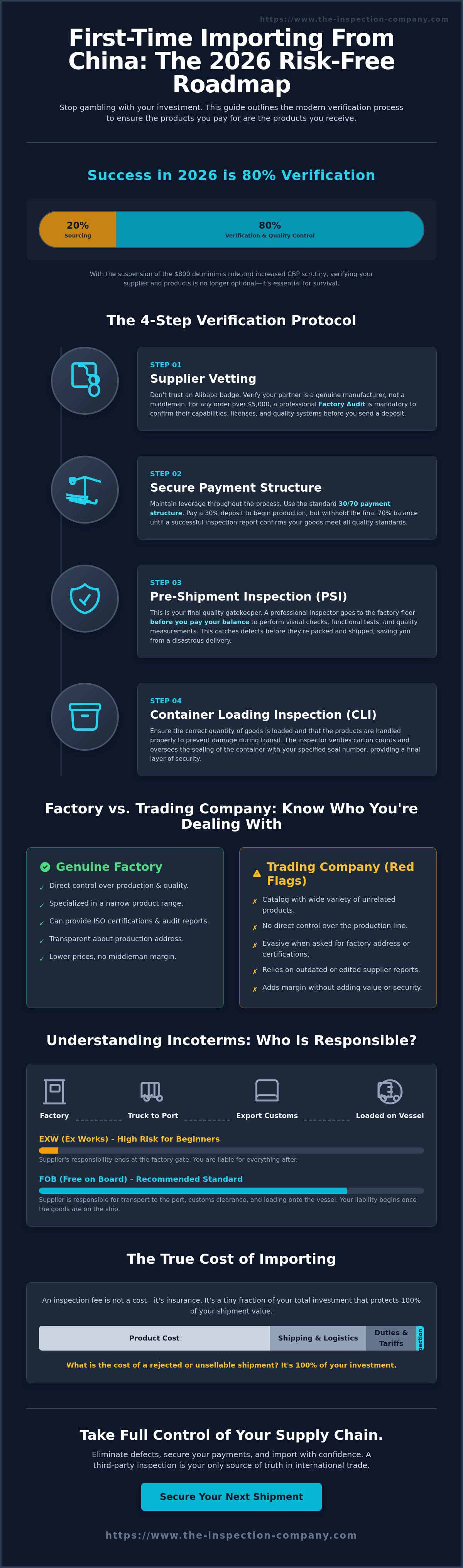
In 2026, successful importing is 20% sourcing and 80% verification. If you don't inspect your goods before you release the final payment, you aren't an importer, you're a gambler. You've likely felt the anxiety of sending a 30% deposit to a supplier thousands of miles away, wondering if you'll receive the quality you were promised or if you've just funded a middleman's commission. With the 2025 suspension of the $800 de minimis exemption and increased CBP scrutiny on every shipment, the financial stakes of a mistake have never been higher.
This first time importing from china guide replaces that uncertainty with a methodical, risk-free roadmap. You'll learn how to distinguish real factories from trading companies and how to secure your investment through professional quality management. We'll outline the exact steps needed to verify your products on the ground, ensuring that when your shipment arrives, it meets your standards and is ready for the market. By following this protocol, you can eliminate the fear of defects and take full control of your supply chain.
Key Takeaways
- Follow the standard 30/70 payment structure to maintain leverage, ensuring you never pay the final balance until a successful inspection is confirmed.
- Utilize this first time importing from china guide to distinguish between genuine manufacturers and trading companies through mandatory Factory Audits for any order exceeding $5,000.
- Implement a Pre-Shipment Inspection (PSI) as your final gatekeeper to catch quality defects and functional failures before your goods leave the factory floor.
- Secure your logistics by using a Container Loading Inspection to verify that the correct quantity is packed and that the container is sealed according to your specifications.
Fundamentals of Importing from China: The 2026 Landscape
Importing from China in 2026 is a multi-stage process involving sourcing, vetting, production, inspection, and logistics. It's no longer a simple transaction. With China's export market shifting toward high-value sectors like green technology and advanced electronics, staying informed on China's trade policies is vital. This first time importing from china guide focuses on building a secure chain where each link is verified. If you treat importing as a single step, you risk falling into the Sourcing Trap, where polished Alibaba photos mask a lack of legitimate manufacturing capability.
To mitigate risk, you must use the 30/70 payment structure. You pay a 30% deposit to start production, but the 70% balance stays in your bank until a successful inspection occurs. This protocol ensures the supplier remains accountable for quality. Our quality management services help you maintain this leverage by providing an objective report before you release the final funds.
Understanding Incoterms: Who Pays for Shipping?
Choosing the right Incoterms determines where your liability begins. Under EXW (Ex Works), you're responsible for the goods the moment they leave the factory gate. This is often too complex for beginners. FOB (Free on Board) is the standard recommendation. The supplier handles the transport to the Chinese port and clears the goods for export, while you take over once they're loaded onto the vessel.
The Hidden Costs of First-Time Importing
Total landed cost includes more than just the unit price. You must account for the following expenses:
- Wire transfer and currency exchange fees.
- Customs duties and Section 301 tariffs.
- The "cost of quality," including professional inspections and sample testing.
While some skip professional oversight to save money, an inspection fee is a tiny fraction of the cost of a rejected or unsellable shipment.
Supplier Vetting: Distinguishing Factories from Trading Companies
Many new buyers assume a "Verified Supplier" badge on a digital platform is a guarantee of quality. It isn't. This first time importing from china guide emphasizes that true verification happens on the factory floor, not through a screen. For any order exceeding $5,000, a professional Factory Audit is a mandatory investment. It's the only way to confirm you're dealing with a manufacturer rather than a trading company that adds margin without adding value. While trading companies have their place, they often lack the direct control over production that you need to ensure consistency.
Trading companies often give themselves away through specific red flags. Look for a catalog with a suspiciously wide variety of unrelated products. If a supplier can't provide ISO certifications or becomes evasive when asked for a specific production address, they likely don't own the machinery. Before committing any funds, use a Supplier Survey to gather preliminary data on their operational history and legal status. This initial screening filters out high-risk candidates before you invest in a full on-site evaluation.
What a Professional Factory Audit Reveals
An on-site audit provides a transparent view of a supplier's production capacity and their Quality Management Systems (QMS). It verifies that machinery is maintained and that the factory holds valid export licenses. You'll receive a detailed breakdown of their workforce, production lines, and internal testing capabilities. Without this data, you risk your deposit on a facility that might not have the technical capability to meet your specifications or the financial stability to complete your order.
Vetting Suppliers on Alibaba and Global Sources
Platforms like Alibaba use badges to signal reliability, but these are often paid memberships or surface-level checks. They're a useful starting point, but they don't replace independent verification. Never rely on audit reports provided by the supplier themselves. These documents are frequently outdated or selectively edited to hide flaws. Independent, third-party reports are the only credible source of truth in international trade.
Modern importing requires more than just checking product quality. You must ensure your supplier meets ethical standards to protect your brand from reputation damage. This also ensures compliance with the U.S. Customs and Border Protection guide regarding forced labor and legal entry requirements. If you're unsure about a potential partner's background, consult with an expert to review their credentials before signing a contract.
The Quality Control Framework: Securing Your Goods
Quality control is the most critical phase of this first time importing from china guide. Once you have used a guide to sourcing suppliers in China to find a partner, you must verify their output. The Pre-Shipment Inspection (PSI) acts as the final gatekeeper. It ensures that the goods meet your specifications before the final 70% balance is paid. Releasing funds without this verification is an irreversible risk.
Professional inspectors use a statistical tool called AQL (Acceptable Quality Limit) to determine if a batch is acceptable. This method ensures that a representative sample is checked for functional and aesthetic flaws. For a deeper dive into how sampling works, see our guide on AQL Explained. For complex electronics or high-volume orders, a During Production Inspection (DUPRO) is essential. This catches systemic errors early, preventing a total loss at the end of the production cycle.
The 4-Step Inspection Process
A structured approach ensures transparency and control over your inventory. Follow these steps to secure your investment:
- Define Criteria: Establish a "Golden Sample" and clear quality standards before production starts.
- Schedule Inspection: Book an inspector when production is at least 80% complete and packed.
- Analyze Results: Review a comprehensive digital report featuring photos and test data within 24 hours.
- Make a Decision: Approve the shipment for loading or demand the factory perform a rework based on the data.
Major vs. Minor Defects: What to Accept?
Not all defects carry the same weight. Critical defects are safety hazards that render a product unsellable. Major defects affect function or appearance, while minor defects are small aesthetic flaws. For a full breakdown of these categories, read our post on Understanding Product Defects. Identifying these issues on the factory floor is the only way to protect your brand reputation. Contact us today to secure your next shipment with a professional inspection.
Logistics and Final Compliance: The Road to Your Warehouse
The final stage of this first time importing from china guide focuses on the transition from the factory floor to your warehouse. Even with a passed quality report, your investment isn't safe until the goods are properly loaded. Damage during transit or "container switching" are real risks that occur after the inspector leaves. A Container Loading Inspection (CLI) ensures that the correct quantity of inspected goods is packed securely and that the container is sealed in the presence of an expert. This is your final layer of protection against logistical failures.
Customs clearance requires meticulous attention to detail. You must ensure your commercial invoices are accurate and your products are correctly classified using the appropriate HTS codes. Errors lead to delays, storage fees, or legal penalties. Once the container is sealed and the bill of lading is issued, it's typically time to pay the remaining 70% balance. This payment should only happen after you've verified both the quality of the batch and the integrity of the loading process.
Amazon FBA Requirements and Compliance
Amazon sellers face additional layers of complexity. The platform has strict requirements for labeling, palletization, and carton weight. Non-compliance can result in rejected shipments or costly prep fees at the fulfillment center. An Amazon FBA Inspection specifically checks for these variables, ensuring your inventory is ready for immediate check-in. This proactive step prevents your goods from being stranded in a warehouse thousands of miles away.
Shipping Methods and Market Access
Choosing between air and sea freight depends on your volume and urgency. In 2026, sea freight remains the standard for bulk importing due to its cost-efficiency, despite longer transit times. Regardless of the method, you hold the legal responsibility for product safety. You must ensure your goods meet regional standards like RoHS, CE, or CPC. For a comprehensive look at these requirements, refer to our Product Compliance Guide. Verification of these certifications should happen before production begins to avoid total shipment rejection at the border.
Securing Your Supply Chain for 2026 and Beyond
Navigating international trade requires a decisive shift from hope to verification. You now have the strategic roadmap needed to protect your capital and your brand reputation. By implementing a strict 30/70 payment structure and mandating on-site factory audits, you eliminate the primary risks of financial loss and sub-par manufacturing. Your control over the process shouldn't end until the goods are verified and the container is sealed. This first time importing from china guide serves as your foundation for building a resilient, high-quality supply chain that scales with your business.
The Inspection Company provides the on-the-ground expertise you need to operate with absolute confidence. With over 700 inspectors across Asia and a management structure built on European quality standards, we act as your eyes and ears in the factory. Our detailed digital reports are delivered within 24 hours, giving you the objective data required to make informed decisions instantly. Don't leave your investment to chance. Secure your first shipment with a professional Pre-Shipment Inspection today. You're ready to turn these risk-mitigation strategies into a successful, predictable importing operation.
Frequently Asked Questions
Is it safe to pay a Chinese supplier via bank transfer (T/T) for the first time?
Bank transfer is safe only if you follow the 30/70 payment structure and verify production quality before the final transfer. Sending 100% of the funds upfront to a new supplier is a high-risk gamble with no legal recourse if the goods are never shipped or arrive damaged. By holding the 70% balance until a successful inspection report is issued, you maintain the necessary leverage to ensure the factory meets your specific requirements.
What is a 'Golden Sample' and why is it essential for my first order?
A Golden Sample is the final, approved version of your product that serves as the absolute benchmark for mass production. It's essential because it provides an objective reference for both the factory and your third-party inspector. Without this physical standard, distinguishing between acceptable variations and genuine defects becomes subjective. This is a critical step in any first time importing from china guide to avoid disputes over quality expectations.
Can I import from China without a business license?
You can technically import as an individual, but it's increasingly difficult following the August 2025 suspension of the $800 de minimis exemption. All commercial shipments now require formal customs entry and the payment of duties, regardless of their value. Operating with a business license and a registered tax ID provides a more professional profile to suppliers and simplifies the mandatory compliance paperwork required by customs authorities at the border.
How much does a professional product inspection service cost in 2026?
Professional inspection services are typically billed as a flat rate per man-day spent at the factory. This fee covers the inspector's travel, the on-site examination of your goods, and the delivery of a comprehensive digital report within 24 hours. While the exact investment depends on the factory's location and the complexity of the product, the cost is a small fraction of the financial loss you'd face from a rejected or unsellable shipment.
What happens if the inspection report shows my goods have failed?
If your goods fail inspection, you must immediately withhold the final 70% payment and demand that the supplier performs a rework or replacement of the defective units. This first time importing from china guide emphasizes that the inspection report is your primary tool for negotiation. Once the factory corrects the issues, you should schedule a re-inspection to confirm the defects are resolved before the container is loaded for shipping.