

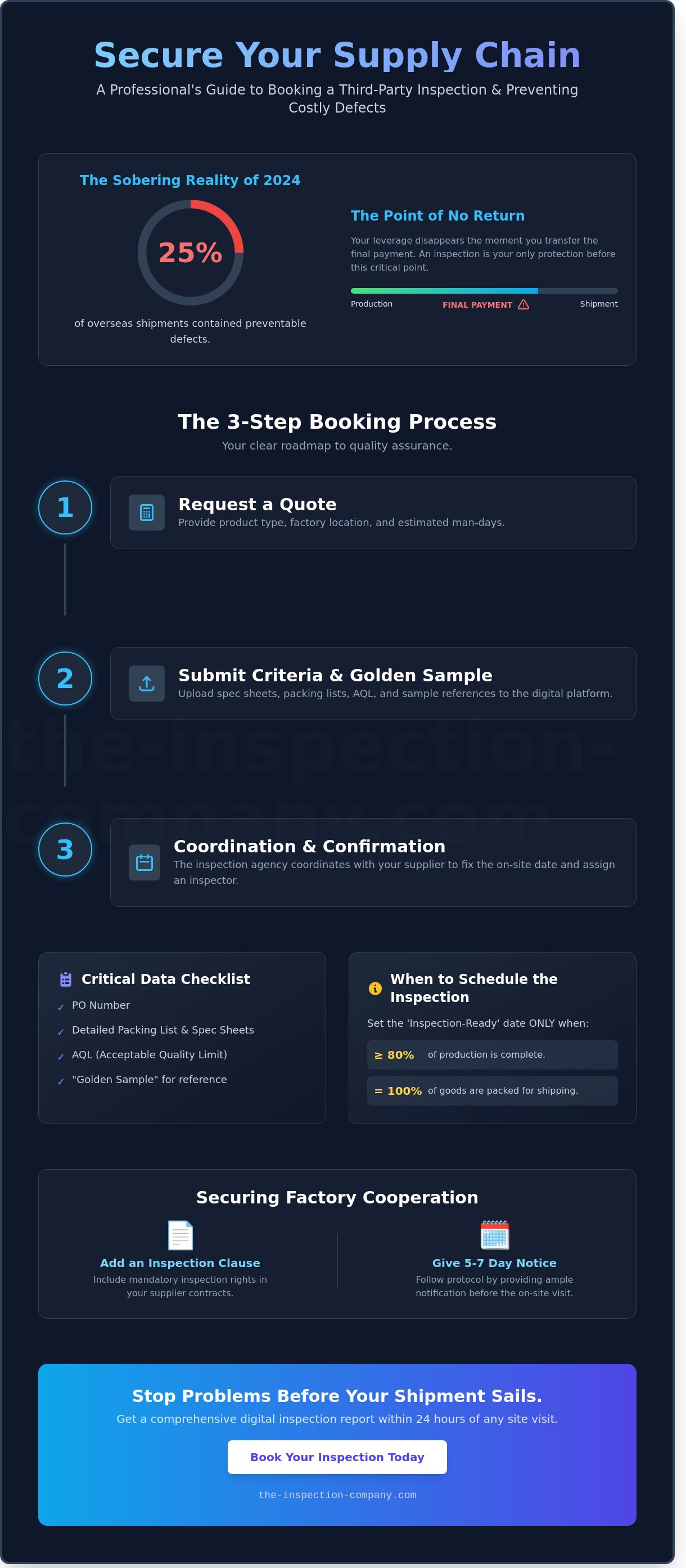
What if your "passed" factory sample bears zero resemblance to the 5,000 units currently being loaded onto a container in Ningbo? In 2024, industry data indicated that nearly 25% of overseas shipments contained defects that could have been caught before leaving the port. You likely already feel the pressure of these risks. It's frustrating to manage uncooperative factories while trying to decode complex acronyms like PSI, DuPro, and AQL. You understand that one day of inspection can save months of trouble, but the logistics often feel like a barrier to your peace of mind.
This guide removes that barrier by teaching you exactly how to book a third party inspection to secure your supply chain and avoid costly shipment errors. We draw on over 25 years of experience to provide a clear, professional roadmap for your 2026 procurement strategy. You'll learn how to coordinate with suppliers effectively and ensure you receive a comprehensive inspection report within 24 hours of the site visit. By the end of this article, you'll have the confidence to stop problems before your shipment sails.
Key Takeaways
- Identify the critical "Point of No Return" and why scheduling your quality check before final payment is the only way to prevent unrecoverable shipment errors.
- Master the exact workflow of how to book a third party inspection, from requesting man-day quotes to submitting your "Golden Sample" for reference.
- Learn to secure factory cooperation by including a mandatory "Inspection Clause" in your contracts and following the 5-7 day notification protocol.
- Evaluate inspection partners based on local expertise and their ability to deliver comprehensive digital reports within 24 hours of the site visit.
- Implement proactive supply chain insurance to detect product defects at the source and ensure total compliance with your quality standards.
Table of Contents
-
Why Booking a Third-Party Inspection is Your Best Supply Chain Insurance
-
Coordinating with Your Factory: Avoiding Delays and Denied Access
-
Selecting Your Inspection Partner: Why Expertise Matters in 2026
Why Booking a Third-Party Inspection is Your Best Supply Chain Insurance
A third-party inspection is an independent quality assessment conducted by specialized TIC companies to verify that your goods meet specific standards before they depart the factory. In international trade, the "Point of No Return" occurs the moment you transfer the final balance to your supplier. Once that money leaves your account, your leverage disappears. Understanding how to book a third party inspection before this financial milestone is reached is the only way to ensure you aren't paying for sub-standard or defective inventory.
The stakes are high. A single day of professional oversight can prevent months of legal disputes and financial recovery efforts. For e-commerce sellers, this is about more than just money; it's about brand survival. Shipping defective goods leads directly to the "Amazon Death Spiral," where a cluster of 1-star reviews tanks your organic ranking and destroys years of brand building. These Conformity Assessment Bodies act as your eyes on the ground, stopping errors before they reach your customers. We stop problems before your shipment sails, giving you the security needed to scale your operations safely.
The Cost of Negligence vs. The Price of Professional Oversight
The math is simple. If you skip an inspection to save a few hundred dollars, you risk a 100% loss on your shipment value plus the cost of international freight and disposal fees. An independent product inspection provides a definitive ROI by identifying defects while they can still be fixed at the supplier's expense. For 2026 sourcing strategies, this level of transparency is no longer optional. It's a fundamental requirement for any business that values its reputation and its bottom line. Learning how to book a third party inspection early in your production cycle ensures you maintain control over your quality standards and your cash flow. Avoid costly surprises by treating quality control as an investment, not an overhead cost.
The 3-Step Process to Book a Third-Party Inspection
Learning how to book a third party inspection is the first step in protecting your investment from manufacturing defects. To understand how to book a third party inspection effectively, you must follow a structured workflow that eliminates communication gaps between your office and the factory floor.
Step 1: Request a Quote. This initial phase requires details on your product type, the factory location, and the estimated man-days needed. We calculate man-days based on the sample size required by international standards to ensure the data is statistically significant.
Step 2: Submit Criteria. You must upload your detailed inspection criteria and 'Golden Sample' references through a digital quality platform. This step ensures your specific quality expectations are locked into the system and accessible to the inspector on-site.
Step 3: Coordination and Confirmation. The agency coordinates directly with your supplier to fix a specific on-site date. Once the factory confirms, you'll receive a final booking schedule and the specific inspector assignment for your project.
Critical Data Needed for a Successful Booking
Precision at the booking stage prevents costly delays and ensures your inspector knows exactly what to look for. You need a checklist of essentials: your PO number, a detailed packing list, spec sheets, and your AQL (Acceptable Quality Limit) requirements. According to the Importing into the United States guide, importers are legally responsible for exercising 'reasonable care' to ensure compliance. Inspections provide the documentation needed to prove this due diligence. Crucially, your 'Inspection-Ready' date must only be set when at least 80% of the production is finished and 100% of the goods are packed.
Leveraging the TIC Quality Platform for Real-Time Monitoring
Modern sourcing requires more than just email threads. A centralized platform streamlines the supplier management process by providing real-time updates from booking to the final report. Avoid agencies that rely on fragmented email communication for complex orders. Digital tracking reduces the risk of human error and ensures that every defect found is documented with photographic evidence. If you're ready to secure your supply chain, you can view our full range of inspection services to find the right fit for your next shipment.
Coordinating with Your Factory: Avoiding Delays and Denied Access
Your quality control strategy starts with the purchase contract. You must include a clear Inspection Clause that legally grants your agency the right to enter the facility. Without this written agreement, factories may deny access at the gate, which results in the total loss of your booking fee and significant shipping delays. When you are learning how to book a third party inspection, establishing this right is the first step to mitigating risk.
Adhere to strict notification protocols to keep production on track. Give your supplier at least 5 to 7 days' notice before the scheduled date. This timeframe allows the factory to ensure that at least 80% of the order is packed and ready, which is the industry standard for a valid Pre-Shipment Inspection. If a factory claims they "aren't ready" just 24 hours before the visit, treat it as a red flag for potential production errors or missed deadlines.
Our inspectors operate under European management standards to ensure a disciplined presence on-site. They don't just "show up"; they follow a methodical process that prevents factory staff from influencing the results. This professional distance is vital for maintaining the integrity of your data. Understanding how to book a third party inspection involves more than just filling out a form; it requires managing the relationship between the inspector and the factory owner to ensure a smooth workflow.
What to Do if Your Factory Fails the Inspection
A failed inspection report is your primary tool for leverage. Standard industry practice requires the supplier to pay for all re-inspection costs if the initial visit reveals major defects. This protocol places the financial burden of poor quality on the factory, not the buyer. Use the evidence in the report to negotiate repairs or price deductions before the container is loaded. You shouldn't release the final payment until you receive a "Pass" report from a follow-up visit. Explore our specialized inspection services to learn how we document these failures to protect your investment.
Selecting Your Inspection Partner: Why Expertise Matters in 2026
Choosing the right agency is the final, most critical step when you learn how to book a third party inspection. In 2026, global supply chains are too volatile for guesswork. You need a partner with a massive physical footprint to ensure your interests are protected directly on the factory floor.
-
Local Presence: Look for an agency with a network of 700+ inspectors across major Asian manufacturing hubs. This density means an inspector can reach your supplier within 48 hours, which slashes travel costs and prevents scheduling bottlenecks.
-
Speed of Reporting: Data loses value every hour it sits in an inbox. You need a detailed report, complete with high-resolution photos and video evidence, delivered within 24 hours of the site visit. This allows for immediate "go or no-go" decisions before the balance payment is made.
-
Accreditation and Ethics: Verify that the agency holds ISO 9001 certification and maintains Sedex membership. These aren't just titles; they're proof of a commitment to ethical standards and rigorous quality management protocols.
-
Specialized Compliance: Your partner must understand specific Amazon FBA requirements and labeling compliance. A single barcode error or packaging oversight can lead to an entire shipment being rejected at the fulfillment center.
The Advantage of European Management with an Asian Base
Communication gaps often lead to the most expensive mistakes in international trade. Western quality expectations frequently clash with Eastern manufacturing realities. This is why The Inspection Company remains the preferred choice for risk-averse importers. We bridge this gap by combining European management standards with a deep, local presence in Asia. It's a strategy designed to stop problems before your shipment sails. When you're figuring out how to book a third party inspection, remember that one day of professional oversight saves months of financial trouble. We prioritize transparency so you don't have to deal with costly surprises once the container arrives at your door.
Take Control of Your Global Supply Chain Quality
Mastering how to book a third party inspection is the most effective way to eliminate costly surprises before your goods leave the factory floor. You've seen that proactive coordination with your supplier prevents denied access and ensures your production timeline stays on track. By following a structured three step booking process, you transform quality control from a reactive headache into a strategic advantage. One day of on site inspection can save months of financial trouble and brand damage.
The Inspection Company leverages over 25 years of experience in Asian quality control to protect your interests. Our European managed teams deliver detailed reports within 24 hours of the site visit, providing the transparency you need to approve or reject a shipment with confidence. We maintain ISO 9001 certification to ensure our processes meet the highest international standards. Don't let avoidable defects compromise your 2026 growth strategy when expert oversight is readily available.
Secure your shipment today; get an instant inspection quote from The Inspection Company.
Your path to a more reliable supply chain starts with a single booking. We're ready to help you secure your next shipment.
Frequently Asked Questions
How much does it cost to book a third-party inspection in China or Vietnam?
Most independent inspection companies charge a flat man-day rate for services in China or Vietnam. Industry standards typically range between $200 and $300 per man-day, covering the inspector's time and travel within major manufacturing hubs. This fee ensures a professional review of your goods before they leave the factory. It's a small investment compared to the thousands of dollars lost on defective shipments. We provide a transparent breakdown of these costs during the initial booking phase.
How far in advance should I book my product inspection?
You should book your service at least 3 to 5 business days before the scheduled inspection date. Peak seasons, such as the 4 weeks leading up to Chinese New Year, require bookings 14 days in advance to guarantee a slot. Learning how to book a third party inspection early helps you avoid shipping delays. It gives our coordination team enough time to confirm the production status with your supplier and finalize the checklist.
What happens if the factory refuses to cooperate with the inspector?
A factory's refusal to cooperate is a major red flag that often indicates quality issues or production delays. In these cases, we immediately notify you and document the refusal in a formal report. Data shows that over 90% of professional suppliers comply once they realize the shipment won't be authorized without an inspection. We act as your eyes and ears on the ground to handle these confrontations and protect your financial interests.
Can I book an inspection if I am only ordering a small quantity (LCL)?
Yes, you can book an inspection for any order size, including Less than Container Load (LCL) shipments. Even if you're only importing 2 pallets of goods, the risk of receiving defective items remains the same. Knowing how to book a third party inspection for smaller batches ensures that every unit meets your specifications. We adapt our sampling plans, like the ISO 2859-1 standard, to fit your specific order volume and risk profile.
Do I need to be present during the inspection process?
You don't need to be present at the factory because our team provides a comprehensive digital report within 24 hours of the visit. This report includes high-resolution photos, video footage, and a detailed checklist of our findings. Our European management ensures that the process follows strict international standards. You get the same level of control as being there yourself without the cost of international travel or the time spent on-site.