

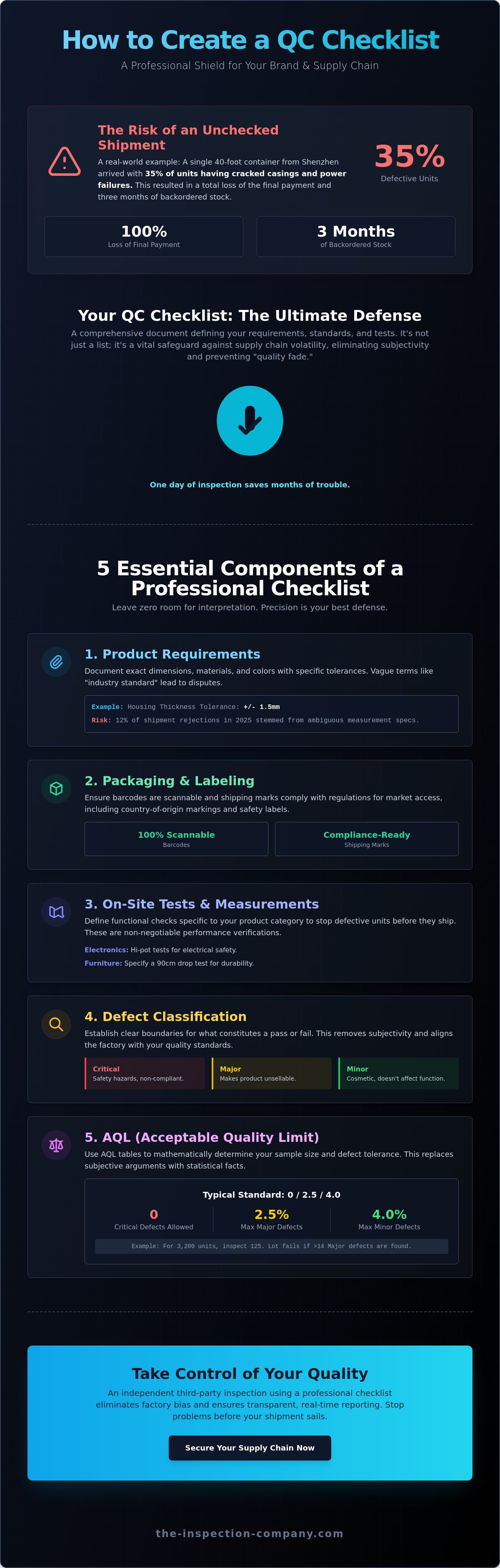
On October 12, 2024, a mid-sized electronics retailer opened a 40-foot container from Shenzhen only to find that 35% of their units had cracked casings and failed to power on. This single shipment resulted in a total loss of the final invoice payment and three months of backordered stock. You know that trusting a supplier's verbal promise is never enough when your capital is on the line. It's frustrating to face communication gaps that lead to unsellable defects, especially when you lack the technical expertise to define every minute production standard. One day of inspection can save months of trouble, but that inspection is only as effective as the instructions you provide.
This guide teaches you how to create a QC checklist that acts as a professional, objective shield for your brand. You'll learn how to build a technical document that eliminates manufacturing errors and secures your supply chain across Asia. We'll break down the essential components of a professional inspection document, from AQL sampling levels to specific testing protocols, giving you total peace of mind before you pay the final invoice. By the end of this article, you'll have a clear roadmap to reduce defect rates and hold your factory accountable to your exact standards.
Key Takeaways
- Understand why a comprehensive inspection document is your primary defense for mitigating risk and avoiding costly surprises before your shipment sails.
- Master the essential steps on how to create a QC checklist that integrates technical specifications, specific tolerances, and international packaging compliance.
- Discover a proven 5-step process to identify potential failure points using your golden sample to prevent recurring manufacturing errors.
- Learn how independent third-party inspections and digital quality platforms eliminate factory bias to ensure transparent, real-time reporting on your production.
What is a QC Checklist and Why is it Critical for Your Supply Chain?
A Quality Control (QC) checklist is a comprehensive document that defines your product requirements, packaging standards, and testing protocols. It functions as a foundational quality management tool to ensure your supplier understands exactly what you expect before production begins. For importers in 2026, knowing how to create a QC checklist isn't just a technical task; it's a vital safeguard against supply chain volatility.
One day of inspection can save months of trouble. This document serves as your primary legal and commercial reference point within your supplier contract. Without it, you're relying on verbal agreements that rarely hold up during disputes. A professional checklist removes subjectivity. It ensures the factory floor manager and the independent inspector use the same pass/fail criteria. This alignment prevents "quality fade," a common issue where product standards slip over successive production runs.
The Cost of Skipping a Professional Checklist
Relying on a factory's internal QC is a high-risk strategy that often leads to failure. Internal teams may overlook product defects to meet shipping deadlines or reduce waste costs. In 2024, industry data suggested that rework and returns can consume up to 25% of an importer's total revenue. These costly surprises damage your brand reputation and drain your resources.
When you understand how to create a QC checklist, you take control of the outcome. You transition from hoping for the best to demanding measurable results. Our European management team at The Inspection Company has seen how clear documentation prevents the financial ruin of a rejected shipment. We focus on transparency and reliability to stop problems before your shipment sails. You can explore our full range of quality control services to see how we apply these checklists in the field.
5 Essential Components of a Professional Product Inspection Checklist
A professional checklist acts as your eyes on the factory floor. When learning how to create a QC checklist, precision is your best defense against costly surprises. This document must leave zero room for interpretation by the factory or the inspector. High-stakes environments rely on these tools. Even a quality control checklist for decision making helps experts avoid cognitive biases and simple errors during high-pressure situations.
- Product Requirements: Document dimensions, materials, and colors with specific tolerances. If a tolerance is +/- 1.5mm, state it clearly. Vague terms like "industry standard" lead to disputes. Data shows that 12% of shipment rejections in 2025 stemmed from ambiguous measurement specs.
- Packaging and Labeling: Barcodes must be 100% scannable. Shipping marks must align with product compliance regulations to ensure market access. This includes checking for correct country-of-origin markings and warning labels.
- On-Site Tests and Measurements: Define tests specific to your category. For electronics, include hi-pot tests. For furniture, specify a 90cm drop test. These functional checks stop defective units from reaching your customers.
- Defect Classification: Establish clear boundaries. Critical defects are safety hazards. Major defects make the product unsellable. Minor defects are cosmetic issues that don't affect function. Mastering how to create a QC checklist ensures your supplier understands that quality is non-negotiable.
Integrating AQL Standards into Your Checklist
Use AQL tables to mathematically determine your sample size. Most importers use a 0/2.5/4.0 standard. This means zero critical defects are allowed. If a shipment of 3,200 units shows more than 14 major defects in a 125-unit sample, the lot fails. Setting these levels based on product value and safety risks prevents subjective arguments with the manufacturer.
Special Requirements for Amazon FBA Sellers
FBA shipments require strict adherence to FNSKU labeling and carton weight limits, which are capped at 22.5kg in most regions. Your checklist must verify "ready-to-ship" status. Failure here results in Amazon rejecting the container, causing weeks of delay and extra fees. You can book professional inspection services to verify these specific FBA requirements before the goods leave the factory.
How to Create a QC Checklist for Your Asian Suppliers in 5 Steps
Understanding how to create a QC checklist is your primary defense against substandard production. Avoid costly surprises by following these five steps to build a document that leaves no room for factory interpretation. When you learn how to create a QC checklist, you're not just writing a list; you're building a risk mitigation framework for your entire supply chain.
- Step 1: Gather Technical Specifications. Use your golden sample and spec sheets as the foundation. These documents represent the "contractual truth" of your product. If a measurement isn't in your specs, you can't hold the factory accountable for it later.
- Step 2: Identify Potential Failure Points. Review historical data from the last 24 months or analyze competitor complaints to predict where things will go wrong. This proactive approach stops problems before they reach the shipping container.
- Step 3: Define Objective Pass/Fail Criteria. Vague terms like "good quality" or "smooth finish" lead to disputes. Use measurable data, such as "tolerance ±2mm" or "color match within Delta E 1.0." For structured data collection, refer to ASQ's Guide to Check Sheets to ensure your logic is sound and consistent.
- Step 4: Categorize Defects. Assign severity levels to every possible issue. A "Critical" defect involves safety hazards, while a "Major" defect affects functionality. "Minor" defects are cosmetic. This hierarchy guides the inspector's final decision during the final count.
- Step 5: Review with Your Factory. Don't assume the supplier understands your standards. Send the checklist months before production starts and get written confirmation. This ensures everyone is aligned on the 2026 quality requirements before the first machine turns on.
The Importance of Visual Aids and Reference Samples
Visuals are non-negotiable in international trade. Include side-by-side photos of "Defect Examples" and "Approved Standards" to bridge language gaps and eliminate ambiguity. Your "Golden Sample" acts as the physical truth during the first article inspection process. It provides a tangible benchmark that inspectors use to verify that the factory can meet your 2026 standards before the full run begins. Without these visual anchors, your checklist is just a list of words that can be misunderstood.
Implementing Your Checklist with an Independent Inspection Company
A well-defined checklist is only as strong as the person executing it. Relying on factory-side QC often leads to biased results because internal teams are frequently pressured to meet shipping deadlines rather than catch every defect. Hiring an independent third party removes this conflict of interest. Our European management team bridges the gap between Western quality standards and Asian manufacturing realities, ensuring your requirements don't get lost in translation.
To maximize efficiency, you should digitize your requirements. Uploading your specific criteria to a quality platform allows inspectors to record data directly from the factory floor. This provides you with real-time visibility and ensures every point you included when learning how to create a QC checklist is strictly followed. Digital integration prevents data tampering and provides a transparent audit trail for every batch.
Your quality requirements should evolve over time. If a pre-shipment inspection reveals a recurring minor defect in 15% of the sample, you can update your checklist to classify that specific issue as a major defect for the next production run. This iterative process turns your QC checklist into a powerful tool for continuous supplier improvement and risk mitigation.
From Checklist to Professional Inspection Report
Once the on-site inspection is complete, you'll receive a comprehensive report within 24 hours. This document includes high-resolution photos of defects, detailed measurement tables, and a clear Pass, Fail, or Pending result based on your AQL limits. It's the objective evidence you need to hold suppliers accountable for their output.
Don't release the final balance payment until you've reviewed the report data. If the results are "Fail" or "Pending," you have the leverage to demand re-work or replacements before the goods leave the port. This proactive approach stops problems before your shipment sails and prevents the nightmare of a product recall. Ready to secure your shipment? Explore our professional inspection services to see how we put your checklist into action.
Secure Your Shipments and Protect Your Bottom Line
Success in international trade in 2026 requires more than just a good supplier; it demands rigorous oversight. You've learned that a professional checklist must include specific dimensions, weight tolerances, and functional tests to be effective. Mastering how to create a QC checklist allows you to set clear expectations and stop defects before they leave the factory floor. This proactive approach turns quality control from a logistical hurdle into a competitive advantage for your business.
The Inspection Company brings over 25 years of experience in Asia to your supply chain. Our ISO 9001 Certified Quality Management systems ensure every detail is verified against your requirements. We deliver detailed inspection reports within 24 hours of the site visit, so you can make informed shipping decisions without delay. Don't leave your reputation to chance when you can rely on proven expertise and European management standards on the ground.
Take control of your manufacturing process today. Avoid costly surprises; get a professional inspection quote today. It's time to build a more resilient and reliable supply chain.
Frequently Asked Questions
What are the most important items to include in a QC checklist for electronics?
Electronics require high-precision testing to avoid safety hazards and functional failures. You must include the Hi-pot test, power consumption checks, and internal component verification against your Bill of Materials. For instance, 100% of units must pass a grounding test to meet CE or UL standards. These checks prevent electrical fires and ensure the device functions as intended. Technical failures account for 45% of consumer electronics returns according to industry data.
How many pages should a professional product inspection checklist be?
A professional product inspection checklist typically spans 5 to 10 pages depending on product complexity. This length allows for detailed sections on packaging, labeling, visual defects, and on-site testing. While a simple plastic toy might only need 4 pages, a complex electronic device often requires 12 or more to cover all technical requirements. Keeping it concise yet comprehensive ensures the inspector doesn't miss critical defects during a standard 8-hour man-day.
Can I use the same QC checklist for different suppliers of the same product?
You should use the same core document for different suppliers to maintain consistent quality across your supply chain. Learning how to create a QC checklist that is standardized allows you to compare the performance of 2 or more factories objectively. However, you must update the supplier information and approved sample sections for each specific partnership. This approach ensures that 100% of your products meet the same brand standards regardless of which facility produced them.
What happens if the factory refuses to agree to my QC checklist criteria?
If a factory refuses your criteria, you must treat this as a major red flag for future quality issues. Research indicates that 30% of manufacturing disputes arise from unaligned expectations at the start of production. You should negotiate these points before sending your deposit. If the supplier won't agree to standard AQL levels or specific safety tests, it's safer to source a different partner than to risk a shipment full of defective goods.
Is a QC checklist the same as a product specification sheet?
A QC checklist is not the same as a product specification sheet. The spec sheet defines what the product is, including dimensions and materials. In contrast, the QC checklist defines how to verify those specs and lists the pass/fail criteria for the inspector. Knowing how to create a QC checklist involves turning your specifications into actionable test steps. While the spec sheet is for the designer, the checklist is the primary tool for the quality inspector.