
Once a container seal is snapped into place, your leverage as an importer effectively vanishes. If you've ever felt the anxiety of releasing a final payment only to receive non-compliant goods or short-shipped quantities, you know that hope isn't a viable management strategy. You must know exactly how to ensure shipment quality before loading to protect your capital and your professional reputation. It's the difference between a profitable quarter and a logistical nightmare involving customer returns and expensive Amazon FBA rejections.
We understand the high stakes of international trade where a single oversight can lead to a $115 red flag inspection fee at bonded facilities. This guide provides the precise steps to verify product integrity and secure your cargo while it's still on the factory floor. You'll learn how to implement a three-tier validation process that covers everything from workmanship standards to the anticipated ISO 9001:2026 quality requirements. This approach ensures total peace of mind before your goods ever reach the port.
Key Takeaways
- Recognize pre-shipment quality control as your final gatekeeping process to prevent costly customer returns and maintain your brand's reputation.
- Implement a professional 5-step framework on how to ensure shipment quality before loading to verify both quantity accuracy and workmanship standards.
- Identify specific container integrity checks, such as moisture and odor inspections, that protect your cargo from environmental damage during transit.
- Master the "80/20 rule" for scheduling inspections to ensure full production oversight without disrupting your 2026 shipping deadlines.
- Learn to interpret comprehensive inspection reports so you can make data-backed decisions before releasing final payments to your supplier.
The Point of No Return: Why Quality Control Before Loading is Critical
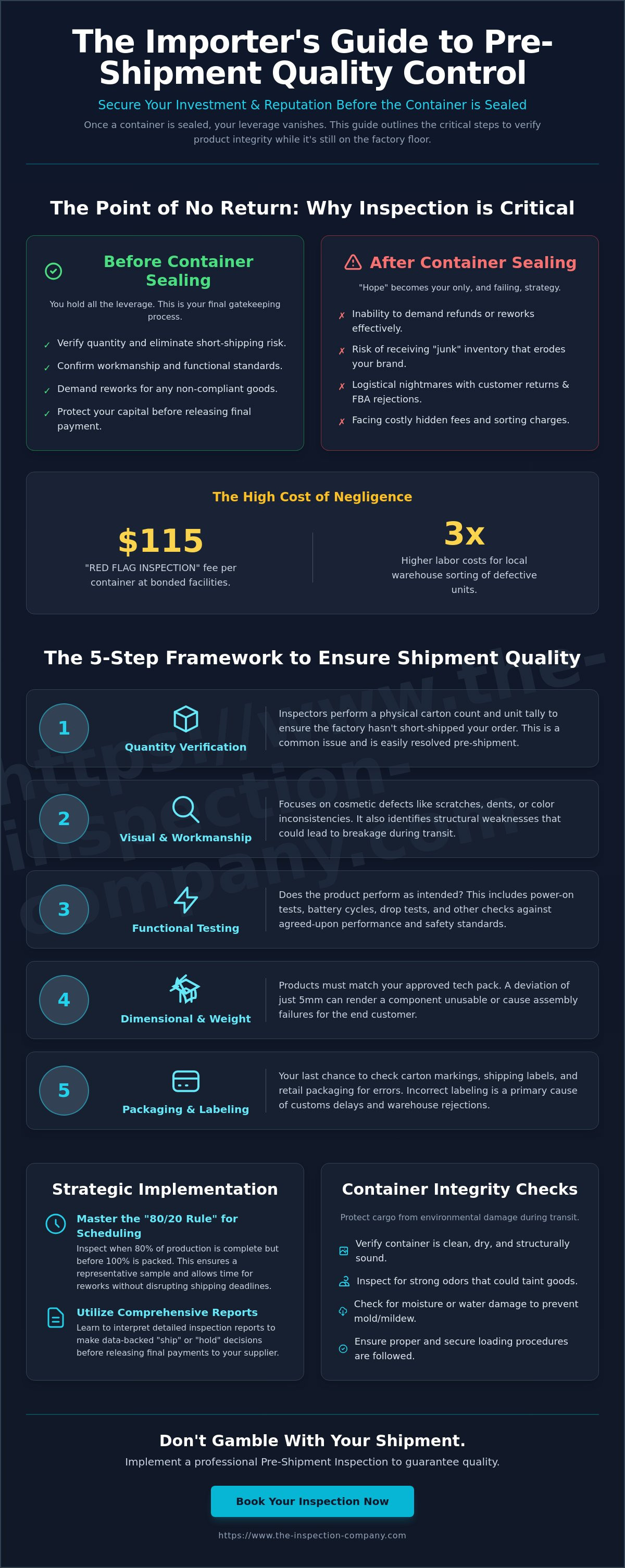
International trade operates on a simple, harsh reality: your financial leverage exists only as long as the goods remain at the factory. Once that container is sealed and the vessel departs, your ability to demand reworks or refunds effectively vanishes. A Pre-shipment inspection (PSI) serves as the final gatekeeping process to verify order compliance before cargo departure. It's the only way to confirm you're paying for sellable inventory rather than "junk" that will lead to customer returns and brand erosion.
Modern supply chains in 2026 demand a higher level of scrutiny than in previous years. Relying on factory-provided quality reports is a high-stakes gamble that often results in operational friction. You need to understand how to ensure shipment quality before loading to avoid the hidden costs that surface once goods arrive at your destination. These aren't just minor inconveniences; they're financial drains. For instance, a failed customs check can trigger a $115 "RED FLAG INSPECTION" fee per container at bonded facilities. Additionally, local warehouse sorting for defective units can cost triple the factory labor rate.
A proactive inspection strategy prevents these issues by identifying risks early. Key focus areas include:
- Quantity Verification: Eliminating the risk of short-shipped orders before you release final payment.
- Functional Testing: Ensuring products perform to agreed-upon specifications and safety standards.
- Packaging Compliance: Confirming labels meet Amazon FBA or specific retail standards to avoid warehouse rejection.
Mitigating Risk in Asian Manufacturing Hubs
Sourcing from hubs like China, Vietnam, and India presents unique cultural and operational challenges. Local factories might prioritize production speed over precision, making European management standards essential for onsite inspections. You can't manage what you don't measure. For a deeper look at these regional complexities, read our guide on Sourcing from Asia: The Ultimate Guide to Managing Quality & Risk. Implementing a professional Pre-Shipment Inspection is the most effective method for how to ensure shipment quality before loading without relying on supplier promises.
The 5-Step Framework to Ensure Shipment Quality
Achieving a defect-free order requires a systematic methodology. You can't simply glance at a few boxes and assume the entire batch is sound. Understanding how to ensure shipment quality before loading involves a rigorous five-step framework that addresses the most common points of failure in international manufacturing.
- Step 1: Quantity Verification. Don't trust the packing list alone. Inspectors perform a physical carton count and unit tally to ensure the factory hasn't short-shipped your order. Discrepancies here are common and much easier to resolve while the goods are still in the factory.
- Step 2: Visual & Workmanship Inspection. This stage focuses on cosmetic defects like scratches, dents, or color inconsistencies. It also identifies structural weaknesses that could lead to breakage during transit.
- Step 3: Functional Testing. Does the product perform as intended? For electronics, this involves power-on tests. For consumer goods, it might include drop tests or battery life cycles. The WTO Agreement on Preshipment Inspection highlights how these standardized checks prevent trade friction by ensuring goods meet international quality expectations.
- Step 4: Dimensional & Weight Checks. Products must match your approved tech pack. Even a 5mm deviation can make a component unusable or cause assembly failures for your end customers.
- Step 5: Packaging & Labeling Review. This is your last chance to check carton markings and retail packaging for errors. Incorrect labeling is a primary cause of customs delays and warehouse rejections.
Applying AQL Standards to Your Inspection
Most professional importers use AQL sampling to determine the statistically significant number of units to inspect based on the total lot size. It's vital to define critical, major, and minor defects before the inspector arrives. A critical defect usually renders the product dangerous, while a major defect affects functionality or sellability. Setting these thresholds early provides a clear "pass" or "fail" result for the entire shipment.
Amazon FBA Specific Requirements
For Amazon sellers, compliance is non-negotiable. Our Amazon FBA Inspection Service verifies that FNSKU barcodes are scannable and carton markings meet strict fulfillment center standards. Failure here leads to costly re-labeling fees or "unfulfillable" inventory. If you're unsure about your specific requirements, consult with our experts to build a tailored checklist for your next production run.
Securing the Cargo: The Container Loading Inspection (CLI)
Even after a successful pre-shipment inspection, your investment remains at risk during the final stage of the factory process. Many importers fail to realize that a perfect product can still arrive damaged if the loading process is unmonitored. Understanding how to ensure shipment quality before loading requires a dedicated focus on the container's physical condition and the way goods are packed inside it. This is a separate, critical layer of security that prevents transit damage and logistical errors.
The process begins with a "Container Integrity Check." Inspectors examine the unit for holes by looking for light leaks from the inside. They also check for lingering odors from previous shipments, such as chemicals or food waste, which can permeate your products during a long sea voyage. Most importantly, they verify the container is dry. Moisture trapped inside a sealed container leads to mold growth, which is a common cause of total inventory loss for textile and furniture importers. Our Container Loading Inspection Service ensures these environmental risks are mitigated before a single carton is moved.
Supervising the loading pattern is equally vital. Factory workers often prioritize speed over safety, which leads to heavy cartons being placed on top of fragile ones. An inspector ensures efficient space utilization and prevents crushing by enforcing a logical stacking order. Once loading is complete, the inspector verifies the seal number and ensures it's applied correctly to the door. This prevents "door-switching" scams and ensures the goods that left the factory are exactly what arrives at your warehouse.
The CLI Checklist for Importers
Your quality control protocol should include a final verification of the container number and seal number against the Bill of Lading. Any discrepancy here can lead to significant customs delays or insurance claim denials. Additionally, monitoring weather conditions during the loading process is essential. Loading in heavy rain without proper coverage can introduce moisture ingress that ruins an entire batch. If you want to secure your next shipment, book an on-site loading supervision today to ensure your goods arrive in sellable condition.
Implementation: How to Book and Manage Your Inspection
Booking an inspection is the final hurdle in your procurement cycle. To master how to ensure shipment quality before loading, you must time your intervention perfectly. We recommend the 80/20 rule: schedule your Pre-Shipment Inspection only when 100% of the goods are produced and at least 80% are fully packed. This ensures the inspector selects samples from a finished, representative lot rather than a cherry-picked selection of early units.
A professional report is your primary tool for risk mitigation. It shouldn't be a vague summary. Expect a detailed technical document featuring high-resolution photos, a breakdown of defects based on AQL standards, and a definitive pass or fail result. If an inspection fails, the report becomes your strongest negotiation asset. You can demand the factory performs reworks or offer a financial discount to cover the cost of sorting at your own warehouse. This data-driven approach is a cornerstone of mastering the supplier management process, allowing you to hold vendors accountable for their output quality and long-term performance.
The 24-Hour Rule: Acting on Your Inspection Data
In the fast-paced 2026 trade environment, delayed information is useless. Receiving a comprehensive report within 24 hours of the on-site visit is vital. It allows you to approve the shipment or halt the loading process without missing your scheduled vessel departure. Speed prevents logistical bottlenecks and ensures your capital isn't tied up in stalled inventory.
Managing this workflow across multiple factories requires a centralized hub. Utilizing our Quality Platform provides real-time visibility into all your global inspections. This digital ecosystem allows you to compare factory performance, track defect trends, and maintain total control over your supply chain from a single dashboard. By integrating these tools, you turn quality control from a reactive chore into a proactive competitive advantage.
Securing Your Supply Chain for 2026 and Beyond
The transition from manufacturing to logistics remains the most vulnerable phase of your supply chain. By implementing a rigorous pre-shipment framework and supervising the container loading process, you eliminate the risk of receiving non-compliant goods or damaged inventory. You now possess the strategic roadmap for how to ensure shipment quality before loading, moving from a position of uncertainty to one of total operational control. This proactive approach prevents the financial drain of customer returns and the logistics friction of warehouse rejections.
We provide the local expertise and European management standards necessary to protect your interests on the ground. Our network includes over 700 professional inspectors across Asia, delivering detailed reports within 24 hours so you can make informed decisions before final payment. This level of transparency is a preventative investment that forestalls much larger financial losses. Secure your next shipment—get an instant inspection quote today. Your brand's reputation depends on the quality you deliver; we're here to ensure you never have to compromise.
Frequently Asked Questions
What is the difference between PSI and Container Loading Inspection?
Pre-Shipment Inspection (PSI) focuses on the integrity of the products, including workmanship, functionality, and packaging standards. In contrast, a Container Loading Inspection (CLI) verifies the physical condition of the container and supervises the actual loading process. While PSI ensures the goods meet your specifications, CLI prevents transit damage and confirms that the factory loads the exact quantity you paid for.
How much of my order should be inspected before loading?
You should inspect a statistically significant sample based on the Acceptable Quality Limit (AQL) standard. For most consumer goods, this involves the ISO 2859-1 sampling plan, which determines the sample size based on your total lot quantity. Inspecting 100% of an order is rarely cost-effective unless you're dealing with high-value electronics or have identified a critical safety defect in a previous batch.
Can I rely on the factory's internal quality control report?
Relying solely on a factory's internal QC report is a significant operational risk. Manufacturers have a natural conflict of interest and may overlook defects to meet shipping deadlines. Third-party inspections provide an unbiased, transparent assessment of your goods. This independent verification is the most reliable method for how to ensure shipment quality before loading and ensures the data you receive is accurate before you release final payment.
What happens if the pre-shipment inspection fails?
If an inspection fails, you must immediately halt the shipment and withhold final payment. Present the detailed defect report to the factory and demand a formal corrective action plan, which may include 100% sorting or reworks. Once the factory claims the issues are resolved, a re-inspection is mandatory to verify that the goods now meet your required standards. This prevents defective inventory from ever leaving the factory floor.
Is a container loading inspection necessary for LCL shipments?
A container loading inspection is vital for Less than Container Load (LCL) shipments because your goods are handled more frequently and stacked alongside cargo from other shippers. Supervising the loading at the factory ensures your cartons aren't placed at the bottom of a heavy stack. This oversight is a key part of how to ensure shipment quality before loading, especially when your cargo is at a higher risk of crushing in a shared environment.