

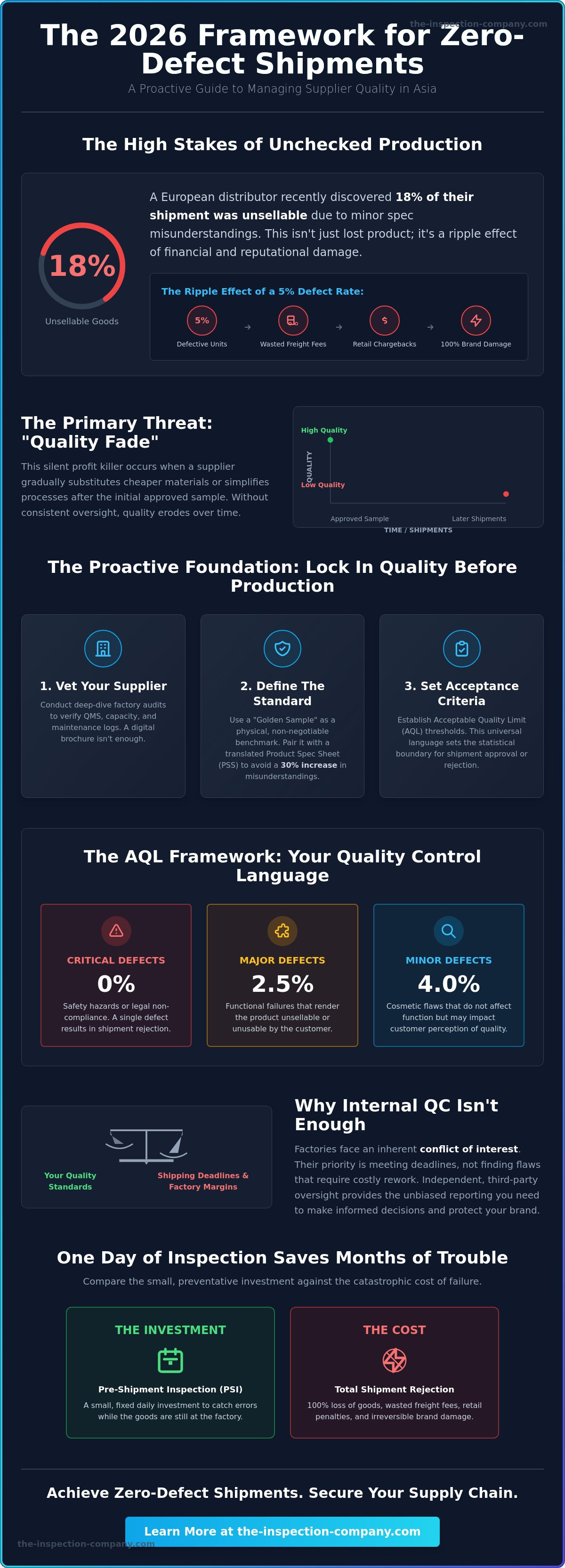
Last month, a European electronics distributor discovered that 18% of their latest shipment was unsellable due to a minor spec misunderstanding during the mass production phase. It's a frustrating reality that many importers face. You pay in full, only to receive defective goods that damage your reputation and drain your capital. Managing supplier quality in Asia remains the single biggest hurdle for businesses looking to scale without losing control over their manufacturing standards.
You shouldn't have to worry about quality consistency dropping after a successful first order. This guide provides the 2026 framework you need to eliminate these risks and ensure every shipment meets your exact requirements before it leaves the factory floor. We'll explore how to bridge communication gaps, implement rigorous inspection protocols, and maintain total transparency throughout the manufacturing process so you can achieve zero-defect shipments every time. One day of inspection can save months of trouble.
Key Takeaways
- Identify the hidden risks of "Quality Fade" and implement a systematic risk-mitigation process to protect your long-term profitability.
- Establish non-negotiable physical benchmarks using the "Golden Sample" rule to ensure technical specifications are locked in before production begins.
- Master a multi-stage inspection protocol to detect systemic errors and verify raw materials while corrections are still cost-effective.
- Transition from reactive checking to proactively managing supplier quality in asia by leveraging historical performance data and independent oversight.
- Bridge the cultural and standards gap with an on-the-ground presence that ensures your specific quality requirements are never lost in translation.
The High Stakes of Managing Supplier Quality in Asia in 2026
Managing supplier quality in Asia is a systematic risk-mitigation process essential for any international trade operation. It's the difference between a profitable quarter and a logistical nightmare. As global supply chains shift toward a "China Plus One" model in 2026, importers face the challenge of maintaining standards across diverse manufacturing hubs in China, Vietnam, and India. Adhering to fundamental quality management principles ensures that your technical specifications aren't lost in translation as production moves across borders.
Quality Fade remains the primary threat to long-term profitability. This phenomenon occurs when a supplier gradually substitutes cheaper materials or simplifies processes to increase their margins after the initial samples are approved. Without consistent oversight, a product that met standards in January might fail by June. One day of professional inspection is an investment that saves months of legal and logistical trouble. We stop problems before your shipment sails.
The Hidden Costs of Poor Quality Control
The financial impact of defects follows a "Ripple Effect" that many importers underestimate. A 5% defect rate in a shipment of 5,000 units doesn't just mean 250 lost items. It can lead to 100% brand damage if those defects reach your customers and trigger negative reviews. Consider the math of risk:
- Pre-Shipment Inspection (PSI): A small, fixed daily investment to catch errors while the goods are still at the factory.
- Total Rejection: Costs include 100% loss of goods, wasted freight fees, and potential retail chargebacks.
You can explore our full range of quality control services to see how we mitigate these specific financial risks.
Why Internal Factory QC is Rarely Enough
Factories often provide their own quality reports, but this creates an inherent conflict of interest. A production manager's priority is meeting shipping deadlines, not identifying flaws that require expensive re-work. Independent, third-party oversight provides the unbiased reporting you need to make informed decisions. We act as your eyes and ears on the ground, ensuring that "factory-grade" actually meets your specific brand requirements. Avoid costly surprises by using an independent partner who has no stake in the factory's output.
The Foundation: Vetting and Technical Specifications
Quality isn't an afterthought; it's a pre-requisite. Successful importers know that managing supplier quality in asia begins with absolute clarity before the first machine turns on. You can't inspect quality into a finished product. You have to define it from the start. This proactive approach stops problems before they reach the shipping container, saving you from the 15% to 20% margin loss often associated with rework or returns.
The "Golden Sample" is your non-negotiable benchmark. This physical reference, signed by both the importer and the factory manager, serves as the ultimate truth when disputes arise. Pair this with a Product Specification Sheet (PSS) translated into the local language. Relying on English alone often leads to a 30% increase in "misunderstandings" regarding material grades or tolerances. Meticulous documentation is a cornerstone for building resilient global supply chains that can survive the complexities of 2026 sourcing. To refine your strategy, consider Mastering the Supplier Management Process to eliminate sourcing blind spots.
Vetting Suppliers via Factory Audits
Don't trust a digital brochure or a self-reported survey. A professional Factory Audit is essential to verify production capacity and Quality Management Systems (QMS). A simple survey confirms a factory exists; a deep-dive ISO 9001-based audit confirms they can actually deliver. We examine machinery maintenance logs, staff training records, and raw material storage to ensure your partner meets international standards.
Standardizing the AQL Framework
The Acceptable Quality Limit (AQL) is the universal language of quality control. It establishes the statistical boundary for what's acceptable before a shipment is rejected. You must set specific thresholds for your product category early. Typical 2026 benchmarks include:
- Critical Defects (0%): Safety hazards or legal non-compliance.
- Major Defects (2.5%): Functional failures that make the product unsellable.
- Minor Defects (4.0%): Cosmetic flaws that don't affect performance.
Defining these limits prevents subjective arguments during the final inspection. You can find detailed guidance in our guide on AQL Explained. If you're unsure about your supplier's current capabilities, our team can provide an independent assessment of their facility.
Implementing a Multi-Stage Quality Control Protocol
Effective managing supplier quality in asia isn't a single event. It's a rigorous sequence designed to catch errors before they become expensive liabilities. Relying on a factory's internal report is a gamble that rarely pays off. Instead, successful importers follow a four-step protocol to maintain total oversight.
- Step 1: Pre-Production Inspection (PPI). We verify raw materials and initial tooling. If a supplier attempts to swap specified virgin resin for cheaper recycled plastics, the PPI identifies the discrepancy before mass production begins.
- Step 2: During Production Inspection (DUPRO). This occurs when 20% to 50% of the order is finished. It's the most effective way to catch systemic errors, such as incorrect color calibration or recurring assembly defects, while there's still time to rework the batch.
- Step 3: Pre-Shipment Inspection (PSI). This is the final gate. We test the finished goods against your specifications to provide a clear "Go/No-Go" decision.
- Step 4: Container Loading Inspection (CLI). We ensure the correct quantity is loaded and that packaging is secure enough to survive a 30 day ocean transit.
The Role of PSI in Risk Mitigation
The PSI is the most critical checkpoint for Amazon FBA sellers and global retailers. For these businesses, a 5% defect rate can trigger account suspensions or costly product recalls. Understanding what pre-shipment means for your risk profile is essential. It's your last opportunity to refuse payment or demand repairs before the goods leave the factory floor.
Adapting QC for Different Asian Hubs
Quality management isn't uniform across the continent. Utilizing China inspection services allows you to leverage a mature infrastructure where factories understand international standards. However, as production shifts to emerging hubs like Vietnam or Cambodia, you'll face a lack of established QC culture. In these newer regions, third-party oversight is even more vital to compensate for less experienced local management.
Don't leave your product quality to chance. Explore our full range of inspection services to protect your investment.
Leveraging Data and On-the-Ground Presence
Effectively managing supplier quality in Asia requires a shift from reactive checking to proactive management. Leading importers no longer treat inspections as isolated events. Instead, they use historical data to rank supplier performance and identify systemic risks. This data-driven approach reveals which 15% of your factory base produces 80% of your quality issues, allowing you to focus resources where they matter most.
Having European management on-the-ground in Asia is a critical bridge for your business. It ensures that Western quality standards and transparent communication aren't lost in translation or cultural nuances. By utilizing the Quality Platform, you gain real-time visibility into factory floor activities from anywhere in the world. This digital transparency creates a "Feedback Loop" where every inspection report is converted into a Corrective Action Plan (CAP). This process forces factories to address the root cause of defects rather than just fixing the symptoms of a single batch.
Building Long-Term Supplier Accountability
A failed inspection should trigger immediate negotiation and strict re-inspection protocols. If a shipment fails to meet your Acceptable Quality Level (AQL), the factory must bear the cost of the second visit. This financial accountability is essential. You should track Key Performance Indicators (KPIs) such as defect rates per 1,000 units and on-time delivery percentages. When a supplier's major defect rate exceeds 3% over three consecutive orders, it's a clear signal that a deeper factory audit is required to maintain the integrity of your supply chain.
Your Partner for Secure Sourcing
The Inspection Company offers a seasoned perspective on managing supplier quality in Asia. With 25 years of experience and a network of 700+ professional inspectors, we provide the meticulous oversight needed to avoid costly surprises. Our independent reports give you the facts you need to make informed shipping decisions. One day of inspection can save you months of financial trouble and customer returns. Book an inspection or audit now to secure your next shipment and protect your bottom line.
Secure Your 2026 Supply Chain Today
Managing supplier quality in asia requires a proactive shift from reactive fixes to preventative protocols. Importers who succeed in 2026 will be those who implement multi-stage quality control and precise technical specifications from day one. You can't afford to wait until goods reach your warehouse to discover errors that occurred months ago at the factory level. Vetting your partners and maintaining a physical presence are the only ways to ensure your brand's reputation remains intact.
The Inspection Company eliminates these risks through meticulous oversight and European management standards. Our ISO 9001 Certified Management systems support a network of 700+ full-time inspectors stationed throughout the region to protect your interests. We provide the transparency you need with detailed reports delivered within 24 hours of every inspection. One day of professional inspection can save you months of logistical trouble and financial loss. Take the uncertainty out of your international trade operations right now and keep your business moving forward with confidence.
Secure your supply chain and get an instant inspection quote today.
Frequently Asked Questions
How do I manage quality if I am sourcing from multiple countries in Asia?
Centralize your quality control through a single independent partner with a regional network across China, Vietnam, and India. This ensures consistent inspection standards and unified reporting formats regardless of the factory location. Managing supplier quality in asia requires a standardized checklist to prevent fragmented data from causing delays in your 2026 supply chain operations.
What is the typical cost of a third-party inspection in Asia?
Industry standard rates for a professional man-day of inspection typically range between $200 and $300 depending on the specific region and the complexity of the product. This fee covers the inspector's travel, the on-site testing, and the detailed digital report. Investing in one day of inspection prevents the potential 100% loss of a $50,000 shipment due to manufacturing errors.
Can an inspection company help if my supplier has already produced defective goods?
Yes, a Defective Sorting Service (DSS) allows inspectors to separate acceptable units from those with critical or major defects after production. We identify specific failure points and oversee the rework process to ensure the final batch meets your quality requirements. This service stops faulty products from leaving the factory floor, which avoids the high costs of international returns and unsellable inventory.
How long does it take to get an inspection report after the visit?
You'll receive a comprehensive inspection report within 24 hours of the site visit completion. Our digital reporting system ensures you have the data needed to make a ship or no-ship decision immediately. Fast turnaround is essential for maintaining your 2026 production schedule and avoiding costly storage fees at the port of departure while waiting for quality clearance.
Is a factory audit necessary if I've been working with a supplier for years?
Annual audits are essential because factory conditions, equipment maintenance, and management personnel change frequently in Asian manufacturing hubs. A supplier that passed an audit in 2023 may have outsourced production or lowered safety standards by 2026. Managing supplier quality in asia involves regular verification to confirm that your long-term partner still maintains their ISO 9001 certifications and ethical compliance standards.