
Receiving a failed inspection report feels like a direct threat to your bottom line, but it's actually the moment you regain control of the production process. Most importers view a "Fail" as a disaster that risks their deposit and delivery schedule. It's natural to feel frustrated when a supplier offers excuses instead of solutions. However, a failed report is a precise, objective tool. With U.S. Customs and Border Protection recovering $192.77 million in trade penalties in the first half of fiscal year 2025 alone, the cost of ignoring quality issues is simply too high.
Effective negotiating with suppliers after failed QC requires moving away from emotion and toward data-driven demands. You'll learn how to use your inspection results to force reworks at the supplier's expense, secure discounts for minor defects, and ensure your goods meet the necessary standards before they leave the factory floor. This guide outlines a clear, professional strategy to turn a failed report into a successful shipment and a more resilient supply chain.
Key Takeaways
- Learn how to leverage AQL breaches and defect categorization as objective evidence to shift the power balance back to the importer.
- Evaluate the repairability of defective goods and the cost of delay to determine whether to demand reworks, discounts, or disposal.
- Master the process of negotiating with suppliers after failed QC by systematically countering excuses regarding raw material quality or inspection strictness.
- Secure future production runs by requiring formal Corrective and Preventive Action (CAPA) reports and updating QC checklists based on failed results.
Analyzing the Failed QC Report: Turning Data into Leverage
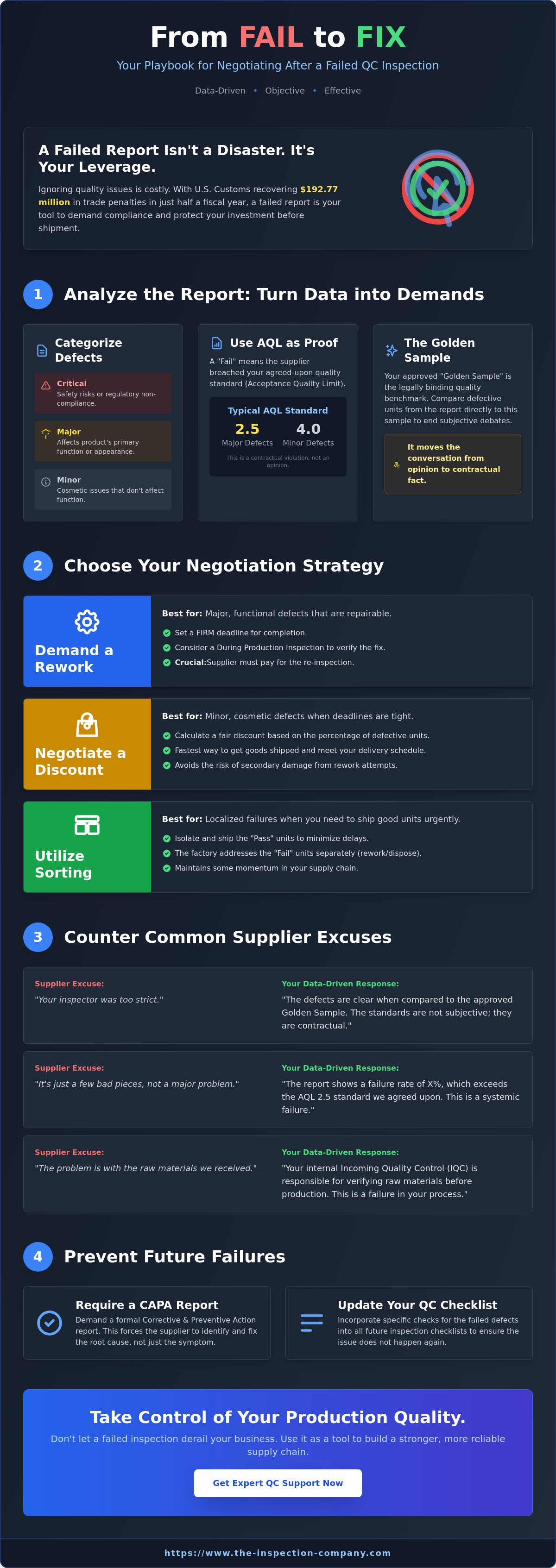
A failed report provides the technical leverage you need to protect your investment. Start by reviewing your Pre-Shipment Inspection report to categorize every non-conformity. You must distinguish between critical, major, and minor defects. Critical defects involve safety risks or regulatory non-compliance that could lead to legal liabilities. Major defects affect the product's primary function, while minor defects are usually cosmetic issues. Categorizing these issues prevents the supplier from downplaying the severity of the failure.
When negotiating with suppliers after failed QC, you must determine if the failure is systemic or localized. A systemic failure suggests a fundamental flaw in the production process that likely affects the entire lot. A localized failure might be limited to a specific production line or a single shift of workers. Identifying this distinction stops the supplier from claiming the issue is "just a few bad pieces" when the data shows otherwise.
Understanding AQL Breaches as Contractual Violations
The industry standard for consumer goods is typically set at AQL 2.5 for major defects and 4.0 for minor defects. This statistical quality control framework defines the maximum number of defective units allowed before a lot is rejected. A "Fail" result means the supplier hasn't met the agreed-upon quality standards. Use the high-resolution photos in your report to silence denials. Visual evidence makes it impossible for a factory manager to argue that the inspector was being unreasonable.
The Role of the Golden Sample in Dispute Resolution
Suppliers often try to dismiss failures as subjective interpretations of quality. You can counter this by comparing the defective units directly against the approved Golden Sample. This sample represents the exact specifications you agreed to pay for before production started. The Golden Sample is the legally binding quality benchmark for production. By anchoring your negotiating with suppliers after failed QC to this physical baseline, you move the conversation away from opinions and toward contractual facts.
Strategic Negotiation Options: Rework, Discounts, or Scrapping
Choosing the right path after a failed report depends on the nature of the defects and your inventory needs. You must first evaluate the repairability of the goods. Can the factory fix the issues without causing secondary damage, such as heat marks or weakened structural integrity? If the defects are localized to a specific portion of the lot, utilizing product sorting services allows you to isolate and ship the "pass" units while the factory addresses the failures. This is a critical step when negotiating with suppliers after failed QC to minimize shipping delays.
Your decision should balance the cost of delay against the cost of defects. A formal process for Reporting quality deficiencies ensures that all parties understand the contractual breach. Establishing the "Who Pays" rule is vital; the supplier should always bear the cost of re-inspection for any failed lot. This financial pressure incentivizes the factory to take the rectification process seriously and avoid recurring errors.
Demanding a Rework: Setting the Deadline
When requesting a rework, specify a firm deadline that respects your shipping window. A vague promise of fixing it soon is insufficient. To ensure the factory doesn't repeat the same errors, consider a During Production Inspection while the rework is underway. This proactive step verifies the fix is effective before the final re-inspection occurs. It's the only way to maintain control over a failing production run.
When to Negotiate a Discount Instead of a Fix
Sometimes, a fix is impossible or too slow. If the defects are minor, such as slight packaging scuffs that don't impact the product's retail value, you might accept the goods at a lower price. Calculate a fair discount based on the percentage of defective units. This approach is often the fastest way to handle negotiating with suppliers after failed QC while maintaining your delivery schedule. If you aren't sure which path to take, you can consult with our quality experts for a technical assessment of your options.
Countering Common Supplier Excuses and Pushback
When negotiating with suppliers after failed QC, you will face a predictable script of excuses designed to shift blame and avoid the cost of rework. Factories often claim that the raw material quality was poor or that the inspector was "too strict." You must reject these claims immediately. It's the factory's contractual responsibility to vet their sub-suppliers and manage input quality. If they suggest a defect won't affect the product's function, remind them that your brand reputation and Amazon FBA requirements are non-negotiable standards. One cosmetic flaw can trigger a wave of returns and negative reviews.
Use the "Third-Party Shield" to keep the relationship professional. Instead of making the dispute personal, blame the objective data in the report. You aren't being difficult; the report simply shows that the lot doesn't meet the agreed-upon criteria. Importers must often Negotiate with Powerful Suppliers who believe they have the upper hand. By anchoring your position to a third-party document, you maintain your authority without destroying the partnership.
The 'Material Fault' Trap
Factories frequently blame their fabric or component providers for failures. Don't accept this. The final assembly factory is responsible for the finished product's integrity. Remind them that the true cost of rework is estimated to be 2.0 to 2.5 times the direct labor cost, a burden they should have avoided through better incoming material checks. To prevent this excuse in the future, insist on Sample Testing of raw materials before mass production begins.
Escalating the Negotiation
If a sales representative continues to stall, escalate the conversation to the factory owner. Sales reps often don't have the authority to approve the financial hit of a massive rework. Requesting a formal Factory Audit for their sub-suppliers or their own facility signals that you're reconsidering the long-term partnership. This pressure usually forces a more realistic proposal for fixing the current batch. If your supplier is currently pushing back on a failed report, contact our technical team for immediate advice on handling the dispute.
Preventing Future Failures: Corrective Action and Future-Proofing
Successful negotiating with suppliers after failed QC doesn't end when the current batch is fixed. You must ensure the same errors don't happen twice. Use the failed report to update your QC Checklist immediately. If a specific defect was missed or found late, it must become a high-priority item in the next inspection cycle. For a broader perspective on managing these operational hazards, refer to our Sourcing from Asia guide.
Implementing the CAPA Process
A professional CAPA (Corrective and Preventive Action) report is a mandatory requirement after any failure. It forces the factory to identify the Root Cause, define the Corrective Action, and establish a Verification method. Don't accept vague promises of "doing better" or "paying more attention." A supplier’s willingness to provide a detailed CAPA is a key indicator of their long-term reliability as a partner. If they refuse to document their process improvements, they're likely to repeat the same mistakes in the next lot.
Rewriting the Quality Agreement
Update your future Purchase Orders (POs) to include a "Re-inspection Penalty" clause. This ensures the supplier is financially responsible for the cost of any second or third inspection required after a failure. You can track these trends and monitor factory performance over time using TIC's Quality Platform. Centralizing this data allows you to spot systemic quality issues before they become terminal. It turns raw data into a clear record of supplier accountability.
Moving forward, don't wait for the goods to be finished. Transitioning to a During Production Inspection for your next order allows you to catch errors while they're still repairable. Catching a defect when only 10% of the goods are finished is far more cost-effective than finding it at the finish line. This proactive shift is the ultimate goal of negotiating with suppliers after failed QC. It moves your supply chain from a reactive state to one of total control.
Securing Long-Term Quality Through Strategic Accountability
A failed inspection report is a strategic opportunity to realign your supplier with your quality standards. By categorizing defects, rejecting unfounded excuses, and demanding a formal CAPA process, you protect your brand from the financial risks of unsellable inventory. Effective negotiating with suppliers after failed QC relies on having objective, third-party evidence that leaves no room for debate. It's about moving from a reactive state of damage control to a proactive system of risk mitigation.
Don't let a single failure compromise your entire supply chain. Our European management team oversees more than 700 local inspectors to provide the transparency you need. We deliver detailed reports with high-resolution photos within 24 hours; this speed is critical for maintaining delivery schedules. Trusted by Amazon FBA sellers and global retailers, we provide the authoritative oversight necessary for high-stakes international trade.
Secure your next shipment with a professional Pre-Shipment Inspection. You now have the strategic framework to turn production challenges into a more resilient and reliable supply chain.
Frequently Asked Questions
Should I pay the final balance if the QC report failed?
You should never pay the final balance until the quality issues are resolved and a re-inspection has passed. Payment is your strongest leverage in negotiating with suppliers after failed QC. Once the factory receives the full amount, their incentive to perform costly reworks or offer financial compensation vanishes. Hold the balance to ensure the supplier remains committed to meeting the agreed-upon standards.
Who is responsible for the cost of re-inspection after a failure?
The supplier is responsible for all costs associated with a re-inspection following a failed report. This requirement should be clearly stated in your initial Purchase Order or Quality Agreement. Charging the factory for the second visit creates a financial deterrent against poor quality management. It also ensures that you aren't paying extra to verify that the factory finally did the job they were originally contracted to do.
Can I still ship the goods if the report shows 'Pending' or 'Fail'?
Shipping goods with a "Fail" status is a high-risk decision that often leads to expensive returns or customs issues. While you technically own the goods, importing defective products can result in brand damage or Amazon FBA account suspension. If you must ship due to tight deadlines, only do so after a professional product sorting service has isolated the acceptable units from the defective ones.
How do I know if the supplier actually performed the rework?
You cannot rely on factory photos or verbal promises to verify a rework. The only reliable method is to schedule a professional re-inspection. An independent inspector will check the specific units that failed previously to confirm the defects were corrected. This process is essential for negotiating with suppliers after failed QC, as it provides objective proof that the corrective actions were actually implemented on the factory floor.
What if the supplier refuses to fix the defects or offer a discount?
If a supplier refuses to take responsibility, you must escalate the dispute to the factory ownership immediately. Remind them of the long-term value of your business and the potential for a formal Factory Audit to reassess their status as a partner. If they remain uncooperative, you may need to consider scrapping the lot. Accepting total non-compliance sets a dangerous precedent for all your future production runs.