
Since the U.S. government suspended the Section 321 de minimis exemption on August 29, 2025, the cost of a shipping mistake has skyrocketed. Every commercial shipment now requires formal customs entry and full duty payments. This means importing a batch of unsellable products isn't just a loss of inventory; it's a guaranteed financial disaster involving non-refundable tariffs and processing fees. You've worked hard to build your brand, and the fear of receiving a container full of defects while your Amazon account hangs in the balance is a valid concern. It's stressful to manage language barriers and factory excuses when your capital is on the line.
This 2026 guide will teach you how to master quality control for small business importers to protect your margins and your reputation. We'll show you how a professional inspection, often costing between $199 and $320 for an all-inclusive man-day, acts as your final line of defense. You'll learn a repeatable process to verify product standards before you pay that final 70% balance. This ensures total peace of mind and protects your cash flow before your goods ever leave the factory floor.
Key Takeaways
- Understand why a 5% defect rate that a large corporation might absorb can lead to a total cash flow crisis for a smaller enterprise.
- Discover how to use Factory Audits and Pre-Shipment Inspections to stop costly surprises before your goods leave the factory floor.
- Learn to implement professional quality control for small business importers by integrating detailed product spec sheets and inspection terms directly into your purchase orders.
- Identify the specific FBA requirements, like FNSKU labeling and suffocation warnings, that protect your Amazon account health from permanent suspension.
Why Quality Control for Small Business Importers is Non-Negotiable in 2026
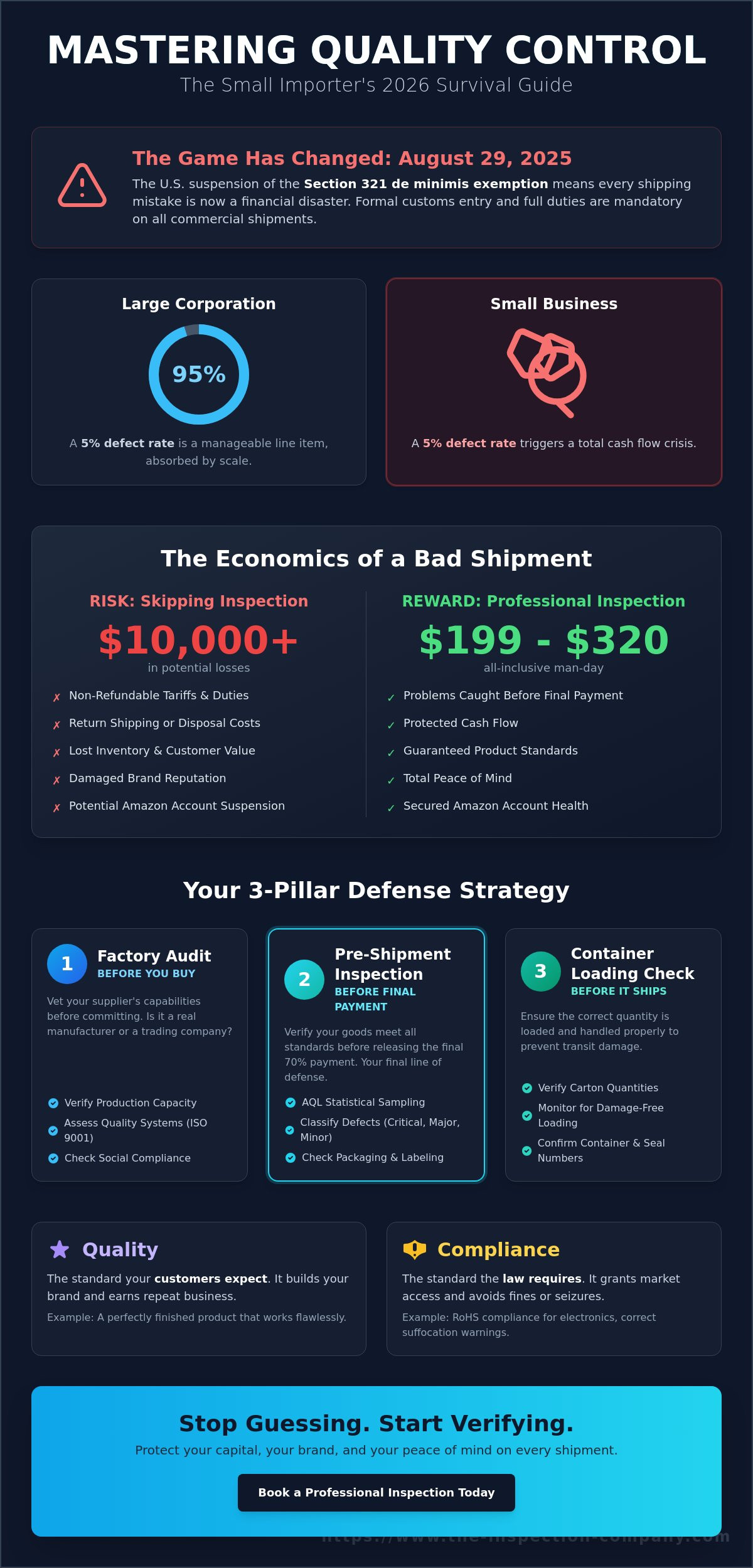
In the current trade environment, quality control is the process of verifying that your products meet every specific requirement before you release the final 70% payment or authorize a shipment. While you can find a comprehensive overview of quality control online, the stakes for small businesses are unique. Large corporations treat a 5% defect rate as a minor line item. For you, that same 5% is a "small business multiplier" that triggers a cash flow crisis. This is particularly true following the August 29, 2025, suspension of de minimis exemptions, which made every imported unit significantly more expensive to replace due to mandatory duties and formal entry fees.
Relying on a supplier's "self-inspection" is a dangerous gamble in 2026. As global material costs continue to fluctuate, factories often cut corners on raw materials or assembly to protect their own margins. Independent verification is the only way to ensure the goods you ordered are the goods you receive. Effective quality control for small business importers acts as an insurance policy against factory errors that could sink your brand before it has a chance to scale.
Quality vs. Compliance: What Small Importers Get Wrong
Many importers confuse these two distinct concepts. A product can be beautifully made yet illegal to sell if it lacks proper certifications. For example, electronics importers must prioritize RoHS compliance to avoid heavy fines, customs seizures, or Amazon account bans. Compliance is the floor for market entry; quality is the ceiling for brand growth.
The True Cost of Skipping an Inspection
The math is simple but brutal. A professional third-party inspection in Asia typically costs between $130 and $400 per man-day. Skipping this step risks a failed shipment that can easily cost $10,000 or more. This total includes non-refundable tariffs, return shipping, customs storage fees, and the permanent loss of customer lifetime value. One day of inspection saves months of financial trouble and protects your limited capital from total loss.
The 3 Essential QC Pillars for Sourcing from Asia
Establishing a robust framework for quality control for small business importers requires more than just a cursory glance at product photos. It demands a systematic approach that covers the supplier's capability, the product's integrity, and the shipment's security. Without these three pillars, you're essentially gambling with your capital. Professional oversight ensures that the factory you've selected is capable of meeting your standards before you commit to a production run.
Factory Audits: Vetting Before You Buy
The first pillar is the Factory Audit. Many small importers make the mistake of assuming an Alibaba "Gold Supplier" is a manufacturer. In reality, many are trading companies that lack direct control over production quality. Vetting the manufacturer is the critical first step in mastering the supplier management process. A formal audit examines their production capacity, social compliance, and quality management systems, such as their readiness for the upcoming ISO 9001:2026 standards. Understanding the Factory Audit vs. Inspection distinction helps you decide if you're hiring a partner or just buying a product.
Understanding AQL for Small Orders
The second pillar is the Pre-Shipment Inspection (PSI), governed by the Acceptable Quality Limit (AQL). This statistical tool defines the maximum number of defects allowed before a batch is rejected. When implementing a QC program, you must categorize defects as Critical (dangerous or illegal), Major (functional failures), or Minor (cosmetic issues). Using a standardized AQL table allows you to maintain professional standards even with smaller Minimum Order Quantities (MOQs).
The third pillar is the Container Loading Inspection (CLI). This final check ensures the factory actually loads the quantity you paid for and that the goods are handled correctly to prevent transit damage. It's your last chance to stop problems before your shipment sails. If you're unsure which pillar to prioritize for your next order, you can request a consultation with our team to build a custom plan.
How to Implement a QC Strategy on a Small Business Budget
Implementing effective quality control for small business importers doesn't require a massive corporate budget. It requires a repeatable, disciplined process. Start by creating a detailed product specification sheet, often called a "golden sample," before production begins. This physical sample acts as the definitive standard the factory must match. Without it, you have no objective basis to reject a shipment if the quality isn't up to par.
Next, you must negotiate "Inspection Terms" directly into your initial Purchase Order (PO). This shifts the risk back to the manufacturer. Once production is at least 80% complete, book your Pre-Shipment Inspection. This timing is critical; it allows the inspector to check finished and packed goods while there's still time for the factory to fix errors. After receiving the report, review it within 24 hours to decide whether to Approve, Hold, or Reject the batch.
Drafting an Inspection-Ready Purchase Order
Your PO is a legally binding contract, not just a receipt. You should include a specific clause stating the supplier is responsible for the cost of any re-inspections if the first one fails. This simple addition incentivizes the factory to maintain standards. Clearly define that a "Fail" result means the factory must perform rework, replacement, or a refund before you pay the final balance. This protects your cash flow and ensures you don't pay for defects.
What to Do When an Inspection Fails
A "Failed" report is a tool for negotiation, not a reason to panic. Request a Root Cause Analysis (RCA) from the supplier to understand why the defects occurred. For quality control for small business importers, managing a rework process remotely is possible by requiring photo evidence of the corrected items and scheduling a follow-up inspection. This methodical approach ensures you only ship sellable inventory. To start securing your next shipment with professional oversight, book your first inspection today.
Specialized Quality Control for Amazon FBA Sellers
For those selling on Amazon, the stakes of quality control for small business importers are exceptionally high. Amazon's "Account Health" metrics don't forgive factory errors. A single batch with incorrect FNSKU labels or missing suffocation warnings on polybags can lead to immediate shipment rejection at the fulfillment center. Worse, a high rate of "Product Not as Described" returns can trigger a permanent account suspension, destroying your business overnight. In the 2026 trade environment, where every shipment requires formal entry and full duty payments, you can't afford to pay tariffs on goods that Amazon won't even let you sell.
Professional oversight is essential to navigate these strict requirements. Our Amazon FBA Service includes specific checks that factories often overlook. These include verifying that carton weights stay within strict limits and ensuring every barcode is scannable and correctly placed. One day of inspection can save months of trouble with Amazon's compliance team. It's the only way to ensure your inventory is ready for sale the moment it arrives.
Preventing 'Product Not as Described' Complaints
To maintain a high star rating, your product must perform exactly as advertised. Inspectors conduct functional tests to verify every claim in your listing. They also perform "drop tests" to ensure your packaging is durable enough for the last mile delivery. If a product arrives broken because the factory used sub-standard cardboard, the customer blames your brand, not the manufacturer. Verifying packaging durability is a non-negotiable step for any seller aiming for long-term growth.
Leveraging European Management for Asian Inspections
Managing suppliers from thousands of miles away requires total transparency. By choosing a partner with European management, you ensure that Western quality standards are applied on the ground in Asia. Small businesses can now access corporate-level visibility through our Quality Platform. This digital tool allows you to track inspection results and manage factory audits in real-time. This level of professional quality control for small business importers is what allows a side hustle to scale into a legitimate, international brand with a protected reputation.
Secure Your Supply Chain for 2026 and Beyond
The landscape of international trade changed forever on August 29, 2025. With the suspension of duty-free entry, every defective unit that crosses the border now carries the heavy weight of non-refundable tariffs and formal entry fees. Protecting your capital requires a shift from reactive problem-solving to proactive risk mitigation. By establishing clear inspection terms in your purchase orders and utilizing statistical tools like AQL, you transform quality management from a logistical headache into a significant competitive advantage.
Implementing professional quality control for small business importers ensures that your brand reputation remains intact while your margins stay protected. You don't need a corporate budget to access corporate-level standards. With over 25 years of experience and European management, The Inspection Company provides ISO 9001 certified processes that stop problems before your shipment sails. We deliver transparent, detailed reports within 24 hours of every inspection so you can make informed decisions with total confidence.
Avoid costly surprises; get an instant quote for your next inspection today. Your business deserves the peace of mind that comes from meticulous, independent verification. Take control of your production today and build a brand that customers can trust for years to come.
Frequently Asked Questions
Is quality control too expensive for a small business importing only 500 units?
Professional quality control for small business importers is a necessary investment even for small orders of 500 units. A standard inspection in Asia typically costs between $130 and $400 per man-day; a small fraction of the cost of shipping unsellable goods. Since the August 29, 2025, suspension of de minimis rules, the cost of replacing even a small order has surged due to mandatory tariffs and formal entry fees.
Can I just trust my supplier's internal quality control report?
Relying on a supplier's internal report is high-risk because the factory has a natural conflict of interest. They're incentivized to ship goods and receive the final 70% balance. This often leads them to overlook or hide defects. An independent third-party inspection provides an unbiased view of your production quality. It ensures you only pay for products that meet your specific "golden sample" standards before they leave the factory floor.
What happens if the inspection report shows major defects but I've already paid the deposit?
Use the inspection report findings as leverage to demand rework or replacements before you release the final payment. While the 30% deposit is already committed, the remaining 70% balance is your strongest bargaining chip. Professional inspectors provide clear, documented evidence that forces the factory to address failures. This prevents them from rushing a shipment of defective inventory to your warehouse while you still hold the financial power.
How do I find a reliable inspection company in China or Vietnam?
Look for an agency with over 25 years of experience and a blend of European management with local Asian expertise. It's essential that the company is ISO 9001 certified and provides transparent, digital reporting within 24 hours of the site visit. A reliable partner will have an established physical presence in both China and Vietnam. This allows them to coordinate bookings quickly and handle the nuances of local factory management.
Do I need to be present at the factory during the quality control inspection?
You don't need to be physically present at the factory when you hire a professional service to handle quality control for small business importers. The inspector acts as your eyes and ears on the ground. They follow a strict checklist based on your product specifications and AQL standards. You'll receive a comprehensive report with high-resolution photos and video evidence. This allows you to make a shipping decision from your home office without the high cost of international travel.