
With global e-commerce fraud losses reaching $48 billion in 2025 and U.S. merchants losing an average of $4.61 for every $1 of fraud, can you really afford to trust a digital profile? You've likely felt the anxiety of sending a massive deposit to a company you've never visited, fearing the factory might not exist or that your quality will fade after the first order. It's a valid concern in a year where trade fraud lawsuits have hit record highs and the suspension of the de minimis exemption has increased regulatory pressure on every commercial shipment.
You need a strategy that moves beyond checking boxes on a website. This guide masters a foolproof supplier verification process for importers designed to eliminate scams, ensure quality standards, and secure your Asian supply chain against 2026 risks. We will provide a clear checklist for vetting partners, from verifying legal licenses to navigating UFLPA compliance. You'll learn how to transition to a physical-first validation process that uses factory audits and pre-shipment inspections to bridge the gap between a supplier's online claims and their actual factory-floor reality.
Key Takeaways
- Learn why a systematic supplier verification process for importers is the only way to move beyond digital badges and confirm a factory's actual legal standing.
- Discover how to spot "trading company" traps so your orders aren't being outsourced to unauthorized sub-tier factories.
- Identify critical payment red flags, such as offshore account requests, that frequently precede significant financial loss in international trade.
- Understand how to integrate initial vetting with Factory Audits and Pre-Shipment Inspections to maintain leverage throughout the production lifecycle.
- Master the transition to physical-first validation to ensure your supply chain remains compliant with evolving 2026 regulatory standards and UFLPA requirements.
What is the Supplier Verification Process for Importers?
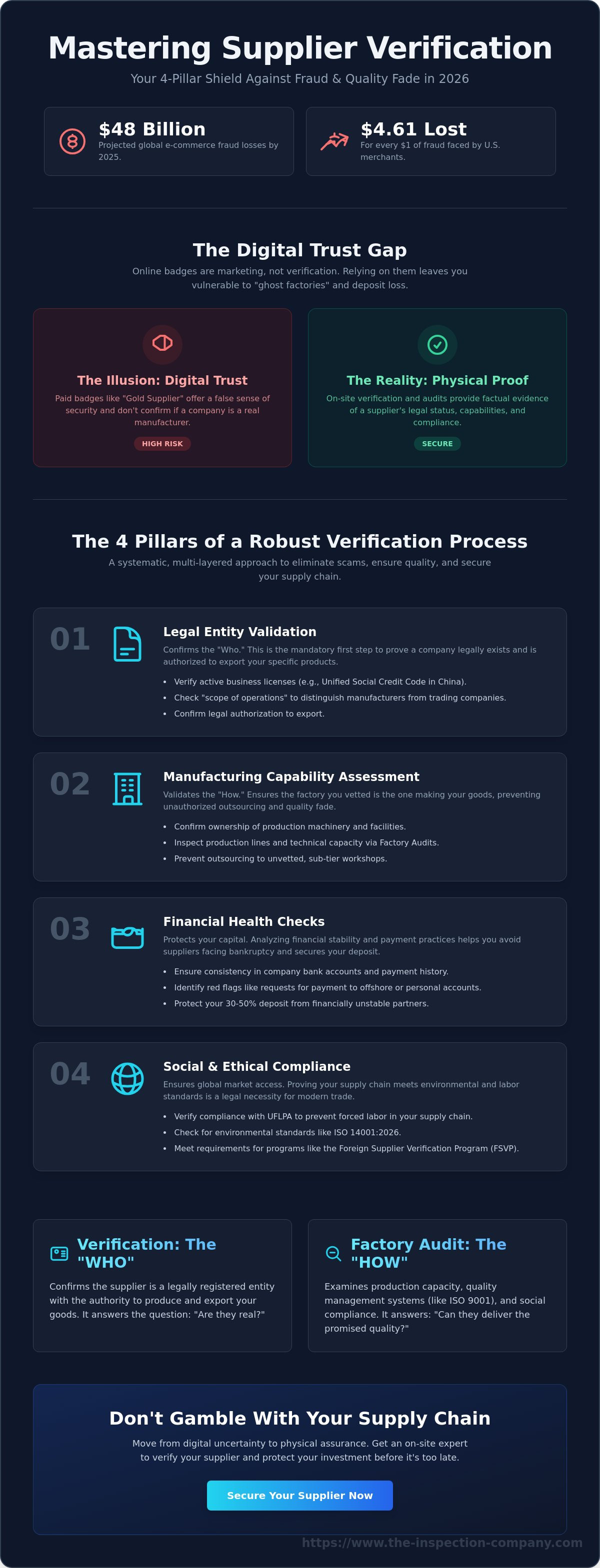
The supplier verification process for importers is a systematic vetting procedure designed to confirm a factory’s legal existence, production capacity, and ethical standing before any capital is committed. It acts as a preventative investment. Without it, you're essentially gambling with your operational budget. Digital badges like "Alibaba Gold" or "Verified Supplier" on B2B platforms are often misunderstood. While they provide a basic starting point, they don't guarantee that the entity is a manufacturer rather than a middleman. In 2026, these badges are often just paid marketing tiers. Relying on them alone leaves you vulnerable to "ghost factories" that disappear once they receive your 30-50% deposit.
To build a resilient supply chain, you must look deeper into the supplier evaluation process to assess long-term viability. This goes beyond simple identity checks. It involves a structured supplier management process that integrates third-party expertise to validate claims on-site. When fraud attempts in logistics are rising by 30% annually, having a boots-on-the-ground partner isn't a luxury. It's a necessity for maintaining control over your capital and your reputation.
Supplier Verification vs. Factory Audit
It's vital to distinguish between these two stages of the supplier verification process for importers. Verification confirms the "Who." It proves the business license is active and the company is legally authorized to export the specific goods you're buying. A Factory Audit, however, examines the "How." It's a deep dive into quality management systems, machinery maintenance, and social compliance standards.
- Verification: Confirms the legal entity exists and identifies the actual owners.
- Audit: Validates production capacity and adherence to international quality standards like ISO 9001.
Using both ensures your sourcing from Asia strategy is secure. You first verify the partner is real, then audit them to ensure they can actually deliver the quality they promised. This two-step approach eliminates operational friction and protects your bottom line from unexpected errors.
The 4 Pillars of a Robust Verification Process
A robust supplier verification process for importers rests on four foundational pillars. These ensure your supply chain isn't just a digital illusion but a physical reality capable of meeting global standards. Without these pillars, you risk significant financial loss and regulatory penalties that can cripple your operations.
First, Legal Entity Validation is mandatory. You must check local government databases for active business licenses. In China, this involves verifying the Unified Social Credit Code. Ensure the "scope of operations" covers manufacturing; if it only lists "trading," you're dealing with a middleman who adds cost and friction. This step confirms the entity is legally authorized to exist and export.
Manufacturing Capability Assessment confirms ownership of the production process. You need to know if the factory owns the machinery or is outsourcing to sub-tier workshops. This is where a Factory Audit becomes vital to inspect production lines and technical capacity. It prevents "quality fade" by ensuring the factory you vetted is the one actually making your goods.
Financial Health Checks prevent mid-production disasters. Consistency in bank accounts and credit history is non-negotiable. Requests for payment to offshore entities or personal accounts are immediate red flags. Analyzing these details protects your 30-50% deposit from being lost to a supplier facing imminent bankruptcy.
Social and Ethical Compliance is now a legal requirement for global trade. With strict UFLPA enforcement and the publication of ISO 14001:2026, you must prove your supply chain is free of forced labor and meets environmental standards. This risk-based approach mirrors the standards found in the Foreign Supplier Verification Programs (FSVP), which emphasize the importer's burden of compliance across all sectors.
On-Site vs. Remote Verification
Virtual tours are often staged marketing tools that hide operational flaws. Physical presence is non-negotiable for high-value orders. Our inspectors act as your "eyes and ears," arriving at the factory floor within 24 hours to provide a fact-based report. This blend of international management standards with a localized presence ensures you get the transparency you need in complex Asian markets. If you're unsure where to start your vetting, you can speak with our team about your specific risk profile.
Key Documents You Must Request
- Business License: Specifically the Unified Social Credit Code for Chinese entities.
- Quality Certifications: Look for updated ISO 9001:2026 or industry-specific marks like RoHS and CE.
- Export Licenses: Validates their legal right to ship goods internationally and their tax standing.
Identifying Red Flags in 2026 Supplier Vetting
Identifying red flags is the most critical phase of the supplier verification process for importers. These warnings often appear early in the negotiation. Ignoring them leads to the "quality fade" or complete capital loss mentioned earlier. In a landscape where global e-commerce fraud reached $48 billion in 2025, your ability to spot these signals determines the safety of your investment.
The "Trading Company" trap remains a primary risk. Middlemen often pose as manufacturers to secure higher margins. To spot them, examine the business scope on their Unified Social Credit Code. If the license lists "sales," "consulting," or "trading" without "manufacturing" or "processing," they are outsourcing your order. This adds hidden costs and removes your direct control over production quality. Similarly, inconsistent documentation is a major warning. If the address on the business license doesn't match the proforma invoice or the website, the entity lacks operational integrity.
Payment discrepancies are the clearest sign of potential fraud. If a supplier asks for a deposit to be sent to a personal account or an offshore entity, stop the transaction immediately. Legitimate factories use corporate accounts that match their registered business name. Transparency is non-negotiable. If a supplier refuses entry to a third-party factory audit team, they are likely hiding sub-tier factories or labor violations. Following supplier verification best practices requires aligning every data point before signing a contract.
Digital Red Flags to Watch For
Scammers often use "burn" websites to lure importers. Check the domain registration date; if the site is less than 12 months old, proceed with extreme caution. Professional entities don't use generic @gmail.com or @163.com addresses for official business; they use dedicated company domains. Also, reverse image search their "factory" photos. If those images appear on multiple sites, they likely don't own the facility. If you've spotted any of these warnings, contact our regional experts to verify the factory's true status before you send a deposit.
- Domain Age: Sites registered within the last year are high-risk.
- Stock Imagery: Usage of generic factory photos instead of actual production lines.
- Communication: Lack of a fixed landline or official company email domain.
Integrating Verification into Your Quality Lifecycle
Completing the initial supplier verification process for importers isn't a one-time event; it's the foundation of a long-term risk management strategy. Many businesses make the mistake of treating vetting as a final hurdle rather than the start of a lifecycle. A verified factory is a legitimate partner, but legitimacy doesn't automatically guarantee that every batch will meet your specifications. To maintain control, you must transition from identity validation to active production oversight through a pre-shipment inspection before any final payments are released.
The data gathered during the supplier verification process for importers provides significant leverage during contract negotiations. When you possess verified details about a factory's machinery, production capacity, and legal standing, you're in a stronger position to demand favorable payment terms and strict quality control agreements. Suppliers are less likely to attempt "quality fade" or unauthorized outsourcing when they know you have a professional third party monitoring their operations. Utilizing a centralized quality platform allows you to track this performance data in real time, giving you a clear view of supplier reliability across multiple seasons.
Establishing a cycle of continuous monitoring through recurring onsite evaluations effectively halts quality fade by signaling to the factory that every production run is subject to rigorous oversight. This proactive approach ensures that the standards established during the first order don't slip as the relationship matures.
Next Steps for Importers
To secure your 2026 sourcing strategy, you should move beyond ad hoc checks and build a structured "Supplier Scorecard." This document should aggregate results from your initial verification, audit findings, and ongoing inspection pass rates. If you're considering expanding your supply chain, scheduling a supplier survey for new potential partners is an efficient way to filter out high-risk entities before they enter your lifecycle.
- Build a Scorecard: Rank partners based on compliance, quality consistency, and communication.
- Audit Annually: Re-verify licenses and social compliance every 12 months to ensure continued alignment with 2026 standards.
- Release Payments Strategically: Only settle balances after a successful pre-shipment report.
Don't leave your supply chain to chance in an increasingly complex regulatory environment. Secure your next order and eliminate operational friction by booking a professional supplier verification with our regional experts today.
Securing Your Supply Chain for 2026 and Beyond
Success in international trade no longer depends on finding the lowest price but on identifying the most reliable partner. As regulatory scrutiny intensifies and fraud methods evolve, a "digital-only" vetting strategy is a liability you can't afford. By implementing a rigorous supplier verification process for importers, you replace anxiety with data-driven confidence. You've learned that physical entity validation, machinery assessments, and continuous lifecycle monitoring are the only ways to prevent costly quality fade and deposit loss.
The Inspection Company provides the boots-on-the-ground presence required to navigate complex Asian markets. With over 700 certified inspectors and European management backed by 15+ years of regional expertise, we deliver detailed reports within 24 hours. Don't let your next shipment become a statistic of operational friction or financial loss. Take control of your sourcing strategy now.
Protect your investment—Schedule an expert supplier verification today. Your supply chain's resilience starts with a partner you can trust.
Frequently Asked Questions
Is an Alibaba Gold Supplier badge enough for supplier verification?
No, an Alibaba Gold Supplier badge is not a sufficient substitute for a professional supplier verification process for importers. These badges are primarily paid marketing memberships that confirm a basic business existence but do not validate manufacturing capacity or quality standards. Relying on digital icons alone leaves you vulnerable to middlemen who pose as factories to secure higher margins while outsourcing your production to unvetted workshops.
How long does the professional supplier verification process take?
A professional verification typically generates a detailed report within 24 hours of the onsite visit. Our inspectors can reach most major industrial hubs across Asia quickly to conduct a physical check of the premises and documentation. This rapid turnaround ensures you can make informed decisions about your deposits and production schedules without introducing unnecessary operational friction into your supply chain.
Can I verify a supplier in China or Vietnam remotely?
You cannot reliably verify a supplier in China or Vietnam through remote methods alone. While reviewing digital business licenses is a helpful first step, it cannot confirm if the factory actually owns its machinery or if it is a "ghost factory" designed to collect deposits. Physical onsite presence is the only way to bridge the gap between a digital profile and the physical reality of the factory floor.
What is the difference between a supplier survey and a full factory audit?
A supplier survey is a foundational check that confirms the legal existence and business scope of an entity. It answers the question of whether the company is a legitimate manufacturer. A full factory audit is a deeper technical evaluation of quality management systems, machinery maintenance, and social compliance. Using both within the supplier verification process for importers provides a comprehensive view of both legal standing and production capability.
What happens if a supplier fails the verification process?
If a supplier fails verification, you should terminate negotiations and withhold all payments immediately. Failure typically signals critical risks such as mismatched business licenses, lack of declared machinery, or refusal of onsite access. Walking away at this stage is a preventative investment that protects your capital from total loss and prevents the long term complications of receiving non compliant or substandard goods.