
Would you hand over a six-figure wire transfer for a shipment you’ve never actually seen? For many importers, the final payment is a blind leap of faith that often ends in the arrival of defective "garbage" and significant financial friction. The product quality inspection process isn't just a box to check. It is your strategic kill switch to prevent operational disasters before your goods ever reach the container.
We understand the anxiety of operating without visibility into factory conditions. You need more than just a vague hope that your supplier followed the spec sheet. This guide provides the exact workflow professional inspectors use to identify critical defects and secure your supply chain in 2026. We will examine the new ISO 2859-1:2026 standards and the shift toward predictive quality analytics so you can move from reactive damage control to proactive risk management. You'll gain the data-driven confidence needed to approve or reject any shipment with total certainty and significantly reduced defect rates.
Key Takeaways
- Learn how a standardized product quality inspection process acts as a strategic safeguard to prevent financial loss before goods ever leave the factory.
- Discover how to implement the 7-step on-site workflow, utilizing the updated ISO 2859-1:2026 standards for precise and statistically significant random sampling.
- Master defect classification to distinguish between minor cosmetic flaws and critical safety risks that could compromise your brand's legal standing.
- Understand how to interpret AQL data to make informed "ship or no-ship" decisions based on objective, data-driven factory performance metrics.
- Gain the technical expertise to mandate 100% product sorting when inspections fail, ensuring only compliant units enter your inventory.
What is the Product Quality Inspection Process in 2026?
The product quality inspection process is the systematic measuring, examining, and testing of goods to ensure they align perfectly with your predefined specifications. It isn't a passive observation. It's a rigorous technical audit designed to identify any deviation from your approved golden sample. While many importers confuse this with Quality Assurance (QA), the two are distinct functions. QA focuses on the management systems and manufacturing processes. In contrast, Quality control (QC) is the tactical execution of checking the physical units themselves to catch defects before they leave the factory floor.
By 2026, AI-driven factory monitoring and automated data logs have become standard. However, technology has its limits. Algorithms can't detect subtle tactile defects, nor can they identify chemical odors that suggest poor material quality. Physical "boots on the ground" remain the only definitive way to verify that a factory's digital reporting matches the physical reality of the shipment. This verification occurs at critical intervals, including Pre-Production to vet raw materials and During Production to catch early-stage errors that could ruin an entire lot.
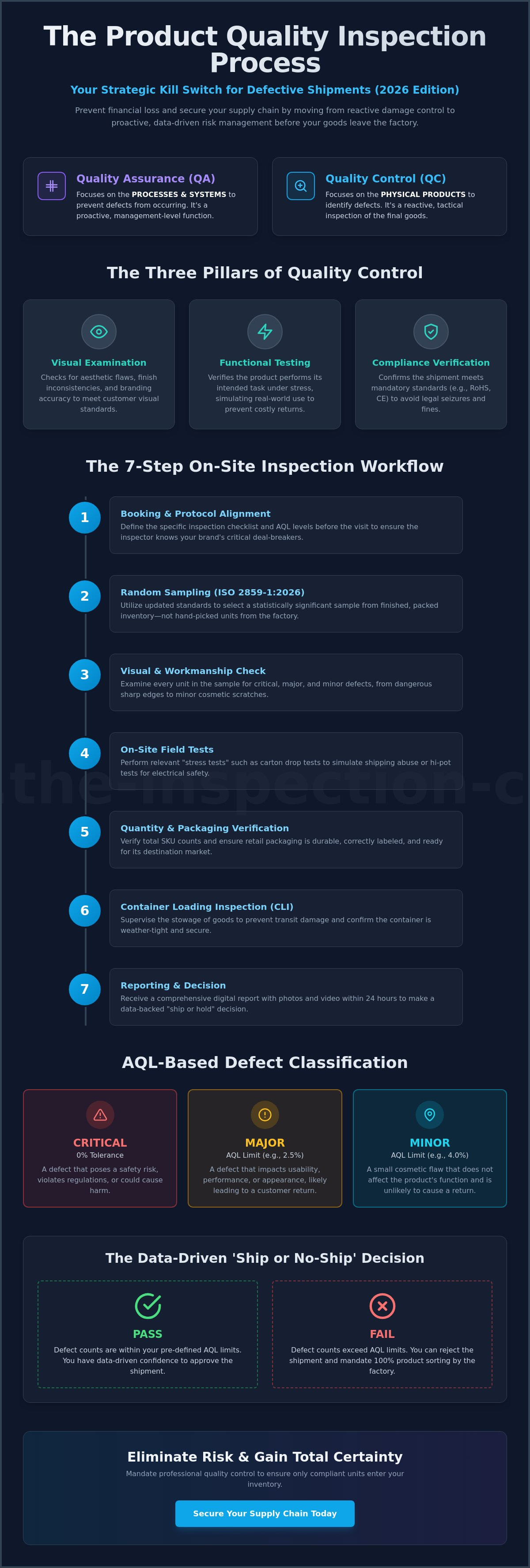
The Three Pillars of Quality Control
A professional product quality inspection process rests on three fundamental pillars that protect your brand reputation and your financial interests.
- Visual Examination: Inspectors check for aesthetic flaws, finish inconsistencies, and branding accuracy. This step ensures your product doesn't just work; it meets the high visual standards your customers expect.
- Functional Testing: This involves putting the product through its paces. Does it perform its intended task under stress? We verify that the item functions as promised in real-world scenarios to prevent costly returns.
- Compliance Verification: We confirm the shipment meets mandatory international standards, such as RoHS or CE marking. Failure here doesn't just mean a loss of sales. It can lead to legal seizures and heavy fines at customs.
The 7-Step On-Site Inspection Workflow
Executing a standardized product quality inspection process ensures that every variable is controlled from the moment an inspector enters the factory. This isn't a casual walkthrough. It's a high-stakes technical audit where every minute is dedicated to uncovering hidden risks. The NIST definition of Quality Control highlights the necessity of operational techniques to fulfill quality requirements. Our workflow translates these high-level standards into actionable steps on the factory floor.
- Step 1: Booking and Protocol Alignment. We define your specific checklist and AQL levels before the visit. This alignment ensures the inspector knows exactly which defects are deal-breakers for your brand.
- Step 2: Random Sampling. Inspectors use the revised ISO 2859-1:2026 standards to select a statistically significant sample set. We don't let the factory hand-pick the units; we pull them randomly from finished, packed inventory.
- Step 3: Visual and Workmanship Check. Every unit in the sample is examined for critical, major, and minor defects. This step catches everything from dangerous sharp edges to minor cosmetic scratches.
- Step 4: On-Site Field Tests. We perform "stress tests" relevant to your product category. This often includes carton drop tests to simulate shipping abuse or hi-pot tests for electrical safety and grounding.
Completing the Physical Audit
The final stages of the product quality inspection process focus on the logistics of the shipment itself. In Step 5, we conduct Quantity and Packaging Verification. We verify the total SKU count and ensure your retail packaging is durable and correctly labeled for its destination. Step 6 involves a Container Loading Inspection (CLI). We supervise the actual stowage of your goods to prevent transit damage and confirm that the container is weather-tight and secure. Finally, Step 7 is Reporting. You receive a comprehensive digital report with high-resolution photos and video within 24 hours of the inspection. This transparency allows you to make a data-backed decision to ship or hold. If you need help drafting a custom inspection checklist, you can contact our regional experts today.
Defining Quality Standards: AQL and Defect Classification
Defining standards is the most technical phase of the product quality inspection process. You can't rely on a factory's internal definition of "good quality," as their thresholds often prioritize production speed over precision. Instead, professional importers use the AQL (Acceptable Quality Limit) standard. This statistical tool allows you to set a clear pass or fail threshold based on the number of defects found in a sample set. It transforms subjective opinions into objective data, giving you the leverage to hold a supplier accountable for sub-standard output.
To manage risk effectively, defects are categorized into a strict hierarchy. A 'Critical Defect' is any flaw that could cause harm to the user or result in a legal recall. These represent a zero-tolerance zone; a single critical defect usually results in an automatic failure of the entire lot. Major defects involve functionality failures that make the product unusable, while minor defects are typically cosmetic issues that don't impact performance but may affect brand perception. If you're selling on e-commerce platforms, you must tailor your checklist to meet specific Amazon FBA requirements. Amazon is notorious for rejecting entire shipments due to minor labeling errors or non-compliant barcode placement.
Common Defect Categories in Asian Manufacturing
Experience in regional hubs reveals recurring patterns of operational friction. We frequently encounter material and workmanship flaws, such as fabric defects in textiles or poor solder joints in electronics. Inconsistent branding or labeling remains a primary cause for warehouse rejections and customs delays. Additionally, mechanical and electrical failures often surface only during rigorous stress testing, proving that a visual check alone is insufficient for high-stakes trade. Ready to set your AQL levels? Speak with our technical team to build a robust inspection protocol for your next shipment.
Post-Inspection: Making the 'Ship or No-Ship' Decision
Receiving the final report is the most critical moment in the product quality inspection process. This document is your primary defense against a warehouse full of unsellable goods. Reports typically arrive with a status of 'Passed,' 'Pending,' or 'Failed.' While a 'Passed' status is the goal, 'Pending' or 'Failed' results require immediate executive action. You shouldn't ignore these red flags. Instead, use the data to determine if the defects are pervasive or isolated to specific batches.
If the failure rate exceeds your AQL limits, you have significant leverage. You can demand that the factory performs a 100% product sorting. This forced intervention requires the supplier to manually inspect every single unit to remove defective items at their own expense. It's a powerful tool that shifts the cost of quality failure back onto the manufacturer. Never release the final payment or authorize shipment until you've seen proof of rework or booked a re-inspection to verify the corrections. The report acts as objective evidence for negotiating credit notes or demanding that the factory covers the cost of the second inspection visit.
Corrective Action Plans (CAP)
A failed inspection shouldn't just be a one-time fix. To secure your supply chain, you must work with the supplier to identify the root cause of the failures. Was it a specific raw material? Was a machine out of calibration? Establishing long-term quality improvements often requires deeper factory audits to assess the supplier's overall management systems. The goal of a CAP is to ensure the same defect never appears in future production runs. By closing this loop, you move from merely catching errors to preventing them entirely, transforming your quality management into a scalable competitive advantage.
Take Control of Your Global Supply Chain Quality
The product quality inspection process is your most effective tool for mitigating the financial risks of international trade. By shifting from a reactive mindset to a data-driven workflow, you ensure that every shipment meets your brand's specific standards before it leaves the factory floor. You've seen how the 7-step on-site audit provides necessary visibility and how AQL classification gives you the leverage to demand corrections or 100% sorting when things go wrong.
Don't leave your brand's reputation to chance or factory self-reporting. The Inspection Company offers European management with over 700 professional inspectors across Asia to provide the essential oversight you need. Whether you require specialized Amazon FBA inspection protocols or a standard pre-shipment audit, we deliver comprehensive reports within 24 hours. This level of speed and transparency allows you to manage your inventory with total confidence.
Secure your supply chain; book a professional inspection with The Inspection Company today.
Take control of your manufacturing quality now to build a more resilient and profitable business for the years ahead.
Frequently Asked Questions
How long does a typical product quality inspection take to complete?
A standard on-site inspection typically requires one full man-day at the factory to execute the sampling and testing protocols. Once the physical audit is finished, the data is processed and reviewed for accuracy. You should expect to receive the comprehensive digital report, including all photos and videos, within 24 hours of the inspector leaving the site. Larger shipments or highly technical products may require additional man-days to maintain the statistical integrity of the sample set.
Can I customize the inspection checklist for my specific product type?
You absolutely can and should customize your checklist to reflect your unique product specifications. Generic checklists often miss the technical nuances that define your brand's quality standards. During the protocol alignment phase of the product quality inspection process, you can define specific stress tests, branding requirements, and packaging standards. This ensures the inspector focuses on the exact variables that matter most to your customers and your bottom line.
What happens if the factory refuses to let the inspector in?
A factory refusal is a significant red flag that often indicates a high risk of systemic quality failure or unfinished production. We immediately notify you if an inspector is denied access to the site. Since you shouldn't release the final payment before a successful inspection, this refusal provides you with the leverage to halt the transaction. We recommend including a clear clause in your purchase order that mandates factory access for your chosen third-party inspectors.
Is a pre-shipment inspection enough, or do I need audits during production too?
A Pre-Shipment Inspection is your essential final checkpoint, but it's often too late to fix deep-seated errors without massive shipping delays. During Production Inspections (DUPRO) are recommended for complex goods or when working with new suppliers. Catching a defect when only 20% of the order is finished allows the factory to correct the process immediately. This proactive approach prevents the financial friction of a completely failed shipment at the container loading stage.
How much does a professional product quality inspection service cost in 2026?
Pricing for a professional product quality inspection process is typically calculated on a per man-day basis. This rate varies depending on the factory's geographic location and the level of technical expertise required for your specific product category. It's best to view this cost as a preventative investment rather than an administrative expense. The price of a single inspection is always significantly lower than the catastrophic cost of receiving a shipment of defective or unsellable goods.