

What if your next shipment isn't a profit driver, but a liability waiting to be unboxed? You've likely felt the frustration when a batch arrives with uneven stitching or fabric that fails to match your approved golden sample. It's a common reality where a 5% defect rate can quickly spiral into a suspended Amazon account or thousands in lost revenue. Implementing a rigorous textile quality control process is the only way to stop these problems before your shipment sails.
You deserve a sourcing strategy where "good enough" isn't the standard and communication with overseas factories is crystal clear. This 2026 guide provides the roadmap to eliminate costly surprises and ensure every product meets international compliance standards. We'll show you how to secure transparent inspection reports within 24 hours and implement a step-by-step framework that guarantees your shipments match your samples every single time. One day of professional inspection can save you months of financial trouble.
Key Takeaways
- Understand why a single day of inspection is a vital investment that prevents months of shipping delays and costly supply chain disruptions.
- Discover how to master the textile quality control process at every stage, from raw material verification to catching errors while they are still fixable.
- Learn to apply industry-standard AQL sampling and defect classification to set clear, measurable expectations for your production quality.
- Shift from reactive checking to proactive risk management by leveraging digital quality platforms to track supplier performance over time.
- Protect your brand’s bottom line and ensure regulatory compliance by implementing fail-safe sourcing strategies specifically for the Asian market.
What is the Textile Quality Control Process and Why Does it Matter?
The textile quality control process is a systematic framework used to verify raw materials, construction, and finished goods against specific buyer requirements. It's not a single event. It's a series of rigorous checkpoints that ensure your fabric meets every technical specification before it leaves the factory floor. This process covers everything from initial yarn selection to the final packaging of the garment.
At The Inspection Company, we operate by a simple rule: one day of inspection can save months of trouble. Spending 24 hours on the ground in a factory prevents 90 days of shipping delays caused by rejected shipments or customs seizures. Skipping professional QC exposes your business to three primary risks:
- Financial Loss: Paying for unsellable inventory and facing return rates that can exceed 15%.
- Brand Damage: Losing customer trust due to poor garment performance, pilling, or color bleeding.
- Compliance Failures: Violating safety regulations like REACH or CPSIA, which can lead to heavy legal fines.
It's vital to distinguish between internal factory-led QC and independent third-party inspection. Factory staff often face production quotas that conflict with quality goals. Our external auditors provide an unbiased perspective, ensuring "good enough" for the factory actually meets your brand's standards. We stop problems before your shipment sails.
The High Cost of 'Invisible' Textile Defects
A garment can look perfect on a mannequin but fail in the hands of a consumer. "Invisible" defects like incorrect Grams per Square Meter (GSM) or low yarn counts often go unnoticed until it's too late. Integrating a formal fabric inspection process into your production cycle identifies these issues early. These inconsistencies can ruin an entire production run, even if the stitching is flawless. You can monitor these metrics in real-time through our quality platform.
European Standards vs. Local Factory Realities
Bridging the gap between Western quality expectations and Asian manufacturing realities requires a physical presence. Our European management team in Asian hubs ensures that local factory output aligns with international standards. This hands-on approach is the foundation of effective risk mitigation. By utilizing a professional quality control service, you gain transparency into the factory's actual performance, moving beyond the promises made in a sales office. We provide the security and control needed for high-stakes international trade.
The 4 Critical Stages of Textile Quality Control
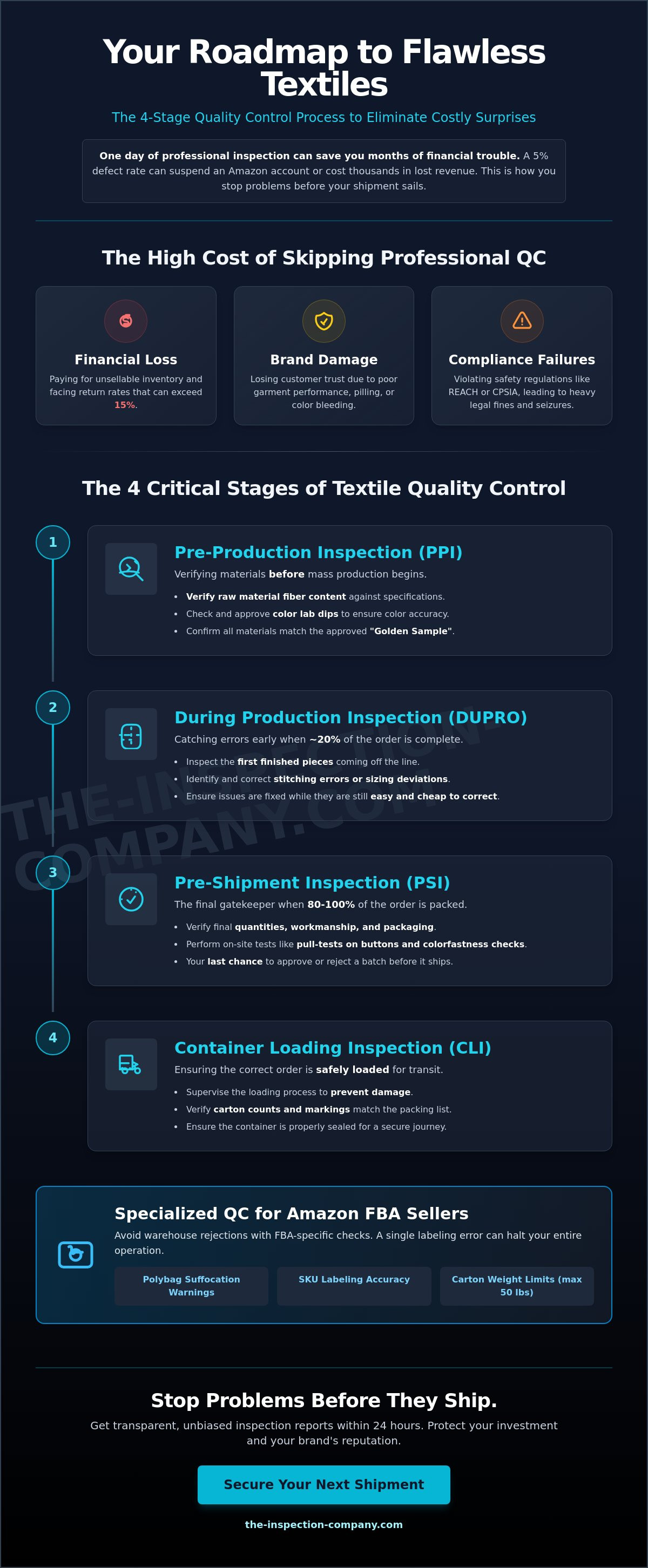
Success in global sourcing depends on a rigorous textile quality control process that monitors production from start to finish. One day of inspection can save months of trouble. We break this down into four essential stages to mitigate risk and ensure compliance. Skipping even one stage can lead to 15% or higher defect rates in final shipments.
- Pre-Production Inspection (PPI): We verify raw material fiber content and color lab dips. By referencing AATCC textile standards, we ensure the base materials match your approved gold sample before the machines start.
- During Production Inspection (DUPRO): Our inspectors check the first finished pieces when 20% of the order is complete. This catches stitching errors or sizing deviations while they're still fixable.
- Pre-Shipment Inspection (PSI): This is the final gatekeeper check once 80% to 100% of the order is packed.
- Container Loading Inspection (CLI): We supervise the loading process to ensure the correct quantity is loaded and handled safely for transit.
Pre-Shipment Inspection: Your Last Chance to Stop a Disaster
The Pre-Shipment Inspection is the most common service for textile importers because it's the final opportunity to halt a bad shipment. During a PSI, we verify quantities, workmanship, and perform on-site testing like pull-tests on buttons or colorfastness checks. This textile quality control process provides the hard data you need to approve or reject a batch. You can read our pre-shipment inspection guide to see how we secure your products before they leave the factory floor.
Specialized QC for Amazon FBA Textile Sellers
Amazon FBA sellers face unique challenges. A single labeling error can result in a total warehouse rejection. We verify specific requirements such as polybag suffocation warnings, SKU labeling accuracy, and carton weight limits, which are typically capped at 50 lbs. These specialized checks protect your seller account health and prevent costly return shipping fees. You can explore our full range of quality control services to find the right fit for your Amazon business requirements.
Setting Your Standards: AQL Sampling and Defect Classification
You can't inspect every single garment in a 10,000-unit order without destroying your margins and timeline. The industry relies on the Acceptable Quality Limit (AQL) to manage risk mathematically. This statistical tool defines the maximum number of defects allowed before a shipment is rejected. As a core part of the textile quality control process, AQL ensures you make decisions based on data rather than guesswork.
Reading an AQL table requires matching your total lot size with an inspection level. For a lot of 5,000 pieces under General Inspection Level II, the table dictates a sample size of 200 units. If your threshold for major defects is 2.5, the "Acceptance Point" might be 10. If the inspector finds 11 major defects, the entire lot fails. We categorize these defects into a strict hierarchy:
- Critical: Safety hazards like broken needles or sharp points. These have a zero-tolerance policy (AQL 0).
- Major: Functional failures or obvious visual flaws like holes or massive size deviations. These make the item unsellable.
- Minor: Small aesthetic issues like loose threads or slight shading differences. These don't impact the garment's use.
Premium brands typically demand tighter standards, such as AQL 0/1.5/2.5. Mass-market retailers often accept 0/2.5/4.0 to keep production costs lower. Choosing the right level is a balance between your brand's price point and your tolerance for customer returns.
Common Fabric Defects to Include in Your Checklist
Visual defects like shading, holes, drop stitches, and stains are the most frequent culprits in garment rejection. Performance defects are even more dangerous because they aren't always visible. These include shrinkage beyond a 3% tolerance, poor colorfastness, and seam slippage. Understanding AQL explained helps first-time importers define exactly which defects are deal-breakers before production begins.
On-Site Textile Testing Methods
Our inspectors perform physical tests on the factory floor to verify quality. The "Crocking Test" uses a crockmeter to check for color transfer, ensuring dyes don't rub off on a customer's skin or furniture. We use the "Pull Test" to apply 90N of force to buttons and trims for 10 seconds to prevent choking hazards. Every inspection includes a "Fitting Test" where we measure garments against your approved tech pack to ensure size consistency across the textile quality control process.
Avoid costly surprises before your shipment sails. Book a professional textile inspection today to secure your supply chain.
Implementing a Fail-Safe QC Strategy in 2026
By 2026, the global textile market is projected to reach a valuation of $1.4 trillion. In this high-volume environment, relying on reactive checks at the end of a production line is a recipe for financial loss. You must shift to proactive sourcing from Asia by vetting suppliers long before the first yard of fabric is cut. Use a centralized quality platform to monitor supplier performance trends. If a factory's major defect rate climbs from 1.5% to 4% over a quarter, you can intervene before a total shipment failure occurs.
Speed is the most critical factor in modern logistics. We enforce a strict 24-hour rule: inspection reports must be delivered within one business day of the site visit. This fast reporting is non-negotiable for keeping your production on schedule and avoiding port storage fees. You also need independent oversight. European-managed teams provide a level of transparency that local factory QC staff cannot provide. Local inspectors often face internal pressure to overlook "minor" flaws; our teams answer only to you, ensuring the textile quality control process remains objective and rigorous.
What to Do When an Inspection Fails
A "Failed" result isn't a catastrophe; it's the system working as intended. When defects exceed the Acceptable Quality Limit (AQL), initiate the 'Reject and Re-work' workflow. Demand that the factory repairs or replaces the affected units immediately. It's standard practice to include a 're-inspection clause' in your purchase orders. This clause mandates that the supplier bears the full cost of any follow-up inspections required after a failure. This creates a financial incentive for the factory to maintain high standards from the start.
Securing Your Supply Chain with The Inspection Company
We provide the on-the-ground expertise required to navigate complex manufacturing hubs. With a network of over 700 professional inspectors across Asia and a strict adherence to ISO 9001 standards, we eliminate the risks of remote sourcing. Our European management team ensures that Western quality expectations are met at every stage of the textile quality control process. Don't leave your brand's reputation to chance. Book a textile inspection service today to protect your investment and ensure your goods arrive exactly as specified.
Secure Your Supply Chain for 2026 and Beyond
Mastering the textile quality control process is the most effective way to protect your brand from the inherent risks of international sourcing. By implementing strict AQL sampling and monitoring production across all four critical stages, you eliminate the guesswork that leads to unsellable inventory. It's not just about finding errors; it's about establishing a fail-safe strategy that ensures every shipment meets your exact specifications before it leaves the factory floor. Proactive oversight prevents minor factory oversights from turning into expensive logistical nightmares.
The Inspection Company provides the professional oversight you need to manage these complexities with confidence. We bring over 25 years of experience in Asia and maintain rigorous European management standards with full ISO 9001 certification. Our team acts as your eyes and ears on-site, delivering detailed digital inspection reports within 24 hours so you can make informed decisions in real time. You don't have to navigate the challenges of overseas manufacturing alone. We've spent decades refining our methods to help importers stop problems before they sail.
Avoid costly surprises; book your textile inspection today!
Take full control of your production today and build a more resilient, profitable future for your business.
Frequently Asked Questions
What is the industry standard for textile quality control?
The global industry standard for the textile quality control process is the Acceptable Quality Limit (AQL), specifically the ISO 2859-1 sampling tables. This statistical model defines the maximum number of defects allowed in a batch before the entire shipment is rejected. Most professional importers apply a standard of 0 for critical defects, 2.5 for major defects, and 4.0 for minor defects to avoid costly surprises and ensure product reliability.
How many pieces are checked during a textile inspection?
The number of pieces checked depends on your total order quantity and the chosen AQL inspection level, which is usually Level II. For a shipment of 3,200 garments, an inspector pulls a random sample of 125 pieces to check for defects. This specific sample size provides a 95 percent confidence level that the batch meets your requirements. It's a proven method to identify risks without the time and expense of a 100 percent check.
What are the most common defects found in garment manufacturing?
Common defects include skipped stitches, open seams, shading variations, and broken needles trapped in the fabric. In a 2024 analysis of factory audits, 35 percent of textile failures were attributed to stitching errors or loose threads that compromise garment durability. These faults lead to expensive returns. We identify these issues on-site so you don't receive defective goods that damage your brand's reputation.
Can an inspection company help with fabric lab testing?
Yes, a professional inspection firm coordinates fabric lab testing by pulling representative samples during the textile quality control process. We secure these samples at the factory and deliver them to ISO 17025 accredited laboratories for colorfastness, fiber composition, and REACH compliance testing. This step is vital for meeting the 100 percent safety standards required by international regulations. One day of inspection can save months of trouble.
How much does a third-party textile inspection cost?
Third-party inspection costs are typically billed as a flat man-day rate, which covers one inspector's work for a full day at the manufacturing site. According to industry data from global quality associations, these rates are fixed per man-day and don't fluctuate based on your total order value. This structure provides a transparent, predictable cost for risk mitigation. Investing in a professional report is the last chance to stop problems before your shipment sails.