
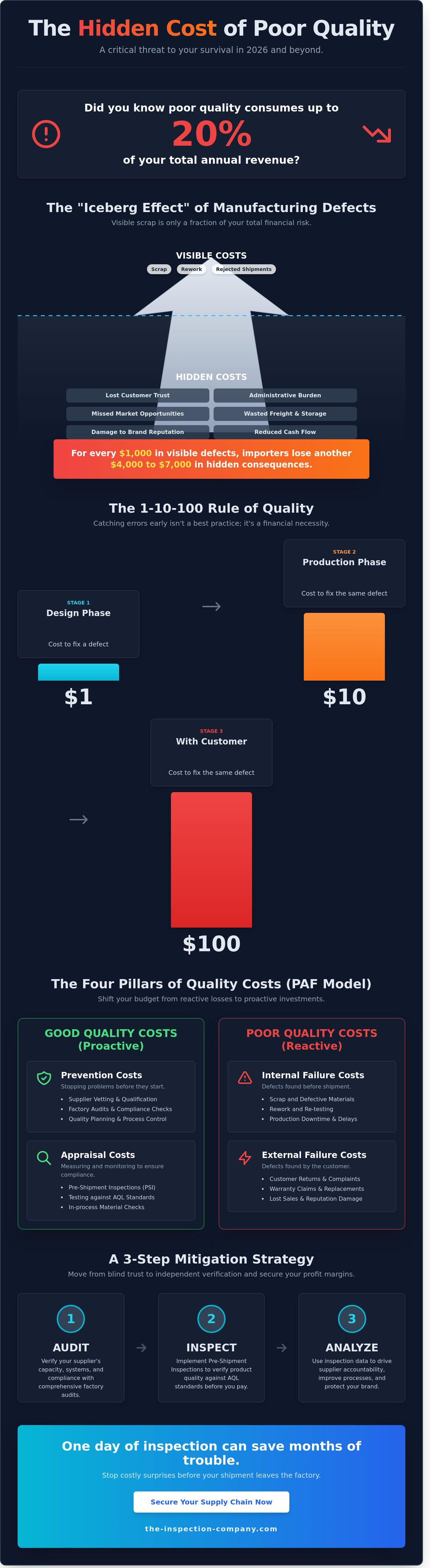
Did you know that for many importers, the hidden cost of poor quality in manufacturing consumes up to 20% of their total annual revenue? If you're currently struggling with high return rates or receiving Amazon account health warnings because your defect rate climbed above 1%, you aren't alone. Most businesses treat these losses as an inevitable part of doing business in Asia, but ignoring them is a direct threat to your survival in 2026.
We understand the frustration of constant firefighting with suppliers in China or Vietnam. It's exhausting to spend your days managing crises instead of growing your brand. This guide provides the exact framework you need to quantify these expenses and implement a strategy that shifts your operations from reactive failure costs to proactive prevention. One day of inspection can save months of trouble. We'll show you how to stop problems before your shipment sails.
You'll learn how to calculate your specific COPQ and establish a system for improved supplier accountability to ensure your brand remains a credible, globally recognized authority. We're moving beyond simple quality control to a comprehensive methodology that protects your profit margins and secures your reputation.
Key Takeaways
- Identify the "Iceberg Effect" of manufacturing defects and learn why visible scrap is only a small fraction of your total financial risk.
- Categorize your expenses using the PAF Model to strategically shift your budget from high-risk external failures to proactive prevention.
- Use our comprehensive formula to calculate the true cost of poor quality in manufacturing, including hidden drains like administrative time and wasted freight.
- Implement a three-step mitigation strategy—Audit, Inspect, and Analyze—to transform supplier behavior and secure your profit margins.
- Discover how moving from blind trust to independent verification stops costly surprises before your shipment leaves the factory.
Table of Contents
-
The Four Pillars of Quality Costs: Categorizing Your Expenses
-
Calculating the True Financial Impact: Beyond Scrap and Rework
-
Strategic Mitigation: How to Reduce COPQ Through Independent Inspections
What is the Cost of Poor Quality (COPQ) in Manufacturing?
The Cost of Poor Quality (COPQ) represents the sum of all expenses that would vanish if every manufacturing process and product were perfect. It isn't just a tally of defective items; it's the total price of operational inefficiency. While the broader Cost of Quality (COQ) includes investments in prevention and appraisal, COPQ focuses strictly on the financial drain caused by failures. In the volatile supply chain environment of 2026, where global freight rates can fluctuate by 15% in a single month, tracking the cost of poor quality in manufacturing has become a vital survival KPI for importers.
The Silent Margin Killer: Why Importers Must Care
COPQ is the difference between your actual profit and the potential profit your business would earn if every unit met 100% of your specifications. Poor quality creates a massive drag on cash flow. When 8% of a shipment arrives with critical defects, your capital stays trapped in unsellable inventory while storage fees and return logistics continue to drain your accounts. You aren't just losing the product; you're losing the liquidity needed to fund your next production cycle.
The Evolution of Quality Standards in 2026
Consumer expectations and stricter product compliance regulations have reached a tipping point in 2026. Regulatory bodies now demand higher levels of transparency and safety than ever before. While ISO 9001 remains the foundational benchmark for quality management, modern importers must go further. Relying on a supplier's word is a high-risk strategy. Professional, independent oversight is the only way to ensure that the cost of poor quality in manufacturing doesn't erode your competitive edge in an increasingly crowded market.
The Four Pillars of Quality Costs: Categorizing Your Expenses
Understanding the financial impact of production errors requires a look at the four main categories of quality costs. This model, often called the PAF (Prevention, Appraisal, and Failure) model, separates proactive investments from reactive losses. While many importers view quality control as an added expense, it's actually a protective barrier against the escalating cost of poor quality in manufacturing, which can consume up to 20% of a company's total revenue according to 2024 industry benchmarks.
Good Quality Costs: Prevention and Appraisal
These are proactive investments designed to ensure products meet your specifications before they leave the factory floor. They include:
- Prevention: This involves front-end work like supplier vetting and factory audits to verify a manufacturer's capacity and compliance. It's about stopping problems before they start.
Poor Quality Costs: Internal vs. External Failures
When prevention and appraisal are ignored, you're left with the true cost of poor quality in manufacturing. These are divided into two destructive categories:
-
Internal Failure: These costs occur before the shipment leaves Asia. They include scrap, rework, and the labor required for re-testing. While painful, these are manageable because the goods haven't shipped yet.
-
External Failure: These are catastrophic. They include customer returns, warranty claims, and legal liabilities. For e-commerce brands, the ultimate external failure is the risk of an Amazon Account Suspension due to high defect rates. This can end a business overnight.
Calculating the True Financial Impact: Beyond Scrap and Rework
Approximately 65% of importers only see the surface level of the cost of poor quality in manufacturing. To find the real number, you must use a comprehensive formula: Total COPQ = (Scrap + Rework) + (Logistics + Duties) + (Administrative Time) + (Lost Sales). Before you can run these numbers, understanding product defects is the essential first step. You can't accurately price what you haven't identified.
Administrative time is a silent profit killer. If a manager spends 10 hours coordinating a return or arguing with a supplier, that's $600 to $1,200 in lost productivity based on average executive salaries. Add freight costs for returns and non-refundable customs duties on defective goods; a $5,000 production error quickly doubles in cost.
Many brands view a $300 Pre-Shipment Inspection (PSI) as an added expense. It's actually a high-yield investment. If a PSI identifies a 15% defect rate in a $20,000 order before it leaves the factory, it saves $3,000 in direct product loss. That represents a 1,000% return on investment. It stops the problem before your shipment sails.
The Amazon FBA Factor: A Special Case for COPQ
For Amazon sellers, poor quality is often fatal. FBA centers reject entire pallets for minor labeling errors or damaged packaging. Removal orders cost between $0.52 and $1.97 per unit for standard items. Beyond these fees, one bad batch of reviews can drop a product's Best Seller Rank (BSR) from the top 100 to the thousands in 48 hours. Recovery is expensive and frequently impossible.
Brand Reputation and Opportunity Cost
Stop costly surprises and book a professional inspection today.
Strategic Mitigation: How to Reduce COPQ Through Independent Inspections
Reducing the cost of poor quality in manufacturing requires a shift from reactive fire-fighting to proactive management. Importers can't rely on hope when dealing with overseas production. You need a structured three-step path to regain control: Audit, Inspect, and Analyze. This framework moves your operations from a position of "Trust" to one of "Verification."
In Asian manufacturing hubs, supplier behavior changes the moment they realize an independent third party is watching. Verification is the only way to ensure your specifications are met. To manage this effectively, the Quality Platform serves as a critical tool for data-driven decision making. It transforms raw inspection data into actionable insights, allowing you to track defect trends across your entire supply chain. One day of inspection can save months of trouble.
-
Audit: Evaluate factory capabilities before you sign a contract.
-
Inspect: Catch defects at the source before they reach your warehouse.
-
Analyze: Use historical data to identify which suppliers are draining your profits.
Shifting the Cost Curve: From Failure to Prevention
A professional China inspection service acts as an essential insurance policy for your business. It's significantly cheaper to identify a defect in a Shenzhen factory than to process a 15% return rate in Europe or North America. By 2026, data-driven importers will use inspection reports to negotiate better terms. If a supplier's defect rate exceeds a 2.5% AQL limit, you have the objective evidence needed to demand rework or price adjustments before the final payment is released. This strategy stops the cost of poor quality in manufacturing from eroding your margins.
The Role of European Management in Asian Quality Control
Western quality standards often get lost in translation during high-volume production runs. The Inspection Company's independent oversight is critical because it applies European management principles directly on the factory floor. Our teams provide 24-hour reporting, giving you the transparency needed to make immediate "go/no-go" decisions. This speed prevents shipping delays that could cost thousands in expedited freight or lost retail windows. We stop problems before your shipment sails.
Stop letting poor quality drain your resources. Secure your next shipment and protect your brand reputation by implementing a rigorous verification strategy today.
Securing Your Supply Chain Against Quality Risks
Managing the cost of poor quality in manufacturing requires more than just reacting to defects. It's about identifying the four pillars of quality costs and addressing hidden financial leaks before they reach your customers. By 2026, the global marketplace won't forgive avoidable errors that damage brand reputation. One day of inspection can save months of trouble. The Inspection Company provides the oversight you need to maintain control over your Asian supply chain. With European management and over 25 years of experience in the region, we ensure your products meet international standards. Our team of 700+ inspectors across Asia delivers detailed reports within 24 hours. As an ISO 9001 certified firm and Sedex member, we prioritize transparency and reliability in every audit. Stop guessing about your product quality and start making data-driven decisions.
Avoid costly surprises, book your professional inspection today
Frequently Asked Questions
What is a typical percentage for Cost of Poor Quality in manufacturing?
A typical cost of poor quality in manufacturing ranges from 15% to 40% of total sales revenue according to data from the American Society for Quality. These hidden expenses include scrap, rework, and warranty claims that drain your profit margins. For importers without a robust quality control process, this figure frequently hits the 25% mark. International logistics and communication barriers only make these errors more expensive.
How do I calculate the ROI of a third-party inspection?
You calculate the ROI of a third-party inspection by dividing the total value of potential losses prevented by the cost of the service itself. If an inspection identifies a 10% defect rate in a $50,000 order, you've prevented $5,000 in unsellable stock from leaving the factory. One day of inspection can save months of trouble by protecting your brand reputation from hundreds of faulty units reaching customers before they ship.
Can a factory audit really reduce my long-term COPQ?
A factory audit reduces your long-term cost of poor quality in manufacturing by identifying systemic failures in a supplier's management system before production begins. By verifying that a factory has the correct machinery and trained staff, you can lower the baseline defect rate by up to 30% over a 12 month period. It's a proactive investment. This stops problems at the source rather than just catching them at the end.
What happens if my shipment has a high rate of defects but is already at sea?
You must arrange for a sorting and rework team at the destination port or file an insurance claim if the damage occurred during transit. Sorting 1,000 units manually in a local warehouse often costs five times more than catching the error at the factory. You should always aim to avoid costly surprises before shipment, as sub-standard goods at sea usually force a choice between a total loss or a 40% price reduction.
Is COPQ different for Amazon FBA sellers compared to traditional retailers?
The cost is often higher for Amazon FBA sellers because a 1% increase in return rates can trigger account suspension or a negative badge on your listing. Traditional retailers might absorb a 3% defect rate through in-store clearance, but Amazon's algorithm penalizes poor quality with lower search rankings immediately. FBA sellers also face additional per-unit disposal fees and return shipping costs that traditional stores don't have to pay.