

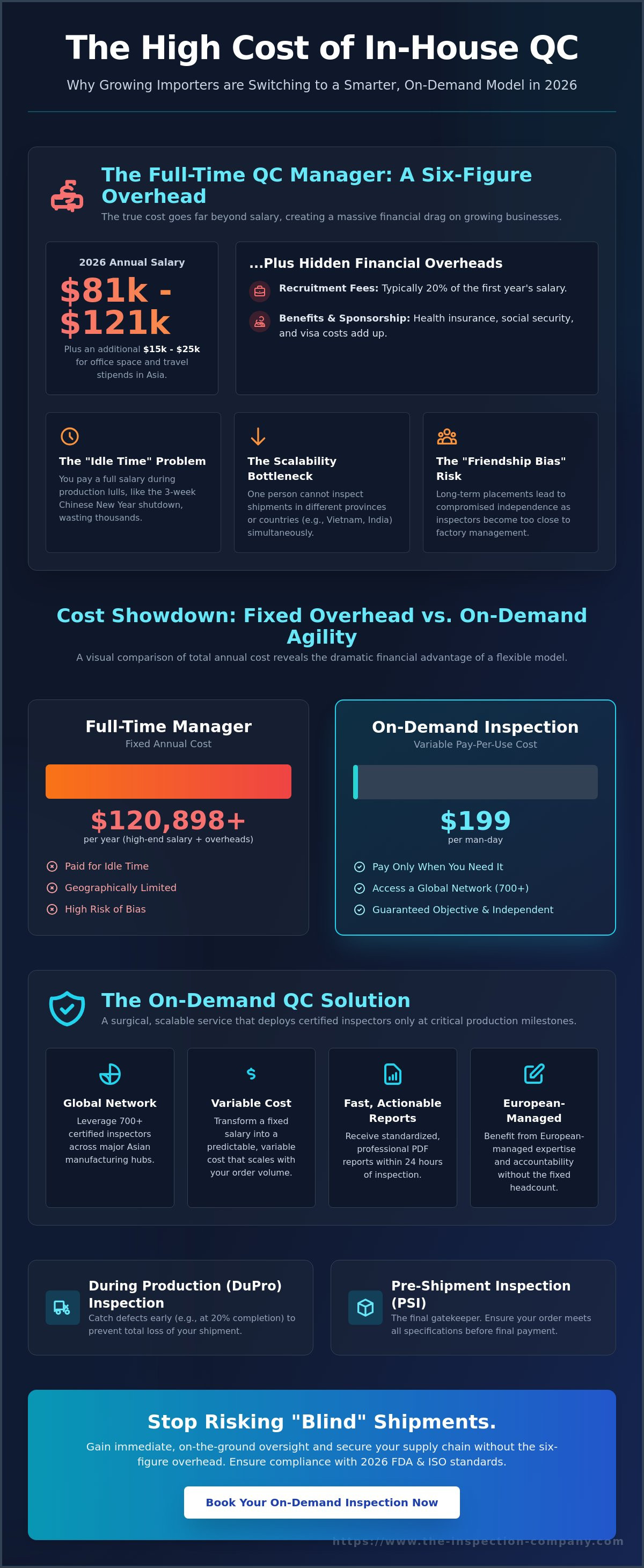
Hiring a full-time Quality Control Manager in 2026 costs between $81,324 and $120,898 annually. This is a massive overhead that often prices growing importers out of the market entirely. When you can't afford a full-time QC manager, it's natural to feel anxious about "blind" shipments and the high defect rates that eat into your margins. You shouldn't have to risk your reputation just because you lack the budget for a six-figure headcount or a $300,000 automated inspection system.
We understand that you need technical expertise to vet factories and stop problems before your shipment sails. You're likely looking for a way to secure your supply chain without committing to a permanent salary. This article reveals how to maintain professional quality standards and mitigate supply chain risks without the overhead of a full-time hire. We'll preview a scalable strategy that uses on-demand inspections, costing as little as $199 per man-day, to ensure your business remains compliant with the latest 2026 regulations like the FDA's QMSR and updated ISO standards.
Key Takeaways
- Identify the hidden financial risks of a full-time hire, including the "idle time" problem where you pay for a salary during production lulls.
- Discover how to maintain professional quality standards through on-demand services when you can't afford a full-time QC manager.
- Implement a 4-step strategy to standardize your requirements using AQL levels and enforceable "No Inspection, No Payment" purchase order clauses.
- Access a scalable network of 700+ certified inspectors to provide immediate, on-the-ground oversight across major Asian manufacturing hubs.
- Mitigate supply chain risks and avoid costly surprises by leveraging European-managed expertise without the burden of fixed headcount overhead.
The Hidden Costs of Hiring a Full-Time QC Manager
Hiring a dedicated expert is a significant financial commitment that many growing businesses find unsustainable. While the average salary for a manager in 2026 ranges from $81,324 to $120,898, the total cost of ownership is much higher. You must account for recruitment fees, which typically cost 20% of the first year's salary, alongside health benefits, social security, and visa sponsorship for expatriate staff. If your production happens in Asia, providing local office space and travel stipends adds another $15,000 to $25,000 to your annual budget. These fixed expenses remain even when production slows down.
- The "Idle Time" Problem: Production cycles are rarely constant. You pay a full-time salary during factory lulls, such as the three week Chinese New Year shutdown or between seasonal collections.
- Scalability Limits: One person cannot physically inspect shipments in different provinces on the same day. As you diversify your supplier base across Vietnam, India, or China, a single hire becomes a bottleneck.
- Localized Bias: Long term placements often lead to "friendship bias." A single hire stationed at one facility for months may become too close to factory management, compromising their independence to avoid personal conflict.
Salary vs. On-Demand ROI
Effective Quality control (QC) isn't about having a body in a chair; it's about objective results. When you can't afford a full-time QC manager, switching to an on-demand model provides immediate financial relief. Instead of a fixed $10,000 monthly overhead, you pay only for the specific days you need. Comparing this to the cost of professional Pre-Shipment Inspections shows a clear advantage. One day of inspection can save months of trouble by stopping defects before they leave the dock, ensuring your capital isn't tied up in unsellable inventory.
The Hidden Risk of Factory Self-QC
Relying on a supplier's internal team is a fundamental conflict of interest. Their priority is meeting shipping deadlines and minimizing waste, which often leads to "relaxed" standards. Trusting a long term relationship without independent verification is a psychological trap that costs businesses millions in returns. You need an objective party to ensure compliance with 2026 standards, like the updated ISO 9001 guidelines, to avoid costly recalls and maintain your brand's reputation for reliability.
What is On-Demand Quality Control?
On-demand quality control is a surgical service model that allows you to deploy certified inspectors only at critical production milestones. Instead of maintaining an expensive, stationary office, you leverage a network of professionals across major Asian manufacturing hubs. This model transforms quality management from a fixed salary burden into a variable cost that aligns perfectly with your order volume. By using this strategy, your Cost of Quality (COQ) becomes a manageable investment rather than an unpredictable financial loss.
When you can't afford a full-time QC manager, this approach provides the same level of technical oversight without the logistical headaches. The global third-party inspection service market is valued at $1.293 billion in 2026, reflecting a massive shift toward this agile model. You receive a standardized, professional PDF report within 24 hours of the inspection. These reports include high-resolution photos, on-site testing data, and a clear pass or fail result, giving you the control to stop shipments before they leave the dock.
The Third-Party Agency Advantage
Many importers consider hiring local freelancers, but this often lacks accountability and transparency. An ISO 9001 certified agency provides a layer of security that a "local guy" found on a job board cannot match. You get access to specialized expertise on demand. Whether you're producing complex medical devices or simple textiles, you can request an inspector with specific technical training for that category. If you need a more tailored approach to your supply chain, you can speak with our experts today.
Key Services for Small Teams
For businesses operating with lean teams, two specific services are essential for risk mitigation. The Pre-Shipment Inspection (PSI) acts as the final gatekeeper, ensuring your order meets every specification before you release the final payment. Meanwhile, a During Production (DuPro) inspection is vital for catching product defects early in the cycle. Catching an error when only 20% of the batch is finished prevents the total loss of your shipment and protects your margins.
A 4-Step Strategy to Manage Quality Without a Manager
Managing a supply chain remotely requires a methodical process that replaces physical presence with data. Even when you can't afford a full-time QC manager, you can achieve professional results by following these Quality control tips for small businesses. This framework shifts the responsibility of quality from a single person's eyes to a verifiable, repeatable system that scales as you grow.
- Step 1: Standardize requirements. Create a detailed defect list and select an appropriate AQL level to ensure the factory understands your expectations from day one.
- Step 2: Enforce accountability. Include a "No Inspection, No Payment" clause in every purchase order. This ensures the factory knows that the balance payment depends on a passed report.
- Step 3: Centralize your data. Use a digital quality platform to track supplier performance and identify which factories consistently produce defects over time.
- Step 4: Conduct random factory audits. Verifying a facility's technical capacity and ethical compliance once or twice a year prevents long-term supply chain disruptions and ensures they meet 2026 compliance standards.
Setting the Standard (AQL)
Choosing the right tolerances is vital for your bottom line. Critical defects, such as safety hazards, usually have a 0% tolerance because they risk total shipment rejection. Major defects, which affect product functionality, often sit at 2.5%, while Minor defects like small scratches might be acceptable at 4.0%. Acceptable Quality Limit (AQL) is the industry-standard statistical tool for quality sampling.
The Power of the Inspection Report
A failed inspection report is your strongest negotiation tool. Instead of discovering issues after the container arrives, you can use the data to demand re-work or negotiate discounts while the goods are still in the factory. Reviewing high-resolution photos and on-site test results allows you to make objective "Ship/No-Ship" decisions without guessing. If you're ready to secure your next order and stop problems before your shipment sails, contact our team to book your inspection.
Why The Inspection Company is Your Scalable QC Department
When you can't afford a full-time QC manager, you need a partner that functions as an extension of your team without the fixed financial burden. The Inspection Company bridges this gap by combining European management standards with a deep, on-the-ground presence across Asia. This hybrid model ensures that Western quality expectations are never lost in translation, providing the authoritative oversight your supply chain requires.
We maintain a network of over 700 professional inspectors ready to deploy to any facility within 48 hours. This infrastructure solves the geographic limitations discussed earlier; our team can be in multiple provinces simultaneously to verify your shipments. We also offer specialized Amazon FBA services to ensure your products meet strict labeling and packaging requirements, preventing costly rejections at fulfillment centers. Our transparent, per man-day pricing makes professional oversight accessible to businesses of all sizes, turning quality management into a predictable investment.
25+ Years of Risk Mitigation
With over 25 years of experience, we've helped thousands of importers avoid costly surprises before their shipments sail. Our comprehensive TIC services cover the entire production lifecycle, from initial factory audits to final container loading. We stop problems at the source, ensuring your capital remains protected and your brand reputation stays intact. One day of inspection truly can save months of trouble.
Fast, Reliable Reporting
Speed is essential in international trade. You'll receive a detailed inspection report within 24 hours of the site visit, allowing you to make "Ship/No-Ship" decisions without delaying your lead times. Our integrated supplier management platform simplifies oversight for small teams by centralizing all your data in one secure location. This digital transparency builds the trust necessary to scale your operations safely in 2026, regardless of your internal headcount.
Secure Your Supply Chain for 2026
Transitioning from a fixed overhead to a scalable inspection model is the most effective way to protect your margins in a volatile market. When you can't afford a full-time QC manager, you don't have to settle for "blind" shipments or unreliable factory self-inspections. By standardizing your AQL requirements and utilizing independent third-party oversight, you gain the technical expertise needed to stop problems before they leave the dock. This systemic approach ensures that your production remains compliant with 2026 standards without the financial strain of a permanent headcount.
The Inspection Company provides a professional bridge between your office and your Asian suppliers. Backed by 25+ years of experience and European management, our ISO 9001 certified team delivers reliable results across a network of 700+ inspectors. You can maintain high quality standards and mitigate risks through every production milestone. Scale your quality control without the overhead; book your first inspection today. We're here to help you build a resilient, defect-free supply chain that grows naturally alongside your business.
Frequently Asked Questions
Is it cheaper to hire a local freelancer for QC?
Hiring a freelancer often costs more in the long run due to a lack of accountability and standardized tools. While their daily rate might seem lower, they lack the ISO 9001 certifications and professional insurance that established agencies provide. This lack of oversight typically results in a 15% to 20% higher risk of missed defects compared to using a managed inspection network.
How much does a third-party inspection typically cost compared to a salary?
A third-party inspection is significantly more cost-effective, with 2026 industry rates in Asia ranging from $130 to $320 per man-day. This is a small fraction of the $120,898 average annual salary for a full-time manager. When you can't afford a full-time QC manager, on-demand services eliminate fixed overhead and ensure you only pay for active production milestones.
Can I rely on my factory's internal QC reports?
Relying on internal reports is a fundamental conflict of interest that often hides production errors. Factory staff are pressured to meet shipping deadlines, which frequently leads them to overlook defects to avoid delays. Independent verification is the only reliable way to ensure 100% compliance with your quality standards and the latest 2026 regulatory updates.
What happens if an inspection report shows a 'Fail'?
A failed report gives you the necessary leverage to demand corrective action before you release the balance payment. You should immediately review the defect photos with your supplier to schedule a re-work or negotiate a discount for the affected units. This process stops problems before your shipment sails, preventing the arrival of unsellable inventory at your warehouse.
Do I need a QC manager if I only order small quantities?
You don't need a full-time hire for small orders, but professional oversight remains essential to protect your profit margins. Even a small shipment of 500 units can suffer from high defect rates that eat into your capital. On-demand inspections are the ideal solution when you can't afford a full-time QC manager, providing expert technical vetting for a single day.