What if a stronger factory relationship came not from avoiding difficult conversations, but from having them earlier and with better evidence? Building a long-term relationship with your factory doesn’t mean accepting missed requirements to keep the peace. It means making expectations clear, sharing changes promptly, and addressing quality concerns before they become costly disputes.
Consistent production and a cooperative partnership are reasonable goals, but specifications can be interpreted differently between orders, and defects may surface late. Smaller buyers may also worry that their concerns won’t receive attention. A practical working relationship gives both sides clear points of reference and a professional way to resolve problems. This guide explains how to document product and production expectations, set a reliable communication rhythm, and raise quality issues with specific, evidence-based feedback. It also covers how inspections and factory audits can provide useful information for supplier discussions, helping you strengthen collaboration without compromising product requirements.
Key Takeaways
- Building a long-term relationship with your factory starts with shared responsibilities and clear records, not repeat orders alone.
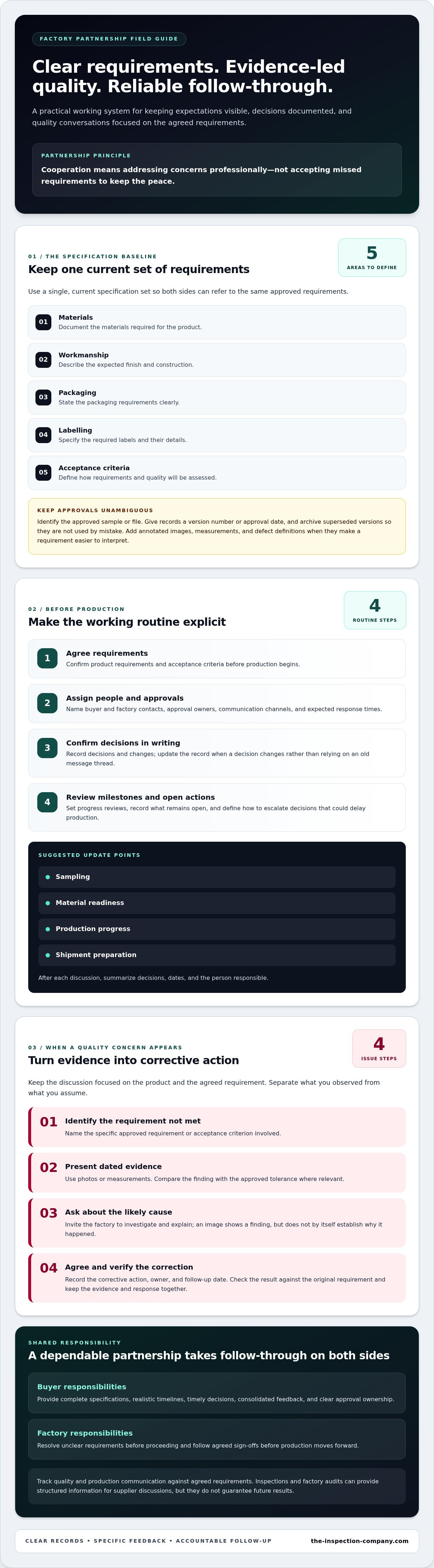
- Keep one current specification set for materials, workmanship, packaging, labelling, and acceptance criteria.
- When a quality issue appears, document the finding, ask about its cause, and agree on corrective action and follow-up.
- Review quality, communication, open actions, and product changes regularly to recognise progress and address recurring gaps.
Why a Long-Term Relationship with Your Factory Needs More Than Repeat Orders
Repeat orders create familiarity, but familiarity alone doesn’t make production dependable. Building a long-term relationship with your factory means establishing professional cooperation over time, with clear responsibilities, documented decisions, and a shared understanding of product requirements. Continuity can help both sides retain product knowledge, refer to approved specifications, and follow established communication routines instead of reopening the same questions with every order.
A supplier relationship processes orders; a dependable manufacturing partnership turns agreed expectations, clear communication, and accountable follow-up into a consistent way of working. That partnership supports cooperation, but it can’t guarantee factory capacity, quality results, or commercial terms. Review performance against the requirements both sides actually agreed to.
What both sides need from a manufacturing partnership
Buyers need to provide complete specifications, realistic timelines, and timely decisions. Factories need consolidated feedback, clear approval ownership, and predictable sign-offs before production moves forward. Supply chain management includes coordinating these responsibilities, as outlined in this Supply Chain Management Overview. A buyer who sends conflicting comments from several departments can create avoidable rework. A factory that proceeds without resolving an unclear requirement creates a different risk. Recognising both sides’ responsibilities improves coordination without excusing unmet specifications.
Why repeat orders alone do not build trust
Recurring orders can still create friction if requirements change without a clear record, approvals come from different people, or no one confirms which specification is current. Agreeing on a routine helps, but trust depends on whether both sides follow through. Track quality and production communication against agreed requirements, and discuss gaps directly rather than treating order history as proof of performance. A factory audit can provide structured information about a factory’s capabilities, but it is one input to supplier decisions, not a promise of future results.
Set Clear Expectations and Communication Routines with Your Factory
Before production begins, turn the agreement into a working process. Building a long-term relationship with your factory is easier when both sides know which requirements apply, who can approve changes, and how decisions will be recorded. The ASCM Guide to Building Strong Supplier Relationships also highlights the value of collaboration and clear information-sharing.
Written, version-controlled requirements reduce ambiguity during repeat production. Keep one current specification set covering materials, workmanship, packaging, labelling, and acceptance criteria. Add approved samples, annotated images, measurements, and defect definitions when they make a requirement easier to interpret. Make clear which sample or file is approved, and archive superseded versions so they aren’t used by mistake.
Agree a communication rhythm before production starts
Name the buyer and factory contacts, agree on communication channels and expected response times, and define how to escalate decisions that could delay production. Set update points for milestones such as sampling, material readiness, production progress, and shipment preparation. After each discussion, send a factual summary recording decisions, dates, and the person responsible. If a decision changes, update the record rather than relying on an old message thread.
A practical sequence keeps expectations visible:
- Agree product and acceptance requirements.
- Assign contacts and approval owners on both sides.
- Confirm decisions and changes in writing.
- Review progress at agreed milestones and record open actions.
Make specifications and approvals easy to follow
Give every specification and approval record a version number or approval date, and identify which file replaces an earlier one. Consolidate comments into specific observations, requested actions, an owner, and a response date. For example, identify the affected measurement and required tolerance instead of writing “check the size.” Early production review can help surface differences before they carry through a run. A During Production Inspection can provide structured information about production quality against agreed requirements.
Handle Quality Problems with Evidence, Respect, and Consistent Follow-Up
A quality concern is easier to resolve when the discussion stays focused on the product and the agreed requirement. Building a long-term relationship with your factory doesn’t mean avoiding difficult feedback. It means raising issues calmly, asking about the cause, and tracking whether the agreed correction works.
Use a clear sequence: identify the requirement that wasn’t met, present dated photos or measurements, ask the factory to explain the likely cause, then agree on corrective action, an owner, and a follow-up date. For example, show the measurement against the approved tolerance rather than describing an item as “poorly made.” Keep the evidence and response together so both sides can refer to the same finding.
Discuss defects without turning the conversation personal
Separate what you observed from what you assume. A photo can show a seam out of position; by itself, it can’t establish why it happened or whether anyone ignored instructions. Ask the factory to investigate and propose a correction. Before closing the issue, verify the result against the original requirement and record the outcome. Across orders, track findings, responses, and closure to see whether an issue was isolated or recurring.
Use independent checks to clarify shared expectations
A third-party inspection can provide structured, photo-backed findings for a factual discussion. During Production Inspection can help identify issues while production is underway. AQL sampling provides an agreed basis for acceptance decisions, but it doesn’t mean every unit is checked or guarantee that every unit is defect-free. Keep inspection results separate from conclusions about intent or future performance. If the concern is a factory’s capabilities or quality-management systems, a factory audit can offer additional information, not a guarantee of future results.
Use objective inspection evidence to support a constructive quality discussion. Learn about inspection support for your quality requirements.
Review the Partnership Regularly and Build a Reliable Factory Relationship
A reliable partnership needs periodic review, not just conversations when an order goes wrong. Building a long-term relationship with your factory means recognising progress while checking performance against agreed requirements. Set a recurring review point and consider quality results, production communication, open corrective actions, and changes to product requirements. Record decisions and owners so the discussion leads to follow-through.
Keep the review balanced. Recognise specific improvements, such as clearer updates or a corrective action completed as agreed. Document repeated gaps just as clearly, including what happened, how the factory responded, and what must change next. A factory visit can add useful context about processes and communication, but observations are a starting point for questions, not proof of a quality outcome. Record what you saw and follow up against objective requirements.
- Review quality findings and whether agreed corrections were verified.
- Check how reliably production updates and delivery changes were communicated.
- List unresolved actions, responsible owners, and next review dates.
- Confirm whether product requirements or approvals have changed.
Know when to strengthen, reset, or reconsider the relationship
One setback may be recoverable. Repeated missed commitments, corrective actions left unresolved, or persistent communication breakdowns call for a closer review. Compare documented findings and the factory’s responses over time before deciding whether to reset expectations or reconsider the arrangement. A supplier survey can help gather structured information, while a factory audit can provide insight into supplier capabilities. Neither replaces ongoing communication or guarantees future performance.
Use a practical next step to support better decisions
Match the support to the question: a supplier survey for supplier information, an audit to understand factory systems, or an inspection during production to assess product quality at that stage. The Inspection Company has more than 700 inspectors across Asia and operates in more than 25 countries. Its Quick Report is provided on the inspection day, followed by a detailed photo-backed report within the following 24 hours. This evidence can inform direct discussions, not replace them.
Explore inspection and factory audit support.
Put the Next Order on a Stronger Footing
The next order is an opportunity to test whether your working arrangements hold up under real production conditions. Choose one practical sign of progress, such as earlier escalation of a production change or timely closure of a corrective action. Review the result before carrying the approach into future orders. This keeps the partnership responsive without allowing product requirements to drift.
Building a long-term relationship with your factory is an ongoing business decision, not a promise that every order will run smoothly. Independent inspection evidence can help keep quality discussions grounded in observable findings. The Inspection Company is ISO 9001:2015 certified and an ISO/IEC 17020 Accredited Type A Inspection Body, providing structured inspection and audit support.
Decide what evidence would be useful for your next supplier discussion, then choose a proportionate next step. Explore inspection or factory audit support for your next order. A measured, evidence-led approach can help you strengthen cooperation while protecting the standards your products depend on.
Frequently Asked Questions
Can a small business build a long-term relationship with a factory?
Yes. Building a long-term relationship with your factory depends more on credible, consistent conduct than on being its largest customer. Give the factory requirements it can act on, combine internal comments before sending them, and make decisions when promised. Be realistic about future orders, too. If demand changes, communicate early rather than making commitments you can’t sustain. That consistency helps both sides plan and understand their responsibilities.
How often should I communicate with my factory?
Set communication around the order’s milestones, then adjust the pace to its complexity and risk. A straightforward repeat order may need fewer check-ins than a first production run or an order with changing requirements. Agree who sends updates and how urgent issues are raised. If a material substitution or schedule risk emerges, communicate promptly and capture the decision so the team isn’t relying on scattered messages.
Should I visit a factory to build a stronger relationship?
A visit can improve your understanding of the people and production context behind an order, but it can’t replace documented requirements or ongoing performance review. Prepare questions about how responsibilities are handled and where production information comes from. Take notes on observations rather than treating a brief visit as proof of capability. Afterward, share a concise record of agreed actions and follow up on them.
What should I do if my factory contact changes?
Ask the factory to clarify who will manage the order and which decisions that person can approve. Send a handover that points to the latest approved files, outstanding questions, upcoming milestones, and decisions still awaiting confirmation. Invite the new contact to summarize their understanding of any open issue. This simple check can reveal missing context before it causes delay or conflicting instructions.
Can third-party inspections help preserve a factory relationship?
Yes. Independent inspection findings can give the buyer and factory a shared reference for discussing whether products meet the agreed criteria. Before the inspection, align on the specification and applicable AQL sampling plan. Treat the results as evidence about the sampled products, not a judgement of intent or a guarantee that every unit is defect-free. Direct discussion is still needed to understand causes and agree on next steps.