

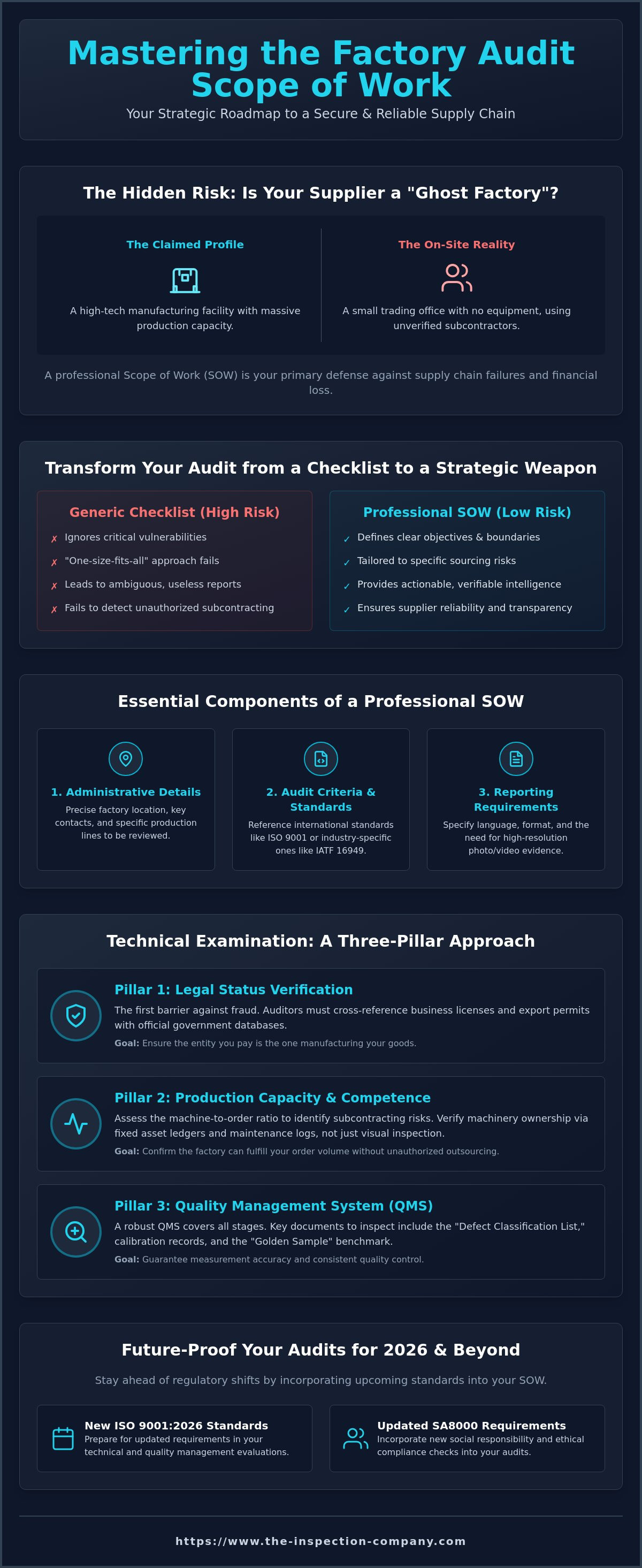
What if the high-tech facility featured in your supplier's profile is actually a small trading office with no manufacturing equipment? This isn't just a worst-case scenario; it's a frequent reality for importers who fail to verify on-site operations. As we enter 2026, the risk of financial loss due to "ghost factories" or sub-par quality management has never been higher. A precise factory audit scope of work is no longer optional; it's a preventative investment that protects your capital from avoidable supply chain failures.
It's understandable to feel anxious about whether your partners can keep up with the new ISO 9001:2026 standards or the updated SA8000 social responsibility requirements. This guide will help you master the essential components of a factory audit scope of work to mitigate these risks and ensure supplier reliability. We'll outline a professional SOW template and provide actionable data to help you negotiate better terms or find alternative suppliers. By the end of this article, you'll have a clear, methodical path to securing your production line against the complexities of modern international trade.
Key Takeaways
- Establish a robust factory audit scope of work to transform a basic checklist into a strategic roadmap that defines clear objectives and supplier boundaries.
- Identify the critical documentation needed to verify legal status and production capacity, ensuring your supplier isn't a trading company in disguise.
- Prepare for 2026 regulatory shifts by incorporating new ISO and SA8000 standards into your technical and social compliance evaluations.
- Master the implementation process, from selecting a qualified 3rd-party inspection company to conducting effective kick-off meetings that align expectations.
Defining the Core: What Must a Factory Audit Scope of Work Include?
A professional factory audit scope of work serves as your primary defense against supply chain volatility. It isn't a mere checklist; it's a contractual roadmap that defines objectives, boundaries, and methodology. Without a specific scope, you risk receiving a generic report that ignores critical vulnerabilities. In complex sourcing environments like China or Vietnam, a "one-size-fits-all" approach often fails. These regions present unique challenges, such as unauthorized subcontracting or "ghost factories" masquerading as legitimate manufacturers. A tailored scope ensures your factory audit captures the reality on the ground.
Drafting this document requires collaboration across departments. Procurement teams focus on vendor reliability, while quality teams prioritize technical standards. Compliance teams ensure the facility meets legal and ethical requirements. Together, they create a comprehensive framework that leaves no room for supplier ambiguity.
Essential Components of a Professional SOW
Your factory audit scope of work must begin with precise administrative details. This includes the exact factory location, primary contact persons, and the specific production lines scheduled for review. The audit criteria should reference international standards, such as a systematic examination of a quality management system (QMS) based on ISO 9001. For automotive or specialized sectors, you might include IATF 16949 requirements. Finally, define your reporting needs. Specify the language, format, and the necessity of high-resolution photo or video evidence to verify findings.
Matching Scope to Sourcing Risks
The depth of your audit should reflect the level of risk involved. New suppliers require an exhaustive deep dive into their legal and financial status. For established partners, you might focus on consistency and long-term stability. Risk-Based Auditing is a method to prioritize high-impact production areas where failure would cause the most damage. By focusing resources on these critical zones, you maximize the value of the inspection. Integrating these scopes into your broader management strategy creates a culture of transparency and continuous improvement.
Technical Examination Areas: From QMS to Production Capacity
Verification of a factory's legal status is the first barrier against fraud. In Asian markets, business licenses and export permits must be cross-referenced with local government databases to ensure the entity you're paying is the one actually manufacturing your goods. This verification is a non-negotiable part of a comprehensive factory audit scope of work. Once legitimacy is established, the focus shifts to whether the facility can fulfill your order volume without resorting to unauthorized subcontracting.
Verifying Production Capacity and Technical Competence
Analyzing the machine-to-order ratio is the most effective way to identify subcontracting risks. If a factory claims to produce 50,000 units monthly but only operates ten injection molding machines, the math doesn't add up. To verify if a factory actually owns the machinery they claim, auditors must inspect fixed asset ledgers and maintenance logs rather than relying on a visual walkthrough alone. Technical expertise is also validated through staff training records and specialized equipment certifications. This ensures the workforce is capable of handling complex production requirements without unexpected errors.
Quality Control Infrastructure
A robust Quality Management System (QMS) must cover every stage, from incoming material inspection to final packaging. Within your factory audit scope of work, ensure there's a requirement to review the factory's internal "Defect Classification List." This document reveals how the factory defines critical, major, and minor defects. Additionally, auditors should assess on-site laboratory facilities and calibration records for testing equipment to guarantee measurement accuracy. The presence of a "Golden Sample" is vital; it serves as the physical benchmark for all quality decisions during production.
Once a factory passes this technical gauntlet, the next logical step is scheduling a pre-shipment inspection to verify the final quality of your specific order. Working with professional social compliance auditors ensures that technical competence isn't overshadowed by ethical lapses. If you need assistance defining these technical parameters for your specific product, you can consult with our regional experts to secure your supply chain.
Beyond the Basics: Customizing Your Scope for Social and Environmental Compliance
Modern supply chains face unprecedented scrutiny from regulators and consumers alike. Environmental, Social, and Governance (ESG) criteria are no longer optional additions; they're central to comprehensive risk management. As of 2026, the significant revision to the SA8000 social responsibility standard expands an organization's responsibility to include all workers in their value chain. This shift makes it critical to expand your factory audit scope of work beyond simple production metrics. Failure to identify ethical lapses can lead to legal penalties and irreparable brand damage.
Social Compliance and Labor Rights
Labor risks remain a primary concern for international importers. Your SOW must mandate a thorough review of local labor law adherence, specifically focusing on minimum wage compliance and maximum working hours. Auditors must physically verify health and safety standards, including the accessibility of fire exits and the proper use of Personal Protective Equipment (PPE). Dormitory conditions should also be inspected to prevent human rights violations. For a deeper understanding of these regional complexities, consult our guide on sourcing from Asia.
Environmental Management Systems (EMS)
Environmental compliance is the next frontier of supply chain vetting. Verifying an ISO 14001 certification on paper is insufficient; auditors must observe actual implementation on the shop floor. This includes checking hazardous material handling and disposal protocols to avoid environmental contamination and costly fines. Modern SOWs now incorporate energy efficiency and carbon footprint tracking to align with the EU Corporate Sustainability Due Diligence Directive (CSDDD). These data points provide the transparency needed to satisfy both stakeholders and regulatory bodies.
Integrating these ethical and environmental checks into your broader social audit strategy ensures long-term supplier stability. If you're unsure how to integrate specific ESG metrics into your current vetting process, you can contact our compliance team for a customized assessment of your supplier network.
Implementing the SOW: How to Ensure Your Audit Delivers Actionable Intelligence
Executing a factory audit scope of work requires more than just a document; it demands a capable partner. Selecting a qualified 3rd-party inspection company ensures that the technical parameters you've defined are verified on the ground. The process begins with a "Kick-off Meeting." During this stage, auditors align expectations with factory management to ensure transparency before the walkthrough. This prevents misunderstandings and sets a professional tone for the entire assessment.
When the final report arrives, you must distinguish between "Major" and "Critical" non-conformities. Critical issues, such as failed safety tests or evidence of "ghost factory" subcontracting, are immediate deal-breakers. Major issues involve significant process failures that require urgent attention but might not halt production immediately. Using this data to drive continuous improvement is the hallmark of a sophisticated procurement strategy. It transforms a simple pass/fail grade into a strategic roadmap for supplier development.
Translating SOW Findings into a Corrective Action Plan (CAP)
A successful audit starts a cycle of improvement. You must identify the root cause of an issue rather than just fixing the symptom. If a machine is miscalibrated, don't just fix the machine; update the maintenance schedule that allowed the error to occur. Set realistic, firm timelines for these improvements to ensure the factory remains accountable. Follow-up audits are essential to verify that the factory has actually implemented the CAP as promised and hasn't reverted to old habits.
Why 3rd-Party Expertise Outperforms Internal Checks
Internal assessments often suffer from a conflict of interest because factories are rarely objective about their own failings. 3rd-party experts provide "boots on the ground" with local language skills across Asian manufacturing hubs. This cultural bridge is vital for uncovering hidden risks that a remote team would miss. In the fast-paced market of 2026, 24-hour reporting is critical. Speed of data allows you to make pivot decisions quickly, preventing costly delays. This proactive approach transforms the factory audit scope of work from a passive document into a dynamic tool for supply chain excellence.
Future-Proofing Your Manufacturing Partnerships
A robust factory audit scope of work is your most effective tool for preventing catastrophic supply chain failures. By moving beyond generic checklists and focusing on technical competence, legal legitimacy, and ESG compliance, you create a transparent environment where quality isn't left to chance. You've learned how to identify "ghost factories" and how to turn audit findings into actionable Corrective Action Plans that drive long-term supplier improvement. These steps transform your vetting process from a simple hurdle into a strategic advantage.
Achieving this level of precision requires a partner with deep regional expertise and uncompromising standards. The Inspection Company provides exactly that. With European management overseeing international standards and a network of over 700 expert inspectors across Asian manufacturing hubs, we deliver the clarity you need. Our detailed reports are delivered within 24 hours, giving you the speed required to make critical procurement decisions in real-time. Don't leave your brand's reputation to luck when you can rely on verified data.
Secure your supply chain with a professional Factory Audit from The Inspection Company today. Taking control of your supplier vetting now will save you from the operational friction of tomorrow. You're ready to build a more resilient and reliable global network.
Frequently Asked Questions
What is the primary difference between a factory audit and a product inspection?
A factory audit evaluates a supplier's systemic capabilities, infrastructure, and management systems to determine if they can reliably produce goods over the long term. In contrast, a product inspection focuses on a specific batch of goods to verify they meet quality standards before shipping. While an audit assesses the facility's overall health, an inspection assesses the physical output. Both are essential components of a proactive risk management strategy to prevent costly shipping errors.
How long does it typically take to complete a factory audit based on a standard SOW?
A standard factory audit typically requires one to two man-days on-site, depending on the facility's size and complexity. This timeframe allows auditors to conduct a thorough walkthrough, interview staff, and review critical documentation like business licenses and maintenance logs. Larger facilities with multiple production lines or complex social compliance requirements may necessitate additional time to ensure every element of the scope is verified accurately and without bias.
Can I customize the factory audit scope of work for specific industries like textiles or electronics?
Yes, you can and should customize your factory audit scope of work to address industry-specific risks. For electronics, the scope might prioritize ESD controls and specialized testing equipment calibration. For textiles, the focus often shifts to chemical management and social compliance standards. Tailoring the SOW ensures that the most critical vulnerabilities of your specific product category are thoroughly examined during the on-site visit by specialized inspectors.
What are the red flags to look for in a factory audit report?
Key red flags include missing or expired business licenses, inconsistent maintenance logs, and evidence of unauthorized subcontracting. If a factory refuses access to certain production areas or cannot produce staff training records, it often indicates hidden operational risks. A professional report should clearly document these non-conformities with high-resolution photo evidence. Ignoring these warnings often leads to severe financial loss and quality failures once mass production begins.
How often should I re-audit my existing suppliers using an updated SOW?
Importers should generally re-audit existing suppliers annually or whenever there is a significant change in production requirements or management. Using an updated factory audit scope of work ensures the facility remains compliant with evolving standards like ISO 9001:2026. Regular assessments prevent compliance drift and verify that any previously agreed-upon corrective actions are still being followed, maintaining long-term supplier reliability and quality consistency across your entire network.