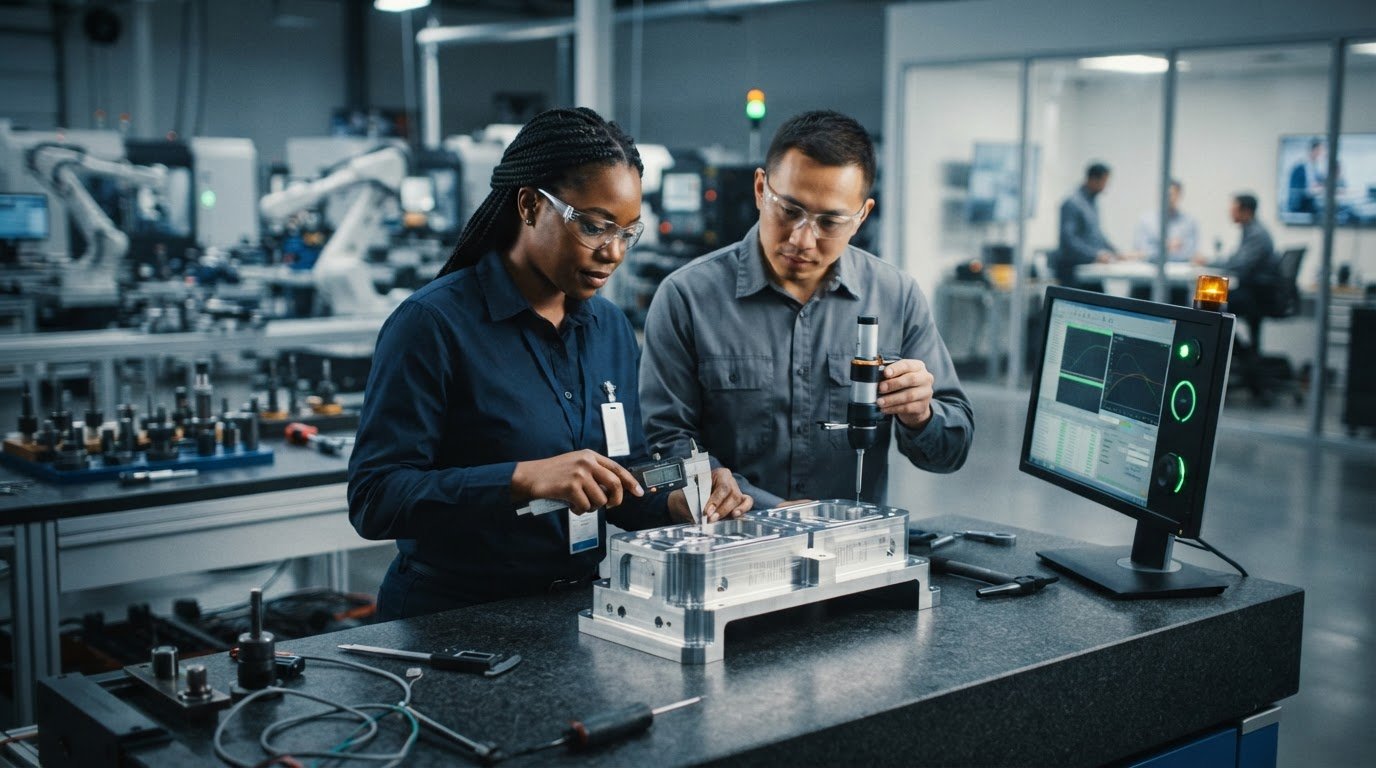

A supplier’s stated production capacity may look convincing on paper, but does the factory floor support that claim? A mismatch can raise the risk of delays, defects, or rework. A factory technical audit helps you check evidence about equipment, production processes, and quality controls before you commit to or continue a supplier relationship. A focused audit starts with the requirements that matter to your product and order.
It helps to be clear about what an audit can establish. A factory assessment examines a supplier’s systems and capabilities at a point in time. It is not the same as inspecting finished products, and it cannot guarantee future performance. This article explains what a factory technical audit can verify, how to set a scope around product and supplier risks, and how to interpret documented findings. You’ll also learn how to distinguish technical capability from product inspection and social compliance, so you can make sourcing decisions based on evidence rather than assurances.
Key Takeaways
- Use a factory technical audit to assess whether a supplier’s production capabilities and operational controls fit your requirements.
- Focus the production-floor review on equipment, processes, and quality systems relevant to your product and expected order volume.
- Prepare by identifying product risks, setting the audit scope, and sharing specifications, volumes, and known concerns.
- Choose an audit scope that answers your sourcing question, then use documented findings to decide on practical follow-up.
What a Factory Technical Audit Reveals About a Supplier
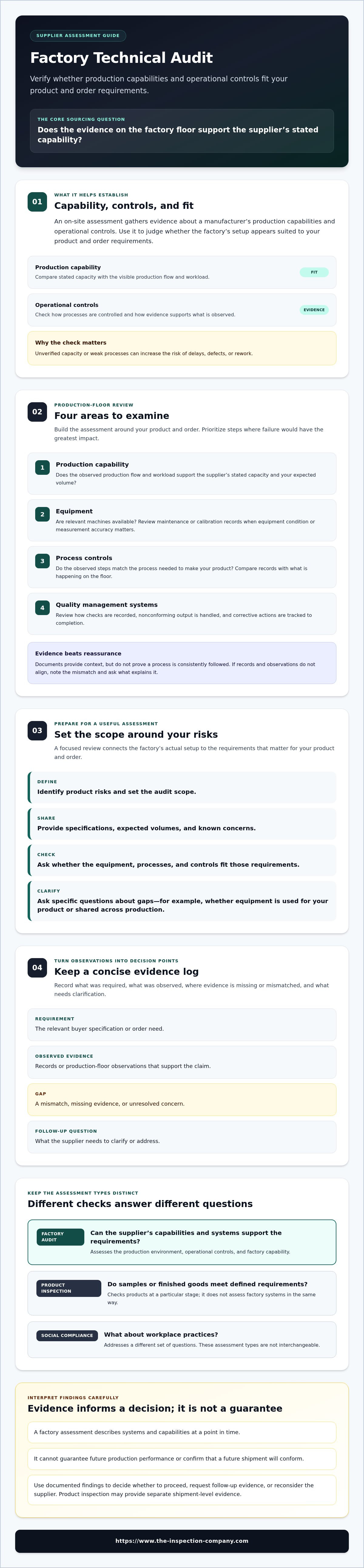
A factory technical audit is an on-site assessment of a manufacturer’s production capabilities and operational controls. It helps importers assess whether the factory’s equipment, processes, and quality management systems appear suited to the product and order requirements. The broader purpose of a technical audit is to assess operations against relevant objectives. In a factory, that means gathering evidence to help you decide whether to place an order or continue working with a supplier. The assessment can inform your decision, but it cannot guarantee future production results.
Keep the scope clear: a technical assessment concerns factory capability, not whether a specific shipment meets your requirements. Social compliance reviews address a different set of questions about workplace practices. These assessments can all contribute to supplier risk management, but they are not interchangeable.
Which supplier risks can a technical factory audit help identify?
Unverified production capacity or weak processes can increase the risk of delays, defects, and rework. For example, a supplier may claim it can handle your expected volume, while the factory’s production setup raises questions about whether it can support that workload. An audit helps you compare those claims with evidence gathered on site. Record the concern, ask the supplier to explain any gaps, and decide whether to proceed, request follow-up evidence, or reconsider the supplier.
Factory audit versus product inspection: what is the difference?
A factory audit examines the supplier’s capabilities and systems. A product inspection checks samples or finished goods against defined requirements at a particular stage. One assesses the production environment; the other assesses the products being inspected. A factory assessment cannot confirm that a future shipment will conform, so importers may need both types of evidence at different points in a purchasing decision.
For shipment-level checks, see the pre-shipment inspection guide. To learn more about The Inspection Company’s factory audit service, review its dedicated page.
What a Factory Technical Audit Should Examine on the Production Floor
Build the assessment around your product and order rather than relying on a generic checklist. A factory technical audit should connect four areas: production capability, process controls, equipment, and quality management systems. For each area, ask whether the factory’s actual setup fits your specifications, required production volume, and any process that could affect product performance. Prioritize the steps where a failure would have the greatest impact on your order.
How to assess production capacity, equipment, and process controls
Compare the supplier’s stated capacity with the production flow and workload visible during the visit. Are the relevant machines available? Do the observed steps match the process needed to make your product? Are there records or other evidence that help explain how the process is controlled? Review maintenance or calibration records when equipment condition or measurement accuracy matters to the process. For measurable processes, the American Society for Quality explains how process capability can indicate whether output meets specification limits.
Documents provide context, but they do not prove that a process is consistently followed. Compare records with what is happening on the floor. If the evidence and observations do not align, note the mismatch and ask what explains it. A specific question, such as whether the equipment shown is used for your product or is shared across production, is more useful than a general request for reassurance.
How to review a factory’s quality management system
Look at how checks are recorded, how nonconforming output is handled, and whether corrective actions are tracked to completion. Consider whether the records relate to the processes and product risks in your scope. A certificate can indicate that a system has been assessed against a standard, but it does not, by itself, show that controls are followed effectively in daily production. Check relevant records against observed practices and clarify any gaps.
Capture findings in a concise evidence log:
- Requirement: The buyer’s relevant specification or order need.
- Observed evidence: The records or production-floor observations that support the claim.
- Gap: Any mismatch, missing evidence, or unresolved concern.
- Follow-up question: What the supplier needs to clarify or address.
This format turns observations into clear decision points. To define an assessment around your supplier risks, review The Inspection Company’s factory audit service.
How to Prepare for a Factory Technical Audit and Evaluate Findings
A focused factory technical audit starts with the decision you need to make. Use this sequence: identify product risks, set the audit scope, review the evidence, and agree on follow-up actions. This keeps the assessment tied to your sourcing needs instead of a generic checklist. Before the audit, decide what evidence would reassure you and what kind of finding would change your decision.
What information should buyers prepare before the audit?
Share the product specifications, expected production volumes, and known supplier concerns before defining the scope. Add the process requirements that matter most and the questions you need the factory to answer. For example, if a particular production step is critical to product performance, identify it so the assessment can focus on the related capability and controls. If your concern is whether the factory can support the order, explain the expected volume and ask for the relevant capacity evidence. For broader context on managing supplier risks in the region, read the Asia sourcing risk guide.
How should buyers respond to audit findings?
Assess each finding by its potential impact on your product and order, rather than against a universal pass threshold. A gap that could prevent the factory from meeting a critical requirement may affect whether you proceed. Missing or unclear evidence may call for clarification. A correctable weakness may require documented corrective action and follow-up evidence. Keep the response proportionate to the risk and record the reason for your decision.
Agree on who will address each issue, what evidence is needed, and when you’ll review it. If an unresolved gap could change your supplier decision, consider whether reassessment is needed before committing. An audit is a snapshot of conditions observed at a point in time, not a guarantee of future output. Use it alongside ongoing quality controls and other relevant checks.
For help defining a scope around your supplier and product risks, contact The Inspection Company.
Choose a Factory Technical Audit Scope That Fits Your Sourcing Decision
Choose the review by asking what decision you need to make and what evidence is missing. A factory technical audit focuses on manufacturing capability and operational controls. A quality-system review examines how checks and corrective actions are managed. A social-compliance review addresses workplace practices. These scopes can complement one another, but they answer different questions. State your priority clearly so the assessment can focus on the risks that matter to your order.
When is a technical audit enough, and when is a broader review useful?
A technical review may be appropriate when your main concern is whether the factory’s production setup can meet your product and order requirements. Add a broader review if unanswered questions involve quality-system practices or social compliance. Match the scope to your product risks and supplier concerns instead of assuming one audit covers everything. For broader supplier oversight, see this supplier management process guide.
Once you’ve defined what needs verification, explore factory audit service details. The Inspection Company conducts on-site factory audits to assess supplier capabilities and quality management systems.
What is the next step after defining your audit scope?
Prepare the supplier’s location, product context, expected order volume, and the concerns you want the assessment to address. These details help clarify which questions belong in scope and what evidence may inform your decision. An audit provides a view of conditions at a point in time, so use its findings as one part of supplier risk management, not as a guarantee of future production.
Discuss your factory audit requirements with The Inspection Company.
Make Your Next Supplier Decision With Stronger Evidence
A factory technical audit can help you test supplier claims against observed production capability, equipment, processes, and quality management controls. The most useful assessment is tailored to your product, order volume, and unresolved concerns, with findings recorded clearly enough to guide follow-up. Treat the results as evidence for a sourcing decision, not as a guarantee of future output.
The Inspection Company conducts on-site factory audits to assess supplier capabilities and quality management systems. Its team includes more than 700 inspectors across key Asian manufacturing hubs, supporting international businesses sourcing from the region.
Before committing to a supplier, define what you need to verify and which findings would change your decision. The Inspection Company’s factory audit service can help assess supplier capabilities and quality management systems on site. Discuss your factory audit requirements to plan the next step.
Frequently Asked Questions
What does a factory technical audit include?
A factory technical audit typically examines whether a manufacturer’s capabilities and operational controls fit your product and order requirements. Depending on the agreed scope, this may include production processes, equipment, capacity, and quality management systems. The review uses on-site observations and relevant evidence to help assess supplier readiness. Social compliance questions are distinct and should be included only when they are part of the intended audit scope.
How is a factory technical audit different from a product inspection?
A factory technical audit assesses the supplier’s capabilities and systems, while a product inspection checks samples or finished goods against specified requirements. An audit can help identify whether a factory appears equipped to handle an order, but it does not establish whether a particular shipment conforms. Buyers may use both assessments at different points: one to evaluate factory readiness and another to check actual products.
When should I arrange a technical audit of a factory?
Arrange an assessment when you need evidence about a supplier’s capabilities before placing an order, or when considering a change or continuation of a supplier relationship. It can also help investigate specific concerns, such as uncertainty about production capacity or quality controls. Share product requirements, expected volumes, and known issues when defining the scope so the review focuses on questions that could affect your sourcing decision.
Can a factory audit guarantee that my products will meet requirements?
No. A factory audit provides evidence about the supplier’s capabilities and controls at the time of the assessment; it cannot guarantee future production performance or shipment conformity. Processes, workloads, and production conditions may change. Treat audit findings as one part of supplier risk management, alongside appropriate product checks and follow-up. This helps you make a better-informed decision without treating a point-in-time review as a promise of future results.
What happens if an audit identifies gaps in a factory’s capabilities?
First, assess each gap against your product requirements and order risks. Ask the supplier to clarify missing or conflicting evidence, and request documented corrective action where a weakness may be addressable. If a critical capability concern remains unresolved, consider whether to delay a commitment, seek further evidence, or arrange reassessment. There is no universal pass threshold; the significance of a finding depends on how it affects your sourcing decision.