

What if a factory that looks capable on paper can’t reliably support your order in practice? Supplier claims are difficult to verify remotely, and finding gaps late can leave little room to change course. A third party factory audit gives you independent evidence about a site’s facilities, production processes, quality management, and relevant compliance controls. It provides a snapshot of capability, not a guarantee that every shipment will meet your specifications.
An audit report is useful only when you can turn its findings into a sourcing decision. Scope matters: a basic supplier verification answers different questions from a deeper review of quality systems or social compliance. This guide explains what an independent audit can and can’t verify, how to separate documented evidence from unanswered questions, and how to assess findings against your order. You’ll also learn what follow-up checks or corrective actions to request before committing, or when an existing supplier relationship needs closer monitoring.
Key Takeaways
- Use a third party factory audit to gather independent evidence about a supplier’s facilities, capabilities, and documented practices before making a sourcing decision.
- Match the audit scope to your order and buyer requirements, then identify which records or controls need closer review.
- Confirm access, evidence requirements, timing, and scope with the audit provider so you know what the assessment can verify.
- Turn report findings into clear next steps by requesting clarification, corrective actions, or additional checks where evidence is incomplete.
What a third-party factory audit can, and cannot, tell you about a supplier
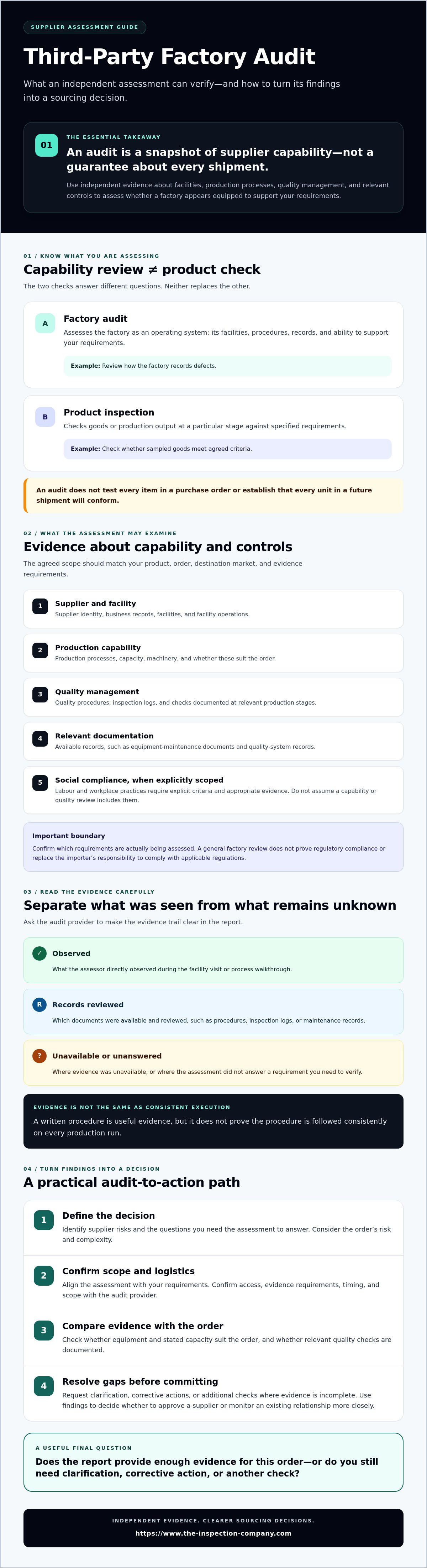
A third-party factory audit is an on-site assessment of a supplier’s facilities, capabilities, management systems, and relevant practices. It gathers independent evidence to help you judge whether a factory appears equipped to meet your requirements. A quality audit examines a system and its controls; it does not test every item in a purchase order.
Quotable definition: A factory audit assesses whether a supplier has the people, facilities, and processes to support an order; product inspection checks goods or production output against specified requirements.
That distinction defines the audit’s limits. A facility may have documented procedures and suitable equipment, but an audit alone cannot establish that every unit in a future shipment will conform. Treat the findings as a snapshot of capability, then use them to identify questions or risks before approving a supplier or continuing to source from one. The factory audit service assesses supplier capabilities, quality management systems, and social compliance.
When should an importer request an independent factory audit?
Consider an audit before approving an unfamiliar manufacturer or expanding an existing supplier relationship. Match the timing and scope to the order’s risk and complexity. A technically demanding product or a supplier with little verified history may call for stronger evidence before you commit. List what you need to confirm, such as relevant equipment, production capacity, or documented controls, and check that those questions are included in the audit scope.
Factory audit versus product inspection: what is the difference?
An audit looks at the factory as an operating system: its facilities, procedures, records, and ability to support your requirements. An inspection checks products or production output at a particular stage. For example, an audit may review how the factory records defects, while an inspection checks whether sampled goods meet agreed criteria. Neither replaces the other. For a broader view of supplier risk, see the supplier management process guide.
What a third-party factory audit examines: capability, controls, and compliance
A third party factory audit can review whether a supplier’s identity, facilities, and operating systems align with your order requirements. Depending on the agreed scope, an assessment may cover business records, facility operations, production capacity, machinery, quality procedures, and relevant documentation. The purpose is to gather evidence about capability and controls, not to assume a factory meets every requirement just because it has written procedures.
How are factory capability and quality systems assessed?
An assessor may observe the facility, walk through production processes, and review available records such as quality procedures, inspection logs, or equipment-maintenance documents. Compare the evidence with your needs: does the equipment and stated capacity suit the order, and are quality checks documented at relevant stages? A written procedure is useful evidence, but it doesn’t prove that the procedure is followed consistently on every production run. Ask the audit provider to distinguish what was observed, which records were reviewed, and where evidence was unavailable.
Set the scope according to the product, order, destination market, and your evidence requirements. An audit can inform a supplier assessment, but it does not replace the importer’s responsibility to comply with U.S. and foreign regulations. Confirm which requirements are being assessed instead of treating a general factory review as proof of regulatory compliance.
When does a social-compliance audit need separate scope?
Labour and workplace practices need explicit criteria and appropriate evidence. Confirm which topics the assessment covers and how findings will be documented. Don’t assume a capability or quality-systems review includes social compliance. If workplace practices are a priority, review the social compliance audit service and clarify the intended scope before the assessment.
How a third-party factory audit works, and why it cannot guarantee every order
A third party factory audit is most useful when you define its purpose and limits before the visit. The process typically moves through six steps:
- Define objectives: Identify the supplier risks and questions you need the assessment to address.
- Confirm scope: Agree which facilities, processes, records, and criteria will be reviewed.
- Coordinate access: Confirm site access, relevant contacts, and the availability of requested evidence.
- Assess: The auditor examines the agreed areas and records observations.
- Document: Findings should distinguish observed conditions from evidence gaps.
- Follow up: Clarify open questions, request corrective actions, or decide whether more verification is needed.
Timing, access, evidence availability, and scope all affect what can be assessed. Confirm these details with the audit provider in advance, and ask which facilities and records will be accessible. Don’t assume every location or document will be available for review.
A single visit cannot guarantee future performance or the quality of every order. Production conditions can change, and an audit captures evidence within its defined scope and timeframe. An audit assesses the factory’s capability; production and shipment checks assess specific output at particular stages. Use both when the order’s risk calls for ongoing verification.
What should buyers prepare before the factory visit?
Share supplier details, product context, purchase expectations, and specific risk questions. Agree in advance which locations, records, processes, and compliance criteria are in scope. This preparation helps focus the assessment on evidence that matters to your decision and reduces the chance that important questions are left unanswered.
What should an importer do with audit findings?
Separate verified observations from missing evidence and points that need clarification. For each relevant finding, request a specific corrective action or decide whether further verification is needed before proceeding. A documented gap isn’t automatically proof of failure, but keep it open until you understand its significance and how it affects your decision.
Need to clarify the questions your assessment should cover? Discuss your factory audit scope.
Choose a third-party factory audit and turn findings into action
A useful third party factory audit depends on more than the site visit. Choose a provider that can assess the supplier independently, cover the factory’s region, work to a clearly defined scope, and deliver findings you can act on. Before appointing a provider, ask:
- Independence: How does the provider keep the assessment objective?
- Regional presence: How are auditor experience and local coverage matched to the factory location?
- Scope: Which sites, processes, records, and criteria are included, and what falls outside the assessment?
- Reporting: What observations and supporting evidence will the report include? How can you clarify a finding?
Confirm the reporting format and expected evidence before the audit, not after receiving a report with gaps. The Inspection Company is based in Hong Kong, has European management, and uses more than 700 inspectors across key Asian manufacturing hubs. Review its factory audit service to understand the assessment offering.
How to connect audit findings with ongoing supplier management
Turn each relevant finding into a next step. Prioritize corrective actions by their potential effect on your order, then request documented evidence when the supplier reports completion. If your remaining concern is whether production output meets requirements, consider a pre-shipment inspection. An audit reviews supplier capability; an inspection checks product output at a specific stage. Together, they address different risks without treating a factory assessment as a shipment guarantee.
Use the report to decide whether the supplier’s evidence is sufficient, corrective action is needed, or further checks should be planned. To define an assessment around your supplier and requirements, discuss your factory audit scope.
Make your next supplier decision with clearer evidence
A third party factory audit helps replace unverified supplier claims with evidence about a facility’s capabilities, systems, and relevant practices. Its value depends on a clearly defined scope and careful review of the findings. Separate verified observations from evidence gaps, then decide whether corrective action or further checks are needed.
Keep the audit in perspective. It assesses the supplier and facility, not every unit in a future order. Pairing its findings with production or shipment checks can help address risks that arise while an order is being made and prepared for dispatch.
The Inspection Company is based in Hong Kong, has European management, and uses more than 700 inspectors across key Asian manufacturing hubs. If you’re assessing a supplier or reviewing an existing relationship, Discuss your factory audit requirements to identify a scope that fits your evidence needs.
Frequently Asked Questions
What is a third-party factory audit?
A third-party factory audit is an independent assessment of a supplier’s facility, capabilities, and selected management practices. Buyers define the scope around their product, order, and sourcing risks. The findings can inform supplier approval or continued sourcing by showing what was observed and documented. An audit is not product certification, and it can’t guarantee that future production will meet every requirement.
What does a third-party factory audit check?
A third-party factory audit may review facility operations, equipment, production capability, quality-management processes, and relevant records. Social-compliance topics can also be assessed when they’re specifically included and measured against defined criteria. The checks depend on the supplier, product, buyer requirements, and agreed scope. Before booking, confirm which areas will be assessed and what evidence the report will document.
Does a factory audit guarantee product quality?
No. A factory audit is a time-bound assessment of a supplier and facility, not a guarantee that every unit in an order will be defect-free. Production conditions and product quality can change after the visit. To check a specific order, importers may use during-production inspection or pre-shipment inspection. These checks complement the audit by examining production progress or finished goods against the buyer’s requirements.
When should I arrange a third-party factory audit?
Consider an audit before approving an unfamiliar supplier, placing a significant order, or relying on a factory whose capabilities haven’t been verified. It may also be useful if supplier risks or your evidence needs change. First decide what sourcing decision the audit should support. Then agree with the provider on scope, site access, timing, and the evidence needed to answer your key questions.
What should I look for in a factory audit report?
Look for a clearly stated scope, documented observations, relevant supporting evidence, and a distinction between verified facts and information that couldn’t be confirmed. Findings should help you identify follow-up questions or actions tied to your supplier decision. Report detail and format depend on the agreed service, so confirm beforehand what the provider will document and how you can clarify findings that are unclear.