
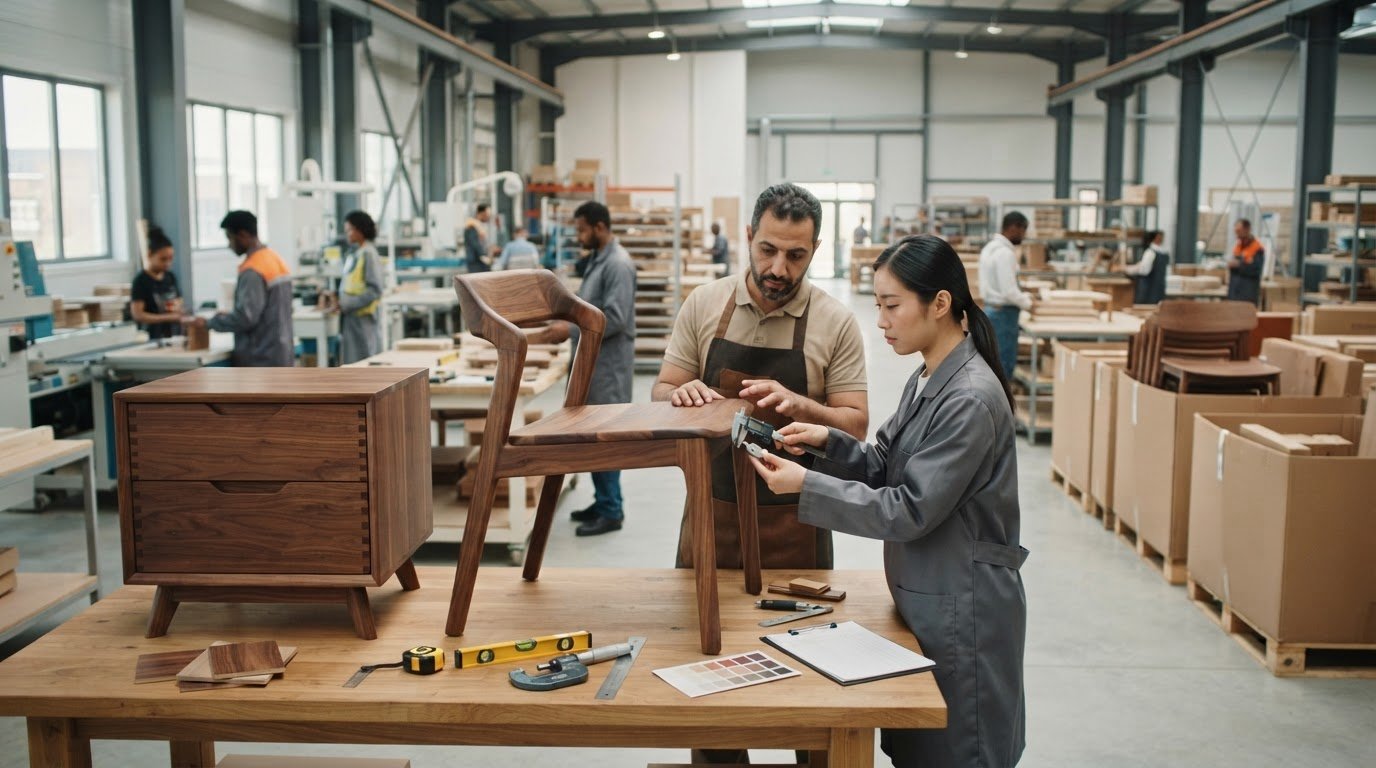
A furniture defect found after assembly is often a production problem discovered too late. That’s why quality control for furniture manufacturing can’t rely on a final check alone: loose joints, uneven finishes, dimensional errors, or unstable components may be harder to correct once production is complete. If inspection criteria are vague, factory teams and inspectors may judge the same item differently.
Effective control starts earlier, with measurable requirements and checks at production stages where faults can still be corrected. This guide explains how to define furniture-specific acceptance criteria, inspect materials and workmanship as production progresses, and assess finished items before shipment.
You’ll learn how to match inspection timing to product risks, document findings with clear evidence, and make an informed decision to release, hold, or rework an order. Inspections at production milestones can verify furniture against agreed specifications and help identify issues before goods leave the factory.
Key Takeaways
- Build quality control for furniture manufacturing around agreed requirements that can be checked consistently at each production stage.
- Use a staged workflow to review materials and samples, monitor production, inspect finished goods, and verify packing.
- Turn drawings, approved samples, and order requirements into checklist criteria for dimensions, workmanship, function, labels, and packing.
- Match pre-production, during-production, and pre-shipment inspections to the product’s risks and the time available to correct problems.
Why quality control for furniture manufacturing must start before shipment
Furniture manufacturing quality control is the ongoing process of checking agreed requirements for materials, production, finished goods, and packing, not a single inspection at the factory gate. This approach reflects broader quality control principles: detect variation early, record findings, and correct issues while production can still be adjusted.
A defect discovered only at the end may mean rework, inconsistent batches, customer complaints, or shipment delays. A visual review can identify surface flaws, but appearance alone can’t confirm dimensions, assembly, stability, or intended function. Check those requirements against approved references using specific criteria.
Which furniture quality risks deserve attention first?
Prioritize risks according to the product’s design, materials, and agreed specifications. A practical review covers:
- Materials: visible damage or moisture-related concerns in components.
- Dimensions and construction: measurements, frame distortion, and whether parts align as specified.
- Workmanship and finish: uneven joints, scratches, or inconsistent coatings.
- Function and hardware: missing fittings or components that don’t work as intended.
- Packaging: whether the specified protection will help prevent damage to finished surfaces.
These are prompts for risk assessment, not universal acceptance rules. Set the criteria for each item using its specifications and approved sample.
Why is a final inspection not the whole quality plan?
A final check can show whether finished goods meet requirements, but it may leave little time to correct a recurring production fault. If the issue affects a batch, the buyer may face a difficult choice between rework and delaying shipment. Earlier checks of materials and production samples can reveal deviations before they spread. A pre-production inspection can verify agreed inputs before full production begins. Later checks assess whether those requirements are being followed consistently. Each stage provides evidence for action, rather than leaving the shipment decision to one late snapshot.
How to control furniture quality at each manufacturing stage
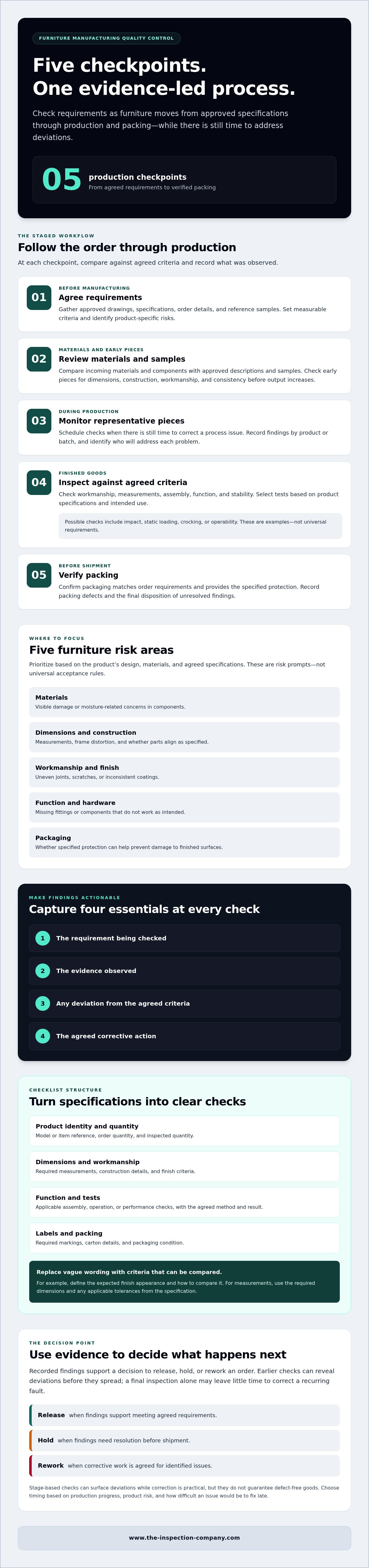
Effective quality control for furniture manufacturing follows the order through production, with checks timed early enough to support corrective action. At each checkpoint, record the requirement, the evidence observed, any deviation, and the agreed corrective action. This makes it easier to track whether an issue has been addressed before the next stage.
- 1. Agree requirements. Gather approved drawings, specifications, order details, and reference samples. Record measurable criteria and identify product-specific risks before manufacturing starts.
- 2. Review materials and samples. Compare incoming materials and components with approved descriptions and samples. Check early production pieces for dimensions, construction, workmanship, and consistency before output increases. A pre-production inspection can verify requirements before full production begins.
- 3. Monitor production. Schedule checks when representative pieces are available and there’s still time to correct a process issue. Record findings by product or batch, and identify who will address each problem.
- 4. Inspect finished goods. Check workmanship, measurements, assembly, function, and stability against agreed criteria. Select tests according to product specifications and intended use. Examples may include impact, static loading, crocking, or operability checks; they aren’t universal requirements.
- 5. Verify packing. Confirm the packaging matches order requirements and provides the specified protection. Record any packing defects and the final disposition of unresolved findings.
The Inspection Company provides during-production inspection to assess goods at a manufacturing milestone, while there’s still an opportunity to address issues before completion. For wood furniture operations, environmental controls are a separate consideration from product acceptance; the EPA overview of wood furniture manufacturing regulations covers air pollutant requirements relevant to certain operations.
Stage-based checks can surface deviations while correction is practical, but they don’t guarantee defect-free goods. Choose inspection timing based on production progress, product risk, and how difficult an issue would be to fix late. Align checks with milestones when findings can still inform corrective action.
How to build a furniture inspection checklist that works
A useful checklist turns order requirements into checks an inspector can apply consistently. Base each criterion on approved drawings, reference samples, specifications, and order details. Replace subjective wording such as “good finish” with a description of the expected appearance and a clear way to compare the item against it. For measurements, include the required dimensions and any applicable tolerances from the specification.
Organize the checklist so findings are easy to locate and act on:
- Product identity and quantity: model or item reference, order quantity, and inspected quantity.
- Dimensions and workmanship: required measurements, construction details, and finish criteria.
- Function and tests: applicable assembly, operation, or performance checks, with the agreed method and result.
- Labels and packing: required markings, carton details, and packaging condition.
For every finding, record the item or sample reference, observed condition, applicable criterion, result, evidence, and corrective-action status. An agreed AQL sampling plan can guide how many units to inspect. Set the sampling context in advance, and don’t treat a sample result as proof that every unit is identical.
How should criteria differ by furniture type?
Tailor checks to the product. For seating, define applicable assembly, stability, and load-performance checks. For case goods, focus on dimensions, alignment, hardware, surface finish, and assembly. For upholstered items, specify fabric appearance, seam quality, color consistency, and any relevant material checks. In each case, the approved specification determines what passes.
How can inspection findings support a shipment decision?
Compare results with documented criteria, then support each finding with clear notes and photos. Classify defects as critical, major, or minor only if the buyer’s agreed quality standard defines those categories. Keep corrective actions and reinspection results attached to the finding, so the shipment decision is based on evidence rather than impression. The Inspection Company’s pre-shipment inspection assesses finished goods against agreed requirements before release.
For consistent quality control for furniture manufacturing, make the checklist specific to the order and clear enough for different inspectors to apply in the same way.
How third-party furniture inspections fit into your quality plan
Independent inspections add an evidence-based check at selected production milestones. The right sequence depends on furniture complexity, order requirements, production risks, and how much time remains to correct problems. One final check may suit some orders; products with more process-sensitive components may benefit from earlier verification too.
When should importers schedule each inspection stage?
Pre-production inspection reviews requirements and samples before bulk manufacturing progresses, helping surface misunderstandings before they affect a larger run. During-production inspection checks representative output while production is underway, so emerging process or consistency issues can be identified while corrective time remains. Pre-shipment inspection assesses finished goods against agreed criteria before dispatch. These stages serve different purposes, so select them according to order risk rather than treating them as interchangeable checks.
What should an inspection report help you decide?
A useful report connects findings to agreed requirements. It should make clear what was inspected, which criteria were applied, what the results showed, and whether corrective action is needed. Photos document observed conditions, while clear findings support a reasoned decision to release, hold, or rework goods. The Inspection Company provides a detailed report with photos within 24 hours of the inspection. A pre-shipment inspection offers a final assessment against agreed criteria, but it doesn’t replace earlier checks where production risks warrant them.
Align inspection timing with product complexity, the consequences of a defect, and the practical window for correction. That’s how quality control for furniture manufacturing becomes a planned sequence of checks rather than a last-minute shipment gate.
Make your next furniture order easier to control
Use your next order to turn quality expectations into a practical decision framework. Before production advances, align everyone involved on which requirements matter most, what evidence will demonstrate a pass, and who will act if a check identifies a gap. Clear ownership helps prevent inspection findings from becoming unresolved notes when a shipment decision is due.
That preparation also helps an inspection focus on the risks that matter to your order. The Inspection Company’s team of more than 700 inspectors operates across key Asian manufacturing hubs. With a defined plan, quality control for furniture manufacturing becomes a deliberate way to manage production risk, not simply a last-minute review.
Discuss a furniture inspection plan for your order to turn clear requirements into actionable findings and a more informed shipment decision.
Frequently Asked Questions
What does quality control for furniture manufacturing include?
Quality control for furniture manufacturing includes planned checks that compare products and production outputs with agreed requirements. For a practical system, identify which document governs each feature and keep one current reference set for the factory and inspection team. If a drawing changes, record the revision and update the criteria; otherwise, teams may assess the same item against different versions.
When should furniture be inspected during manufacturing?
Schedule checks around decision points, not just a fixed date on the production calendar. Review requirements and samples before a bulk run advances, examine output once enough representative pieces are available to reveal process variation, and assess completed goods before dispatch. If production is short or correction time is limited, prioritize the stage where a finding can still change the outcome.
What defects are commonly found in furniture inspections?
Findings vary by product, but practical examples include drawers that bind, doors that sit unevenly, chair legs that cause rocking, veneer bubbles, and puckered upholstery seams. These issues may be missed by a quick surface review because they appear during operation or from a particular angle. Record where each issue occurs and how it differs from the approved reference.
Can a pre-shipment inspection guarantee furniture quality?
No. An inspection provides evidence about the goods examined at that time, not a prediction of every unit’s condition after delivery, storage, or use. The sample and inspection scope also limit what the result can show. To make the decision more robust, retain the report, note any exclusions, and document how unresolved findings were handled before authorizing shipment.
Which tests are used for furniture quality control?
Test selection depends on what the product is expected to do and which risks its requirements identify. For example, a chair and a storage unit may need different performance checks. Define the test method, sample, and acceptance threshold before inspection so results can be interpreted consistently. A test verifies a particular attribute; it doesn’t replace visual review or dimensional checks.