

If a single container of defective sofas can wipe out 40% of your annual profit margin through return shipping costs alone, can you afford to rely on a generic furniture inspection checklist? You already know that a minor misalignment between a design sample and mass production, or a missing anchor kit in a clothing storage unit, can lead to catastrophic recalls or unsellable inventory. It's a risk that grows as regulatory scrutiny intensifies across global markets. The cost of a defect is always higher once the product reaches your warehouse and the final payment has been settled.
This guide provides a professional framework built for the 2026 regulatory landscape. You'll learn how to master the essential quality checks that eliminate structural defects and ensure compliance with mandatory standards like the STURDY Act and EUDR traceability. We'll examine the critical structural tests, AQL sampling protocols, and material verifications you need to hold factories accountable. By implementing these standardized steps, you can reduce defect rates and secure the peace of mind required to protect your brand and your bottom line.
Key Takeaways
- Understand why a standardized approach is the only way to mitigate the high financial risks associated with furniture returns and structural defects.
- Learn how to verify visual consistency and dimensional tolerances against your approved samples to ensure mass production meets technical specifications.
- Discover the material-specific tests, such as wood moisture content and upholstery rub-tests, that must be included in your furniture inspection checklist.
- Identify how professional third-party reporting provides the objective data and speed necessary to make confident, high-stakes shipping decisions.
Why a Furniture Inspection Checklist is Critical for Risk Mitigation
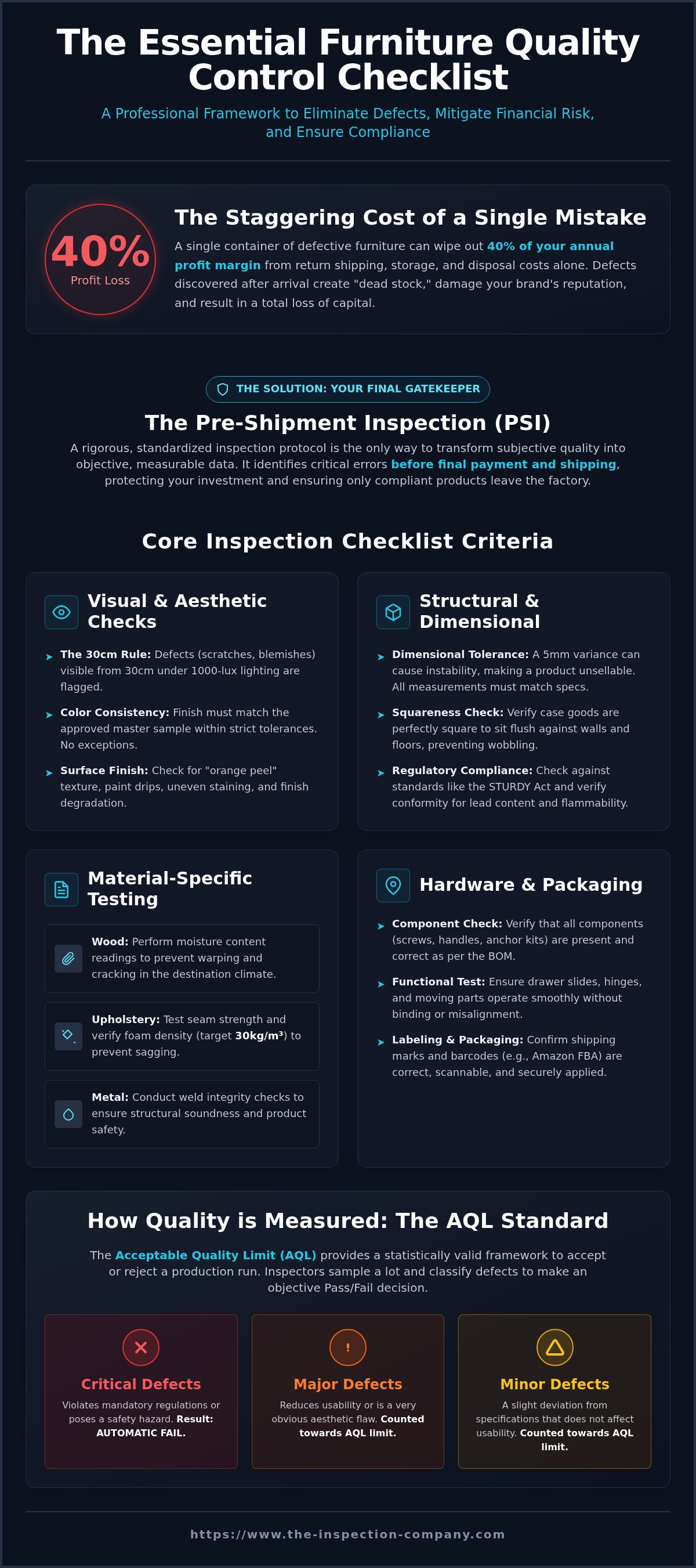
A furniture inspection checklist is a standardized protocol used to verify that every item in a production run matches your exact technical specifications. In this sector, the stakes are uniquely high. Furniture incurs massive shipping costs and offers almost zero feasibility for return-to-vendor logistics once a container leaves the port. If you discover structural issues after the shipment arrives, you face unsellable inventory and a total loss of capital. A Pre-Shipment Inspection (PSI) serves as the final gatekeeper in your sourcing lifecycle, identifying errors before they become your financial burden.
This document transforms subjective quality into objective, measurable data. By incorporating knowledge from furniture conservation and restoration, inspectors can identify early signs of material fatigue or finish degradation. It's the tool that replaces factory assumptions with hard evidence. A rigorous furniture inspection checklist ensures that the physical product aligns perfectly with the digital design before final payment is settled.
The Financial Impact of Furniture Defects
Defective goods create "dead stock" that clogs warehouse space and destroys margins. Beyond the immediate loss, negative reviews regarding structural failure or poor finish cause lasting brand damage. An experienced inspection company with European management and over 700 inspectors across Asia functions as a necessary insurance policy for your balance sheet. It's the mechanism that ensures only compliant products are shipped, protecting your reputation and your cash flow.
Aligning with International Standards
We utilize the AQL (Acceptable Quality Limit) standard to provide a statistically valid sample of your production. This method determines the Pass or Fail result based on the specific number of critical, major, and minor defects found within the sampled lot.
Essential Criteria for Your Furniture Quality Control Checklist
A high-performance furniture inspection checklist must move beyond surface-level aesthetics to address mechanical and compliance risks. When sourcing from overseas factories, the margin for error is thin. A robust checklist ensures that every SKU leaving the facility is ready for the showroom floor or the end-customer's home.
Visual and Aesthetic Checks
Visual defects like "orange peel" textures, paint drips, or uneven staining are the primary drivers of negative customer reviews. Inspectors apply the "30cm rule" to determine defect severity. If a blemish is visible from a standard viewing distance of 30cm under 1000-lux lighting, it's recorded as a defect. For a deeper look at how to classify these issues, see our guide on Understanding Product Defects. Color consistency is equally vital; finishes must match the approved master sample within a strict tolerance.
Structural Integrity and Dimensions
Dimensional verification is non-negotiable. A 5mm variance in a table leg or a cabinet frame can lead to instability, making the product "unsellable." We verify the "squareness" of all case goods to ensure they sit flush against walls and floors. Beyond physical measurements, products must align with U.S. Furniture Compliance Requirements regarding lead content and flammability. This objective data prevents costly legal liabilities.
Finally, the checklist must cover hardware and packaging. Missing screws or poorly aligned drawer slides are common factory oversights that trigger high return rates. We verify that all components are present and that Amazon FBA labels or shipping marks are correctly applied and scannable. If you're unsure how to apply these criteria to your specific product line, contact our experts to refine your quality protocol.
Material-Specific Checks and On-Site Functional Testing
A generic furniture inspection checklist often fails because it ignores the specific physical properties of different materials. Wood products require precise moisture content readings to prevent warping once they reach drier destination climates. For upholstered goods, we verify seam strength and foam density, which should ideally meet a 30kg/m³ standard to avoid sagging. Metal furniture requires checks for weld integrity and powder coating thickness, while glass must feature permanent tempering marks for safety compliance.
Mandatory On-Site Furniture Tests
These tests simulate real-world usage and transport stress. The carton drop test is essential to ensure packaging survives the container loading process and final courier delivery. Stability is equally critical; for clothing storage units, we perform tests to meet STURDY Act safety standards. This prevents hazardous tip-overs. Fatigue testing, such as cycling drawers 20 times, identifies hardware failures before the product leaves the factory floor.
Environmental and Compliance Testing
Chemical safety is a significant legal risk. We verify RoHS compliance for all metal hardware and surface coatings. In 2026, checking for formaldehyde emissions in composite woods like MDF is mandatory to meet US and EU regulations. A robust furniture inspection checklist must include these material-specific protocols to avoid costly recalls and health claims. To ensure your shipment meets these rigorous standards, contact our technical team for a customized inspection plan.
Implementing Your Furniture Inspection with a Professional Partner
DIY inspections carry significant operational risk. Internal factory staff often suffer from bias, overlooking defects to hit production targets. They also lack the specialized testing equipment required for a technical furniture inspection checklist. By partnering with a third-party expert, you ensure objective results based on hard data rather than factory convenience.
You can integrate your custom requirements directly into The Inspection Company's quality platform for seamless execution. We deliver comprehensive reports within 24 hours of the site visit. This speed allows you to make immediate "Ship/No Ship" decisions, preventing costly delays or the release of defective lots before final payment is settled.
Choosing the Right Inspection Service
A Pre-Shipment Inspection (PSI) is your primary tool for quality verification. While Container Loading Inspection (CLI) ensures your goods are packed securely, only a PSI validates the structural integrity of the furniture itself. Our European management team oversees over 700 inspectors across Asia, ensuring that international quality standards are maintained in every factory environment. It's a level of oversight that localized DIY efforts simply cannot match.
Scaling Your Furniture Brand Securely
Consistent quality control is the foundation of a successful supplier management process. By applying a standardized furniture inspection checklist across all your production sites, you create a level playing field for your vendors. For high-volume orders, coordinating a During Production Inspection helps catch errors early, reducing the need for late-stage reworks. This proactive approach leads to lower Amazon FBA rejection rates and protects your seller ratings from the impact of negative customer feedback.
Securing Your Furniture Supply Chain for 2026
Mitigating the high cost of returns starts with a rigorous furniture inspection checklist that transforms subjective quality into objective data. By verifying structural integrity and material compliance before products leave the factory floor, you protect both your profit margins and your brand’s reputation. A robust quality protocol ensures your shipments meet strict safety standards like the STURDY Act while avoiding the crushing financial burden of unsellable inventory.
Reliable, on-site data is the only tool that allows for confident "Ship/No Ship" decisions in a high-stakes market. The Inspection Company provides the ground-level expertise required to execute these complex checks across Asia. With European management overseeing over 700 qualified inspectors, we offer specialized knowledge in Amazon FBA requirements and deliver comprehensive reports within 24 hours. This speed and precision give you the control needed to scale your furniture brand securely.
Secure your furniture shipment with a professional Pre-Shipment Inspection from The Inspection Company today. You can move forward with the peace of mind that your supply chain is protected by seasoned experts.
Frequently Asked Questions
What are the most common defects found during a furniture inspection?
The most frequent issues include surface blemishes like scratches, paint drips, or "orange peel" textures, often caused by poor finishing environments. Structural instability, such as wobbly legs or misaligned joints, and faulty hardware like sticking drawer slides are also prevalent. Identifying these through a furniture inspection checklist prevents the high cost of return shipping. Our inspectors look for these flaws specifically to ensure your shipment matches the approved master sample.
How many furniture units should be inspected in a typical order?
We determine the sample size using the ISO 2859-1 (AQL) standard, which provides a statistically valid representation of your total order. For a typical shipment of 1,000 units, an inspector might check 80 to 125 pieces depending on the chosen inspection level. This ensures that the pass or fail result is based on objective data rather than guesswork. Testing a diverse range of SKUs within the lot is essential for accuracy.
What is a moisture content test, and why is it vital for wood furniture?
A moisture content test uses a specialized meter to measure the percentage of water within wood fibers. It's vital because wood is hygroscopic; it expands or contracts based on humidity. If the moisture level is too high at the factory, the furniture will likely crack or warp once it reaches a drier destination climate. We verify these levels to ensure the long-term durability and structural integrity of your wooden goods before they ship.
Can I use a generic checklist for all types of furniture?
You shouldn't use a generic checklist because different materials face unique risks. While a visual check is universal, upholstered items require rub-tests and seam strength verification, whereas metal furniture needs weld quality and rust prevention audits. A specialized furniture inspection checklist tailored to your specific product category ensures that critical safety standards, like the STURDY Act for dressers, are met. Customization is the only way to catch material-specific flaws effectively.
What happens if the furniture fails the on-site stability test?
If a unit fails an on-site stability test, such as a tip-over simulation, the entire lot is typically rejected. This failure indicates a critical safety hazard that could lead to recalls or legal liability. You should instruct the factory to pause shipment and perform a full root-cause analysis. Our 24-hour report delivery gives you the immediate evidence needed to hold the supplier accountable for necessary structural reworks before final payment is settled.