
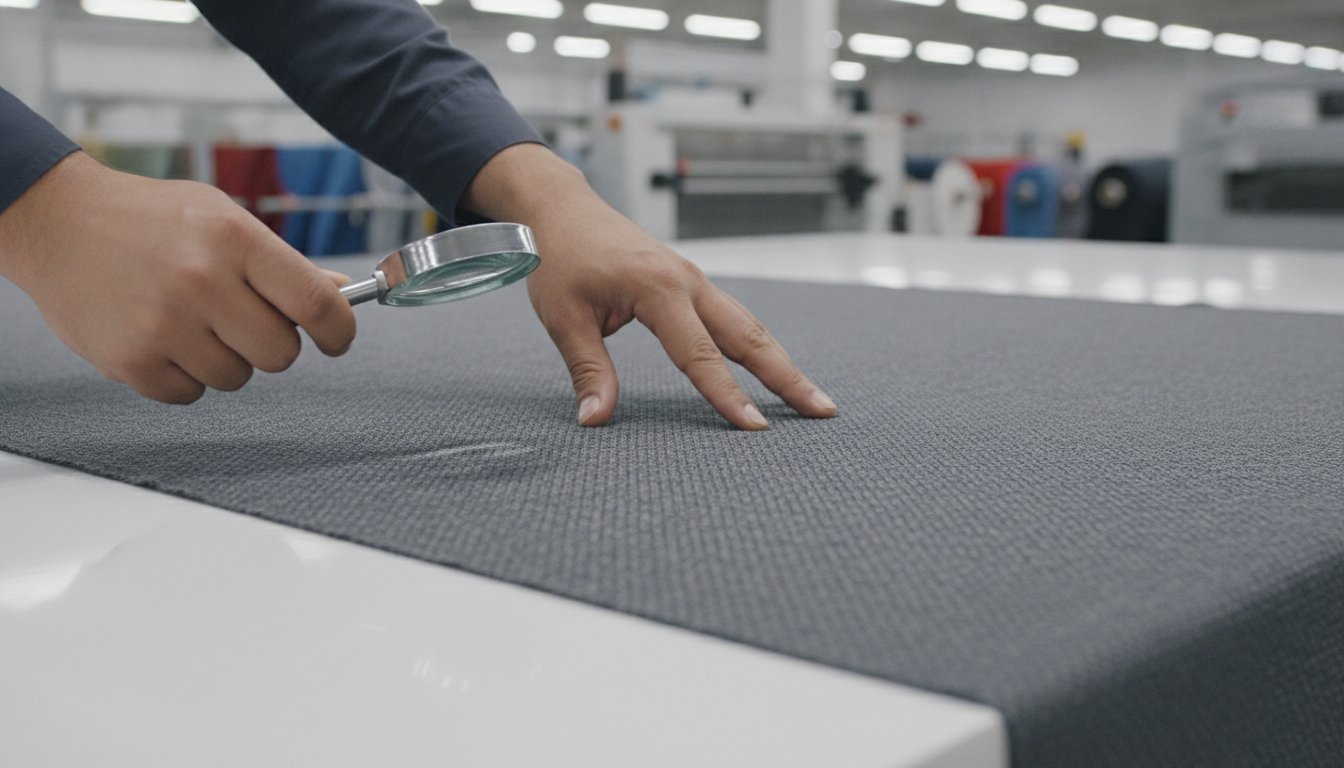
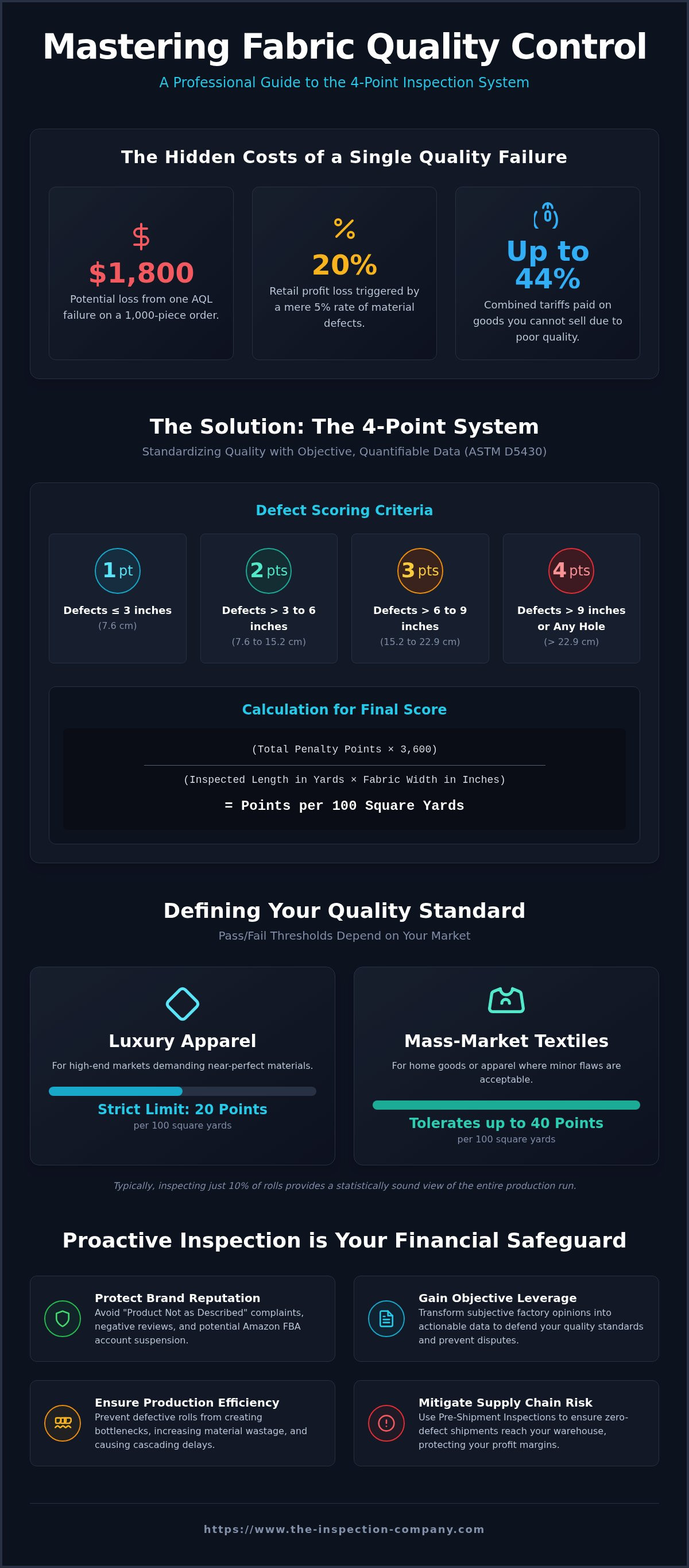
Did you know that a single AQL failure on a 1,000-piece order can drain up to $1,800 from your bottom line due to rework and markdowns? For many importers, quality control feels like a gamble against subjective factory opinions. Without rigorous fabric inspection standards, you risk receiving shipments with material faults that trigger high customer return rates or an Amazon FBA account suspension. Relying on vague quality promises isn't a strategy; it's a liability in an industry where textile imports face combined tariffs as high as 44% for certain origins.
To secure your supply chain, you must implement an objective framework that leaves no room for debate. This guide provides a professional roadmap for mastering the industry-standard 4-point system. You'll learn how to transform subjective quality into actionable data, ensuring zero-defect shipments arrive at your warehouse. We will break down the ASTM D5430-13(2017) grading process and show you how to gain objective leverage during factory negotiations to protect your profit margins from costly manufacturing errors.
Key Takeaways
- Understand how minor material flaws can escalate into 20% retail profit losses, making early detection a critical financial safeguard.
- Master the industry-standard 4-point system to implement objective fabric inspection standards that eliminate subjective quality disputes with your factory.
- Identify common visual and structural defects, from shade variations to drop stitches, and learn their root causes to prevent recurring manufacturing errors.
- Leverage professional Pre-Shipment Inspection to ensure zero-defect shipments reach your warehouse and protect your Amazon FBA account standing.
The True Cost of Fabric Defects for Global Importers
A fabric defect is any physical or aesthetic abnormality that reduces the utility or market value of a textile. While a 5% defect rate in raw material might seem manageable, it often triggers a 20% or higher loss in retail profit after cutting and sewing. This occurs because labor, overhead, and logistics costs are already "baked into" the defective unit. If you pay a 44% combined tariff on Chinese textiles, as seen in mid-2026, you're essentially paying a premium to import waste. Adopting rigorous fabric inspection standards and conducting a Pre-Shipment Inspection is the only way to move from subjective factory promises to objective, data-backed verification.
Beyond material loss, hidden costs erode your margins. Consider these financial pressures:
- Import Tariffs: Paying 9% to 16.5% base rates on goods you cannot sell.
- Logistics: Wasted ocean freight spend, which averaged $0.18 to $0.24 per kg in early 2026.
- FBA Fees: Amazon removal and disposal fees for defective inventory.
Brand Reputation and the 'Amazon Effect'
Subtle faults like pilling or shade variation are profit killers. On platforms like Amazon, these issues trigger "Product Not as Described" complaints. One bad batch can damage your account health scores, leading to suppressed listings. Fabric inspection ensures a consistent material feel, which is essential for building long-term customer trust and avoiding the risk of account suspension.
Operational Friction in Manufacturing
Defective rolls create immediate bottlenecks. Manufacturers often attempt to "cut around" flaws, but this increases material wastage and causes cascading delays. It rarely solves the problem. The end consumer still receives a garment with inconsistent grain lines or weak spots. Adhering to strict fabric inspection standards ensures your production line remains efficient and your final product is reliable.
Standardizing Quality with the 4-Point System (ASTM D5430-07)
The 4-point system stands as the global benchmark for objective textile grading. It effectively eliminates the "subjectivity trap" that often leads to disputes between importers and manufacturers. By adhering to ASTM D5430-07, you transform visual observations into quantifiable data. This ensures your fabric inspection standards are defensible and consistent across all suppliers.
Breaking Down the Scoring Criteria
The 4-point system is the primary tool for eliminating subjectivity in fabric QC. It relies on a specific point allocation based on defect size:
- 1 point: Defects less than 3 inches.
- 2 points: Defects between 3 and 6 inches.
- 3 points: Defects between 6 and 9 inches.
- 4 points: Defects exceeding 9 inches or any physical hole.
Calculating the final score is straightforward. Use the formula: (Total Penalty Points × 3,600) / (Inspected Length in Yards × Fabric Width in Inches). This calculation yields the total points per 100 square yards, providing a clear metric for shipment viability.
Integrating AQL Sampling into Textile Checks
Pairing the 4-point system with an Acceptable Quality Limit (AQL) sampling plan provides statistically sound results. Inspecting 10% of rolls typically offers a representative view of the entire production run's quality. Defining the "Pass" threshold depends on your market. Luxury apparel usually requires a strict limit of 20 points per 100 yards. In contrast, mass-market home textiles might tolerate up to 40 points. If you haven't yet defined these limits in your supplier contracts, consult with a QC expert to establish a secure quality baseline. This proactive step prevents the financial friction of rejecting goods after they've already left the factory floor.
Identifying Common Fabric Defects and Their Root Causes
Identifying the root cause of a defect is as critical as spotting the flaw itself. Importers often struggle with subjective factory disputes because they cannot pinpoint the origin of a fault. High-level fabric inspection standards require a clear distinction between raw material failures and machine errors. This categorization allows you to provide precise, actionable feedback to your supplier. It transforms a simple rejection into a long-term quality improvement plan.
Visual and surface defects, such as oil stains from poorly maintained looms or misprinting, are immediate red flags. Structural faults like holes or defective selvage compromise the material's integrity during cutting. Yarn-related issues, including neps and 'Barre' (distinguishable horizontal streaks), often remain hidden until the final garment is finished. Finally, finishing errors like permanent creases or abrasion marks suggest improper handling during the dyeing or coating stages.
Dyeing and Colorfastness Challenges
Shade variation is a primary driver of customer returns and retail markdowns. This often stems from Metamerism, a phenomenon where fabric color appears to change under different light sources. Poor colorfastness doesn't just damage brand longevity. It can also lead to non-compliance with international product safety standards.
Mechanical vs. Raw Material Faults
You must distinguish between machine-caused snags and yarn-caused slubs to hold the factory accountable. A snag indicates a mechanical maintenance issue, while a slub points to poor raw material selection. Most professionals rely on the ASTM D5430-07 standard to categorize these flaws objectively. For a broader perspective on quality risks, read our guide on Understanding Product Defects. Ensuring your inspector can differentiate these faults is the only way to secure your investment. Contact TIC today to secure your supply chain with expert on-site inspections.
Mitigating Supply Chain Risk with Professional Pre-Shipment Inspection
A Pre-Shipment Inspection (PSI) serves as your final barrier against defective textiles entering your warehouse. Once goods leave the factory floor, your financial leverage vanishes. Professional 3rd party inspectors provide the objective data needed to enforce your fabric inspection standards before the container is sealed. At TIC, our on-site process includes meticulous light box testing to detect shade variation, GSM verification for material weight, and random roll selection based on AQL protocols. These steps ensure that the material you paid for matches the material that arrives.
Speed is essential for agile supply chain management in a competitive market. We deliver detailed reports within 24 hours, allowing you to make informed "Ship/No-Ship" decisions without delaying your lead times. This data is more than a quality check. It's a strategic asset for long-term Supplier Management. By documenting historical performance against established fabric inspection standards, you gain significant leverage during future contract negotiations and price discussions.
Agile Quality Management in Asia
TIC's extensive network across China, Vietnam, and India provides "local eyes" for international brands. This geographic positioning allows us to respond quickly to production shifts. If a shipment contains localized defects, we offer Product Sorting services. This allows you to salvage the conforming portion of an order, minimizing total financial loss and preventing stockouts that could damage your retail presence.
Ensuring Compliance and Safety
Physical inspections also verify critical safety standards. We check for compliance with regulations like RoHS and CPC to ensure your materials are safe for the end consumer. Don't leave your brand reputation to chance. Protect your textile margins and book a professional fabric inspection today.
Secure Your Supply Chain with Objective Data
Adhering to rigorous fabric inspection standards is no longer optional in a global market defined by thin margins and high customer expectations. By implementing the 4-point system, you move beyond "factory promises" and gain the objective data required to protect your brand reputation. Whether you are managing complex dyeing variations or preventing structural weaving faults, a standardized approach ensures that every yard of material meets your specific quality threshold. This proactive investment prevents the cascading costs of retail markdowns and manufacturing delays.
The Inspection Company provides the localized expertise needed to secure your shipments. With over 700 professional inspectors across Asian manufacturing hubs, we deliver detailed reports within 24 hours to keep your supply chain agile. Our specialized Amazon FBA quality control workflows are designed to prevent account damaging complaints before your goods ever leave the factory. Secure your textile quality by contacting our experts for a custom inspection plan. We're ready to help you transform quality management into a measurable competitive advantage.
Frequently Asked Questions
What are the most common fabric defects found during pre-shipment inspections?
Shade variation, oil stains, holes, and drop stitches are the most frequent defects identified on-site. Shade variation often occurs due to inconsistent dyeing temperatures or chemical ratios. Oil stains typically result from poorly maintained machinery in the weaving or knitting mills. Identifying these during a Pre-Shipment Inspection prevents the financial friction of importing unsellable goods that could lead to Amazon FBA account suspension.
How does the 4-point system for fabric grading actually work?
The 4-point system assigns penalty points based on defect length or size. One point is given for defects up to 3 inches, while four points are assigned for defects over 9 inches or physical holes. The total points are calculated per 100 square yards of material. This standardized framework provides objective fabric inspection standards that transform subjective quality into actionable, data-backed reports for factory negotiations.
Can fabric defects be mended or fixed after production is complete?
Most structural fabric defects cannot be effectively mended once production is finished. While surface stains might be spot-cleaned, holes, drop stitches, or shade variations are permanent material failures. Attempting to "cut around" flaws in the garment stage increases material wastage and labor costs. Professional fabric inspection standards ensure these issues are identified at the roll stage, preventing defective material from entering the cutting room.
What is the difference between a major and a minor defect in textiles?
A major defect is a flaw that will likely result in a customer return or product failure, such as a large hole or significant shade variation. Minor defects are aesthetic abnormalities that don't necessarily compromise the garment's utility but still detract from the perceived value. In the 4-point system, any defect longer than 9 inches is automatically classified as a major penalty of four points.
How many fabric rolls should be inspected in a standard production run?
Standard industry practice involves inspecting at least 10% of the total rolls in a shipment. This sampling rate provides a statistically representative view of the entire production run. If initial rolls show high penalty scores, inspectors may expand the sample size to assess the full extent of the risk. Random selection is critical to ensure the factory doesn't hide defective batches in the back of the warehouse.