
A supplier qualification audit is a practical check of whether a potential factory partner’s quality systems, processes, staff training, and records can meet your requirements. It looks beyond written procedures to how work is carried out and how issues are controlled. The aim is to identify gaps before supplier approval creates avoidable quality or production risks.
Good documentation matters, but it does not tell the whole story. You also need to know whether procedures are followed consistently, employees understand their responsibilities, and findings lead to effective corrective action. This guide explains what a supplier qualification audit examines, how auditors assess a factory’s quality management system and personnel, and what to expect from findings, reporting, and follow-up.
You’ll also learn how risk and the supplier’s role shape the audit’s scope, and how the results can support a clear qualification decision. A structured review helps you base supplier approval on evidence and address problems before they affect production.
Key Takeaways
- Set audit scope according to the supplier’s role, risk, and effect on product quality before deciding whether to approve them.
- Review quality procedures, records, process controls, and change management to see whether requirements are followed in practice.
- Observe employees performing their work to assess how well they understand their responsibilities and follow procedures.
- Record findings clearly, assign corrective actions, and follow up to confirm that identified gaps have been addressed.
What is a Supplier Audit?
A supplier qualification audit examines whether a factory can meet defined quality and production requirements. Risk assessment determines the audit’s scope, the evidence to gather, and the basis for an approval decision.
Risk-Based Supplier Qualification
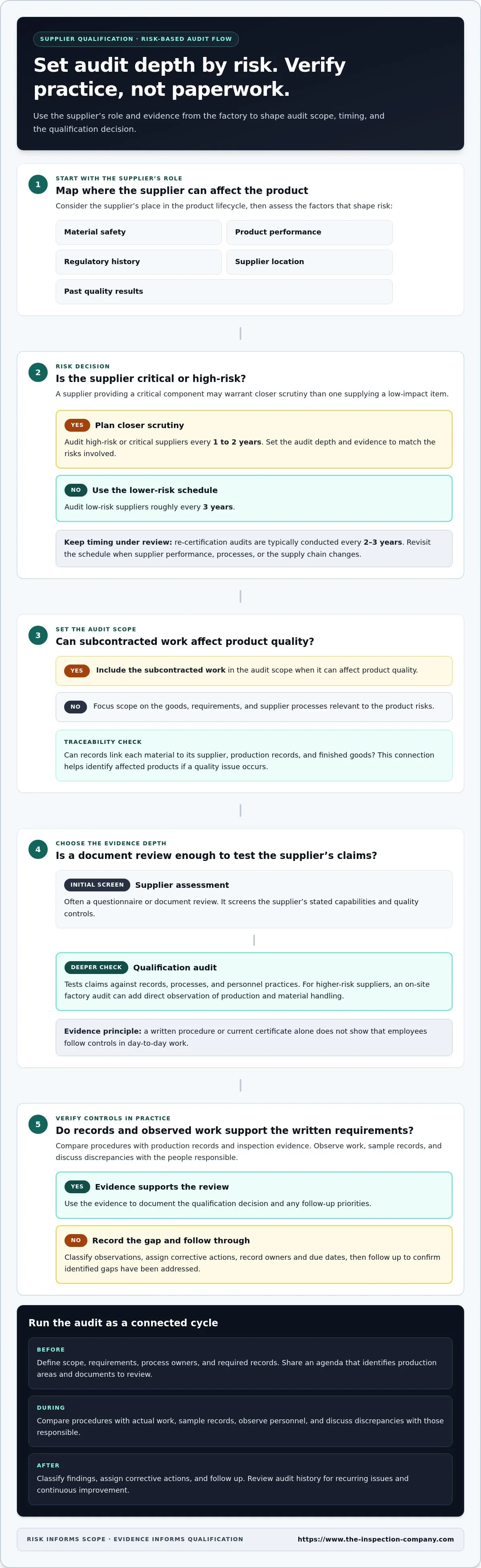
Start by mapping the supplier’s role in the product lifecycle. Consider material safety, product performance, regulatory history, location, and past quality results. A supplier providing a critical component may warrant closer scrutiny than one supplying a low-impact item.
Use these factors to set audit depth and frequency. High-risk or critical suppliers should be audited every 1 to 2 years; low-risk suppliers roughly every 3 years. Re-certification audits are typically conducted every 2-3 years. Risk can change, so review the schedule when performance, processes, or the supply chain changes.
Traceability matters, too. Check whether records link each material to its supplier, production records, and finished goods. This makes it easier to identify affected products if a quality issue occurs.
Supplier Assessments and Qualification Audits
A supplier assessment is an initial review, often based on a questionnaire or documents. It helps screen a potential partner’s stated capabilities and quality controls. A qualification audit goes further by testing those claims against records, processes, and personnel practices.
The difference is depth and evidence. An assessment may show that a factory has a written procedure; an audit examines whether staff follow it and whether records support consistent control. For higher-risk suppliers, a on-site factory audit can add direct observation of production and material handling.
Plan the audit around the goods and risks involved. First define the requirements, then review documentation, process controls, and traceability. Include subcontracted work if it can affect product quality. The assessment helps identify where scrutiny is needed; the audit gathers evidence to support qualification.
Use the results to document the approval decision, identify gaps, and set follow-up priorities. A supplier can protect quality only when its controls work consistently, not just when it completes a questionnaire or prepares for an audit visit.
Quality management systems
A factory’s quality system should turn written requirements into controlled, repeatable work. Review its records, responsibilities, and improvement process together.
Quality Management Standards
Use the applicable standard as an audit criterion, not as a substitute for reviewing factory practice. ISO 9001 can guide checks of supplier controls, documented procedures, nonconforming materials, and corrective action. For regulated outsourced work, according to the European Commission, Section 7.4 of the EU GMP Guidelines says the contract giver’s Pharmaceutical Quality System should control and review outsourced activities, and the contract giver remains ultimately responsible for ensuring their control.
Compare the facility’s written procedures with production records and inspection evidence. A current certificate alone does not show whether employees follow controls in their day-to-day work.
Managing the Audit Lifecycle
Before the audit, define its scope, requirements, process owners, and required records. Share an agenda identifying the production areas and documents to review. During the visit, compare procedures with actual work, sample records, and discuss discrepancies with the people responsible.
Afterward, classify observations, assign corrective actions, and record owners and due dates in the quality system. QMS software can centralize audit plans, evidence, finding status, and approval records. Review the history to identify recurring issues and support continuous improvement, rather than treating each audit as a standalone inspection.
Remote Qualification Audits
A remote audit can combine structured document review, live interviews, and video walkthroughs of relevant processes. Request controlled procedures and representative records in advance, then trace a sample from incoming material through production documentation.
Ask personnel to demonstrate how they access current work instructions and record deviations. Compare video observations with documents and interview responses. Remote review can assess records and explanations, but views of equipment, handling, or restricted areas may be limited. Document these limits in the audit report and consider them when deciding whether further assessment is needed.
Personnel qualifications and training
Factory procedures work only when people understand and follow them. During a supplier qualification audit, assess both employees doing production tasks and auditors evaluating the factory.
Auditor Training and Qualifications
Internal supplier auditors should receive GMP audit training and develop risk assessment skills and supplier engagement strategies. They need to connect requirements with observable evidence, such as a work instruction, a completed production record, or an employee demonstration.
Before an audit, establish its scope and criteria. Auditors should understand the product, the supplier’s processes, and the quality requirements being reviewed. This helps them ask focused questions, distinguish a documentation gap from a process failure, and record findings in enough detail to guide corrective action.
Personnel Training and Competency
Observe personnel performing their day-to-day tasks. Check whether they understand their responsibilities, follow current procedures, and apply relevant guidelines during manufacturing. For example, compare an operator’s demonstrated process with the applicable work instruction and production record.
Review training records alongside direct observation. A signed record shows that training was documented, but does not by itself prove an employee can perform the task correctly. Ask staff to explain key steps, show where they find controlled instructions, and describe how they report a deviation. These checks provide a clearer picture of practical competency.
Supplier Onboarding and Ongoing Training
Set expectations during supplier onboarding. Explain product specifications, documentation requirements, communication channels, and how to report process changes or quality concerns. Clear instructions establish transparency between buyer and supplier before production begins.
Training should reflect each role. Production staff need task-specific instructions, while quality personnel need to understand record review, nonconformance handling, and corrective actions. When a procedure changes, identify who is affected and how updated instructions will reach them. A training matrix can link job roles to required instruction and completed records.
Use audit observations to identify gaps and plan targeted follow-up. If staff cannot explain a changed inspection step, address both the procedure and employee understanding, then verify that the revised practice is followed on the production floor.
Audit findings, reporting, and follow-up
A finding is useful only if it identifies a specific gap and supports a decision. A clear report connects evidence, risk, corrective action, and follow-up.
Documenting Audit Findings
Record each observation alongside the relevant requirement, objective evidence, and affected process. For example, note a missing production record, the procedure it relates to, and the material or operation involved. Classify findings by their potential effect on product quality and operational control so critical issues receive appropriate attention.
Three supplier and vendor qualification audits at sterile pharma and biologics manufacturing facilities produced 29 findings, including 8 Major findings, in Q1 2026. The example shows why audit teams should document both the number and significance of gaps, rather than treating every observation alike.
Preparing Supplier Audit Reports
Organize the report so decision-makers can evaluate the supplier’s quality management systems and distinguish evidence from conclusions. Include the audit scope, processes reviewed, records sampled, observations, nonconformances, and supporting documentation. Photos or certificates can clarify an issue when they directly support an observation.
For each finding, state the applicable requirement and explain the observed gap. Describe its operational significance without claiming more than the evidence supports. A concise summary should make approval status and unresolved risks clear to internal quality, purchasing, and production teams.
Audit Follow-Up
Assign an owner and due date for every corrective action. Ask the supplier to document the cause, proposed correction, and steps to prevent recurrence. Check that the response addresses the underlying process, not only the specific record or product observed during the audit.
Close findings only after reviewing evidence of implementation. A follow-up audit can verify that corrective actions have been completed and controls work in practice. For critical gaps, assess whether production should proceed before effective closure. Discuss a factory audit and follow-up plan to define the next quality-control step.
The Inspection Company: Pre-Shipment Inspection
The Inspection Company helps turn audit findings into practical quality checks before goods leave the factory. Use a Factory Audit when you need to assess a supplier’s facility and processes before production. During manufacturing, During Production Inspection can identify issues while there is still time to address them. Pre-Shipment Inspection checks finished goods before shipment, supporting an informed shipment decision.
After an inspection, you receive a detailed report with photos within 24 hours, so you can review the results and approve or reject the shipment before it leaves the factory. These checks complement supplier qualification by examining production or finished goods at the relevant stage. For quality control aligned with your production timeline, contact The Inspection Company to discuss your requirements.
Put Supplier Approval Into Practice
A supplier qualification audit is most useful when its findings inform decisions beyond the approval meeting. Translate open risks into clear controls for the next production run: specify the evidence to review, who owns each action, and which checkpoint will confirm compliance. This keeps supplier approval aligned with purchasing and quality decisions as specifications or production conditions change.
The Inspection Company provides Pre-Shipment Inspection, During Production Inspection, and Container Loading Inspection to support quality checks at different points in an order. Choose a checkpoint that matches the risk you need to manage, whether that means assessing work during manufacturing, reviewing finished goods, or observing loading. These services complement supplier qualification by adding product-level verification to a factory-system review.
When you’re ready to plan the right quality-control step for an upcoming order, contact The Inspection Company to discuss your requirements. A clear next action can help turn audit evidence into more controlled purchasing decisions.
Frequently Asked Questions
What is Supplier Qualification?
Supplier qualification is the documented decision to approve a supplier for a defined product, service, or manufacturing scope. It establishes what the supplier is approved to provide and which controls support that approval. For example, approval for one factory or product line does not automatically cover another site or process. Keep the scope clear in purchasing and quality records.
What is a supplier qualification audit?
A supplier qualification audit is an evidence-based review that helps determine whether a supplier can meet the buyer’s requirements before approval. It examines how the supplier works, not just what its documents claim. For example, an audit of a packaging vendor can compare actual label controls with the specifications for the products it will handle.
What criteria are used to qualify a supplier?
Qualification criteria should match the product and the supplier’s assigned work. Assess whether the supplier can consistently meet specifications, control process changes, identify nonconforming output, and maintain records that support traceability. Include subcontracted steps if they can affect the finished product. Write each criterion so it can be evaluated through evidence, such as a record, process demonstration, or documented control.
What documents should be reviewed in a supplier qualification audit?
Review controlled procedures and revision histories, completed production records, inspection results, calibration records, training evidence, and change-control files. Where relevant, examine material traceability records and corrective-action documentation. Compare each record with the procedure that governed the work at the time. This can show whether the supplier used current instructions and documented decisions consistently.
What are the steps in a supplier qualification audit?
Begin by defining the supplier’s scope and applicable requirements. Prepare an audit plan, review relevant records, then examine processes and discuss how work is controlled. Document evidence and gaps, assess their effect on approval, and record the decision. If corrective actions are needed, assign ownership and review evidence of completion before closing findings or expanding approval.
How often should suppliers be re-audited?
Set the interval according to supplier risk and performance. High-risk or critical suppliers are generally audited every 1 to 2 years, while low-risk suppliers are reviewed roughly every 3 years; supplier re-certification audits are typically conducted every 2-3 years. Bring forward a review after a serious nonconformance, complaint, regulatory action, or meaningful change to the supplier’s process.