

Could the wrong AQL table entry lead you to approve a shipment that should be held, or reject one that meets the agreed criteria? It’s an easy mistake when lot size, inspection level, code letter, and defect class all affect the lookup. If you’re searching for “aql tablosu hesaplama,” the key is to treat the calculation as a sequence of decisions, not a single percentage lookup.
This guide walks through that sequence: identify the lot size and inspection level, find the corresponding code letter, choose the agreed AQL for each defect class, then read the sample size and acceptance and rejection numbers (Ac/Re). You’ll see how to interpret those limits and why AQL is a sampling decision rule, not a promise that every unit in the lot is defect-free. When a shipment decision carries risk, an independent inspection can provide documented evidence, including a report with photos, to support your next step.
Key Takeaways
- Use a consistent sequence for aql tablosu hesaplama: define the lot, select the inspection level, find the code letter, and read the plan’s sample size.
- Choose defect classes and AQL values based on the agreed inspection criteria, not assumptions made during the lookup.
- Compare the observed defect count with the plan’s Ac/Re limits to determine whether the sample meets the acceptance rule.
- Record the lot scope, sampling plan, and inspection findings so you can support a clear shipment decision.
AQL Table Calculation: What the Result Actually Tells You
Before goods ship, buyers need a consistent way to decide whether inspection findings support release, a hold, or further review. AQL table calculation helps structure that decision, but it doesn’t certify every unit in a batch. The result applies to a defined sample and the sampling plan chosen for the lot.
AQL is a sampling-plan parameter used to assess a lot from an inspected sample; an acceptance result means the sample meets the plan’s decision criteria, not that the shipment is defect-free. For a foundational overview of the term and its background, see Acceptable Quality Limit. In practice, aql tablosu hesaplama is not just a percentage lookup: the lot size, inspection level, selected plan, and AQL assigned to each defect class shape the result.
AQL, lot size, and sample size: how they differ
The lot is the batch being evaluated, such as the finished units in a production order. The sample is the subset drawn from that lot and inspected. Lot size describes how many units are in scope; sample size tells you how many units the plan requires you to examine. AQL is not the percentage of defects guaranteed in every shipment. A sample can meet its acceptance criteria while defects remain among units that were not inspected.
Why defect classification changes the calculation
Defects should be grouped as critical, major, or minor using definitions agreed for the product. Each category can have its own AQL, so the same sample may be assessed against separate limits. A safety-related issue and a cosmetic flaw shouldn’t be treated as equivalent. Misclassification can distort the table lookup and the shipment decision. For practical guidance on distinguishing these categories, see Understanding Product Defects: A Complete Guide for Importers & Brands.
Once the criteria are set, apply the plan consistently during inspection. A pre-shipment inspection can document sample findings before a release decision, helping buyers base that decision on recorded evidence rather than an assumption that sampling proves the entire lot is flawless.
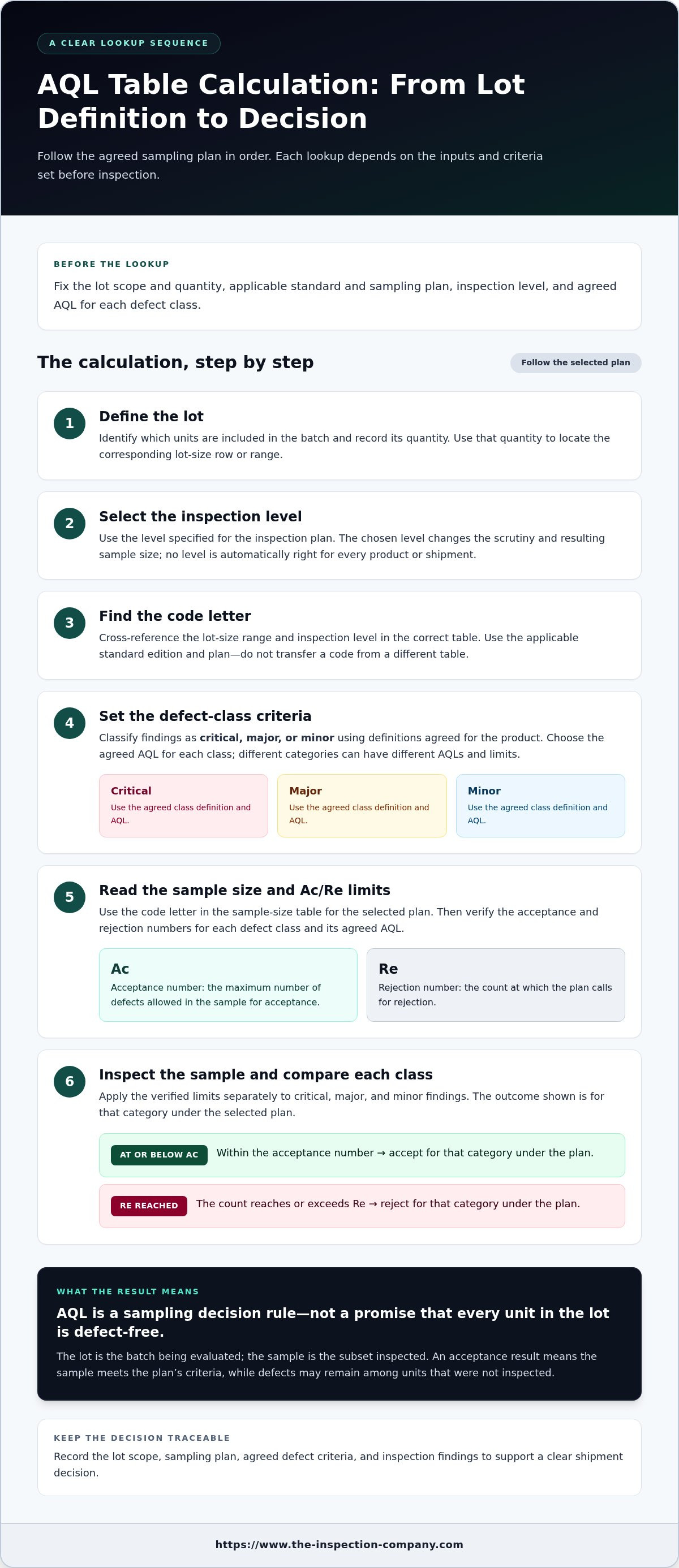
How to Calculate an AQL Table Sample Size Step by Step
To determine a sample size, first fix the inputs: the lot’s defined scope and quantity, the applicable standard and sampling plan, the inspection level, and the agreed defect-class AQL. Without these, a code letter or sample-size entry can’t be selected reliably. That’s the practical starting point for aql tablosu hesaplama.
Choose the lot size and inspection level
Define the lot as the specific batch you’ll evaluate, then establish its quantity. Use that quantity to locate the corresponding lot-size row or range in the table. Next, select the inspection level specified for the inspection plan. Levels change the scrutiny and resulting sample size; none is automatically right for every product or shipment.
Find the code letter and sample-size entry
Follow the selected lot-size range and inspection level to the code letter. Then use that letter in the sample-size table for the applicable standard and plan. Don’t transfer a code or figure from a different table: editions and plans matter. For broader background, consult AQL Explained: The Ultimate Guide to Acceptable Quality Limit.
- Define the lot: identify which units are included and record the quantity.
- Select the inspection level: use the level agreed for the plan.
- Find the code letter: cross-reference the lot-size range and level in the correct table.
- Read the sample size: locate the entry for that code letter in the selected plan.
Illustrative lookup, without table values: for a defined production batch, take its quantity to the lot-size range, follow the agreed inspection level to the code letter, then read the sample-size entry from the matching plan. This shows the sequence, not a numeric recommendation. Since exact entries must be checked against the applicable standard edition, don’t rely on an unverified online example. The eCFR provides a U.S. regulatory reference for sampling-plan terminology, but use the standard named in your agreement for the actual lookup: official U.S. Standards for Sampling Plans.
Applying the selected sample during a pre-shipment inspection can help document findings before the shipment decision.
How to Read AQL Acceptance and Rejection Numbers Correctly
Once you have the sample size, the plan’s decision limits tell you how to interpret the defects found. Ac is the acceptance number: the maximum number of defects allowed in the sample for acceptance. Re is the rejection number: the count at which the plan calls for rejection. These figures belong to the selected plan and AQL, not to AQL tables in general.
What happens when the sample is within or beyond the limits?
Use the verified Ac/Re figures for each defect class. This symbolic example shows how to compare results without implying universal limits:
| Illustrative finding | Comparison with the agreed limit | Plan outcome |
|---|---|---|
| Observed defects are at or below Ac | Within the acceptance number | Accept for that category under the plan |
| Observed defects reach or exceed Re | At the rejection number | Reject for that category under the plan |
For example, if a sample’s major defects are at or below its agreed Ac, that category meets the plan’s acceptance rule. If the count reaches its Re, it does not. Apply the same comparison separately to critical, major, and minor defects, using limits and definitions agreed before inspection begins. AQL table calculation only produces a meaningful decision when the defect criteria and plan are clear. NIST’s discussion of MIL-STD-105D sampling procedures provides historical context for how lot size, inspection level, and AQL inform attribute sampling.
What AQL sampling does not guarantee
A result within Ac supports acceptance under the chosen sampling plan. It doesn’t prove that every unit in the lot is defect-free. Sampling assesses a portion of the goods, so defects may remain among units not inspected. Treat the result as evidence for a shipment decision, not certainty about every item.
A pre-shipment inspection can document findings before goods ship. To discuss inspection evidence for a shipment decision, contact our inspection team.
Turn Your AQL Calculation Into a Reliable Inspection Decision
A correct table lookup is only useful if the inspection team and the buyer apply the same criteria. Before inspection begins, align with the supplier on what counts as the lot, which sampling plan applies, and how defects will be classified. Clear requirements reduce inconsistent judgments when results affect whether goods are approved, held, or rejected.
Prepare the inspection plan before the goods are checked
Record the decisions that make your aql tablosu hesaplama repeatable:
- Lot scope: identify the products and quantity covered.
- Sampling plan: note the applicable standard, plan type, and inspection level.
- Defect criteria: define critical, major, and minor defects in terms inspectors can assess consistently.
- AQLs and limits: record the agreed AQL for each defect class and the corresponding Ac/Re numbers.
Share product specifications and inspection criteria before the check. If requirements are unclear, different people may classify the same finding differently, weakening the value of the result.
Use inspection evidence to support the next decision
An independent product inspection can apply the agreed plan, record sample findings, and provide photos that help buyers review the evidence. The report supports a decision; it doesn’t replace product requirements, change the agreed limits, or guarantee that every unit is defect-free. Inspection clients receive a detailed report with photos within 24 hours of inspection.
Earlier checks can also help identify production issues before the final shipment stage. A during-production inspection can provide visibility while manufacturing is underway, giving the buyer an opportunity to review findings before goods are finished.
Before approving, holding, or rejecting a shipment, compare the documented findings with the agreed plan and review the nature of any defects, not only the totals. A clear record helps keep the decision traceable. Discuss your inspection requirements.
Make Your Next Shipment Decision With Clear Evidence
A reliable aql tablosu hesaplama starts with a defined lot, the agreed inspection level, and clear defect categories. The correct sampling plan then gives you the sample size and Ac/Re limits to apply. Treat the result as evidence about the inspected sample, not proof that every unit in the lot is defect-free.
Before approving, holding, or rejecting goods, document the plan and review the findings against the agreed criteria. An independent inspection can help make that process traceable. The Inspection Company has more than 700 inspectors across key Asian manufacturing hubs, and inspection clients receive detailed reports with photos within 24 hours of inspection.
Put a clear inspection plan in place before your shipment decision. Discuss your inspection requirements and take the next step with confidence.
Frequently Asked Questions
How do you calculate an AQL sample size?
Use the applicable sampling standard and plan to look up the sample size. Define the lot and its quantity, select the inspection level, then find the corresponding code letter in the standard’s table. Read the sample-size entry for that letter, then consult the selected plan and defect-class AQL for the Ac/Re limits. In short, aql tablosu hesaplama is a sequence of connected lookups, not a calculation from the AQL percentage alone.
What information do I need to use an AQL table?
Before using a table, establish the lot’s scope and quantity, the applicable standard and edition, the sampling plan, and the inspection level. You’ll also need the agreed AQL for each defect class and clear definitions of critical, major, and minor defects. These inputs determine which table entries apply. Record them before inspection so the inspector and buyer use the same criteria to assess the findings.
What do Ac and Re mean in an AQL table?
Ac is the acceptance number, the highest defect count in the sample that meets the plan’s acceptance criterion. Re is the rejection number, the count at which the plan indicates rejection. Always read both values from the selected plan and apply them separately to the relevant defect categories. They aren’t universal limits, and using figures from a different plan can lead to a wrong shipment decision.
Does passing an AQL inspection mean every product is defect-free?
No. Passing means the inspected sample meets the acceptance criteria of the agreed sampling plan. Units outside the sample haven’t been checked, so the result can’t establish that every item in the lot is defect-free. Sampling gives buyers structured evidence to support a decision, not certainty about each unit. Review the inspection findings and any serious defects alongside the plan before approving a shipment.
Which AQL level should I choose for an inspection?
There’s no single AQL that fits every product or shipment. Agree on values before inspection, considering product requirements, the consequences of each defect type, and the buyer-supplier agreement. Set separate AQLs for critical, major, and minor defects where appropriate, and define each category clearly. AQL is a sampling-plan parameter, not a promise about the defect percentage in every shipment, so choose it as part of an agreed inspection plan.