

Is the "Anxent" on your shipping manifest a brand name, or is it the literal anxiety of not knowing what's actually inside your containers? You've likely felt that pit in your stomach when a shipment from a specialized tech hub arrives, fearing a high percentage of dead-on-arrival (DOA) units or a rejection from Amazon FBA due to poor labeling. It's a common concern in a market where component lead times have reached 40 weeks and regulatory requirements are constantly shifting.
We understand that the high stakes of international trade require more than just trust; they require a methodical approach to risk mitigation. This guide will show you how to eliminate that uncertainty by utilizing a rigorous electronics inspection checklist to manage sourcing risks for both consumer electronics and high-risk goods. We promise to help you secure your supply chain with transparent, third-party data that ensures 100% compliance with international safety standards.
We'll examine the differences between general quality control and the specialized strategies needed for the July 2026 RoHS updates and the EU AI Act. You'll learn how to transform your sourcing process from a source of stress into a controlled, predictable asset for your business growth.
Key Takeaways
- Identify the specific triggers of "Anxent" sourcing and why electronics importers face significantly higher operational risks than general merchandise buyers in 2026.
- Differentiate between manageable cosmetic flaws and critical internal circuit failures to ensure specialized tech products meet strict functional standards.
- Implement a professional electronics inspection checklist as part of a 4-stage quality control process to eliminate the risk of dead-on-arrival (DOA) units.
- Secure your supply chain by leveraging transparent, third-party data and comprehensive reporting to guarantee 100% compliance with evolving international safety regulations.
What is 'Anxent' Sourcing? Defining Supply Chain Anxiety
In the 2026 manufacturing landscape, "Anxent" describes the pervasive uncertainty that haunts electronics importers. It's the fear that what was promised in a sample won't match what's packed in the container. Supply chain anxiety is the financial risk associated with unverified production quality.
Importers of consumer electronics face significantly higher stress levels than those buying general merchandise. A scratch on a plastic chair is a minor cosmetic issue; a faulty integrated circuit is a total loss. With component lead times hitting 40 weeks as of early 2026, you cannot afford a mistake. A failed batch doesn't just cost money. It costs time you don't have, potentially missing critical market windows or failing to meet the August 2, 2026, EU AI Act compliance deadline.
Operating without a clear electronics inspection checklist leads to catastrophic outcomes. The high cost of "blind" sourcing includes:
- Massive return rates that erode thin profit margins.
- Irreparable brand damage on platforms like Amazon.
- Legal liabilities from non-compliance with the updated July 2026 RoHS lead exemptions.
- Total loss of revenue due to dead-on-arrival (DOA) units.
Implementing rigorous Quality control (QC) is the only way to safeguard your investment. It transforms a gamble into a controlled business process.
The Psychology of the Importer
The stress isn't just about money; it's about the pressure of tight deadlines and the complexity of modern hardware. Working with new suppliers in specialized tech hubs often triggers intense anxiety. The "Anxent" brand phenomenon illustrates how trending tech products, rushed through production to meet demand, frequently suffer from higher defect rates. Utilizing a pre-shipment inspection ensures your goods meet the necessary functional and safety standards before you release the final payment.
Comparing Risk Profiles: Electronics vs. General Merchandise
Electronic components aren't just parts; they are the nervous system of your product. While a batch of textiles might fail due to loose threads or dye lot variations, electronics face "invisible" risks. A standard guide for Understanding Product Defects highlights that cosmetic flaws in general merchandise rarely render a product useless. In contrast, a single cold solder joint or a microscopic fracture in a PCB can lead to 10,000 dead-on-arrival units.
Specialized tech like "Anxent Wear" smart apparel demands more than a cursory glance. You can't see a firmware bug or a failing capacitor during a basic visual check. This complexity is why a specialized electronics inspection checklist is mandatory. It moves beyond aesthetics to verify functional performance and safety. It's the difference between a minor refund and a total shipment loss.
Regulatory compliance adds another layer of friction. You're not just managing quality; you're managing legal liability. Requirements for CE marking, FCC certification, and the July 2026 RoHS lead-related exemptions are non-negotiable. Missing a single marking or failing a lab test can result in customs seizures or heavy fines. If you're unsure about your current supplier's compliance, you can request a consultation with a technical expert.
Complexity and Failure Points
Industry data suggests that battery-operated devices often experience a major defect rate significantly higher than textiles. This spike is usually due to the volatile nature of lithium-ion cells and the intricate semiconductor supply chain risks involved in power management. Your branded product is only as reliable as its weakest sub-supplier. If the factory uses unverified "drop-in" components to bypass 40-week lead times, your brand pays the price.
The Amazon FBA Factor
Standard retail packaging rarely survives the rigorous handling of the Amazon logistics network. FBA compliance requires specific labeling, drop testing, and suffocation warnings that general merchandise buyers often overlook. Our Amazon FBA Service acts as a final filter. It ensures your goods aren't just functional, but also "ready to ship" according to Amazon's strict intake standards. Properly Understanding Product Defects at the source prevents the nightmare of account suspension or costly removal orders.
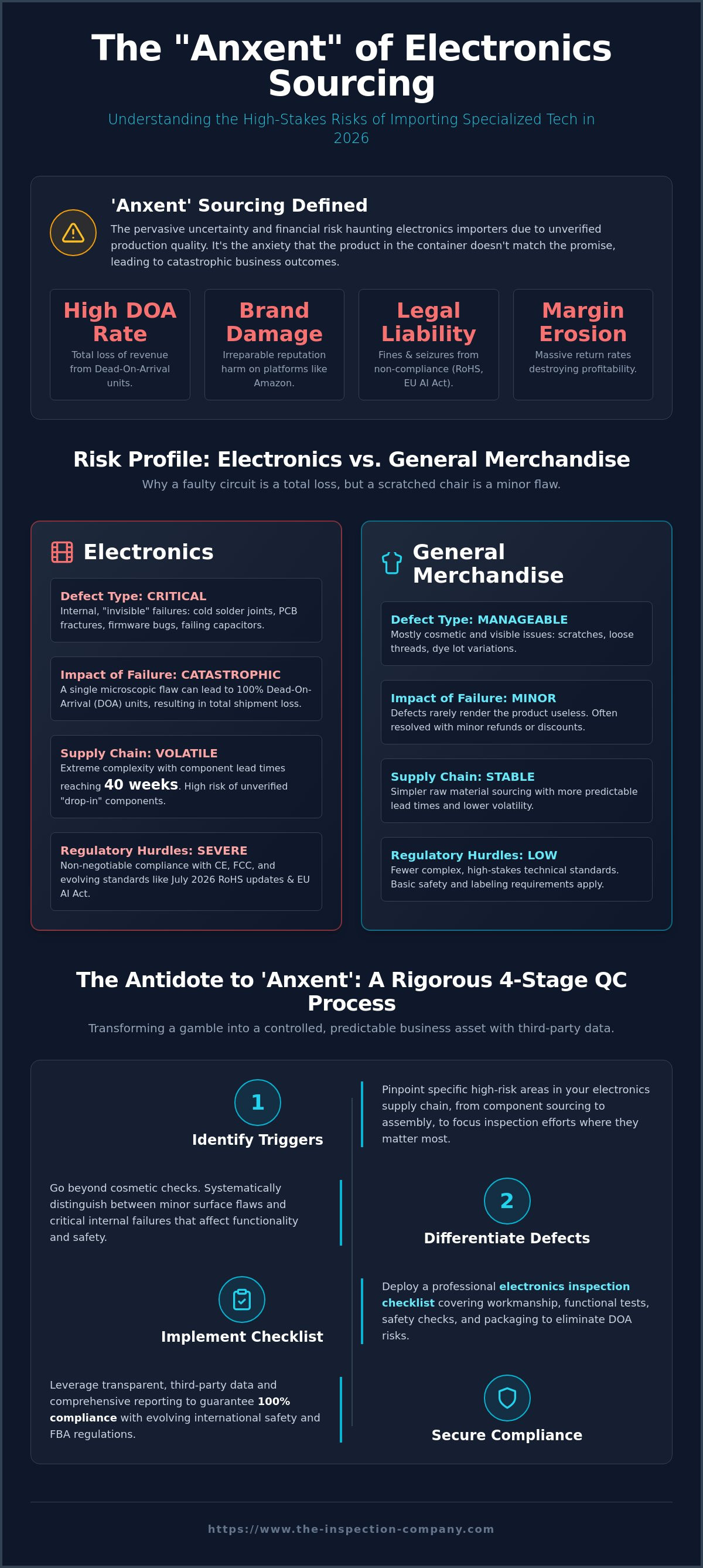
Mitigating 'Anxent' Risks: The Professional Electronics Inspection Checklist
Sourcing anxiety isn't solved by a digital dashboard or a factory's promise. It's solved by physical presence and objective data. To eliminate the "Anxent" of unverified production, we utilize a methodical 4-stage process that secures your investment before you release the final balance payment. This structured approach replaces gut feelings with a data-driven electronics inspection checklist.
- Step 1: Establishing AQL Standards. We define the Acceptable Quality Limit (AQL) for your specific product. This ensures the factory knows exactly how many minor, major, or critical defects will trigger a shipment rejection.
- Step 2: On-Site Verification. Our inspectors visit the factory in person to pull random samples from finished batches. This prevents the "golden sample" trap where only perfect units are shown to the client.
- Step 3: Real-Time Reporting. You receive a comprehensive report within 24 hours of the inspection. This includes high-resolution evidence of any issues found during the process.
- Step 4: The Go/No-Go Decision. Armed with a technical report, you can confidently authorize the shipment or demand a full rework at the factory's expense.
Why Third-Party Inspection is Essential
Internal factory QC reports often suffer from a fundamental conflict of interest. Production managers are incentivized to meet shipping quotas, which can lead them to overlook marginal defects. 3rd Party Inspection Companies provide an unbiased "ground truth" that protects the buyer. This independent oversight is your most effective defense against the financial loss of a defective shipment.
On-Site Testing Protocols for Electronics
Generic visual checks don't work for hardware. Our electronics inspection checklist includes specialized functional testing for battery life, Bluetooth pairing stability, and sound frequency response. Safety is equally critical. We perform Hi-pot tests and earth continuity checks to ensure powered devices don't pose a fire or shock hazard. This rigorous testing also incorporates a Counterfeit Electronic Part Detection and Avoidance Policy to verify that your sub-components are authentic and reliable. If you need to secure your next production run, contact our technical team for a customized inspection plan.
Why The Inspection Company is the Cure for Sourcing Anxiety
Sourcing from specialized tech hubs doesn't have to be a gamble. The Inspection Company (TIC) provides the infrastructure to convert risk into a manageable variable. With over 700 inspectors positioned across all major Asian manufacturing hubs, we provide immediate, on-the-ground oversight. This localized presence allows us to intervene quickly, preventing minor production errors from escalating into total shipment failures.
We apply rigorous European management standards to every engagement. This ensures that localized operational presence meets international quality benchmarks. For a deeper look at navigating these markets effectively, see our Sourcing from Asia Guide. Reassurance comes through transparency. We deliver detailed, fact-based reports within 24 hours of the site visit. You don't have to wait days to know if your production line is failing or succeeding. Our electronics inspection checklist is designed to catch the "invisible" defects mentioned earlier, from firmware inconsistencies to safety non-compliance.
Your Eyes in the Factory
Our Quality Platform acts as your digital command center. It gives you total control over the inspection process from anywhere in the world. By combining this technology with professional Factory Audits, we reduce the "Anxent" factor. We verify that the facility actually has the technical capacity to produce your goods before you sign a contract. We don't just check the product; we check the source.
Ready to Secure Your Shipment?
Don't let anxiety dictate your business growth. In the high-stakes world of electronics, a single bad shipment can derail an entire fiscal year. It's a costly mistake that you can easily avoid. Secure your supply chain with transparent, third-party data. Use a professional electronics inspection checklist to safeguard your brand reputation. Book your Pre-Shipment Inspection today and take the first step toward a predictable, profitable sourcing strategy.
Securing Your Supply Chain for 2026 and Beyond
The transition from supply chain anxiety to operational certainty requires more than just a change in mindset; it requires a change in procedure. We've examined how the invisible failure points of hardware differ from simple cosmetic flaws in general merchandise. You now understand that a professional electronics inspection checklist is your most effective tool for preventing financial loss and protecting your brand's reputation on global platforms.
The Inspection Company provides the ground-level expertise needed to navigate these high-stakes markets. With over 700 professional inspectors across Asia and an ISO 9001 certified European management structure, we offer the meticulous oversight your business demands. You'll receive detailed, transparent reports within 24 hours of every inspection, ensuring you have the data to make confident decision regarding your shipments.
Secure your production and eliminate sourcing anxiety by contacting our experts today. Your growth depends on a reliable supply chain. We're here to help you build it with confidence.
Frequently Asked Questions
What does 'Anxent' mean in the context of manufacturing?
'Anxent' describes the psychological and financial anxiety importers experience when dealing with unverified production quality in the global supply chain. It's the uncertainty of whether a shipment meets technical specifications or international safety standards. This stress is particularly high in the electronics sector where component lead times and regulatory complexity are at an all-time high.
How do I verify the quality of electronics like cat-ear headphones before shipping?
You verify the quality of specialized electronics by implementing a rigorous electronics inspection checklist that goes beyond basic visual checks. For products like headphones, this includes functional testing of Bluetooth pairing stability, battery endurance, and sound frequency response. Our inspectors also perform critical safety tests, such as Hi-pot and earth continuity checks, to ensure the hardware is safe for consumer use.
Why is a Pre-Shipment Inspection (PSI) better than relying on the factory's report?
A Pre-Shipment Inspection (PSI) is superior because it provides an unbiased, third-party "ground truth" that factory-led reports cannot offer. Factory QC teams often face internal pressure to meet shipping deadlines, which can lead to the suppression of defect data. An independent inspector ensures that the data you receive is objective and accurately reflects the state of your production before you release the final payment.
Can an inspection company help with Amazon FBA labeling requirements?
Yes, our Amazon FBA Service specifically addresses the stringent labeling and packaging requirements mandated by Amazon's logistics network. We verify that FNSKU labels, suffocation warnings, and carton markings are 100% compliant. This proactive step prevents costly rejections, account suspensions, or removal orders once the shipment reaches the fulfillment center.
What happens if the electronics inspection report shows major defects?
If a report identifies major defects exceeding your pre-defined AQL limits, you have the data-backed authority to halt the shipment and demand a full rework. The factory is typically responsible for correcting these issues at their own expense before a re-inspection occurs. Utilizing an electronics inspection checklist ensures you don't pay for defective inventory that would otherwise lead to high return rates and brand damage.