

What if a factory’s “on schedule” update doesn’t tell you whether your order is actually on track? For buyers managing production timelines with asian factories, progress depends on more than promised completion dates. A production delay can affect packaging, consolidation, and downstream commitments, while a late quality check leaves less time to respond.
Clear supplier updates are useful, but the key is knowing which milestones provide evidence, how one stage depends on another, and when a slip calls for a decision. This guide explains how to build a realistic schedule, track meaningful production milestones, and spot risks early. It also covers how local holidays and contingency time affect planning, and what to do when a milestone moves. During Production Inspection can provide an independent snapshot of order progress and quality to inform your decisions. The goal is fewer surprises, clearer choices, and a plan based on verified progress rather than promises alone.
Key Takeaways
- When managing production timelines with asian factories, separate supplier estimates from buyer-controlled approvals and decision windows.
- Work backward from the delivery deadline, map dependencies, and assign an owner and review date to each milestone.
- Compare dated production evidence with planned milestones, then address missed approvals or slipping dependencies early.
- Use factory audits to assess supplier systems and order inspections to check live production or finished goods before key decisions.
Why production timelines slip at Asian factories, and how to see the risk earlier
A promised completion date doesn’t prove that production is progressing as planned. Schedules can shift when specifications are unclear, approvals arrive late, materials aren’t ready, factory capacity is constrained, or quality issues require rework. These dependencies matter throughout the year, not only around major holidays. For buyers managing production timelines with asian factories, the earlier a risk becomes visible, the more time there is to make an informed decision.
One late SKU can hold up packaging for an entire order. If products from several suppliers share a shipment deadline, a delay at one factory may disrupt consolidation or force a decision about whether to wait, split the order, or revise commitments. This is why supply chain management principles emphasize how connected stages affect the wider flow.
Which production milestones are most vulnerable to slippage?
Track material readiness, first production output, quantity completion, and packaging as separate checkpoints. Each answers a different question: Are inputs available? Has production started? Is the required quantity finished? Can the goods be packed as planned? Unclear specifications or late approval of samples, artwork, or packaging details can delay work before or during production. Set a target date and an owner for each approval rather than treating all activity as a single completion date.
Why supplier updates need evidence and context
A status message reports progress, but dated evidence gives it context. Seeing a production line operating is stronger evidence that work is underway, though it doesn’t confirm that the required finished quantity is ready. A supplier’s forecast describes expected progress; evidence shows what has actually been completed. Request updates that identify the production stage, quantity completed, and remaining work. A During Production Inspection can provide on-site evidence of production status to support schedule decisions. Include this verification in broader sourcing risk planning, alongside clear milestones and approval deadlines.
Build a production schedule around dependencies, not just a ship date
A workable schedule starts with the date goods must be ready, then makes every preceding dependency visible. When managing production timelines with asian factories, separate supplier-estimated production durations from buyer-controlled steps such as approving specifications, samples, artwork, and packaging. The supplier can estimate production time, but you control your internal review deadlines and decision windows.
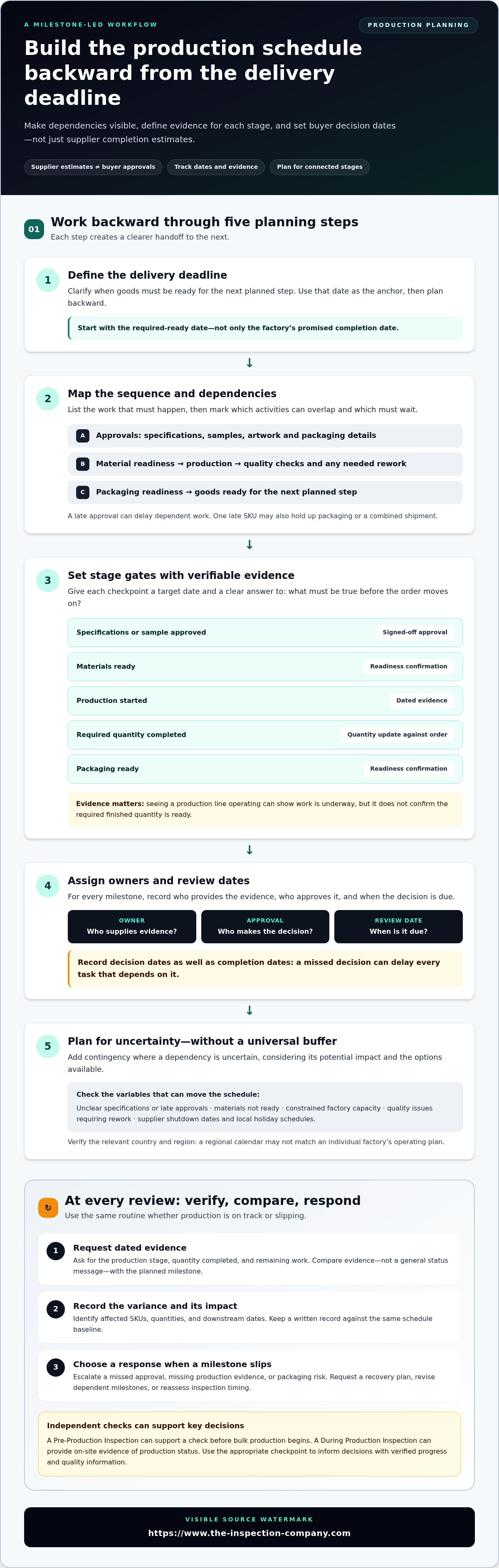
- Define the delivery deadline. Clarify when the goods must be ready for the next planned step, then work backward.
- Map the sequence. List approvals, material readiness, production, quality checks, any needed rework, and packaging. Mark which tasks can overlap and which must wait for another task to finish.
- Set stage gates. Agree on measurable evidence for approved specifications, available materials, production start, completed quantity, and packaging readiness.
- Assign owners and review dates. Record who provides the evidence, who approves it, and when a decision is due.
- Plan for uncertainty. Add contingency where a dependency is uncertain, based on its potential impact and available options rather than applying a universal buffer percentage.
A reliable schedule records decision dates as well as completion dates, because a missed decision can delay every task that depends on it.
Set stage gates from approved sample to finished goods
Make each gate verifiable: a signed-off specification or sample, confirmation that required materials are ready, dated evidence that production has started, a quantity update against the order, and confirmation that packaging is ready. A Pre-Production Inspection can support a check before bulk production begins. If a gate is missed, record the variance and decide whether to revise the sequence, deadline, or next approval.
Coordinate multiple suppliers and country calendars
Track each factory and SKU separately, then mark shared dependencies such as packaging or a common shipment deadline. A delayed component or supplier can hold up the combined order even if other items are complete. Record each supplier’s shutdown dates and verify local holiday schedules for the relevant country and region. A regional calendar may not reflect every factory’s operating plans. For help planning suitable inspection checkpoints, review the options on The Inspection Company’s contact page.
How to monitor production and respond when a milestone slips
Use the same review routine at each milestone, whether production is on track or not. Request dated evidence, compare it with the planned stage and quantity, then record the variance and its effect on dependent tasks. “Production is progressing” is less useful than a dated quantity update or evidence showing the relevant work in progress.
- Escalate when an approval deadline is missed, production evidence is absent, or packaging may hold up completed goods.
- Assess impact by identifying affected SKUs, quantities, and downstream dates.
- Choose a response: request a recovery plan, revise dependent milestones, or reassess the timing of an inspection.
Set review dates around the order’s milestones and risk points. A missed approval may need prompt follow-up if production cannot proceed without it; a stable stage may need less frequent review. Keep a written record so you can compare each update against the same baseline.
What to do when a factory misses a planned milestone
Ask for the cause, affected quantities, corrective action, the person responsible, and the date when new evidence will be available. Update the schedule and flag any approvals, packaging steps, or commitments that may also move. Treat a revised completion date as a new forecast, not proof that the goods are finished. Verify progress before relying on downstream dates again.
Where a during-production check fits
A During Production Inspection provides an on-site snapshot of production progress and observed issues, adding independent information to supplier updates. Use the findings to decide whether to request corrective action, adjust the plan, or review inspection timing. An inspection report informs buyer decisions; it doesn’t manage factory output or guarantee shipment. Guidance on inspection planning can help you align the check with the schedule risk you need to assess.
Use inspection checkpoints to make the final timeline decision
Inspection checkpoints answer different questions at different stages. Choose one based on the decision you need to make, not simply because a date appears on the calendar. For buyers managing production timelines with asian factories, independent findings can inform schedule and quality decisions, but they can’t guarantee an on-time shipment.
| Checkpoint | Timing | Decision supported |
|---|---|---|
| Pre-production check | Before bulk production | Is the order ready to proceed against the approved requirements? |
| During-production check | While production is underway | What progress and potential issues are observable, and does the plan need review? |
| Pre-shipment inspection | When finished goods are available before shipment | Should the order be approved, rejected, or investigated before release? |
Early production visibility and a final shipment decision serve different purposes. A mid-production check can reveal progress or issues while work is underway; it doesn’t replace a check of finished goods. For the final checkpoint, the pre-shipment inspection guide explains how findings can inform the decision before goods leave the factory.
Match the inspection checkpoint to the schedule risk
A factory audit assesses a supplier’s capabilities and systems. An order inspection checks products or production for a specific order. Use an audit to understand factory-level processes, and an inspection checkpoint to gather evidence about the live order. Neither manages production output; both can inform buyer decisions at the appropriate stage.
Turn inspection findings into a clear release decision
Photo-backed findings help you assess whether requirements appear to be met or whether defects or discrepancies need further investigation. The Inspection Company provides a Quick Report on the inspection day and a detailed photo-backed report within the next 24 hours. Use the evidence to approve, reject, or investigate the order, then record your decision and any required follow-up.
Before release: review the findings, document the decision, resolve open issues, and update downstream dates if needed. Plan an inspection for your production timeline.
Build a stronger forecast with every order
Each completed order can make the next production plan more accurate. After delivery, compare planned dates with actual milestone dates and record which assumptions held up and which did not. Note what changed, which decisions took longer than expected, and which updates gave you a clear picture of progress. This creates a practical reference for setting future deadlines without treating past estimates as guarantees.
When managing production timelines with asian factories, the goal isn’t to remove every uncertainty. It’s to make assumptions visible, learn from schedule variances, and set decision points that leave room to respond. That discipline helps you make clearer choices as new orders move from planning to production.
Use independent inspection evidence as one input when deciding what to do next. Align an inspection checkpoint with your production schedule to give your next order a more informed starting point.
Frequently Asked Questions
Do all Asian factories close for Lunar New Year?
No. Asian factories don’t all close for Lunar New Year; operating plans vary by country, factory, and workforce. For an order involving multiple suppliers, ask each factory for its last planned production day, restart date, and any period of reduced capacity. Record these separately rather than assuming one holiday schedule applies across the order, and verify dates with each supplier before finalizing the production plan.
Can a third-party inspection guarantee that a factory will ship on time?
No. A third-party inspection provides an independent view of production or product condition at the time of the check, but it doesn’t control factory output, rework, or dispatch. Use the findings to inform decisions, such as requesting corrective action or reviewing the next milestone. Base delivery commitments on verified progress and schedule reviews, not on an inspection alone.
Is a factory audit the same as checking an order in production?
No. A factory audit assesses a supplier’s capabilities and systems, including how its quality processes are organized. An order inspection focuses on a specific order, either while it’s being made or after the goods are finished. An audit can inform supplier decisions, but it doesn’t establish whether a current order has reached its planned quantity or meets product requirements.
What happens if the required finished quantity is not ready on inspection day?
If the vendor can’t provide the required quantity of finished products on the scheduled inspection date, the inspection is cancelled and reported. The unavailable goods haven’t been verified through that inspection, so don’t treat the cancellation as approval or rejection of product quality. Review the reported status, agree on the next evidence date, and make a fresh schedule decision based on the updated situation.
When should I schedule an inspection during production?
Schedule it while production is active and early enough for observed progress or issues to inform a decision. The right point depends on the production sequence and what you need to learn. A check too early may reveal little, while one near completion may leave less time to respond. When managing production timelines with asian factories, tie the inspection date to a defined milestone and the order stage you need assessed.