

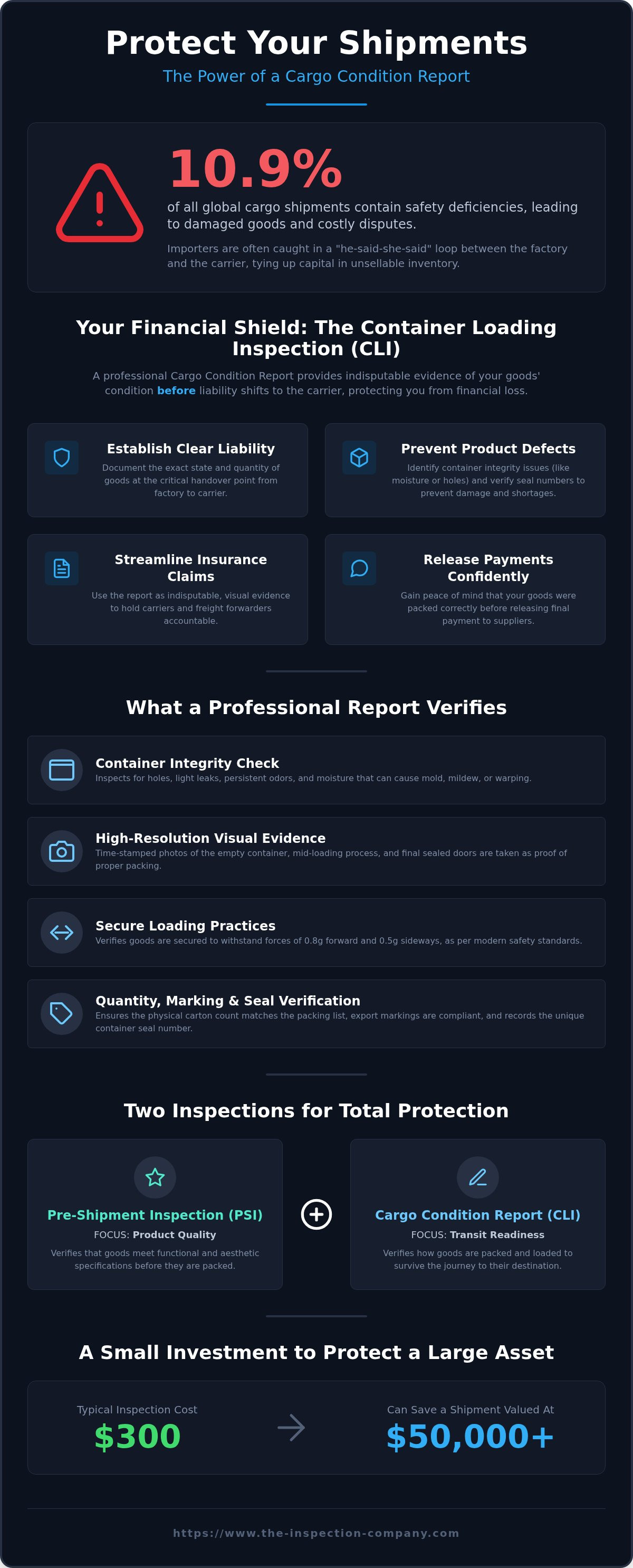
Did you know that 10.9% of all global cargo shipments now contain safety deficiencies? For an importer, there's nothing more frustrating than opening a container to find damaged inventory and realizing that professional cargo condition reports were the only thing standing between you and a rejected insurance claim. You're often caught in a "he-said-she-said" loop where the factory blames the carrier and the carrier blames the loading crew. It's a costly, avoidable situation that leaves your capital tied up in unsellable goods.
Professional documentation acts as your ultimate financial shield by shifting the burden of proof away from your business. This article outlines how these reports protect your interests by providing indisputable evidence of how your goods were packed and secured before leaving Asia. We'll explore how to use this data to streamline insurance claims and ensure your suppliers follow strict loading protocols. You'll discover how a Container Loading Inspection provides the peace of mind you need to release final payments with total confidence.
Key Takeaways
- Establish clear liability by documenting the physical state and quantity of goods at the critical transition point between the factory and the carrier.
- Identify how inspecting container integrity and recording lead seal numbers prevents product defects caused by moisture or transit shortages.
- Use professional cargo condition reports as indisputable evidence to streamline maritime insurance claims and hold freight forwarders accountable for damage.
- Learn why a Container Loading Inspection (CLI) with 24 hour reporting is the modern standard for protecting your financial interests in Asian markets.
What is a Cargo Condition Report in International Trade?
A cargo condition report is a formal document recording the physical state, quantity, and packaging of goods at a specific point in the logistics chain. It acts as the critical "point of transition" documentation when liability shifts from the manufacturer to the carrier. While many importers rely solely on the Bill of Lading, this document is often insufficient for proving the specific condition of individual cartons or pallets. A Bill of Lading confirms the receipt of a container; however, it rarely details internal loading practices or minor external damages that lead to major losses later. A cargo condition report serves as the definitive evidence of product integrity at the exact time of loading.
By utilizing professional cargo condition reports, importers gain a clear visual record of how their goods were handled before the container seal was applied. This evidence is vital when disputes arise regarding moisture damage, crushed boxes, or "phantom" shortages. Without this specific record, you're left guessing whether the damage occurred on the factory floor or during the high-stress environment of maritime transit. For consumer goods importers, this documentation is the only way to hold third parties accountable for handling errors that occur behind closed container doors.
Condition Reporting vs. Pre-Shipment Inspection
It's vital to distinguish between product quality and transit readiness. While Pre-Shipment Inspections verify that your goods meet functional and aesthetic specifications, condition reporting focuses on how those goods are prepared for the journey. A product can pass every quality test but still arrive unsellable if it's poorly stacked or if the container is structurally compromised. Combining quality control with logistics supervision creates a synergy that protects your investment from the factory door to your warehouse.
Critical Data Points in a Professional Condition Report
A high-quality report functions as a technical audit of the shipping environment. It begins with a thorough check of container integrity. Any holes, persistent odors, or moisture levels can trigger significant product defects like mold, mildew, or structural warping. Meticulous inspectors also examine the container floor and walls for "light leaks" that signal potential water ingress during the voyage.
Seal verification provides the next layer of security. By recording the specific lead seal number, the report creates a chain of custody that protects against "phantom" shortages. This documentation aligns with the legal definition of a bill of lading, ensuring that any discrepancies discovered at the destination can be traced back to the point of origin. If you need to secure your supply chain, it's wise to reach out for professional loading support.
The Importance of Visual Evidence
In 2026, high-resolution, time-stamped photos are the most valuable component of cargo condition reports. Insurance adjusters prioritize visual proof over written descriptions. A professional report includes specific angles: the empty container, the half-full load showing dunnage placement, and the final sealed door. These images prove that loads are secured to withstand forces of 0.8g forward and 0.5g sideways, as mandated by modern safety standards. This 3D-loading evidence proves that goods weren't just present, but were packed to survive the journey.
Quantity and Export Marking Verification
Physical counting is non-negotiable for preventing inventory errors. Inspectors verify that the physical count matches the packing list exactly, pallet by pallet. They also scrutinize export markings to ensure they meet the specific compliance regulations of the destination country. This verification prevents the operational friction of customs rejections or labeling fines, keeping your goods moving through the logistics network without delay.
How Condition Reports Mitigate Importer Risk and Loss
A professional report serves as your primary defense during high-stakes financial disputes. By providing "pre-damage" proof, you meet the strict evidentiary requirements of maritime insurers. This documentation follows standard Marine Cargo Survey Practices, ensuring that the condition of your goods is verified before the carrier takes possession. Utilizing cargo condition reports is a simple calculation: a $300 inspection can save a $50,000 shipment from being a total loss by ensuring insurance claims are approved rather than summarily rejected due to lack of evidence.
Streamlining the Claims Process
Engaging a 3rd party inspection company provides an unbiased record that carries significantly more weight in legal disputes or "General Average" maritime declarations. When a vessel encounters an emergency and cargo is sacrificed, you must prove the value and condition of your specific shipment to recover costs. Independent cargo condition reports eliminate the "he-said-she-said" dynamic between factories and freight forwarders. They pinpoint exactly when damage occurred, allowing you to hold the responsible party financially accountable without delay.
Supplier Accountability and Loading Supervision
Loading supervision prevents "loading-style" damage, such as when heavy pallets are stacked on top of fragile retail cartons. It also ensures the factory doesn't "short" the order at the last minute to cover production errors. For e-commerce brands, these reports are vital for preventing Amazon FBA rejections. They verify that every pallet meets strict warehouse entry standards before the container is sealed in Asia. To protect your next shipment from these common pitfalls, contact our regional experts for a loading consultation.
Implementing Condition Reporting in Your Asian Supply Chain
Integrating cargo condition reports into your operations requires a fundamental shift in your standard operating procedures. The primary vehicle for generating these documents is the Container Loading Inspection (CLI). By making this a mandatory step for every high-value shipment, you create a consistent paper trail that protects your financial interests. In the fast-moving supply chain environment of 2026, receiving these reports within 24 hours is non-negotiable. Rapid data delivery allows you to address loading errors or container defects before the vessel leaves the port, preventing weeks of logistical friction and costly disputes.
European management standards applied directly on the factory floor ensure that Western quality expectations are met without compromise. This localized presence bridges the cultural and operational gap that often leads to misunderstandings during the loading process. It's a preventative investment that forestalls much larger financial losses later in the journey.
Choosing the Right Inspection Partner in Asia
Consistency is the hallmark of a reliable supply chain. Partnering with a firm that maintains a network of 700+ professional inspectors ensures that your reporting remains standardized across different provinces and countries. This scale is vital when sourcing from Asia, as it provides the localized expertise needed to navigate regional logistical challenges. You need a partner who acts as your eyes on the ground, ensuring that every pallet is secured and every seal is verified according to international protocols.
Next Steps: Secure Your Next Shipment
Don't wait for a damaged shipment to realize the value of professional documentation. Requesting a quote for a cargo condition report is a straightforward process that offers immediate peace of mind. By formalizing your loading inspections, you shift from a reactive stance to a proactive strategy of risk mitigation. Protect your investment and secure your cargo by contacting our expert team today.
Protect Your Capital with Standardized Loading Documentation
Transit risk is a constant threat to your bottom line, but it doesn't have to be a source of operational friction. By implementing professional cargo condition reports, you replace uncertainty with indisputable evidence. You've learned how container integrity checks and seal verification prevent "phantom" shortages and facilitate successful insurance claims. These reports are your strategic financial assets. They ensure your goods meet strict standards, like those for Amazon FBA, before they ever leave Asia.
The Inspection Company provides the transparency you need with 700+ certified inspectors and European management standards. We deliver detailed photo and video evidence within a 24-hour turnaround, giving you the control to release payments with confidence. Don't let a "he-said-she-said" dispute drain your resources. Secure your supply chain and prevent transit losses. Contact The Inspection Company now. Your peace of mind is just one inspection away.
Frequently Asked Questions
What is the difference between a cargo condition report and a Bill of Lading?
A Bill of Lading acts as a legal receipt and title document, confirming the carrier received the container. Conversely, professional cargo condition reports provide a detailed physical audit of the goods inside. These reports include high-resolution photos of the loading process, container integrity, and seal verification. While a Bill of Lading notes external container status, the condition report documents the specific state of your inventory before the journey begins.
Does a cargo condition report guarantee my goods won't be damaged?
No document can physically prevent transit accidents; however, these reports significantly lower the risk of damage caused by poor loading. By supervising the placement of pallets and ensuring correct dunnage use, inspectors prevent avoidable crushing and shifting. If damage does occur, the report provides the "pre-damage" evidence required to hold the carrier or factory financially accountable. It's a preventative investment that eliminates the "he-said-she-said" dynamic.
Who pays for the cargo condition report, the buyer or the seller?
In most international trade agreements, the importer or buyer pays for the inspection and resulting cargo condition reports. This ensures the inspector remains an unbiased third party working exclusively in your interest. While some sellers may offer to provide their own reports, relying on an independent third-party inspection company prevents conflicts of interest. Investing in your own documentation is the only way to ensure the data is accurate and legally defensible.
Can a cargo condition report be used in a court of law for a dispute?
Yes, these reports are vital evidence in legal disputes and insurance claims. Because they are generated by independent third parties, they carry significant weight in proving the condition of goods at the time of loading. This documentation is essential for resolving conflicts regarding maritime transit damage or "General Average" declarations. Having a time-stamped, photographic record allows your legal team to pinpoint exactly when liability shifted from the manufacturer to the carrier.
How long does it take to receive a cargo condition report after the inspection?
Speed is essential for modern supply chain management. At The Inspection Company, we deliver comprehensive reports within 24 hours of the Container Loading Inspection. This rapid turnaround allows you to review the evidence and address any loading deficiencies before the vessel leaves the port. You receive the transparency needed to approve shipments or halt payments immediately, ensuring your capital isn't tied up in damaged or incorrect inventory.