
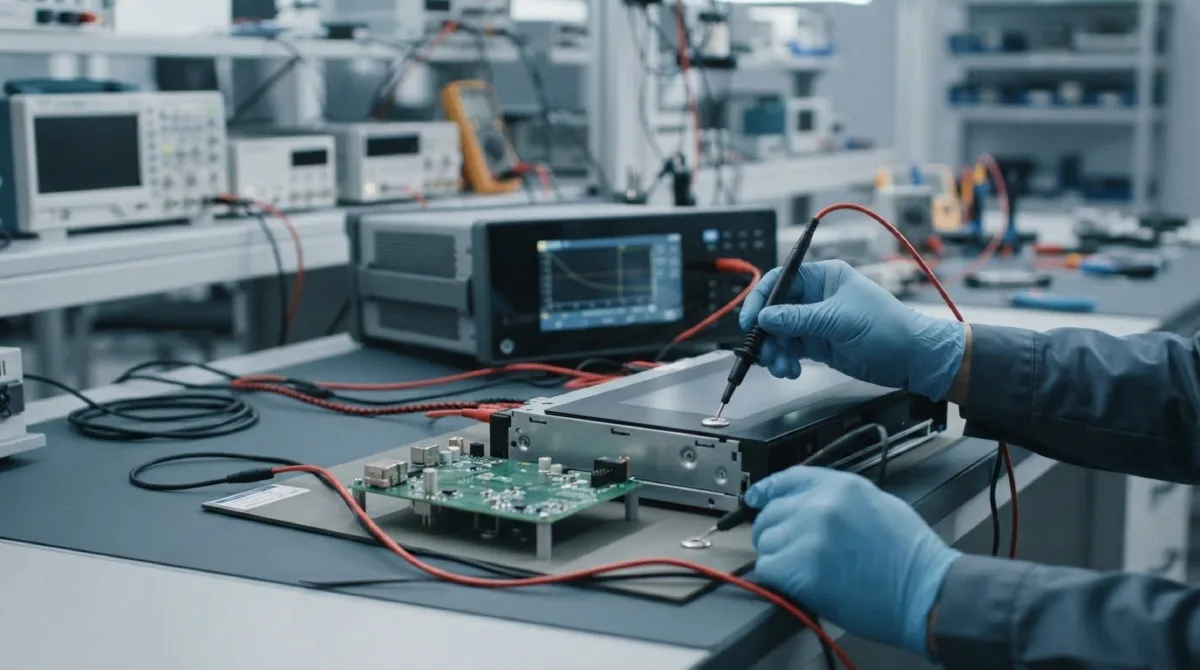
A product can switch on and still present an electrical hazard. Electrical safety testing for electronics uses checks such as dielectric withstand, leakage current, insulation resistance, and ground continuity to assess whether electrical protections perform as intended. The applicable requirements depend on the product and the market where it will be sold.
That matters because faults in insulation, protective grounding, or current control can put users at risk and cause problems after production. Testing helps identify these issues before devices reach consumers, while certification requirements provide an additional framework for assessing safety.
This guide explains what the main electrical tests measure, why they matter, and how standards differ across product categories and markets. You’ll also learn how safety assessments apply to consumer electronics and household appliances, so you can understand what testing can reveal and how product inspections fit into quality control.
Key Takeaways
- Identify which product standards and market rules shape the safety assessment your device needs.
- Understand what each electrical test checks and how test results can reveal weaknesses in protective measures.
- Compare how international requirements apply to different product categories, including consumer devices and appliances.
- Use product inspections at the right production stage to spot quality issues before goods are shipped.
Why Is Safety Testing Important?
Electrical safety testing checks whether a product’s design and construction control hazards such as electric shock, overheating, and fire. The applicable tests depend on the equipment, its users, and the markets where it will be sold.
Regulations and Equipment Classes
Product regulations set safety and performance requirements, while equipment classes describe how protection is designed. This distinction matters because a medical device, radio product, and industrial machine can require different assessments.
IEC 60601-1 addresses medical electrical equipment. Its classifications include Class I and Class II equipment, while applied parts may be Type B, BF, or CF. These distinctions guide assessment of protective measures and patient connections. IEC 60601.1, Section 3, covers general protection against electric shock hazards.
Market rules also shape the assessment. In the European Union, the Electromagnetic Compatibility Directive is 2014/30/EU. The Radio Equipment Directive may determine electrical-safety requirements for radio products. The EU Machinery Regulation, Regulation (EU) 2023/1230, was introduced in June 2023, and its requirements become mandatory in January 2027. ATEX requirements apply to equipment intended for potentially explosive atmospheres.
Equipment used to generate, transmit, and distribute energy needs assessment suited to its electrical hazards and intended operation. Laboratory equipment and consumer appliances also require product-specific evaluation, rather than a single test plan for every device.
Testing, EMC, and Certification
Electrical safety testing evaluates hazards such as leakage current and inadequate dielectric insulation. EMC testing checks whether equipment emits or tolerates electromagnetic disturbances. Product certification is a separate conformity outcome based on assessment against applicable requirements.
For safety testing, laboratories use instruments such as leakage-current analyzers and dielectric withstand testers. Costs depend on the instruments’ capabilities, voltage ranges, calibration needs, and intended tests. In the United States, Nationally Recognized Testing Laboratories (NRTLs) test products against safety standards and can certify eligible equipment. Manufacturers can then apply authorized certification marks.
For products made in factories, sample testing can help assess whether selected units match specified requirements before shipment. It complements laboratory safety evaluation; it doesn’t replace electrical testing or product certification.
Electrical safety tests: dielectric withstand, leakage current, insulation resistance, and ground continuity
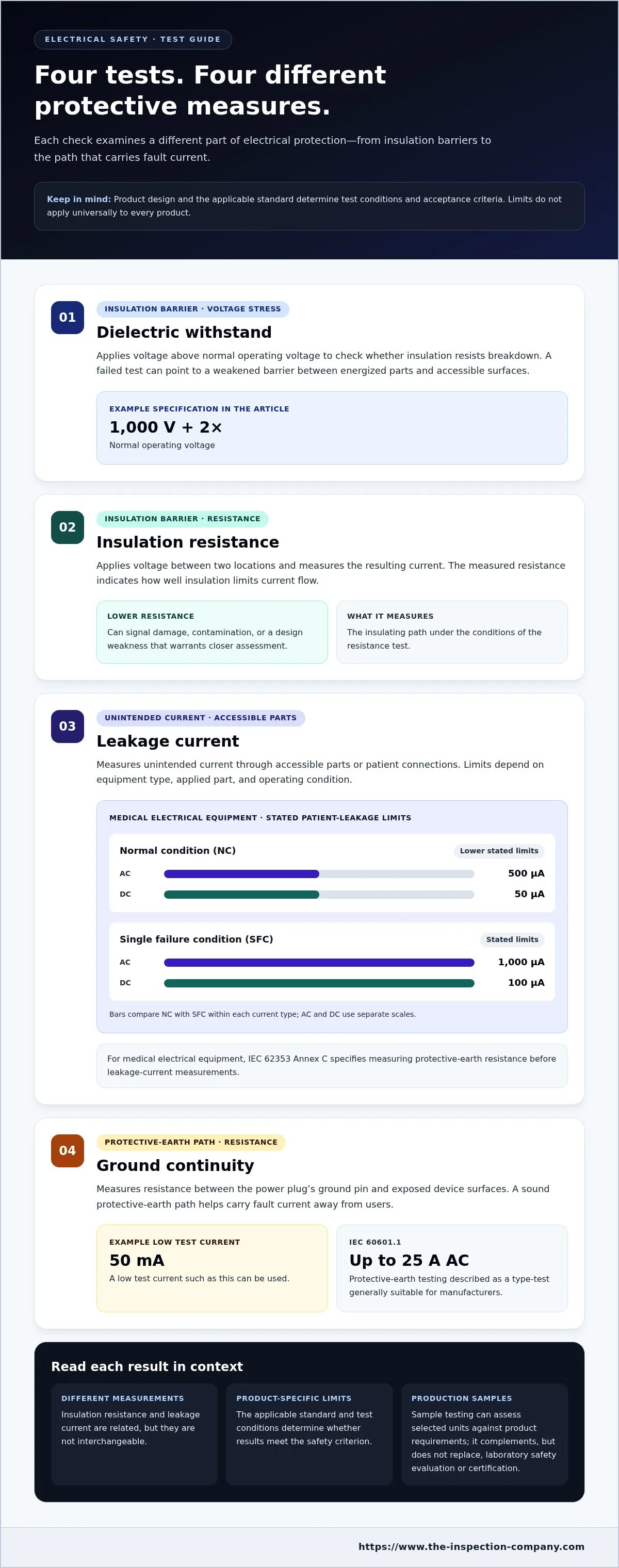
Each test checks a different protective measure, from insulation barriers to the path that safely carries fault current. The product’s design and applicable standard determine the test conditions and acceptance criteria.
Dielectric Withstand and Ground Continuity
A dielectric withstand test applies voltage above normal operating voltage to assess whether insulation resists breakdown. A typical specification is 1,000 volts plus twice the normal operating voltage. Dielectric-strength and insulation testing can help assess whether insulation withstands electrical stress. Failure can indicate a weakened barrier between energized parts and accessible surfaces.
Ground continuity testing measures resistance between the power plug’s ground pin and exposed device surfaces. A low test current, such as 50 mA, can be used. IEC 60601.1 describes protective-earth testing up to 25 amperes ac as a type-test generally suitable for manufacturers. A sound protective-earth path helps carry fault current away from users.
Insulation Resistance Measurements
An insulation resistance test applies voltage between two locations and measures the resulting current. The measured resistance indicates how well the material limits current flow across an insulation barrier. Low resistance can signal damage, contamination, or a design weakness that warrants closer assessment.
Insulation resistance and leakage current are related, but they are not interchangeable measurements. Resistance testing evaluates the insulating path under its test conditions; leakage testing measures current flowing through defined paths during operation or simulated conditions. For medical electrical equipment, IEC 62353 Annex C specifies measuring protective-earth resistance before leakage-current measurements.
Leakage Current Measurements
Leakage-current testing measures unintended current through accessible parts or patient connections. Leakage-current measurements can help assess unintended current through accessible parts or patient connections. Limits depend on the equipment type, applied part, and operating condition, so one threshold cannot be applied to every product.
For medical electrical equipment, stated patient-leakage limits include 500 μA AC and 50 μA DC in normal condition (NC). In single failure condition (SFC), the stated limits are 1000 μA AC and 100 μA DC. Test results must meet the applicable limit; dielectric breakdown or excessive leakage indicates a failed safety criterion. Testing instruments should meet IEC 61010-1, and modern hipot testers use electronic source technology to maintain required voltage for the specified duration.
For a production review, sample testing can assess selected units against product requirements, alongside laboratory electrical tests.
International electrical and electronic product safety assessment
International assessments match a product’s hazards, design, and intended markets to relevant safety standards. A pre-assessment and risk review can reveal design gaps before changes become more disruptive during production.
Safety Testing During Product Development
Development testing evaluates safety at design milestones and after repairs or modifications that affect protective measures. A changed power supply, insulation barrier, or accessible enclosure can alter leakage current or resistance results. Retesting affected functions helps identify whether the revision changes the product’s safety profile.
A pre-assessment compares technical documentation and product construction with applicable standards. A gap analysis can prioritize design improvements, such as strengthening insulation or revising a protective-earth connection. For gas and electrical products, assessment must consider each energy source and its distinct hazards.
Product Assessment and Certification Costs
Third-party assessment combines technical review and testing, and may include certification against relevant requirements. In the United States, costs depend on product complexity, applicable standards, test scope, documentation, and design changes needed after failures.
Early risk assessment can help manufacturers focus testing on critical hazards and avoid repeat evaluations caused by late design changes. Once products enter production, manufacturers can use production-line testing to help confirm ongoing compliance with applicable safety standards. Production controls help maintain consistency, but they don’t replace the initial product assessment.
Applicable US Standards
US requirements depend on product category and use. The International Electrotechnical Commission references IEC 62368-1 for the safety of information technology and audio/video equipment. Medical devices may require safety testing and certification tailored to their intended use.
UL standards may form part of an NRTL evaluation, while IEC standards can support international assessment. The IECEE CB Scheme covers 50+ countries, helping organize recognition of test results across participating markets. A consumer device, medical product, and laboratory instrument may therefore need different technical evidence. Matching the standard to intended use is central to a defensible assessment.
Consumer electronics and household appliances
Consumer devices and household appliances can expose users to electric shock, fire, or heat hazards. A charger, blender, or television may use different protective designs, so assessment considers its construction and intended use. Laboratories examine components, insulation, grounding, and enclosure features, then test against relevant safety standards. The goal is to identify product-specific risks, not apply an identical test plan to every device.
For example, an appliance with accessible metal parts relies on effective protective grounding or insulation. A handheld electronic device may need assessment of its power supply, casing, and leakage current. Testing also considers whether a product behaves safely during normal use and relevant fault conditions. A medical device follows a different path: IEC 60601 addresses medical electrical equipment, while consumer appliances are assessed against standards suited to their product category.
Certification marks can help buyers understand that a product has undergone a safety assessment. NRTL-certified electronics undergo independent testing against safety standards for intended use in the United States. NRTLs authorize manufacturers to apply marks to eligible products and conduct factory inspections for certified products. A CE mark is not a certification mark, and a CE-labeled product may not have been tested by a third party. These distinctions matter when assessing what a label demonstrates.
Survey findings show that consumer awareness and purchasing behavior vary. One survey reported 80% familiarity with NRTLs and 76% awareness of what NRTL certification means. Another reported that 33% were more likely to purchase certified items, while 50% said they look for certification when buying electronics. A separate reported result found 73% said certification did not affect their purchase decision. For manufacturers, clear evidence of testing helps retailers and consumers assess product safety claims. For buyers, checking the mark and product category can clarify what was assessed.
The Inspection Company: Pre-Shipment Inspection
The Inspection Company helps importers assess finished goods before shipment through Pre-Shipment Inspection. This is useful when production is complete and you need to identify visible defects or specification mismatches before products leave the factory. It complements electrical safety testing but does not replace laboratory testing or product certification.
For electronics, an inspection can compare sampled units with agreed product requirements and document findings. The Inspection Company provides a detailed report with photos within 24 hours of the inspection, helping you decide whether to approve or reject a shipment before it leaves the factory. During Production Inspection can provide an earlier quality checkpoint while manufacturing is underway.
For an inspection plan suited to your product and shipment stage, contact The Inspection Company.
Turn Safety Findings Into Production Controls
Testing is most useful when its findings inform decisions beyond the laboratory. Translate identified risks into clear product requirements, inspection criteria, and production checks. This helps teams track whether the approved design and finished goods remain aligned as manufacturing progresses.
Electrical safety testing for electronics can inform quality checkpoints before shipment, during production, and while goods are loaded. The Inspection Company offers Pre-Shipment Inspection, During Production Inspection, and Container Loading Inspection to help importers assess product and shipment conformity at these stages. These inspections complement technical safety evaluations; they do not replace laboratory testing or certification.
Choose the checkpoint that matches your production stage and the risks you need to manage. A defined plan can help your team make timely decisions and address quality issues before they cause avoidable disruption.
Contact The Inspection Company to discuss an inspection plan for your products. A practical next step can bring greater control to your quality process.
Frequently Asked Questions
What is the Low Voltage Directive (LVD) (2014/35/EU) and what types of electrical equipment does it apply to?
The Low Voltage Directive (LVD), 2014/35/EU, applies in the EU to electrical equipment rated from 50 to 1,000 volts AC and from 75 to 1,500 volts DC. That includes equipment designed for use within those voltage ranges, across product categories. A manufacturer assessing a device should first establish its rated input and intended use, then identify the relevant product-specific safety requirements.
Why Choose These Testing Standards?
Choose standards that match the product’s function, users, design, and destination markets. A standard for a medical device will not automatically suit a household appliance or information technology product. Applying relevant criteria gives manufacturers a consistent basis for evaluating hazards and documenting design decisions. It also helps prevent gaps caused by selecting a familiar standard that does not address the product’s actual use.
What is electrical safety testing for electronics?
Electrical safety testing for electronics is a structured evaluation of whether a product’s electrical design controls risks during its intended use. It examines protective features and test results against criteria relevant to the product category. For example, an assessment of a battery-powered handheld device may consider its charger and accessible conductive parts as well as the device itself, since the complete use arrangement affects exposure to electrical hazards.
Which electrical safety tests are commonly performed on electronic products?
Common tests include protective-earth continuity, insulation resistance, dielectric withstand, and leakage-current measurement. A test plan may also include functional checks and examination of wiring, markings, enclosures, and power supplies. The appropriate combination depends on the product’s construction and applicable standard. For instance, equipment with a protective-earth connection needs a different assessment focus from a double-insulated device without one.
How do you perform an electrical safety test on an electronic device step by step?
Start by identifying the device’s intended use, construction, and applicable standard. Review its circuit diagrams and safety-critical components, then inspect the unit for visible damage or assembly issues. Select calibrated test equipment suited to the required measurements. Perform the standard’s prescribed checks in sequence, record the conditions and results, and compare them with its acceptance criteria. Retest after relevant design changes or repairs.
What are the limits for leakage current, dielectric withstand, and ground bond tests?
There is no single limit for every product; acceptance criteria come from the applicable standard and test conditions. For medical electrical equipment, stated patient-leakage limits are 500 μA AC and 50 μA DC in normal condition, and 1000 μA AC and 100 μA DC in single failure condition. A typical dielectric specification is 1,000 volts plus twice normal operating voltage. Ground-bond current is a test condition, not an acceptance limit.