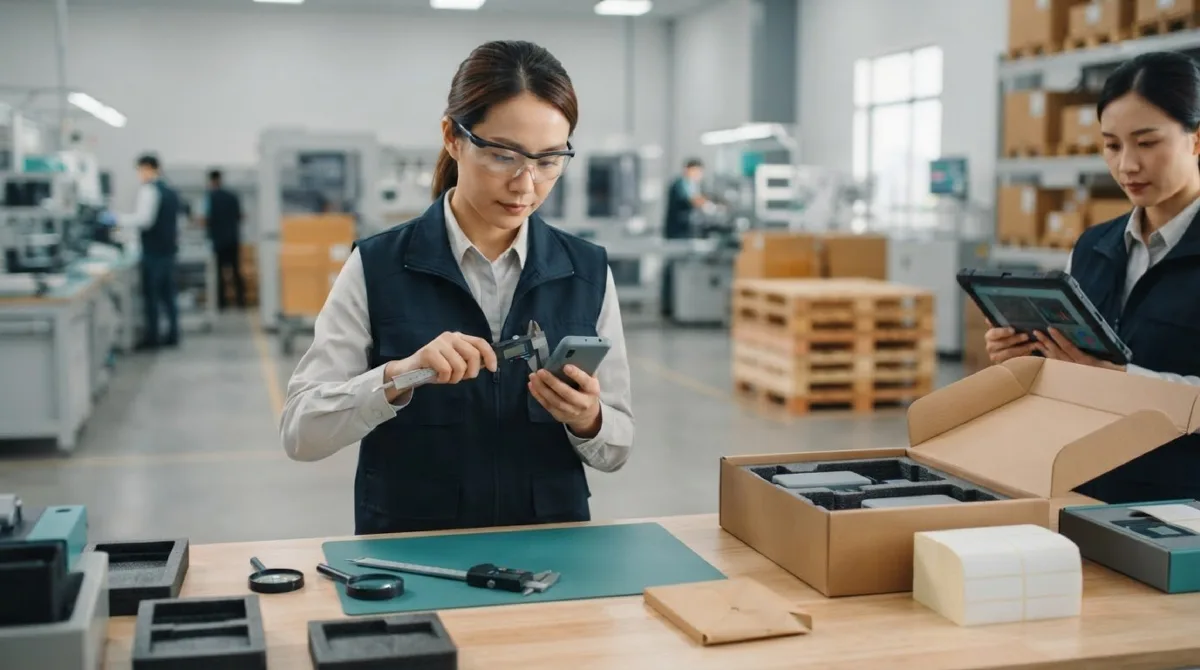
An effective Amazon FBA quality control strategy checks product quality, dimensions, labels, packaging, and defects before goods ship. Inspectors use sampling and agreed acceptance criteria to identify problems while there is still time to address them at the factory. These checks help sellers assess whether an order matches its specifications and is ready for fulfillment.
It is easy to focus on the final inspection, but quality control can also happen during production, when issues may be easier to correct. The inspection method and timing determine what gets checked, how defects are classified, and what the findings mean for your shipment.
This guide explains the quality-control services available to Amazon sellers, when inspections can take place, and how findings are assessed. It also covers product safety standards, so you can understand what inspections can verify and when compliance documentation matters.
Key Takeaways
- Understand what product, packaging, labeling, and defect checks can reveal before inventory reaches Amazon customers.
- Learn why safety-standard checks and compliance documentation are distinct considerations, especially for children’s and food-contact products.
- See how production-stage and pre-shipment inspections can catch different problems while there’s still time to address them.
- Evaluate inspection performance by looking at clear criteria, useful evidence, and timely reporting, not just whether an inspection took place.
Can the quality control company also verify that the products comply with mandatory safety standards?
An inspection can check products against specifications, labels, packaging requirements, and supplied compliance documents. Physical verification can identify mismatches, such as a missing warning or a label that names the wrong material. However, inspection alone does not certify that a product meets every legal requirement. The applicable standard depends on the product, its intended use, and the market where it will be sold.
For children’s products, CPSIA is a relevant compliance reference, according to the U.S. Consumer Product Safety Commission. Food-contact products may require FDA compliance review. Chemical disclosures can also matter: as of July 31, 2026, the California Office of Environmental Health Hazard Assessment shows 1 to 10 of 879 entries for chemicals. That list is a useful example of why product materials and market-specific obligations deserve attention. An inspection can compare visible product details with submitted documents, but paperwork and testing evidence remain important to a full compliance assessment.
Preparing inventory for FBA also depends on accurate packaging and identification. A quality inspection can compare carton markings, product labels, barcode placement, and packaging condition with the approved specifications and shipment plan. For example, if the packaging shows one model but the label identifies another, the mismatch can cause confusion during receiving or fulfillment. Checking label legibility and packaging consistency helps catch errors before dispatch.
Include safety and FBA checks in one verification record. List the product model, intended market, required label text, packaging artwork, and relevant compliance documents. Compare samples against that checklist and record discrepancies with photographs and clear descriptions. Distinguish a packaging defect from a gap in safety documentation, since each needs a different correction. This structured review helps catch avoidable labeling errors and highlights unresolved compliance questions before shipment.
What Exactly Does a Quality Control Service Company Do for Amazon Sellers?
Amazon may suspend an account for repeated order defect rates (ODR) above 1% or policy violations. Checks against product specifications, listing details, and AQL criteria help identify defects before shipment.
Defect-Related Returns and Losses
A defect can lead to a return or refund when an item does not match its listing or performs poorly. Returns can also waste advertising spend: a campaign may bring a customer to a product that fails to meet expectations. For example, a listing that promises a complete set can disappoint customers if a component is missing. Track complaint reasons to identify which defects need correction.
Defective Item Handling and Reporting
Handling defective items starts with documenting each failure clearly and separating affected goods from acceptable units. An inspection report can identify the product model, defect type, affected sample, and supporting photo. The supplier can use these details to investigate the production cause and correct the issue. Distinguishing a cosmetic flaw from a functional failure supports targeted corrective action and follow-up checks.
Defect Metrics and AQL Checks
Defect metrics classify inspection findings and compare them with an agreed acceptance threshold. AQL sampling provides a consistent basis for assessing a production lot, rather than relying on a few informal spot checks. The cited guidance describes AQL 4.0 for minor defects and AQL 2.5 for major defects. Level II sampling with 1.5 for major defects is an example of a stricter inspection plan.
Record defect categories and results by supplier and production run. Comparing these records can reveal recurring problems and show whether corrective actions are working.
Common Defects in FBA Audits
An FBA inspection can identify visible damage, missing components, incorrect dimensions, finish flaws, or packaging that differs from the approved sample. Checks can also flag mismatches between the product, its advertised features, and included accessories. For example, the stated quantity in a set should match the pieces in the box. Record each issue by type to distinguish isolated damage from recurring supplier problems.
Production-stage inspections for Amazon FBA products
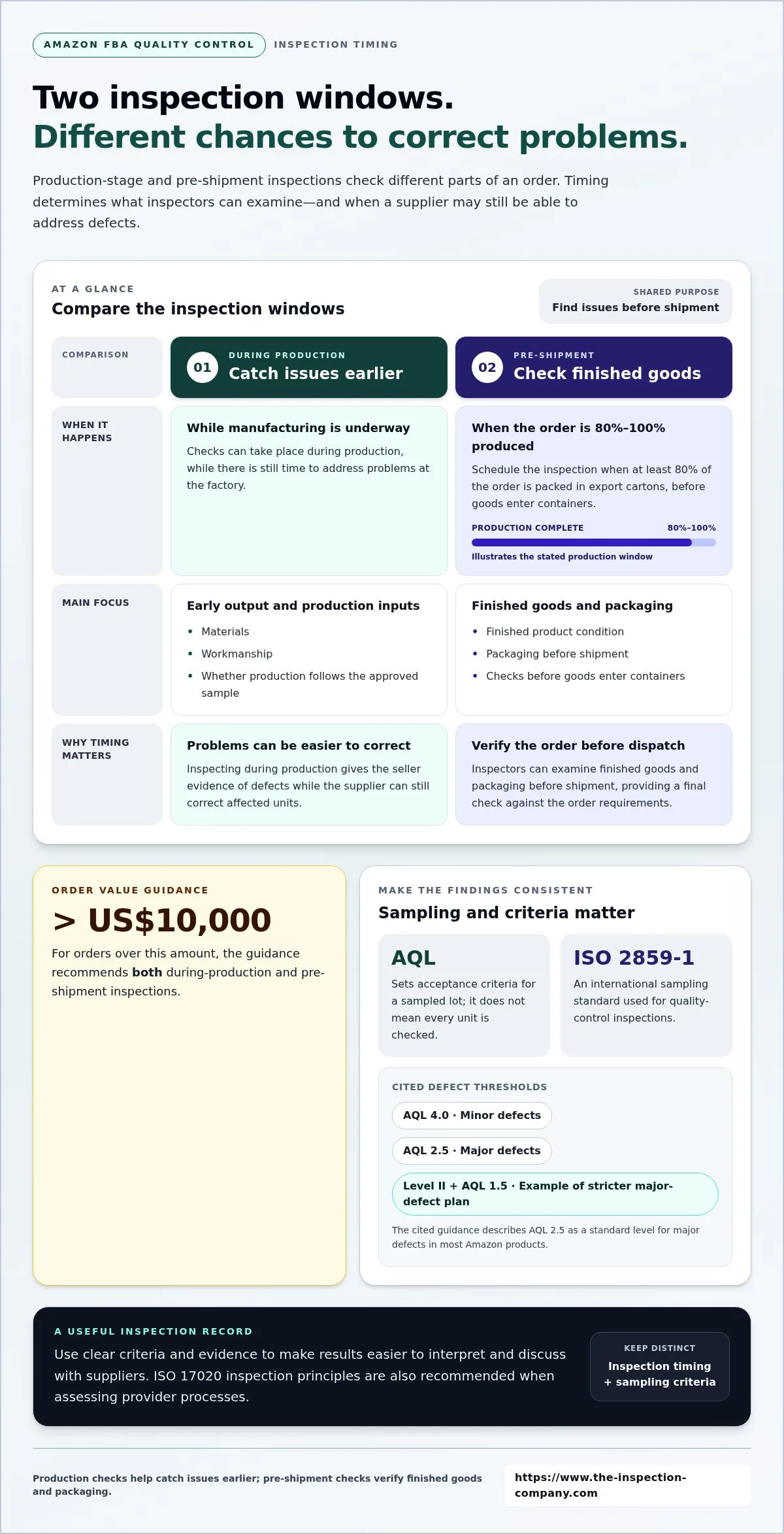
Production-stage inspection checks goods while manufacturing is underway or before shipment. That timing gives a seller evidence of defects while the supplier can still correct affected units. It matters most when an order grows from 500 to 5,000 units, because the same production flaw can then affect far more inventory. A quality inspection can also help protect profit by catching defects before they generate returns or damage customer confidence.
During-production checks focus on early output, materials, workmanship, and whether production follows the approved sample. A pre-shipment inspection takes place when an order is between 80% and 100% produced, before goods enter containers. Schedule it when at least 80% of the order is packed in export cartons. This allows inspectors to examine finished goods and packaging before shipment. For orders over US$ 10,000, the guidance recommends both during-production and pre-shipment inspections.
Sampling makes inspection results more consistent. ISO 2859-1 is an international sampling standard used for quality-control inspections. The cited guidance describes AQL 2.5 as a standard level for major defects in most Amazon products. AQL sets acceptance criteria for a sampled lot; it does not mean every unit is checked. ISO 17020 inspection principles are also recommended when assessing provider processes. Clear criteria make results easier to interpret and discuss with suppliers.
Strong evidence connects each finding to a corrective action. Inspection records should identify the product, defect, sample, and supporting photos, so the supplier can investigate and respond. A 5,000-unit shipment, for example, can be inspected before leaving the factory. The cited guidance says 70-80% of negative product reviews cite quality issues, underscoring the commercial stakes. After 3 to 5 reorders, arrange an inspection before final payment. Standard supplier payment terms are a 30% deposit and 70% before shipping. Aligning inspection timing with payment milestones gives both parties a documented basis for resolving defects.
Quality-control service performance metrics
Measure inspection performance by the evidence and decisions it enables, not inspection count alone. A useful benchmark is report delivery within 24 hours of inspection. Timely findings give sellers a chance to assess defects before shipment decisions become harder to change. A detailed report with photos can show where a serious issue appears and help distinguish a product defect from handling damage.
Assess report quality by checking whether findings are clear and actionable. Each finding should identify the product or batch, defect category, sample examined, and relevant specification. Photos should show the issue clearly, ideally with a reference point or comparison to the approved sample. For example, a photo of a misaligned component is more useful when the report records its location and inspection result. Missing details can slow supplier follow-up.
Track whether inspection findings lead to a resolution. Record the number and type of findings, the supplier’s corrective action, and whether a follow-up check confirms the fix. Compare results across production runs to see whether defects recur. A repeated packaging flaw, for example, may indicate a process problem rather than damage to one unit. These records turn an inspection into a supplier-quality trend.
- Timeliness: compare inspection completion with report delivery, using 24 hours as a practical reporting benchmark.
- Evidence: check that photos and defect descriptions support each finding.
- Action: record supplier responses and follow-up outcomes for each serious issue.
Consider the metrics together. A fast report without clear photos may not give you enough evidence to assess a negative finding. A complete report delivered after goods ship may arrive too late to inform a factory decision. Review an inspection record from start to finish, checking timing, evidence, defect classification, and follow-up. This shows whether the process gives you useful control before inventory moves onward.
The Inspection Company: Pre-Shipment Inspection
The Inspection Company’s Pre-Shipment Inspection helps sellers review finished goods before they leave the factory. It is scheduled when at least 80% of the order is packed in export cartons, so inspectors can assess product condition, workmanship, packaging, and consistency with the approved specifications. Findings give you documented evidence for shipment decisions while the goods remain at the factory.
For issues that may emerge during manufacturing, a During Production Inspection can identify problems before the full order is complete. Container Loading Inspection focuses on loading, while Factory Audits assess the factory’s operations. The Inspection Company provides a detailed report with photos within 24 hours of inspection, helping you review findings and decide on next steps. To discuss an inspection for your Amazon inventory, contact The Inspection Company.
Make Quality Checks Part of Every Reorder
A reliable Amazon FBA quality control strategy should evolve with your product, supplier, and customer feedback. Treat each inspection as a decision point and carry its findings into the next production run. If a defect recurs, update the acceptance criteria and focus future checks on that issue. If specifications change, revise the inspection reference before manufacturing begins. This makes quality control a practical feedback loop, not a one-time shipment check.
The Inspection Company provides Pre-Shipment Inspection (PSI), During Production Inspection (DuPro), and Container Loading Inspection (CLI) to assess goods at different stages. Choose the timing that matches the risk you need to manage, whether you want to review production progress or check a finished order before dispatch.
Set your next inspection around the product requirements and the decision you need to make. Contact The Inspection Company to discuss the right inspection stage for your Amazon inventory. A clear plan can help you move forward with greater control.
Frequently Asked Questions
What Happens If I Skip Professional Quality Control and Trust My Supplier?
Relying only on the supplier’s checks and criteria may leave your approved product specifications unverified. A defect can remain hidden until a customer uses the item, making correction more disruptive. For example, a supplier may focus on appearance while overlooking whether an accessory works with the main product. Clear specifications and documented checks help align expectations and reveal differences earlier.
Can I just do a quality check when the goods arrive at me?
An arrival check can identify issues before you send inventory onward to Amazon. It may be less practical for factory correction because goods have already left production and may need sorting, rework, or return arrangements. Separate questionable units from sellable stock, then compare them with your approved sample and product requirements. This keeps suspected defects out of available inventory.
How Can a QC Company Directly Save an Amazon Seller Money?
A quality control company can help limit the number of nonconforming units that reach customers. To assess the financial impact, compare inspection findings with potential costs for returns, refunds, replacements, and wasted advertising spend. Consider whether defects can be corrected before dispatch or require handling after arrival. The value depends on the defect type, affected quantity, product margin, and resolution costs.
How Do I Choose the Right Quality Control Partner for My Amazon Business?
Match the inspection scope to your product and supplier risk. The Inspection Company’s Amazon FBA Service checks labeling, packaging, and product quality. Its Factory Audits assess supplier capabilities, quality management systems, and social compliance. For example, a seller assessing a new manufacturing relationship may need a factory audit, while a seller checking a finished order needs product inspection. Choose the service that fits the decision you need to make.
What is an effective quality control strategy for Amazon FBA sellers?
An effective Amazon FBA quality control strategy connects written specifications, inspection findings, and customer feedback. Keep one approved reference for product details, packaging, and listing claims, then log return reasons against those requirements. If a material, component, or packaging design changes, review the reference before placing the next order. This makes recurring problems easier to trace to a product change or supplier process.
What are Amazon FBA product quality and safety requirements in the US?
Requirements depend on the product category, materials, and intended use. For children’s products, the U.S. Consumer Product Safety Commission identifies CPSIA as a relevant certification. FDA compliance is relevant for food-contact products. Distinguish a physical quality inspection from compliance evidence: checking a label or product sample does not establish that all applicable safety requirements are met.