
A decent work audit assesses whether an organization’s practices align with SA8000 principles, including worker participation, grievance mechanisms, supply-chain responsibility and the handling of non-compliance. SA8000:2026 sets out principles and criteria for decent work in any context, with Section 1 covering management systems and Section 2 covering decent-work principles and performance criteria. The findings matter as much as the checklist: they show where evidence supports compliance and where corrective action is needed.
For buyers and businesses, an audit lavoro dignitoso, or decent work audit, can reveal workplace problems that paperwork alone may miss. This guide explains what auditors review, how workers can participate and raise concerns, and how findings are documented and addressed. It also explores responsibility across the supply chain and when a factory audit can help identify operational risks before they cause costly disruption.
Key Takeaways
- Understand how SA8000 separates management systems from decent-work principles and performance criteria.
- Learn how social audits gather evidence across supplier sites and turn non-compliance into corrective action.
- See how balanced worker and management representation supports participation, while grievance channels help surface concerns.
- Recognize what a useful audit report should document, so findings can guide follow-up and improvement.
SA8000 standard and its principles for decent work
SA8000:2026® sets criteria for decent work across different contexts. An audit compares workplace practices and records with those criteria and applicable labor standards.
SA8000 Purpose and Principles
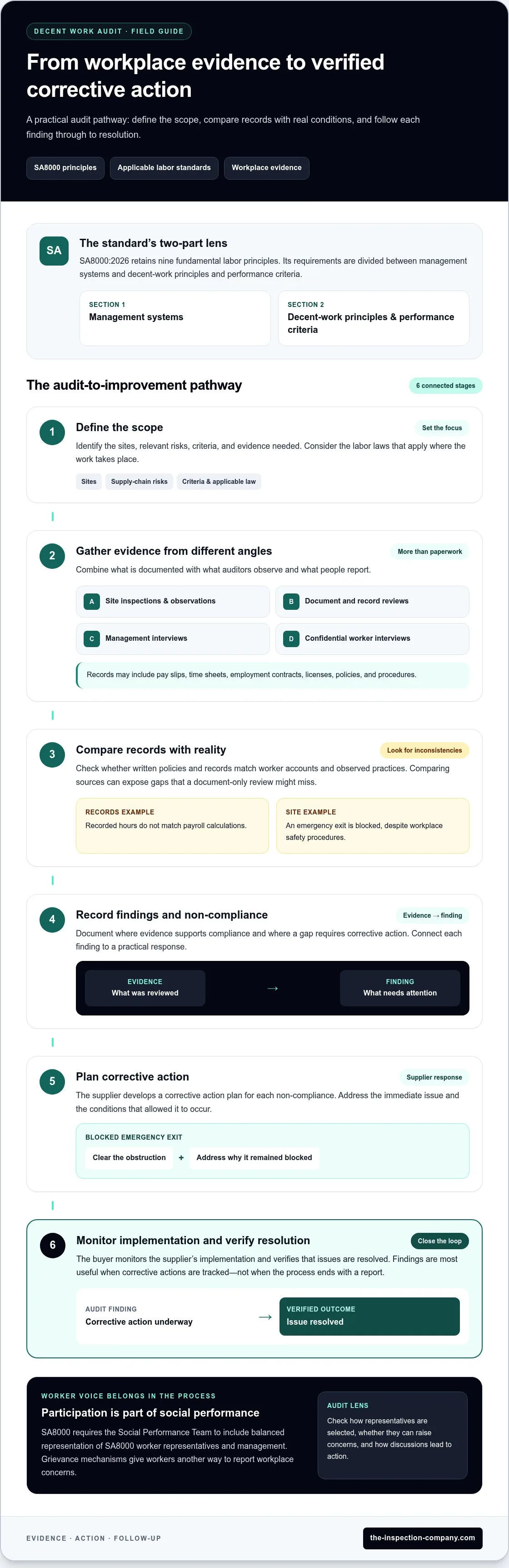
Social Accountability International developed SA8000 and first published the standard in 1997. Its 2026 edition retains nine fundamental labor principles and divides requirements between management systems and workplace performance. Section 1 covers management systems; Section 2 covers decent-work principles and performance criteria. When assessing a workplace, look for evidence that policies operate in practice, not only in written procedures. A social audit can examine this connection through records, interviews, and site observations.
How do internal labor audits compare with independent third-party audits? Internal audits help an organization monitor its own systems and identify issues to correct. Independent audits add an external assessment, giving buyers evidence beyond the organization’s own review.
Labor Standards and Legal Compliance
SA8000 assessment should be considered alongside the labor laws that apply where work takes place. Review employment contracts, payroll records, time data, and workplace procedures together. A policy may appear sound while actual records reveal a gap, such as hours that do not match payroll calculations. Auditors can compare documents with worker accounts and observed practices. This helps distinguish a paperwork weakness from a recurring workplace problem.
In the United States, nonexempt workers must receive at least one and one-half times their regular rate for work after 40 hours in a workweek, according to the U.S. Department of Labor. Compliance reviews should therefore compare recorded hours, pay rates, and wage calculations against the applicable requirements.
Decent Work Indicators and Measures
What are the ILO decent work indicators and standards? They are measures for assessing productive employment, rights at work, social protection, and worker voice. To review fair wages, compare pay records with hours worked and the applicable wage criteria. To assess working hours, compare time sheets with payroll and worker accounts. To review job security, examine contract terms and employment status, then check whether actual practices match those terms.
How much does a decent work or labor audit cost in the United States? Cost depends on the audit’s scope, site location, workforce, records, and required travel; a quote follows a request. These factors shape the work involved, so define the sites, criteria, and evidence needed before setting the audit scope.
Supply-chain responsibility and continuous improvement
A supplier’s workplace practices can affect worker welfare and buyer risk. A social audit turns concerns into evidence, priorities, and follow-up actions.
Supply-Chain Social Audit Value
A social audit can assess labor rights, health and safety, environmental practices, and business ethics. Define the scope during preparation to focus on the sites and risks most relevant to the supply chain. Evidence may come from site inspections, document reviews, management interviews, and confidential worker interviews. Together, these sources help compare written procedures with actual workplace conditions.
Social audits can also support companies addressing supply-chain legislation. Sedex describes the German Supply Chain Due Diligence Act (LkSG) and the CSDDD as legislation for which social audits can help companies meet requirements. An audit is most useful when its findings lead to tracked corrective actions, rather than simply a completed report.
Workplace and Supply-Chain Risk Analysis
Risk analysis should connect workplace conditions at each site with the buyer’s wider supplier relationships. Define the audit scope, then review relevant records and practices against the issues identified during preparation. Auditors may examine pay slips, time sheets, employment contracts, and licenses. Comparing records with site observations and interviews can reveal inconsistencies a document-only review might miss.
Supplier audits may be scheduled with advance notice. Use the findings to prioritize corrective action, then monitor whether the supplier implements it. For example, a finding about a blocked emergency exit calls for clearing the obstruction and addressing the conditions that allowed it to remain blocked.
Worker Safety and Health Assessment
How are worker safety and health assessed in a decent work audit? Auditors examine workplace conditions, safety procedures, relevant records, and worker accounts. They compare documented controls with site observations and record gaps requiring action. Each finding should connect to a practical response, such as updating a safety procedure or providing suitable equipment.
After the audit, the supplier develops a corrective action plan for each non-compliance. The buyer monitors implementation and verifies that issues are resolved. A social audit focused on supplier practices can help buyers organize this evidence and follow-up process.
Worker participation and grievance mechanisms
Worker input helps auditors compare management procedures with employees’ experiences. A decent work audit typically defines its scope, reviews relevant policies, gathers workers’ and management’s perspectives, and records findings for follow-up.
Worker and Stakeholder Participation
SA8000 requires its Social Performance Team to include balanced representation of SA8000 worker representatives and management. This structure gives workers a formal role in reviewing social performance, rather than leaving decisions solely to supervisors. An auditor can examine how representatives are selected, whether they can raise concerns, and how the team’s discussions lead to action.
Grievance mechanisms give workers another way to report workplace concerns. Assess whether employees understand how to use the process, who receives complaints, and how responses are tracked. A procedure that exists on paper but is unfamiliar to workers may not provide an effective way to raise problems. The UN Guiding Principles on Business and Human Rights establish a “Protect, Respect and Remedy” framework for states and businesses, placing remedy alongside respect for human rights.
Worker Interviews and Management Input
Worker interviews help auditors understand whether workplace rules match daily experience. Management interviews provide context about procedures, responsibilities, and how complaints are handled. Comparing accounts can flag issues for further review, such as employees describing a concern that managers believe has already been resolved. Interviews are most useful when questions are clear and responses are considered alongside records and observations.
To assess participation, examine how concerns move from reporting to resolution. Review complaint records for the issue raised, action taken, and follow-up status, while protecting workers’ privacy. Ask whether employees can raise issues without relying only on their direct supervisor. Then compare management’s explanation with worker accounts and the documented process. This helps show whether a grievance channel works in practice or needs improvement.
Audit findings and non-compliance reports
A clear audit report distinguishes good practices from non-compliance and explains which issues need attention. Once violations are identified, the company should document corrective actions, assign responsibility, and track implementation until each issue is resolved.
Documenting Findings and Non-Compliance
A detailed report links each finding to its supporting evidence. It summarizes good practices and lists issues requiring attention, giving management and buyers a practical basis for follow-up. For example, auditors at an electronics factory may compare payroll records with time-measurement data to identify incorrect overtime pay. Recording the discrepancy and its supporting evidence makes the finding easier to investigate and address.
For wage reviews, the Internal Revenue Service advises reconciling wages recorded in the books with wages reported on employment tax returns. Comparing these records can reveal inconsistencies that require further review. A useful report also explains what evidence supports each concern, rather than presenting conclusions without context.
Responding to Identified Violations
What should companies do after a decent work audit identifies violations? The supplier should develop a corrective action plan for each instance of non-compliance, while the buyer monitors implementation and verifies resolution. The plan should identify the corrective step, the person responsible, and how completion will be evidenced. This turns each finding into a trackable improvement process.
For missing overtime wages, a buyer can work with the supplier to pay workers what they are owed and correct the payroll system to prevent repeat errors. For a blocked emergency exit, the response is to clear it immediately and address the underlying safety issue. Follow-up evidence should demonstrate that the action was completed and the problem corrected. To discuss an audit finding or supplier follow-up, contact the audit team.
The Inspection Company: Pre-Shipment Inspection
The Inspection Company helps importers assess factory and product risks through Factory Audits and Pre-Shipment Inspection. A Factory Audit can provide insight into a supplier’s operations, while a Pre-Shipment Inspection checks goods before they leave the factory. These services support purchasing decisions, but a product inspection is not a substitute for SA8000 certification or a social compliance audit.
When goods are ready for dispatch, inspection findings can help buyers decide whether to approve or reject a shipment. The Inspection Company provides a detailed report with photos within 24 hours of the inspection. This gives purchasing teams documented product information to consider alongside supplier audit findings and corrective-action records.
Contact The Inspection Company to discuss inspection needs for an upcoming order.
Turn audit insight into stronger purchasing decisions
Audit findings can inform ongoing supplier decisions, not just a single review. Use a decent work audit to identify supplier practices needing continued attention, then carry those priorities into future purchasing discussions. Keep social performance and product quality distinct, while considering both when assessing supplier relationships and planning orders.
The Inspection Company offers During Production Inspection (DuPro), Pre-Shipment Inspection (PSI), and Container Loading Inspection (CLI). These checks provide product information at different order stages, complementing the supplier insight from a decent work audit. Choose the inspection stage based on the order’s progress and the information your team needs for its next decision.
Start by identifying the supplier or order that needs attention, then define what evidence would support your next decision. A clear scope turns concerns into practical steps. Contact The Inspection Company to discuss your inspection requirements and move forward with greater clarity.
Frequently Asked Questions
What does a decent work audit evaluate?
A decent work audit evaluates whether workplace systems and actual practices align with the labor criteria selected for review. Auditors compare policies with site conditions and worker accounts, then record gaps and effective practices. Before fieldwork, define the facilities, worker groups, and topics in scope. This helps readers interpret the findings and understand which areas the assessment covered.
What labor laws and workplace standards apply to decent work audits in the United States?
Audits compare workplace practices with requirements applicable to the site and workforce, alongside selected standards such as SA8000. The U.S. Department of Labor states that nonexempt workers must receive at least one and one-half times their regular rate for work after 40 hours in a workweek. Keep worker classification and relevant jurisdiction clear when reviewing payroll and time records.
How do audits evaluate freedom of association and collective bargaining?
Auditors examine whether workplace policies and practices allow workers to raise shared concerns and participate in representation processes. They may review relevant agreements, meeting records, grievance procedures, and management responses. Comparing these documents with workers’ accounts helps identify gaps between formal policy and workplace experience. The assessment should also consider whether employees know how to raise concerns safely.
What are the risks and limitations of social compliance audits?
A social audit provides evidence from its defined scope and visit, not a complete guarantee of every workplace condition. Advance notice can give a site time to prepare, while limited records or worker access can leave gaps. Buyers should interpret findings alongside the audit scope and evidence sources, then track corrective actions. An audit identifies issues; sustained improvement depends on follow-through.
What documents and evidence should employers prepare for a labor audit?
Prepare current workplace policies, the organization chart, safety procedures, training records, grievance-process documents, and records of previous corrective actions. Organize materials by site and topic so auditors can trace how a policy is applied. For example, pair a safety procedure with relevant training evidence and follow-up records. Keep explanations of unusual entries available to clarify the evidence during review.