
Your factory’s handwritten test report isn't a legal shield; it's a liability that can lead to your entire shipment being seized at the border. With the FDA annual establishment registration fee rising to $11,423 for fiscal year 2026, the cost of a single regulatory oversight has never been higher. You likely feel the pressure of deciphering a complex web of CPSC, FCC, and ASTM acronyms while worrying about the July 8, 2026, deadline for electronic filing of Children’s Product Certificates. It’s a high-stakes environment where a simple mistake can sink your brand's reputation and your bottom line.
This guide simplifies the product compliance testing usa landscape to help you secure your supply chain against costly failures. You’ll learn how to navigate the shift toward digital traceability and secure verified test results that satisfy both US Customs and Amazon. We provide a clear roadmap for risk mitigation, covering everything from the latest FCC certification costs to the new continuous verification standards required for 2026. By bridging the gap between Asian production and US regulations, you can stop problems before your shipment sails.
Key Takeaways
- Identify the specific safety, chemical, and labeling standards enforced by the CPSC to prevent shipment rejections at the border.
- Distinguish between the Children’s Product Certificate (CPC) and the General Certificate of Conformity (GCC) to ensure your documentation is legally sound.
- Learn why integrating product compliance testing usa into your Pre-Shipment Inspection (PSI) is the only way to guarantee sample integrity.
- Avoid the "Golden Sample" trap by using independent inspectors to select testing samples rather than relying on factory-provided units.
- Discover how proactive on-site verification serves as a high-return investment that stops costly compliance failures before your goods leave the factory.
Understanding US Product Compliance Standards in 2026
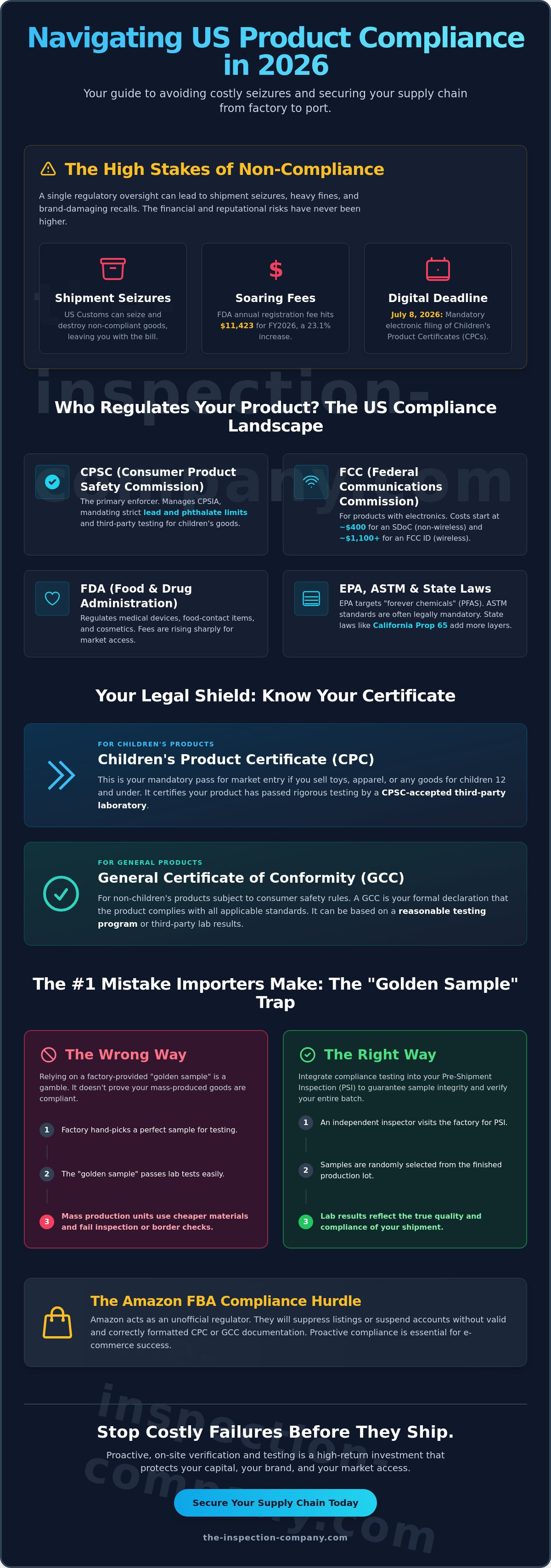
Product compliance isn't a single checkbox. It's the critical intersection of mechanical safety, chemical limits, and accurate labeling. The Consumer Product Safety Commission (CPSC) acts as the primary enforcer of federal standards, but they don't work alone. Importers often confuse "voluntary" standards, like those from ASTM International, with optional ones. In reality, these are frequently incorporated into federal law, making them mandatory for anyone wanting to sell on the US market. For a deeper look at these regulations, see our Product Compliance: The Importer’s Guide.
The financial impact of overlooking these requirements is severe. Beyond simple delays, non-compliance leads to customs seizures, heavy fines, and total product recalls that can bankrupt a brand. When US Customs (CBP) flags a shipment, you're responsible for storage and destruction costs, which often exceed the original value of the goods.
The Legal Framework: CPSIA and Beyond
The Consumer Product Safety Improvement Act (CPSIA) serves as the bedrock of product compliance testing usa. It mandates strict lead and phthalate limits and requires third-party testing for children's goods. As of July 8, 2026, the CPSC requires the electronic filing of certificates of compliance with US Customs. This shift toward digital traceability means your paperwork must be perfect before the ship leaves the dock. Understanding Conformance Testing is essential here; it isn't just about passing a test once but proving your goods meet specific standards every time.
Industry-Specific Regulators (FCC, FDA, EPA)
If your product has a battery or a plug, you'll likely deal with the FCC. For non-wireless items, an SDoC starts around $400, while wireless functions require an FCC ID, often starting at $1,100. The FDA also plays a critical role, especially with the 23.1% increase in medical device establishment fees for 2026, now set at $11,423. Meanwhile, the EPA is cracking down on PFAS, often called "forever chemicals." You must ensure your manufacturing process accounts for these evolving chemical restrictions to avoid market exclusion.
Critical Testing Requirements for the US Market
Every importer must distinguish between the two primary pillars of documentation: the Children’s Product Certificate (CPC) and the General Certificate of Conformity (GCC). If you sell toys or juvenile goods, the CPC is your mandatory pass for entry. It certifies that your product passed rigorous third-party lab tests conducted by CPSC-accepted laboratories. For non-children's products subject to consumer safety rules, the GCC serves as your self-certification of compliance. Navigating these CPSC Testing and Certification Requirements is the only way to ensure your shipment isn't flagged for manual review or seizure by customs agents.
Physical hazards remain a top priority for regulators. Mechanical and physical testing focuses on identifying sharp edges, impact resistance, and small parts hazards. Choking hazards are a primary cause of recalls in the US market. Your product compliance testing usa strategy must include a thorough check of these physical attributes during the sampling phase to avoid the high costs of a total product recall.
The Amazon FBA Compliance Hurdle
Amazon has become an unofficial regulator for e-commerce. They frequently suppress listings or suspend accounts if sellers cannot provide a valid CPC or GCC upon request. To avoid these gaps, you should integrate your compliance documentation into your quality control workflow. Our specialized Amazon FBA Service ensures your products meet these strict documentation standards before they arrive at the fulfillment center, preventing costly storage fees and listing delays.
Chemical Safety: RoHS and California Prop 65
Chemical compliance is non-negotiable. While many importers focus on lead and phthalate limits under the CPSIA, you must also understand the RoHS compliant meaning in a US context. California Prop 65 requires clear warning labels if products contain chemicals known to cause cancer or reproductive harm. In budget-friendly manufacturing regions, heavy metal contamination is a persistent risk. Securing a professional sample testing report is the only way to prove chemical safety before your capital is tied up in a shipment.
Integrating Testing into Your Quality Control Workflow
Many importers fall into the "Golden Sample" trap. This occurs when a factory hand-picks a perfect unit for lab testing while the mass production lot contains defects or restricted chemicals. To secure your brand, you must never allow the factory to select the test samples. Instead, coordinate sample collection during a Pre-Shipment Inspection (PSI). An independent inspector should pull samples directly from the finished production batch to ensure your product compliance testing usa results reflect the actual goods your customers will receive.
Once the samples are selected, the inspector must seal them on-site with tamper-proof tape. This prevents the factory from swapping units after the inspector leaves. By using an independent third party to seal and ship samples to accredited labs, you eliminate the risk of falsified results. Our 24-hour reporting cycle then provides the data you need to make an informed "Go/No-Go" shipping decision before you pay the final balance.
AQL Sampling for Compliance
Applying AQL standards is vital for selecting compliance samples. It ensures the lab-tested batch statistically represents the entire production-ready lot. Following CPSC product testing and certification requirements means you can't rely on luck. Sealing samples at the factory site is the only way to guarantee that the chemical and mechanical properties of the tested items match the shipment sitting in the container.
Managing Suppliers in Asia
Success depends on clear communication before production begins. Use Factory Audits to verify a supplier’s internal testing capabilities and their understanding of US safety laws. With our European management on-the-ground, we bridge the communication gap that often leads to compliance failures. Don't leave your market access to chance; book an independent sample collection today to verify your batch integrity.
Avoiding Costly Failures and Shipment Rejections
US Customs and Border Protection (CBP) operates with zero tolerance for documentation gaps. When a shipment lacks a valid Children’s Product Certificate (CPC) or fails to meet the July 8, 2026, eFiling requirements, the costs escalate instantly. You aren't just looking at a rejected entry. You're facing mandatory storage fees, legal penalties, and the total destruction of your inventory at your own expense. Securing professional product compliance testing usa before your goods leave Asia is the only way to prevent these financial disasters.
"One day of inspection can save months of trouble." This isn't just a slogan; it's a strategic investment in your brand's survival. By leveraging our Quality Platform, you can track the compliance history of every supplier in your network. This data allows you to identify high-risk factories before they send a single defective unit to the port. Your final pre-shipment checklist must include:
- Verified GCC or CPC documents that match the specific production batch.
- Third-party lab reports from CPSC-accredited facilities.
- Correct permanent tracking labels for children's products.
- FCC IDs or SDoC documentation for all electronic components.
Risk Mitigation Strategies for 2026
For any new product launch in 2026, a First Article Inspection (FAI) is essential. It catches compliance errors during the initial production run, allowing for remediation rather than a total shipment rejection. If a test fails at this stage, you have a window to fix the issue on-site. Once the ship sails, that window closes, and your capital is at the mercy of federal regulators. Building a "Compliance First" reputation starts with catching errors before they become legal liabilities.
The Inspection Company Advantage
With over 700 inspectors across Asia and European management standards, we provide a level of security that remote labs simply can't match. We don't just look at a sample; we verify the entire production environment to ensure your product compliance testing usa protocols are followed to the letter. Our independent presence on the factory floor stops problems before they reach the border. Protect your US business—book a compliance-focused inspection today and secure your supply chain against costly failures.
Securing Your US Market Access for 2026
The regulatory landscape for 2026 leaves no room for error. You've seen how the July 8, 2026, eFiling deadline and rising FDA fees make oversight a multi-thousand-dollar liability. Relying on factory-provided samples is a high-risk gamble that leads to seized shipments or total brand destruction. Effective product compliance testing usa requires independent, on-site verification to ensure your mass production lot matches your lab results every time. Securing your supply chain isn't just about passing a test; it's about protecting your capital from seizures and recalls.
With over 25 years of quality control experience and ISO 9001 certification, we provide the authoritative oversight necessary for international trade. Our European management team coordinates more than 700 inspectors across all major Asian manufacturing hubs, giving you eyes on the factory floor. We identify defects and documentation gaps before your goods leave the dock. Don't leave your market entry to chance when professional verification is a click away.
Avoid costly surprises—get an instant inspection quote now.
You now have the roadmap to navigate these complex US standards. Take control of your compliance today and build a resilient, trustworthy brand for the American market.
Frequently Asked Questions
Is third-party testing mandatory for all products sold in the USA?
Third-party testing is mandatory for all children's products under the Consumer Product Safety Improvement Act. It's not required for every single consumer item; however, you must still verify that your goods meet all applicable federal safety rules. For non-children's items, you'll likely need a General Certificate of Conformity. Risking a shipment without verified data often leads to permanent seizure by US Customs and Border Protection.
What is the difference between a CPC and a GCC?
A Children’s Product Certificate (CPC) is for toys and items intended for children aged 12 or under. A General Certificate of Conformity (GCC) covers non-children’s products subject to specific safety regulations. CPCs require testing from a CPSC-accredited laboratory. GCCs are issued by the importer based on their own product compliance testing usa program or specific lab results to prove safety standards are met.
How much does product compliance testing usually cost for US imports?
Costs vary based on the complexity of the product and the required tests. Simple items like silicone toys typically range from $500 to $1,200 per product variant. FCC SDoC filings for non-wireless electronics start at approximately $400. These figures are third-party lab estimates and don't include the cost of independent sample collection, which is necessary to ensure the lab tests production-grade units rather than hand-picked samples.
Can I use the test reports provided by my Chinese supplier?
You shouldn't rely on reports provided by your factory. Suppliers frequently provide "Golden Sample" reports that don't represent the actual mass-produced goods your customers will receive. In many cases, these reports are outdated or entirely forged to avoid testing fees. You must use an independent third party to pull, seal, and ship samples during a Pre-Shipment Inspection to ensure the integrity of your compliance data.
How long does the product compliance testing process take?
Most standard product compliance testing usa procedures take between 5 and 10 working days. Chemical analysis and mechanical stress tests are usually completed within this timeframe. Wireless FCC certifications are more complex and can take 3 to 4 weeks depending on the device's functions. Planning for these timelines prevents costly shipment delays and ensures your documentation is ready before the ship leaves the dock.