

What if an audit identifies serious labour gaps, but no one follows through on corrective action? A report alone can’t reduce supply-chain risk. Buyers need clear evidence about working conditions, and an auditoría de cumplimiento social should be treated as one part of supplier oversight, not a pass-or-fail guarantee.
This guide explains what a social compliance audit typically examines, where its limits lie, and how to prepare a supplier so the audit scope reflects your risks. Depending on the scope, an assessment may include reviewing records and evaluating labour practices and health and safety conditions. You’ll also learn how an audit differs from a product inspection or market-access certification, and how to use documented findings to plan corrective actions and follow-up. Factory audits can assess social compliance alongside supplier capabilities and quality management systems, giving buyers on-site evidence to inform sourcing decisions. The goal is not just to collect a report, but to turn findings into practical next steps.
Key Takeaways
- Set a clear audit scope by naming the supplier site, assessment topics, and applicable framework.
- Use an auditoría de cumplimiento social to examine workplace practices, including hours, wages, safety, and employment conditions.
- Prepare site details, records, contacts, and expectations in advance so the assessment can focus on relevant evidence.
- Turn documented findings into prioritized corrective actions, and choose audits or product inspections based on the risk you need to assess.
What a Social Compliance Audit Examines at a Supplier Factory
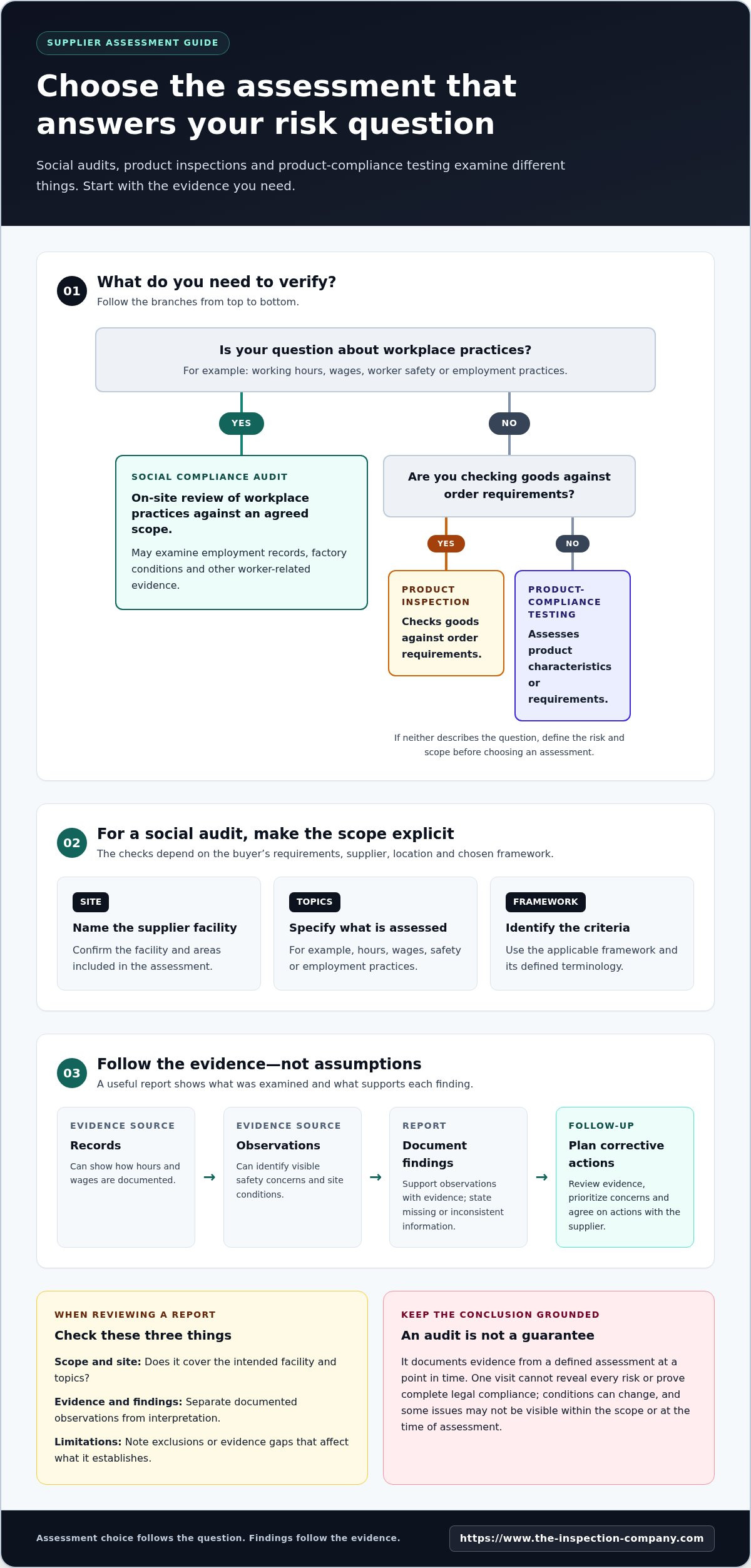
A social compliance audit is an on-site review of workplace practices against an agreed scope. An auditoría de cumplimiento social may examine working hours, wages, worker safety, and employment practices. The specific checks depend on the buyer’s requirements, supplier, location, and chosen framework. The Social audit overview describes the broader role of social auditing in assessing and improving an organization’s social and ethical performance.
A social audit evaluates workplace practices; a product inspection checks goods against order requirements, and product-compliance testing assesses product characteristics or requirements. These activities answer different questions, so one should not be treated as a substitute for another. An on-site social audit can provide evidence about factory conditions. Its usefulness depends on the scope and evidence gathered.
Which workplace practices may an audit review?
Within the agreed scope, auditors may review employment records, observe factory conditions, and assess other worker-related evidence. For example, records can show how working hours and wages are documented; observations can identify visible safety concerns; and other evidence can help explain employment practices. These are possible inputs, not a universal checklist. The framework, location, and assessment scope determine which records, observations, and other evidence are relevant.
What a social audit can, and cannot, establish
An audit documents evidence gathered during a defined assessment. It can help buyers understand observed practices and identify issues that may need attention. It is not a permanent guarantee of conditions, and one visit cannot reveal every risk or prove complete legal compliance. Conditions can change, and some issues may not be visible within the scope or at the time of assessment. Treat findings as a point-in-time evidence base for supplier decisions, not as blanket assurance.
How Social Compliance Audits Gather Evidence and Report Findings
A useful report starts with a clear scope. Before evidence is gathered, an auditoría de cumplimiento social should identify the supplier site, assessment topics, and applicable framework. The process then follows a practical sequence: define the scope, review relevant records, assess the site, document supporting evidence, and report findings. This helps buyers understand what was examined and where the assessment’s boundaries lie.
On site, auditors may review employment records, observe workplace conditions, and gather other evidence relevant to the agreed topics. Procedures vary, so not every audit uses identical checks or interviews. The Association of Professional Social Compliance Auditors provides context on the professional field of social compliance auditing. Depending on its scope, a factory audit can bring together evidence on social compliance, supplier capabilities, and quality management systems. The Inspection Company conducts on-site factory audits that assess these areas.
What happens during an on-site factory audit?
The auditor compares available evidence with the assessment criteria. For example, records may be considered alongside observations of relevant work areas. If information is missing or inconsistent, that should be stated in the documentation rather than replaced with assumptions. Each reported observation or non-compliance should be supported by evidence and use the terminology defined by the applicable framework.
How to read an audit report
An audit report reflects its defined scope and the evidence gathered during that assessment. Before acting on a finding, review:
- Scope and site details: Confirm the report covers the intended facility and topics.
- Evidence and findings: Distinguish documented observations from interpretation, and note the framework’s terminology.
- Limitations: Identify exclusions or evidence gaps that affect what the report can establish.
Use findings as documented inputs for supplier decisions, not as a complete verdict on performance beyond the assessment. Clear scope and traceable evidence make follow-up more focused.
Prepare Suppliers and Respond to Social Audit Findings
Good preparation helps an audit focus on the agreed scope, while an evidence-led response gives findings a path toward improvement. For an auditoría de cumplimiento social, buyers and suppliers should align on the site, assessment topics, records, and access before the visit. Preparation should make the assessment transparent, not script the result.
What should a supplier prepare before an audit?
Share the assessment expectations and confirm practical arrangements with the supplier in advance. This checklist helps organize preparation:
- Confirm the facility name, address, and areas included in the agreed scope.
- Gather relevant employment, working-hours, wage, and safety records for the assessment topics.
- Identify responsible contacts who can explain records and coordinate site access.
- Arrange access to the agreed work areas and make relevant documentation available.
Records should be accurate and reflect actual practices. Encourage cooperation and honest communication. Coaching workers to give particular answers can undermine the credibility of the evidence and obscure issues that need attention.
What should buyers do after receiving findings?
Review each finding against the report’s evidence, the applicable framework’s definitions, and its potential impact on workers. Prioritize urgent or higher-impact concerns, then agree on corrective actions with the supplier. Give each action a clear owner, appropriate milestones, and a way to document progress. If evidence is incomplete or an issue is unclear, seek clarification before drawing broader conclusions about the facility.
A scoped, on-site assessment can help buyers gather evidence about social compliance alongside supplier capabilities and quality management systems. The Inspection Company conducts factory audits that assess these areas. Findings become more useful when they lead to specific actions and proportionate follow-up, rather than remaining unresolved entries in a report. Discuss a factory audit to consider an assessment scope suited to your supplier and risk priorities.
Choosing a Social Compliance Audit Approach That Supports Supplier Decisions
Choose an assessment based on the decision you need to make. A review of workplace risks calls for different evidence than approval of shipment quality. A focused scope helps direct your resources to the risk at hand instead of treating every assessment as interchangeable.
Social audit, factory audit, or product inspection?
| Assessment | Purpose and focus | Decision it can support |
|---|---|---|
| Social compliance audit | Reviews workplace practices within an agreed scope. | How to understand and respond to supplier workplace risks. |
| Broader factory audit | May assess supplier capabilities and quality management systems, and may include social compliance. | Whether the supplier’s broader operations support a potential or ongoing partnership. |
| Product inspection | Checks goods against order requirements, such as agreed specifications or workmanship criteria. | Whether inspected goods meet requirements at a production or shipment stage. |
A factory audit and social assessment can overlap, but they are not interchangeable by default. Confirm that the scope covers the evidence needed for your decision. The factory audit service evaluates supplier capabilities, quality management systems, and social compliance.
When to request an on-site social compliance assessment
Consider an auditoría de cumplimiento social when workplace practices are a material part of supplier risk, such as before expanding a supplier relationship or when you need on-site evidence to inform a partnership decision. An audit will not replace product checks or provide a permanent guarantee. Use its documented findings to guide proportionate follow-up and ongoing supplier oversight. Pair the report with your supplier-management process so that findings inform concrete decisions, such as which corrective actions to prioritize and what evidence to review at follow-up.
Discuss your social audit requirements to align an on-site assessment with your supplier decision and risk priorities.
Turn Audit Evidence Into Stronger Supplier Decisions
A social audit is most useful when its findings lead to clear, proportionate action. Define the assessment scope, prepare the supplier, and review documented evidence carefully. Then assign corrective actions, track progress, and use the results to inform supplier decisions. An auditoría de cumplimiento social can provide a focused view of workplace practices, but it should support ongoing oversight, not replace it.
The Inspection Company conducts on-site factory audits that assess social compliance alongside supplier capabilities and quality management systems. Its team of more than 700 inspectors operates across key Asian manufacturing hubs, with a Hong Kong base and European management.
Clear scope and practical follow-up help turn an audit from a report into a useful risk-management tool. Discuss your social audit requirements and plan an assessment around the supplier decisions you need to make. With the right evidence and next steps, you can move forward with greater clarity.
Frequently Asked Questions
What is a social compliance audit?
A social compliance audit assesses workplace practices at a supplier site against a defined scope or framework. It may include a review of records, site conditions, and other relevant evidence. Topics and procedures vary by assessment. The resulting report documents what was examined, but it cannot guarantee that every risk was identified or that the supplier’s conditions will remain unchanged.
What does a social compliance audit check?
Depending on the agreed scope, an auditoría de cumplimiento social may examine working hours, wages, employment practices, and workplace safety. Evidence may include relevant records and observations of site conditions. The assessment criteria depend on the framework, location, and buyer’s requirements. Review the report’s stated scope before interpreting its findings, since audits do not all cover the same topics or use identical procedures.
How is a social compliance audit different from a factory audit?
A social compliance audit focuses on workplace practices and related evidence. A factory audit can have a broader scope, assessing supplier capabilities and quality management systems, and may include social compliance where specified. The terms can overlap, but they are not automatically interchangeable. Review the assessment scope and report contents to understand what was examined and which supplier decision the findings can support.
What happens if a social compliance audit finds a non-compliance?
The report should document the finding and supporting evidence within the assessment scope. The buyer and supplier can then identify appropriate corrective actions, assign responsibility, and track progress against the applicable framework. Prioritize actions based on the evidence and potential impact on workers. Treat an issue as resolved only when follow-up evidence supports that conclusion and the relevant corrective action has been completed.
Can a social compliance audit guarantee that a supplier follows every labour law?
No. An audit is a defined assessment shaped by its scope, methods, timing, and available evidence. It can help buyers identify and document concerns, but it cannot establish that every workplace practice has been observed or that conditions will not change later. Use the report as one part of ongoing supplier oversight, and check any legal references against current requirements relevant to the supplier’s location.