

How much would it cost your company if a "clean" factory was caught using forced labor just weeks after your last inspection? In 2026, the stakes for ethical sourcing have never been higher. With the new SA8000:2026 standard now in effect and the EU’s CSDDD mandates tightening, a simple "gut feeling" about a supplier is a liability you can't afford. You need a rigorous social compliance audit checklist to strip away the facade of factory-led deception and ensure your operations meet international labor laws. It's not just about ticking a box; it's about protecting your brand from devastating legal and financial fallout.
We understand the anxiety caused by overlapping standards like BSCI and SMETA. You want transparency, not more paperwork. This guide provides a clear, actionable framework to evaluate your suppliers against the latest 2026 requirements. We'll examine the essential criteria for workplace safety, fair wages, and environmental accountability. By the end of this article, you'll have the tools to verify compliance with confidence and secure a supply chain that's both ethical and resilient.
Key Takeaways
- Understand how 2026 regulatory updates, including SA8000:2026 and CSDDD, transition ethical sourcing from a voluntary practice to a mandatory legal requirement.
- Identify the core components of a social compliance audit checklist to verify labor standards, workplace safety, and fair compensation across your global supply chain.
- Learn why unannounced site visits and confidential worker interviews are the only reliable methods to uncover hidden risks and factory-led deception.
- Master the categorization of audit findings and the development of robust Corrective Action Plans (CAP) to address non-conformities before they escalate into scandals.
- Shift your auditing strategy from a reactive "box-ticking" exercise to a proactive investment that safeguards your brand's reputation and financial stability.
The Fundamentals of Social Compliance Auditing in 2026
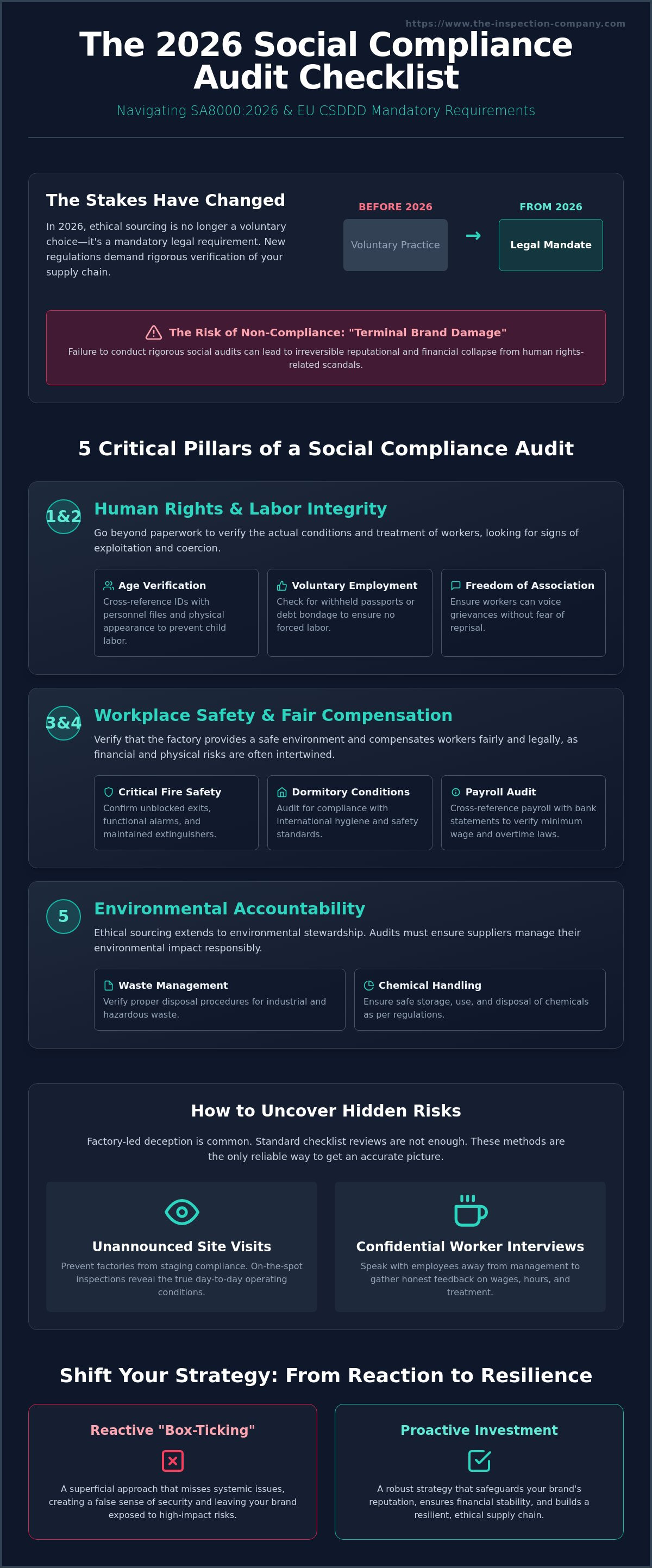
A Social audit is a methodical assessment of a supplier's adherence to international labor standards and regional laws. In 2026, the landscape of global trade has fundamentally changed. Ethical sourcing is no longer a voluntary choice for the socially conscious; it's a mandatory legal hurdle. With the SA8000:2026 standard now active and the EU’s Corporate Sustainability Due Diligence Directive (CSDDD) targeting firms with net turnovers over €1.5 billion, the burden of proof rests entirely on the importer.
It's vital to distinguish these assessments from standard factory audits. Technical audits ensure the factory can build your product; social audits ensure they don't destroy your brand while doing it. Neglecting a rigorous social compliance audit checklist exposes your business to "Terminal Brand Damage." This term describes the irreversible reputational and financial collapse that occurs when a company is linked to systemic human rights abuses. It's a localized operational failure with global consequences.
Why Importers Cannot Ignore Social Compliance
The shift toward mandatory transparency means regulatory bodies now possess the teeth to penalize negligence. In 2026, failing to verify your supply chain can lead to immediate customs seizures and permanent retail bans. Social auditing is a preventative investment. It forestalls massive financial losses by identifying risks before they become public scandals. You don't just audit to be ethical; you audit to stay in business.
Common Standards: SMETA, BSCI, and Beyond
Frameworks like SMETA and BSCI provide standardized benchmarks for evaluation. As of July 1, 2026, SMETA audit fees for Sedex members are £199 per audit, reflecting the increased depth required for modern compliance. These standards are most effective when integrated into a holistic supplier management process. This ensures that every partner you onboard aligns with your risk tolerance and legal obligations. Using a social compliance audit checklist within this process creates a transparent, auditable trail of due diligence that protects your interests.
The Essential Social Compliance Audit Checklist: 5 Critical Pillars
A comprehensive social compliance audit checklist serves as your primary defense against operational friction and legal liability. It categorizes risks into manageable pillars, allowing you to prioritize "Critical" non-conformities that could lead to immediate contract termination or cargo seizures. Without this structure, an audit becomes a superficial walkthrough that misses deep-seated systemic issues. Meticulous auditing transforms vague ethical promises into verifiable data.
Pillar 1 & 2: Human Rights and Labor Integrity
Verifying labor integrity requires looking beyond the paperwork provided by management. Seasoned auditors check for "hidden" child labor, which often occurs in off-site sub-contracting or through falsified age records. Your checklist must include:
- Age Verification: Cross-referencing government IDs with personnel files and physical appearance.
- Voluntary Employment: Identifying signs of forced labor, such as withheld passports or restrictive debt bondage contracts.
- Freedom of Association: Ensuring workers can communicate grievances or form collective bargaining groups without fear of reprisal.
Pillar 3 & 4: Workplace Safety and Fair Compensation
Financial and physical risks are often intertwined. A factory that cuts corners on fire safety is likely cutting corners on wages. Critical fire safety checks must verify that exits are unblocked, alarms are functional, and extinguishers are maintained. Dormitory conditions are also audited to ensure they meet international hygiene and safety standards.
Fair compensation is verified through a rigorous payroll audit. We don't just look at time cards; we cross-reference them with bank statements and production logs to ensure minimum wage compliance and that legal overtime limits aren't exceeded. If you aren't sure if your current suppliers meet these standards, you should consult with an audit expert to review your risk profile.
Pillar 5: Environmental Accountability
Ethical sourcing in 2026 includes environmental stewardship. This pillar focuses on waste management and chemical handling protocols. Auditors verify that hazardous materials are stored correctly and that the factory possesses valid discharge permits. Neglecting these points can result in heavy fines under the German Supply Chain Act (LkSG) or the EU's CSDDD. Using a detailed social compliance audit checklist ensures these environmental risks don't become your legal burden.
Verification Strategies: How to Conduct an On-Site Audit
A social compliance audit checklist is only as effective as the verification strategy behind it. If a supplier has weeks to prepare, they will mask non-conformities and coach staff. This is why unannounced or semi-announced audit windows are essential for genuine risk mitigation. True transparency requires catching the factory in its natural operational state. Without the element of surprise, you aren't auditing reality; you're auditing a performance.
The 5-Step On-Site Audit Workflow
Professional auditors follow a methodical process to ensure no critical failure is overlooked. This structured approach prevents factory management from controlling the narrative. The workflow includes:
- Opening meeting: Setting clear expectations and requesting immediate access to all records.
- Facility walkthrough: A physical inspection to identify immediate health, safety, and environmental hazards.
- Document review: Evaluating payroll, attendance, and safety certifications for inconsistencies.
- Worker interviews: Conducting private sessions away from management to gather honest testimonies.
- Closing meeting: Summarizing findings and identifying "Critical Failures" that require immediate action.
Detecting Factory Deception
Deception is a sophisticated operational risk in international trade. Auditors must utilize "triangulation" to uncover the truth. This involves comparing production logs (how much was made) with payroll records (how much was paid) and worker testimonies (how long they actually worked). If the production volume exceeds what the reported man-hours could realistically produce, it's a clear sign of "double bookkeeping" or hidden overtime.
Identifying coached responses is equally vital. When multiple employees use identical phrasing to describe their working conditions, it signals management interference. High-resolution photo documentation provides the non-negotiable visual evidence needed to back up these findings. If you need to verify a high-stakes supplier, you should book a professional social audit to ensure your data is accurate and untampered.
Managing Audit Results and Corrective Action Plans (CAP)
The delivery of an audit report is the beginning of the risk-mitigation process, not the end. Once you've utilized your social compliance audit checklist to identify vulnerabilities, you must categorize findings to prioritize your response. We classify non-conformities into three distinct levels: Critical, Major, and Minor. This hierarchy allows you to address the most dangerous operational risks first, ensuring that resources are allocated where they can best protect your brand and your bottom line.
- Critical: Immediate deal-breakers such as forced labor, child labor, or life-threatening safety hazards. These require immediate cessation of business or high-level legal intervention.
- Major: Significant violations like systemic wage theft or lack of fire safety permits. These must be addressed within a strict, short-term window.
- Minor: Isolated administrative errors or missing signage. These are tracked for long-term improvement.
Creating an Effective CAP
A Corrective Action Plan (CAP) is a roadmap for supplier rehabilitation. It's not enough to list what is wrong; you must conduct a root cause analysis to understand why the non-compliance occurred. If a factory is consistently exceeding overtime limits, the root cause might be poor production planning rather than intentional malice. Setting SMART goals ensures that the supplier has a clear, time-bound path to meeting your standards. Without these specific metrics, "improvement" remains a vague and unenforceable concept.
Building Long-Term Supplier Accountability
Change isn't real until it's verified. Follow-up audits are mandatory to confirm that the factory hasn't reverted to old habits once the initial pressure subsides. You should integrate these checks into your standard pre-shipment inspection routine. This creates a continuous feedback loop that improves factory performance and product quality over time. By maintaining a rigorous social compliance audit checklist as a permanent fixture of your relationship, you transform your supply chain from a source of anxiety into a verified competitive advantage.
Future-Proof Your Supply Chain for 2026
Ethical sourcing is no longer a choice; it's a legal and operational necessity. You've seen how a detailed social compliance audit checklist identifies hidden risks like forced labor and safety violations that standard factory audits often miss. By implementing unannounced site visits and rigorous Corrective Action Plans, you move beyond "box-ticking" and into genuine brand protection. This proactive investment prevents the financial and reputational loss that follows supply chain negligence. It's about maintaining control in an increasingly transparent global market.
The Inspection Company (TIC) brings European management standards from our Hong Kong headquarters directly to your manufacturing hubs. With over 700 inspectors across Asia, we provide the localized presence needed to uncover deception and ensure international labor standards are met. Our detailed reports are delivered within 24 hours, giving you the transparency required to make high-stakes business decisions without delay. Don't leave your reputation to chance when you can verify the truth on the ground with a partner you trust.
Secure your supply chain with a professional Social Audit from TIC
Take control of your sourcing risks today and build a supply chain that stands up to the highest international scrutiny.
Frequently Asked Questions
What is a social compliance audit?
A social compliance audit is an on-site evaluation of a factory's adherence to international labor standards, health and safety regulations, and environmental laws. It uses a social compliance audit checklist to verify that workers are treated ethically and that the facility operates within the legal frameworks of both the local jurisdiction and international trade directives. This process protects your brand from being associated with human rights abuses.
How long does a social compliance audit typically take?
A standard audit usually takes one to two full business days on-site; the exact duration depends on the factory size and employee count. Large facilities with thousands of workers require more time for comprehensive document reviews and confidential employee interviews. We deliver detailed reports within 24 hours of the audit's completion to ensure you can take immediate action on any critical findings.
What happens if a supplier fails a social compliance audit?
Failing an audit requires the immediate implementation of a Corrective Action Plan (CAP) to address non-conformities. If the failure involves "Critical" violations like forced labor or child labor, you might need to terminate the relationship to avoid legal penalties under laws like the EU's CSDDD. For "Major" or "Minor" issues, follow-up audits are scheduled to verify that the factory has permanently corrected the identified risks.
How often should I audit my manufacturers in Asia?
You should audit your Asian manufacturers at least once a year to maintain continuous oversight. High-risk suppliers or those with previous non-conformities should undergo more frequent semi-announced or unannounced inspections. Consistent auditing creates a culture of accountability. It ensures that factory management doesn't revert to substandard practices once the initial onboarding phase is complete.
Is a social compliance audit different from a quality audit?
Yes, a social audit focuses on human rights and safety, while a quality audit focuses on technical manufacturing capabilities and product specifications. While a quality audit ensures your goods are built correctly, a social compliance audit ensures they're produced ethically. Both are essential components of a robust risk-management strategy. They use entirely different examination criteria and methodologies.
Can I conduct a social audit remotely?
No, a remote audit cannot replace a physical on-site presence because it lacks the transparency needed to detect deception. Remote assessments rely on documents provided by factory management; these can be easily falsified. Professional auditors must be physically present to conduct private worker interviews and perform visual walkthroughs of dormitories and production floors to uncover hidden operational risks.