
A third-party inspection in Poland is an on-site check of your furniture or home goods, carried out at the Polish factory by an inspector you hire and pay, before you release the balance payment or the shipment. The inspector draws a random sample using AQL tables, checks it against your specification and approved sample, and reports a pass, fail or pending result. This guide covers what gets checked on flat-pack, solid wood and upholstered furniture, and on glassware, ceramics, candles and kitchenware, plus the defects that most often fail a lot and how to set up the inspection so the report gives you a clear decision.
What a Third-Party Inspection in Poland Covers
Third-party inspections in Poland use the same production stages as anywhere else. You can book one stage or combine several, depending on how well you know the supplier and how much the order is worth.
For most orders, a pre-shipment inspection of the finished, packed goods is the minimum. It is the last point where the goods are still at the factory and the balance payment is still in your hands. The earlier stages are for faults that cannot be fixed once the whole order is built, such as the wrong foam density across a sofa run or a cover fabric that was swapped for a cheaper one.
Why Polish Factories Still Need an Independent Check
Polish furniture and home goods factories are experienced exporters, and many buyers skip inspection for that reason. The faults inspectors find in Poland rarely come from a lack of skill. They come from how production is organised and how fast high-volume lines run.
- High-volume flat-pack lines. Panel furniture is cut, edged and drilled on automated lines. If a drilling programme is set wrong, the same misplaced hole repeats on every panel until someone assembles a unit and notices.
- Subcontracted parts. Upholstery covers, sofa frames, lacquering and hardware packs are often made by smaller workshops. Nobody at the main factory may have compared their output with your sample.
- Imported components. Hinges, drawer slides, recliner mechanisms, cover fabrics, glass candle jars and kitchenware handles are frequently bought from Asia or Turkey. A component change between your sample and bulk production is a common cause of non-conformity.
- Many customers on one line. A factory producing for several retailers at once can mix up instruction leaflets, carton labels or barcodes between orders that look almost identical.
- Holiday peaks. Orders are rushed before Christmas and before the long May weekend, and finishing and packing quality tends to drop when lines run overtime.
Independence matters as much as the check. An inspection is independent when you book and pay for it and the inspection company takes no money from the supplier. A factory's own QC staff, or an agent paid commission on the order, has a reason to pass a borderline lot.
Where Furniture and Home Goods Are Made in Poland
Polish furniture production is spread across several regions. Wielkopolska (Greater Poland), around Poznań, Swarzędz and Kępno, has a dense mix of upholstered and case goods makers. Warmia-Masuria in the north-east and Podlasie around Białystok have large panel and flat-pack plants. Lubelskie, Kujawy-Pomerania and Lower Silesia also have significant furniture clusters. Home goods are more scattered: glassware is concentrated in Podkarpackie around Krosno, porcelain and ceramics in Lower Silesia and the Świętokrzyskie region, and candle production is spread across several regions, often near furniture and glass suppliers.
When you book, give the full street address of the production site and the name of a contact who will meet the inspector. A supplier's registered office in Warsaw or Poznań is often not where your goods are made or packed, and a large group may run three or four plants under one company name.
Furniture Inspection in Poland: What the Inspector Checks
Furniture inspections in Poland concentrate on panel accuracy, finish, upholstery, assembly and packing. The checks below follow our standard furniture inspection checklist, adjusted to the product types Polish factories make most.
Flat-pack and panel furniture
Panel thickness is measured with a caliper against the specification, for example 18 mm particleboard at ±0.3 mm. Edge banding is checked for gaps, glue lines, overhang and chips at the corners, and for colour match with the panel surface. Melamine and foil surfaces are checked for scratches, pressure marks and lifting at the edges. HDF back panels are checked for thickness and correct size, because an undersized back panel lets a wardrobe go out of square.
The most useful test on a flat-pack lot is a full assembly. The inspector builds sampled units using only the hardware, tools and instructions packed in the carton. Misaligned cam lock or dowel holes, a missing pre-drilled hole and a hardware bag with the wrong screws show up immediately. Hardware bags are counted, and on large lots they can be weighed against a reference bag so that a missing screw is found without opening every bag. The instruction leaflet is checked for the right model, the right languages and a parts list that matches the bag.
Solid wood furniture
Pine, oak and beech furniture is checked for wood moisture with a moisture meter on several pieces drawn from different cartons, and each reading goes into the report. Indoor furniture is typically specified at 8% to 12%. Inspectors look for open knots, resin pockets in pine, end cracks, glue lines at finger joints and sanding marks under oil or lacquer. Colour and grain are compared with a signed reference panel, because solid wood sets often mix lighter and darker boards across one table and its chairs.
Upholstered furniture
Sofas, corner sofas and sofa beds are checked for seam straightness, stitch density, puckering, pattern alignment across cushions and colour match between panels cut from different fabric rolls. Zips and velcro on removable covers are opened and closed. Foam density and filling weight can be checked against the specification, for example 30 kg/m³ seat foam, by weighing a cut sample if the factory supplies one. Sofa bed and recliner mechanisms are cycled through their full range several times, and bedding boxes are opened and closed under load. For orders going to the UK, the inspector checks that the permanent and display fire labels are present and correct.
Assembly, stability and moving parts
Assembled chairs, tables and cabinets are placed on a flat surface and checked for rocking against a stated limit, for example 2 mm. Drawers are pulled fully out under load, doors are checked for even gaps and sag, and soft-close hinges and slides are cycled. Tall storage units are checked for the wall-fixing kit and the tip-over warning. If you sell clothing storage units in the US, the STURDY Act requirements apply, and the stability test is done in a laboratory, with the inspector confirming the warning label and anchoring hardware on site.
Packing
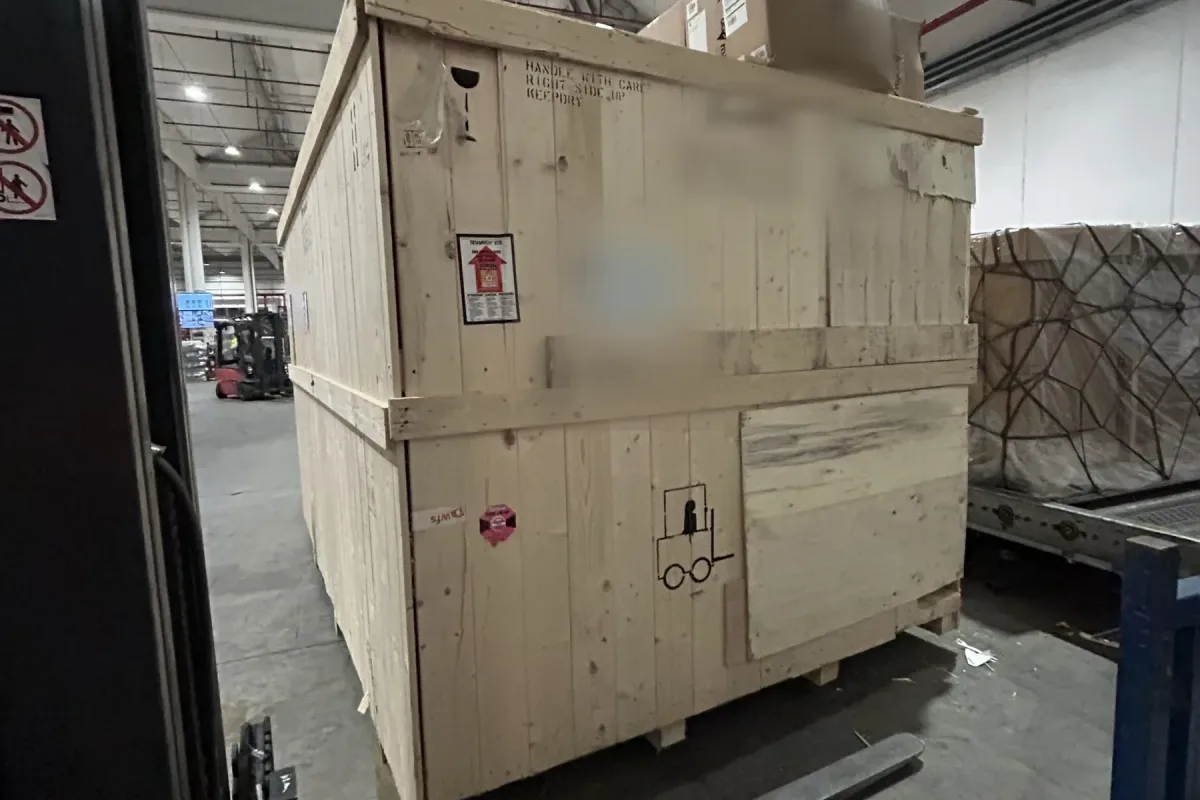
Packing gets as much attention as the product, because bulky furniture takes most of its damage in transit. The inspector checks carton grade, corner and edge protection, the position of heavy panels in the carton, carton markings against the packing list and weight marks on heavy cartons. A carton drop test is run to the procedure in your specification. Wooden pallets and crates going outside the EU usually need ISPM 15 heat treatment and stamping.
Findings that most often fail a Polish furniture lot:
- Misaligned or missing pre-drilled holes found during test assembly
- Chipped or lifting edge banding on panel corners
- Wrong or missing screws, cam locks or dowels in the hardware bag
- Instruction leaflets for a different model or without the required language
- Shade or grain mismatch between pieces of one set
- Puckered seams or misaligned patterns on sofa covers
- Wobbling legs on assembled chairs and tables
- Crushed carton corners and weak edge protection on heavy flat-pack boxes
Home Goods Inspection in Poland: Glass, Ceramics, Candles and Kitchenware
Home goods inspections in Poland cover products that break, burn or touch food, so the checks combine visual inspection with simple on-site function tests. Laboratory tests, such as lead and cadmium migration from ceramics, are arranged separately through sample testing. Our household goods inspection page lists the full checks by category.
Glassware
Drinking glasses, vases and glass jars are checked for bubbles, stones (small solid inclusions), cords, mould seams, rim chips and uneven wall thickness. Each sampled piece is turned under a light against a dark background. Rims are run with a finger for sharpness. Where your specification calls for it, a thermal shock test is done by moving pieces from hot to cold water at the stated temperature difference. Printed or decal decoration is checked with a tape test for adhesion, and the dishwasher-safe claim on the packaging is compared with what the factory has actually tested.
Ceramics and porcelain
Plates, mugs and bowls are checked for glaze defects such as pinholes, crawling, crazing and drips, for chips on rims and foot rings, and for warping. Plates are set on a flat glass surface to check for rocking, and stacked to check that they nest properly. Handles on mugs are checked for cracks at the join. Colour is compared with a reference piece, because glaze shade varies between kiln loads.
Candles
Candles are checked for wick centring, wick length, surface cracks, air pockets, sink holes around the wick and colour consistency. Container candles are checked for jar cracks and for wax that has pulled away from the glass. A burn test on a few sampled candles shows flame height, smoke and whether the candle tunnels. The safety label is checked against EN 15494, which sets the pictograms and warnings for candles sold in the EU.
Kitchenware and cookware
Pots, pans and enamelware are checked for coating chips, bubbles and bare spots, base flatness, handle and rivet tightness and lid fit. A cross-cut adhesion test can be done on a reject piece. Induction-compatible bases are checked with a magnet. Food-contact items are checked for the glass-and-fork symbol or the words "for food contact" where required, and the inspector confirms that the factory holds a declaration of compliance for plastic food-contact parts.
EU and Export Markings to Verify During Inspection
Destination-market requirements decide what the inspector checks on labels and packaging. They depend on where the goods are sold, not where they are made. Under the General Product Safety Regulation (EU) 2023/988, consumer products sold in the EU must show the manufacturer's name, postal and electronic address, and a type, batch or serial number, with safety information in the language of the country where they are sold. For wood-based panels and furniture, the EU formaldehyde restriction, Regulation (EU) 2023/1464, applies from 6 August 2026, so ask the factory for board test reports that cover it. The inspector checks the paperwork exists; emission testing is done in a laboratory.
Furniture, glassware and ceramics generally do not carry the CE mark. A CE mark on a plain bookcase or a drinking glass usually means the factory is unsure of the rules, and it is worth asking what else on the label is wrong.
Setting AQL Levels for Polish Orders
Pass or fail at the pre-shipment stage is normally decided with the sampling tables in ISO 2859-1. The usual setting is zero critical defects, AQL 2.5 for major defects and AQL 4.0 for minor defects, at general inspection level II.
Full assembly of flat-pack furniture and burn tests on candles take time, so they are usually done on a smaller special sample, such as level S-3 or S-4, while visual and packing checks use the full sample. For glassware and ceramics shipped in large lots, buyers often tighten minor defects to AQL 2.5 because small chips and bubbles drive retail returns. State the counting unit in your purchase order: pieces, sets or cartons. Our AQL calculator gives the sample size and acceptance numbers for any lot size.
Which Inspection Stages to Book for Polish Furniture and Home Goods
The right combination of stages depends on where each product usually goes wrong. This table is a starting point for a Polish supplier you have not used before.
Once a supplier has passed several orders in a row, many buyers move to a pre-shipment inspection only. Keep a during production inspection for orders produced in the weeks before Christmas and before the May holidays, and for any order where the factory has changed a component or fabric supplier.
Preparing for an Inspection in Poland
An inspection report is only as useful as the documents behind it. Send the inspection company these before the booking date:
- The specification or drawings with dimensions and tolerances
- Photos of the approved sample, with an instruction to keep the signed sample at the factory for the inspector
- The purchase order quantity and packing list
- AQL levels and a defect list that classes each defect as critical, major or minor
- Label, instruction leaflet, carton marking and barcode artwork for each destination market
- Any on-site tests you want: moisture readings, test assembly, drop test, thermal shock, burn test or tape test
- The confirmed production schedule and the full address of the production site
Book the pre-shipment inspection for when the factory confirms that 100% of the goods are finished and at least 80% are packed. Check Polish public holidays before confirming a date: 1 and 6 January, Easter Monday, 1 and 3 May, Corpus Christi, 15 August, 1 and 11 November, and 24 to 26 December. Many factories also close on 2 May and between Christmas and New Year. If the factory keeps moving the date or refuses access, read our guide on what to do when a supplier refuses inspection before you release any payment.
Buyers who source the same furniture lines from Poland and Asia should use one specification and one defect list for both, so reports can be compared directly. Our guides to furniture inspection in Vietnam and third-party inspection in Italy use the same stages and AQL settings described here.
The Inspection Company has carried out independent inspections since 2007, with European management, a European branch in Germany and inspections run to German QC standards. We take no commission from suppliers, the inspector's check-in and check-out at the factory are geo-tracked, and you receive a quick report on the inspection day and the full photo-backed report with a pass, fail or pending result within 24 hours. Our network is strongest in Asia and covers select European countries, so send us your Polish factory location and we will confirm availability before you book.
To book a third-party inspection in Poland, send your factory address, product details and order quantity through our free quotation form, and we will confirm inspector availability, recommend the inspection stages for your furniture or home goods order and quote a fixed man-day price.
Frequently Asked Questions
How much does a third-party inspection in Poland cost?
Most inspections are priced per man-day, and the total depends on the product, order quantity and factory location. Send the details for a free quote, which is usually confirmed within a few hours.
Does Polish furniture need a CE mark?
No, furniture generally does not carry the CE mark. It must still meet the General Product Safety Regulation, with manufacturer details, a product identifier and local-language instructions and warnings.
Can the inspector assemble flat-pack furniture on site?
Yes. Test assembly using only the hardware, tools and instructions in the carton is a standard check, usually done on a smaller special sample because it takes time.
Does an on-site inspection include food-contact or emission testing?
No. The inspector checks markings and confirms the factory holds the required declarations and test reports. Migration and formaldehyde emission tests are done in a laboratory and arranged separately.
When should I avoid booking an inspection in Poland?
Avoid the long weekend around 1 to 3 May, the period between Christmas and New Year, and national holidays such as 15 August and 1 and 11 November, when many factories are closed.