
A comprehensive factory audit looks beyond a supplier’s finished products to assess its quality management system, production capabilities, working conditions, and compliance. It helps buyers understand whether a factory can produce consistently and manage operational risks. The scope depends on the supplier, product, and standards relevant to the assessment.
A factory visit shows what happens on the production floor, but a useful assessment also examines records, procedures, and how the factory responds when something goes wrong. This article explains what factory audits cover, how to assess a supplier’s quality management, and how a digital checklist can organize evidence and findings. It also shows how audit areas, from production controls to worker conditions, contribute to a clearer supplier assessment.
Key Takeaways
- Assess audit findings by their impact, identify root causes, and assign corrective actions with clear follow-up.
- Use ISO 9001 as a quality management benchmark, then examine how procedures and records work in practice.
- Build a digital checklist around the audit’s scope so findings, evidence, and actions stay organized.
- Match the audit type to the risk, whether you need to assess social conditions, environmental controls, safety, or production processes.
What Is a Factory Audit?
A factory audit assesses a manufacturer’s systems, production practices, working conditions, and compliance. Its purpose is to identify risks that could affect product quality or supplier reliability before they become costly problems.
Audit Preparation and Fieldwork
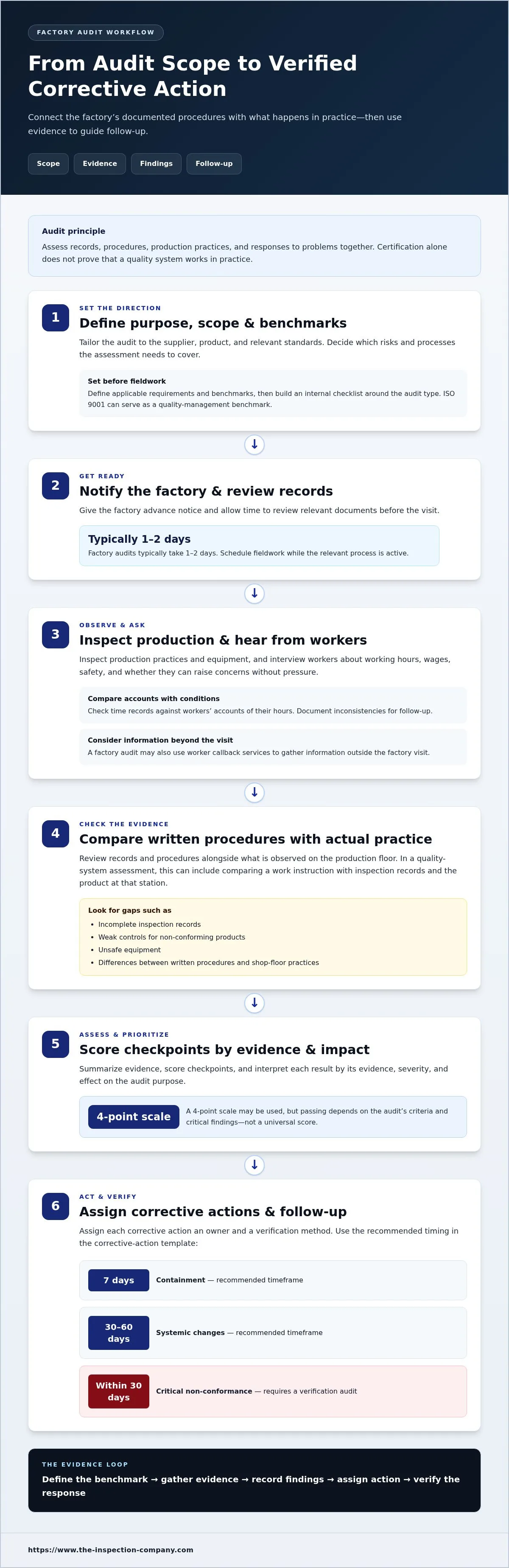
Good audit preparation sets the scope, benchmarks, checklist, and records needed for fieldwork. To conduct a comprehensive factory audit, define its purpose and scope, review relevant documents, inspect production, interview workers, record findings, and agree on corrective actions. This sequence connects documented procedures with actual manufacturing practices.
Factory audits typically take 1-2 days. Give the factory advance notice and allow time to review documents before the audit. Tailor an internal checklist to the audit type, then schedule fieldwork while the relevant process is active.
Worker Interviews and Working Conditions
Worker interviews help auditors compare written policies with employees’ accounts of working conditions. Questions can cover working hours, wages, safety, and whether workers can raise concerns without pressure. A factory audit may also use worker callback services to gather information outside the factory visit.
Compare records and interview responses with observed conditions. For example, check time records against workers’ accounts of their hours, then document any inconsistencies for follow-up. This evidence helps distinguish a missing procedure from a practice that may put workers at risk.
Regulatory Compliance
A regulatory compliance review compares factory practices with applicable local requirements and relevant international frameworks. The checklist can address working hours and wages, child labor, forced labor, discrimination, and workers’ rights to freedom of association and collective bargaining.
Requirements vary by market and product, so define the applicable benchmarks before fieldwork. Germany’s Act on Corporate Due Diligence in Supply Chains is one example of statutory requirements relevant to human-rights and environmental due diligence. A factory audit assessment can be structured around the supplier and risks being evaluated.
Results, Risks, and Corrective Actions
Audit results summarize evidence, score checkpoints, and identify where corrective action is needed. Common findings include incomplete inspection records, weak controls for non-conforming products, unsafe equipment, and gaps between written procedures and shop-floor practices. These issues can threaten product quality, compliance, and delivery reliability.
A 4 point scale may be used to score checkpoints, but passing depends on the audit’s criteria and critical findings, not a universal score. Interpret each result by its evidence, severity, and effect on the audit purpose. Assign corrective actions with an owner and verification method. A corrective action template recommends 7 days for containment and 30-60 days for systemic changes; critical non-conformances require a verification audit within 30 days.
Quality management system assessment
A quality management system assessment examines how a factory controls processes, responds to defects, and verifies product quality. It checks whether documented procedures match operational practice, rather than treating certification alone as proof of performance.
Quality System Documentation
Quality system documentation includes procedures, inspection records, training evidence, and corrective-action logs. These records help auditors trace how the factory controls production and whether teams follow approved methods. ISO 9001 is the quality management standard named as a benchmark for factory audits, according to the International Organization for Standardization.
Assess how managers apply the standard’s core ideas: customer focus, leadership, process control, improvement, and evidence-based decisions. For example, compare a work instruction with inspection records and the product moving through that station. Missing records, outdated procedures, or repeated defects can signal gaps in the factory’s ability to maintain consistent output. A focused factory audit assessment connects these findings to supplier risk.
Environmental Management and Pollution
Environmental management review examines how a factory controls waste, pollution, energy, water, and emissions. ISO 14001 is an international environmental standard suppliers may be assessed against, according to the International Organization for Standardization. Auditors can compare written controls with storage areas, disposal practices, and operating records.
Check how the factory identifies environmental risks, assigns responsibility, and tracks corrective actions. Where relevant, water testing can measure specific substances in effluent, while emissions checks can identify pollution concerns. Because local environmental regulations also shape the assessment, record the applicable requirements and the evidence used to evaluate them.
Management-provided financial information is separate from evidence that a quality system works. Financial records may help explain operational capacity, but they do not verify inspection procedures or defect controls. A financial statement audit provides reasonable, not absolute, assurance against material misstatement; a review provides limited assurance, while a compilation provides none. Keep these distinctions clear when assessing supplier documents.
Creating a digital factory audit checklist workflow
A digital checklist turns audit criteria into organized questions, evidence, and follow-up actions. Structure it around the supplier risks and processes the assessment needs to cover.
Factory Audit Checklist Categories
Checklist categories group questions by factory function, making findings easier to locate and compare. Include manufacturing capability, quality controls, regulatory compliance, operational efficiency, equipment safety, and environmental practices.
For each category, record the applicable benchmark, the evidence to gather, and the finding. A question about production processes could ask whether inspections are recorded and non-conforming products are handled under a documented procedure. Fields for notes and supporting evidence help auditors distinguish observed conditions from factory statements.
Supplier Capability and Sourcing Risk
Supplier capability checks assess whether a factory can meet the buyer’s product, process, and volume requirements. Ask about available production equipment, staff skills, inspection controls, and the factory’s ability to manage defects. These checks help importers identify supply chain risks before relying on a supplier for ongoing orders.
Link each risk to evidence and an owner for follow-up. For example, a checklist can show whether a supplier’s inspection records document consistent checks at relevant production stages. The assessment then gives sourcing teams a clearer basis for comparing supplier readiness and deciding which gaps need action.
Gaps in Traditional Checklists
Paper checklists can capture answers, but they make evidence, ownership, and follow-up harder to track across suppliers. A digital workflow can link each finding to notes, supporting files, and corrective actions, creating a continuous record for later review.
Keep questions specific and tied to observable evidence. Broad prompts such as “Is quality controlled?” can produce vague answers. Separate questions about inspection records, defect handling, and equipment checks reveal more. Review the checklist after each assessment so recurring findings inform the next audit, instead of leaving outdated questions in circulation.
Layered Process Audits (LPAs) add a recurring shop-floor check to the workflow. The AIAG CQI-8 guideline provides a framework for applying IATF requirements on the shop floor. Keep each LPA checklist to ideally 10-12 items, with daily front-line audits and monthly or quarterly executive checks. A digital schedule can assign each check to the relevant role and capture completion, findings, and follow-up in one place.
Ethical, quality, environmental, social compliance, safety, process, product, system, compliance, and security audits
A factory audit can combine checks of production, product quality, safety, environmental controls, and worker conditions. ISO 9001 is a quality management benchmark, while a social compliance audit focuses more narrowly on labor practices and workers’ rights.
Environmental Compliance and Waste
Environmental checks evaluate how a factory manages waste, pollution, energy, water, and emissions. Poor practices can cause environmental harm and disrupt production. Review waste storage and disposal records, observe how materials are handled, and compare practices with applicable local environmental regulations.
Where relevant, water testing can measure specific substances in effluent, while emissions checks can help identify pollution concerns. ZDHC is one international environmental standard suppliers may be assessed against. Record the evidence and any gaps, then identify the corrective actions needed to improve environmental controls.
Business and Compliance Records
Business and compliance records help assess whether factory practices align with relevant product, safety, and operating requirements. Review licenses, training documentation, inspection records, and product test evidence against the supplier’s actual production activities. For applicable products, Consumer Product Safety Improvement Act (CPSIA) requirements may make safety testing records especially relevant.
Compare records with conditions on the floor. Review factory inspection and test records for the last 6 months, then trace a sample entry to the related product or production batch. This can reveal missing documentation or a quality control process that exists on paper but isn’t consistently used.
Ethical and Social Compliance
Ethical audits assess working conditions, labor practices, and respect for workers’ rights. Frameworks include Sedex/SMETA, amfori BSCI, and Higgs FSLM. Compare working-hour and wage records with worker interviews, and assess whether the factory prohibits child labor, forced labor, and discrimination.
Also examine whether workers’ rights to freedom of association and collective bargaining are respected. The UK’s Modern Slavery Act and California Transparency in Supply Chains Act are examples of statutory requirements relevant to human-rights due diligence. Findings help buyers distinguish written policies from everyday factory practices.
Product and process checks complete the picture. Review inspection records, procedures for non-conforming products, equipment safety, and customer complaint handling. To assess these areas together, explore a factory audit tailored to supplier risks.
The Inspection Company: Pre-Shipment Inspection
The Inspection Company’s Factory Audits help importers assess a supplier’s systems and manufacturing practices before committing to production. Once goods are ready, Pre-Shipment Inspection checks products before shipment, helping identify defects or quantity issues while goods remain at the factory.
The right service depends on the decision you need to make. Use a factory audit to evaluate supplier capabilities and operational controls; use During Production Inspection to check product quality while manufacturing is underway. Container Loading Inspection adds checks during loading. For Pre-Shipment Inspection, clients receive a detailed report with photos within 24 hours of the inspection, supporting shipment approval decisions.
Contact The Inspection Company to discuss which inspection approach fits your supplier and order.
Turn audit findings into your next decision
A supplier assessment is most useful when it informs what happens next. Use its findings to decide where you need visibility, which risks require action, and what evidence will support your purchasing decision. A comprehensive factory audit can guide that plan, while ongoing quality control may call for checks at different stages of production and shipment.
The Inspection Company offers Factory Audits alongside During Production Inspection, Pre-Shipment Inspection, and Container Loading Inspection. Each service addresses a different point in the supplier and order process, helping you select an approach that fits the decision at hand.
Contact The Inspection Company to discuss your supplier quality-control needs. Clear findings can help you move forward with greater confidence and a practical plan for managing risk.
Frequently Asked Questions
Decoding the Terminology: What is Manufacturing Audits?
Manufacturing audits are structured evaluations of a factory’s operations, controls, and ability to meet defined requirements. They can cover different scopes, from a quality system to production processes or labor practices. For example, a process audit traces how a component moves through a production line, while a social audit focuses on workplace conditions and worker protections.
How Long Does It Take to Get Audit Results?
Factory audit reports are typically delivered within 3-5 business days after the on-site visit. The time between the visit and report delivery allows auditors to organize evidence, assess findings, and document recommendations. For planning, separate the on-site audit schedule from the reporting period, then allow time internally to review findings and assign owners for follow-up actions.
How Should Audit Findings Be Analyzed and Acted Upon?
Analyze each finding by recording the requirement, observed condition, cause, consequence, and corrective action. This structure, known as the 5 C’s, helps teams move from a description of a problem to a usable response. For example, if records show a recurring inspection gap, contain affected output, investigate why the control failed, and verify that the corrective action works.
What Are The Quick Takeaways?
Before approving a supplier relationship, match the audit scope to the risks in your product and supply chain. Give evidence more weight than policy statements alone: compare records with actual work and note gaps that could affect orders. After reviewing the results, distinguish immediate containment from longer-term process changes, assign responsibility, and track whether actions address the underlying issue.
What is a comprehensive factory audit?
A comprehensive factory audit assesses multiple aspects of a supplier’s facility, rather than checking finished products alone. Its scope can combine production capability, quality systems, compliance, worker conditions, safety, and environmental management. Buyers use the findings to understand supplier performance and make informed partnership decisions, while product inspections focus on goods at a particular stage.
What areas and processes are covered in a factory audit checklist?
A factory audit checklist can cover raw materials, production processes, finished products, packaging, inspection controls, equipment, complaints, and compliance records. Tailor the questions to the product and audit purpose. For a traceability check, follow a batch from incoming materials through production records to finished-product identification, then see whether consistent documentation links each stage.