
Did you know that quality-related costs, including scrap and rework, can consume up to 20% of an importer's annual sales? In a 2026 trade environment where the $800 de minimis exemption has been eliminated and Section 122 surcharges add a 10% baseline to most goods, calculating the cost of poor quality for importers is the only way to protect your margins. You probably already feel the sting of unpredictable losses from defective batches and the high cost of returns that erode your bottom line. These financial drains are no longer just an annoyance; they are significant operational risks that threaten your business stability.
It's difficult to justify the expense of third-party inspections to stakeholders without hard data. This guide solves that problem by providing a professional framework to quantify hidden financial risks and manufacturing defects. You'll learn how to measure the impact of the new FDA Quality Management System Regulation and the $20,000 material scrap costs that often follow batch failures. We'll provide a clear formula to measure COPQ, explain how to use factory audits to improve supplier accountability, and show you why pre-shipment inspections are a necessary preventative investment for your 2026 strategic plan.
Key Takeaways
- Establish a professional framework for calculating the cost of poor quality for importers to identify exactly where your margins are leaking.
- Identify the "Quality Iceberg" of hidden expenses, including the significant management time required to resolve quality claims and supplier friction.
- Learn why investing in appraisal services like Pre-Shipment Inspections is a critical preventative measure against the much larger financial impact of external failures.
- Shift your strategy from simply detecting defects to actively preventing them through meticulous factory audits and improved supplier accountability.
Understanding COPQ in the 2026 Global Import Landscape
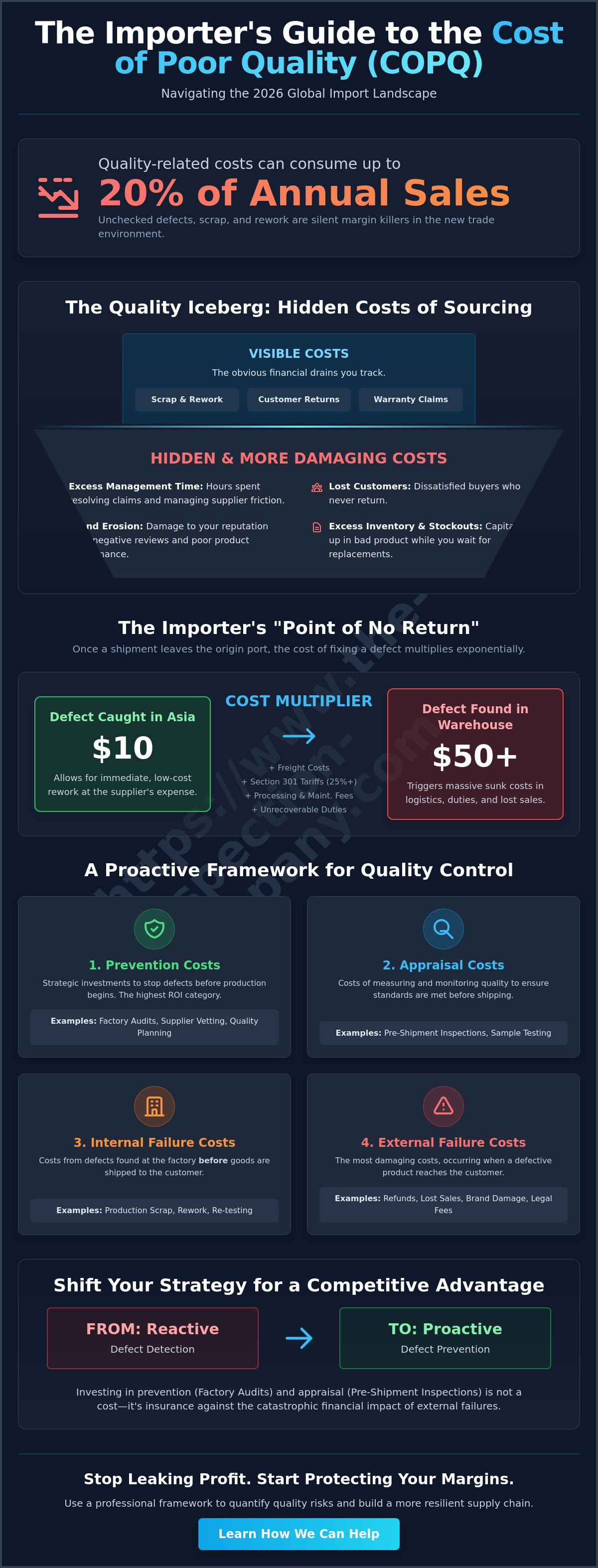
For global businesses, Cost of Poor Quality (COPQ) represents the total financial loss incurred when a product fails to meet predefined specifications. This metric isn't just about defective items. It encompasses every dollar wasted on producing, identifying, and rectifying errors. In 2026, where effective tariff rates on Chinese imports can reach up to 145%, these losses are magnified. Every rejected unit carries the heavy burden of paid duties and high freight costs that cannot be recovered. For many manufacturers, these quality-related expenses consume 15% to 20% of annual sales revenue. If you aren't actively calculating the cost of poor quality for importers, you are likely underestimating your true landed cost by a significant margin.
Distance and lead times create a unique risk profile for the importer. Unlike a domestic manufacturer who can return a batch to a nearby floor for rework, an importer deals with a rigid supply chain. Once a container is sealed, your capital is locked in a high-stakes transit phase. To manage this, we utilize a four-pillar framework:
- Prevention: Investments made to stop defects before they happen, such as factory audits.
- Appraisal: Costs associated with measuring and monitoring quality, including pre-shipment inspection.
- Internal Failure: Costs of defects identified at the factory before the goods ship.
- External Failure: The most damaging costs, occurring when the customer receives a defective product.
The Importer’s Quality Dilemma
Importers face a "Point of No Return" that domestic buyers don't. Once a shipment leaves the origin port, the cost of fixing a defect increases by 10x. Long lead times mean that by the time you discover a fault in your local warehouse, the replacement inventory is still weeks away. This gap leads to stockouts and lost market share that are difficult to reclaim.
Visible vs. Hidden Quality Costs
Visible costs are the tip of the iceberg. These include scrapped items, rework fees, and direct customer refunds. However, the hidden costs often carry a heavier weight. Administrative overhead from managing supplier disputes, brand erosion, and the 20% to 30% increase in error rates caused by poor supplier management can quietly dismantle your profitability. When calculating the cost of poor quality for importers, these secondary ripples must be quantified to see the full financial picture.
The Importer’s COPQ Calculation Framework
To move beyond theory, you need a methodical approach to calculating the cost of poor quality for importers. This process aligns with the standard Cost of Quality (COQ) methodology, but it requires specific adjustments for the logistical realities of 2026. A professional framework breaks down into four actionable steps:
- Step 1: Quantify Internal Failure Costs. These are expenses related to defects identified at the factory before the goods ship.
- Step 2: Calculate Appraisal Costs. This includes the price of Pre-Shipment Inspections and laboratory sample testing.
- Step 3: Measure External Failure Costs. Factor in product returns, customer refunds, and potential legal liabilities.
- Step 4: Factor in Prevention Costs. Include factory audits and the administrative time spent vetting new suppliers.
Calculating Internal vs. External Failure
Catching a defect during a During Production Inspection allows for immediate rework at the supplier's expense. Once that same defect crosses the ocean, it triggers a logistical multiplier. You aren't just losing the base product cost. You are losing the 0.3464% Merchandise Processing Fee, the 0.125% Harbor Maintenance Fee, and potentially a 25% Section 301 tariff. In 2026, a $10 defect caught in Asia can easily become a $50 loss once landed in your warehouse. Catching errors early isn't just about quality; it's about protecting your sunk costs in logistics and duties.
The Amazon FBA Factor
For e-commerce brands, calculating the cost of poor quality for importers involves high-stakes platform risks. Amazon FBA rejections lead to expensive removal orders and storage fees. Even worse, a high Order Defect Rate (ODR) can lead to account suspension. Utilizing a specialized Amazon FBA Inspection ensures your goods meet strict labeling and packaging requirements before they reach the fulfillment center. If you're unsure how these variables affect your specific product line, you can request a professional risk assessment to refine your calculations.
Hidden Costs: The Quality Iceberg for Asian Sourcing
Many importers view third-party inspection as a line-item expense rather than a risk management tool. This perspective ignores the "Quality Iceberg." While the visible costs of scrap and rework are easy to track, they represent only a small fraction of the total financial impact. When calculating the cost of poor quality for importers, you must account for the massive drain on management resources. Resolving supplier disputes and managing quality claims can consume dozens of executive hours each month. This time is better spent on growth and strategy.
Beyond immediate refunds, product defects destroy customer lifetime value and future sales potential. Research into the impact of quality on operational outcomes shows that a single bad batch can derail market momentum. This lead to missed seasonal windows and expensive inventory holding costs. The "lost momentum" of a delayed product launch is a cost that few balance sheets capture, yet it can be the difference between market leadership and obsolescence.
Logistical Liabilities and Customs Risks
Poor quality poses a direct threat to your supply chain's physical movement. In 2026, customs authorities use advanced AI algorithms to flag non-compliant goods. A failure here leads to port seizures or the need for emergency product sorting at the terminal. These interventions are far more expensive than factory-level checks. You might also face the high cost of air-freighting replacement parts to meet urgent contractual deadlines.
Supplier Relationship Erosion
Successful sourcing from Asia relies on mutual trust and clear standards. Constant quality friction erodes these relationships, leading to supplier apathy or partnership failure. Consistent auditing builds a culture of accountability that stabilizes your supply chain and ensures long-term profitability. If you're ready to secure your 2026 margins and eliminate these hidden risks, contact our regional experts today for a tailored quality strategy.
Strategic Mitigation: Turning COPQ into Competitive Advantage
Calculating the cost of poor quality for importers is only the first step toward operational resilience. True competitive advantage comes from shifting your strategy from a reactive "detect and reject" mindset to a proactive prevention framework. While software platforms can track historical data, they cannot physically verify a production line in Vietnam or China. Physical presence remains the only way to ensure your 2026 margins remain intact. By utilizing robust factory audits, you address the root cause of defects before raw materials are even processed.
A proactive quality management strategy for 2026 should include these essential steps:
- Establish clear Acceptable Quality Levels (AQL) in every purchase order to remove ambiguity.
- Implement mandatory Pre-Shipment Inspections for all new and high-risk suppliers.
- Maintain a centralized quality database to track supplier performance trends over multiple quarters.
- Link supplier payment milestones to successful third-party inspection reports.
The ROI of Third-Party Inspection
The return on investment for appraisal services is often orders of magnitude higher than the initial cost of the service. Consider the financial impact of a $30,000 shipment being rejected at your local warehouse due to non-compliance or critical defects. You've already paid for the goods, the sea freight, and the 2026 tariffs. In contrast, a few hundred dollars spent on an inspection at the source prevents this total loss. TIC’s global network of 700+ inspectors provides the "eyes on the ground" required to catch these issues before they become your logistical liability.
Implementing a Zero-Defect Culture
Long-term profitability relies on moving from transactional checks to a comprehensive supplier management process. This approach rewards consistent quality and penalizes recurring negligence, creating a self-correcting supply chain that requires less administrative oversight. Don't let manufacturing errors erode your bottom line. Protect your margins and book an inspection today to secure your 2026 inventory and stabilize your sourcing operations.
Securing Your Supply Chain for 2026 and Beyond
The global trade landscape of 2026 demands a rigorous approach to financial risk management. The true impact of manufacturing errors extends far beyond the factory floor; it includes unrecoverable tariffs, logistical multipliers, and the erosion of customer trust. Mastering the art of calculating the cost of poor quality for importers isn't just a defensive measure. It's a strategic necessity for anyone looking to maintain healthy margins in a high-stakes market. By shifting your focus toward preventative audits and source-level inspections, you transform quality from a variable cost into a predictable competitive advantage.
You don't have to manage these complexities alone. With European management and over 15 years of regional expertise, we provide the meticulous oversight your operations require. Our network of 700+ certified inspectors delivers detailed reports within 24 hours, giving you the transparency needed to make informed shipping decisions. It's time to stop reacting to defects and start preventing them. Stop losing money on defects; get a quote for professional inspection services today. Take control of your sourcing and build a more resilient future for your brand with confidence.
Frequently Asked Questions
How do you calculate the cost of poor quality for a new shipment?
Calculating the cost of poor quality for importers requires summing four specific categories: prevention, appraisal, internal failure, and external failure costs. For a new shipment, you must aggregate the total landed cost of defective units, including non-refundable 2026 duties like the 0.3464% Merchandise Processing Fee and any applicable Section 301 tariffs. This formula ensures you see the true financial impact beyond just the purchase price of the goods.
What are the most common hidden costs of poor quality for importers?
Hidden costs often include administrative overhead from managing supplier disputes, port demurrage fees, and the loss of customer lifetime value. Importers frequently overlook the cost of executive time spent on quality claims and replacement logistics. In 2026, increased customs enforcement using AI algorithms also adds the risk of expensive storage fees and shipment seizures if quality documentation is inconsistent.
Is a 100% inspection necessary to reduce COPQ?
A 100% inspection isn't always mandatory, but it serves as the ultimate safeguard for high-risk or high-value shipments. Most importers utilize AQL sampling to balance appraisal costs with risk mitigation. However, if a supplier has a history of batch failures or if you're launching a critical new product line, 100% inspection is the most effective way to eliminate the threat of external failure costs.
What is the difference between internal and external failure costs?
Internal failure costs occur when defects are caught at the factory before the goods ship, allowing for immediate rework at the supplier's expense. External failure costs happen after the customer receives the product, triggering returns and brand damage. Catching an error at the source prevents the logistical multiplier of paid freight and international duties, making internal failures significantly less damaging to your bottom line.
Can a factory audit help reduce the cost of poor quality?
Yes, a factory audit is a primary prevention tool that identifies systemic manufacturing risks before production even begins. By vetting a supplier's quality management system and equipment, you reduce the likelihood of batch-wide defects. This proactive step is essential when calculating the cost of poor quality for importers because it lowers the long-term frequency of both internal and external failures.