
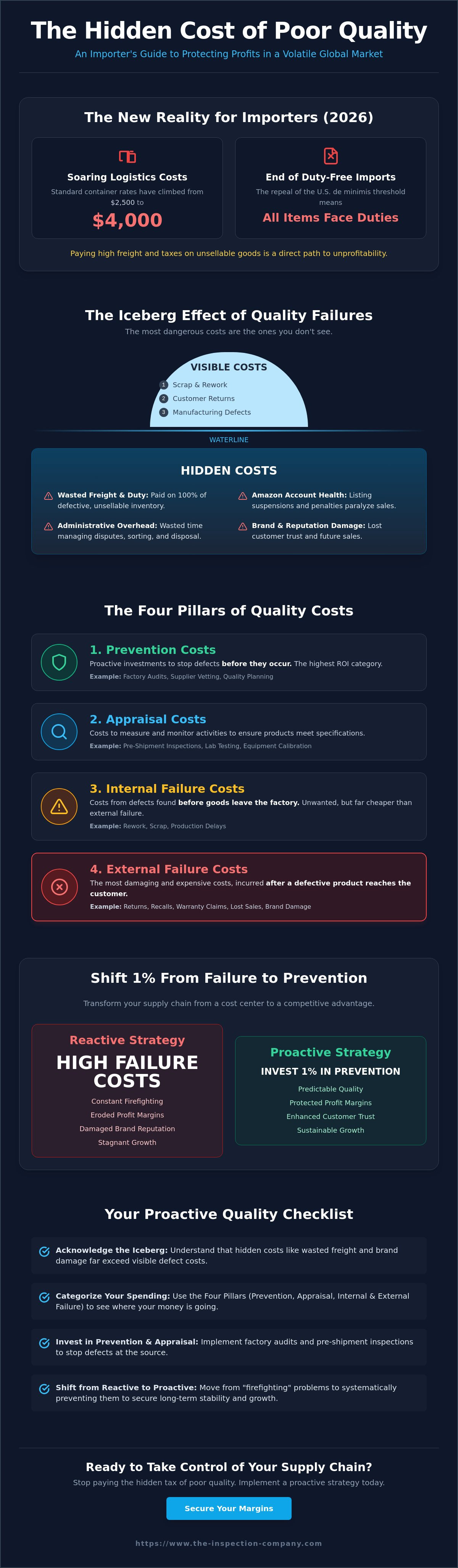
In 2026, a standard shipping container that once cost $2,500 now commands $4,000, while the repeal of the U.S. de minimis threshold has effectively ended the era of duty-free imports. Yet, the most significant threat to your bottom line isn't rising logistics fees; it's the hidden cost of poor quality for importers. When defective goods reach your warehouse or, worse, your customer, the financial damage extends far beyond the price of the item. You're paying for wasted freight, customs duties on unsellable inventory, and the catastrophic risk of Amazon account health warnings that can paralyze your sales overnight.
You likely realize that reacting to quality failures is a losing game that drains your internal resources and erodes thin margins. This guide will show you how to move from a defensive posture to a proactive strategy. You'll learn how to quantify these invisible leaks and transform your supply chain from a cost center into a reliable competitive advantage. By shifting just 1% of your product cost from failure to prevention, you can eliminate the "supply chain tax" that is currently stifling your growth.
We'll provide a clear formula to calculate your total COPQ, establish rigorous supplier accountability through targeted inspections, and protect your brand reputation. This methodical approach ensures you maintain control over your operations despite the volatility of the current global trade landscape.
Key Takeaways
- Identify the "Iceberg Effect" of quality failures, where hidden costs like damaged brand reputation far exceed visible manufacturing defects.
- Learn the specific formula to quantify the total cost of poor quality for importers, allowing you to pinpoint exactly where capital is leaking from your supply chain.
- Categorize quality expenditures into four essential pillars to determine which investments in prevention yield the highest return on investment.
- Implement a multi-stage verification process, including factory audits and pre-shipment inspections, to ensure supplier accountability and protect your margins.
- Shift your operational focus from reactive troubleshooting to proactive risk mitigation, securing your Amazon account health and long-term customer trust.
What is the Cost of Poor Quality (COPQ) for Importers?
The Cost of Poor Quality (COPQ) is a critical financial metric that represents the total sum of expenditures that would vanish if every manufacturing process and product were flawless. It's not merely the price of a broken widget. For those managing global supply chains, the cost of poor quality for importers acts as a heavy tax on every shipment, often hiding in plain sight until it erodes the annual bottom line.
Quality management experts often describe this through the "Iceberg Effect." The visible tip includes obvious losses such as scrap, rework, and returned items. However, the vast majority of the financial damage remains submerged. These hidden costs include:
- Wasted freight and duty payments on defective inventory.
- Administrative overhead spent on supplier disputes.
- Lost customer lifetime value due to brand dissatisfaction.
- Amazon account health warnings or listing suspensions.
In June 2026, the margin for error has disappeared. Standard container rates have climbed to $4,000, and the suspension of the U.S. de minimis threshold means every single item is now subject to full customs processing and duties. When you pay high logistics costs and taxes on goods that cannot be sold, your profitability vanishes. In the context of global trade, COPQ is the total financial burden incurred from supplier errors, including defective merchandise, wasted logistics expenditures, and the administrative overhead required to rectify failures after they've left the factory floor.
The Silent Margin Killer
Many importers mistakenly calculate quality loss as a simple percentage of the purchase price. This is a dangerous oversight. If a supplier sends a 10% defective batch, you haven't just lost 10% of your product cost. You've lost 100% of the shipping, duty, and marketing spend associated with those units.
Beyond the spreadsheets, there is a psychological toll. Constant "firefighting" to resolve supplier issues prevents your team from focusing on growth and product development. Investing in factory audits and pre-shipment inspections isn't an added expense; it's the only way to reclaim the time and capital currently being drained by avoidable errors.
The Four Pillars of Quality Costs: An Importer’s Framework
To effectively manage the cost of poor quality for importers, you must categorize your expenditures using The Four Pillars of Quality Costs. This framework, widely recognized by the American Society for Quality, divides quality-related spending into four distinct areas: prevention, appraisal, internal failure, and external failure. Understanding these pillars allows you to see exactly where your capital is being protected and where it's being wasted.
- Prevention Costs: These are proactive investments designed to stop defects before they occur. This includes conducting a factory audit to verify a supplier's technical capability and quality management systems.
- Appraisal Costs: These involve measuring and monitoring activities to confirm products meet your specifications. The most common example is the use of pre-shipment inspections to catch errors before the goods leave the factory.
- Internal Failure: These costs arise when defects are identified while the goods are still at the manufacturer. While rework or scrap at the source is frustrating, it's significantly less expensive than shipping faulty items across the ocean.
- External Failure: This is the most damaging pillar. It includes everything that happens after a customer receives a defective product, from returns and recalls to the long-term erosion of your brand's reputation.
The Importer’s External Failure Trap
In 2026, the external failure pillar has become a financial trap for the unprepared. When defective merchandise arrives at your warehouse, you've already paid a $4,000 freight bill and full customs duties. Following the August 2025 suspension of the U.S. de minimis threshold, you can no longer avoid duties on low-value shipments. You're effectively paying taxes and premium shipping rates on trash. For those selling on digital marketplaces, a defect rate exceeding 1% can trigger Amazon account health warnings, leading to listing suppression or a total loss of selling privileges.
Appraisal vs. Prevention: Where to Spend First
While many businesses focus on "catching" defects through appraisal, the highest ROI comes from shifting your budget toward prevention and early detection. Implementing during production inspections allows you to identify systemic issues while the assembly line is still active. It's far more efficient to adjust a process mid-stream than to sort through thousands of finished units later. If you're struggling to identify where your supply chain is leaking capital, reach out to a quality management specialist to evaluate your current risk profile.
Calculating Your ROI: Quantifying Quality Control
Most importers view quality control as a line-item expense. This is a fundamental error. To understand the true cost of poor quality for importers, you must apply a rigorous mathematical lens to your operations. The standard formula for quantification is: (Direct Costs + Indirect Costs) / Total Revenue = COPQ%. If this calculation results in a figure higher than 5%, your supply chain is actively hemorrhaging capital that could otherwise fund expansion or product development.
The "1:10:100 Rule" provides a stark perspective on why early intervention is mandatory. This principle suggests that a defect costs $1 to prevent during the design or factory audit phase, $10 to fix if caught at the manufacturer, and $100 or more once the goods have shipped. When you bypass a pre-shipment inspection, you aren't saving money. You're accepting a 100x multiplier of potential financial loss. In one verified instance, a $300 inspection identified a critical wiring flaw in a batch of consumer electronics, preventing a $30,000 recall and protecting the brand from catastrophic legal liability.
Hidden Drains on Your Bottom Line
Beyond the direct loss of inventory, consider the administrative burden. Every hour your team spends managing supplier disputes, processing returns, or filing insurance claims is an opportunity cost. That is time stolen from scaling your business. Furthermore, customer churn acts as a permanent drain on your ROI. A poor out-of-box experience doesn't just lose you one sale; it destroys the lifetime value of that customer and risks negative reviews that suppress your future conversion rates.
Quantifying these risks is the first step toward reclaiming your margins. If you're ready to stop the financial leak and secure your supply chain, contact our team for a professional quality risk assessment.
Implementation: Shifting from Failure to Prevention
Identifying the leaks in your supply chain is only the first step. To permanently reduce the cost of poor quality for importers, you must execute a tactical recovery roadmap that replaces reactive firefighting with systemic prevention. This transition requires a disciplined approach to supplier management and data-driven decision-making. By following a structured implementation plan, you can stop the financial drain and secure your margins against the volatility of 2026 trade requirements.
- Step 1: Baseline Supplier Capability. Conduct a Factory Audit or Social Audit before placing a high-value order. You can't manage what you haven't baselined. These audits ensure your partner has the technical infrastructure and ethical compliance to meet your standards.
- Step 2: Standardize Verification. Implement mandatory Pre-Shipment Inspections for every purchase order. Consistency is the only effective defense against "quality fade," where a supplier's standards slowly slip over time to save on their own internal costs.
- Step 3: Aggregate Quality Data. Use a digital quality platform to track defect trends across your entire supplier base. This bird's-eye view allows you to identify if a specific factory is declining or if certain product categories are prone to recurring failure modes.
- Step 4: Enforce Financial Accountability. Use objective inspection reports as leverage. When you have independent proof of defects before the goods ship, you can negotiate rework or credits before the final balance is paid, shifting the financial burden of failure back to the manufacturer.
The Role of Independent Third-Party Inspections
Relying on "factory self-inspection" is a fundamental conflict of interest. Manufacturers are under intense pressure to meet shipping deadlines and are naturally incentivized to overlook minor defects. By utilizing a third-party partner with European management stationed directly in Asian manufacturing hubs, you ensure unbiased reporting. This localized presence provides the transparency you need to maintain control over high-stakes operations without being physically present on the factory floor.
Securing Your 2026 Profit Margins
The landscape of international trade has shifted. With container costs reaching $4,000 and the total repeal of U.S. duty-free thresholds, the margin for error has vanished. Quality isn't a luxury or a secondary concern; it's the ultimate insurance policy for your business. By investing a small fraction of your unit cost into proactive prevention, you insulate your brand from the catastrophic financial and reputational damage of external failure. Don't leave your bottom line to chance. Protect your margins—Book your next inspection with TIC today.
Securing Your Supply Chain for 2026 and Beyond
The global trade environment in 2026 leaves no room for operational friction. By moving your focus from reactive troubleshooting to proactive prevention, you eliminate the invisible drains on your profitability. You now have the framework to categorize quality costs, calculate your specific ROI, and implement a roadmap that holds suppliers accountable. Managing the cost of poor quality for importers is no longer just a logistical task; it's a strategic necessity to protect your brand and your bottom line.
Reliable quality management requires a partner with localized expertise and international standards. With over 700 inspectors across Asia and a 24 hour report turnaround, we provide the transparency you need to make informed decisions. Our European management standards ensure that every inspection is conducted with meticulous attention to detail, giving you total control over your production from thousands of miles away.
Don't wait for a costly failure to realize the value of prevention. Take the first step toward a more resilient and profitable supply chain today. Get a Free Instant Inspection Quote and start transforming your quality control into a competitive advantage.
Frequently Asked Questions
What is a typical percentage for the cost of poor quality for importers?
Manufacturing experts suggest that the cost of poor quality typically ranges between 15% and 25% of total sales revenue. For businesses without structured quality management systems, this figure can climb significantly higher as hidden inefficiencies accumulate. It's essential to track this metric consistently to identify where your capital is being lost to avoidable errors. Reducing this percentage even slightly can result in a substantial increase in your net profit margins.
How do I calculate the ROI of a third-party product inspection?
You calculate the ROI by dividing the total potential loss prevented by the cost of the inspection service. Consider the full landed cost of the batch, including the 2026 freight rates and customs duties, which would be entirely wasted if the goods were defective. Preventing a single batch rejection often covers the cost of dozens of professional inspections. This calculation demonstrates that quality is a high-yield investment rather than a simple overhead expense.
Can I charge my supplier for the cost of poor quality?
You can hold suppliers financially accountable by including specific quality claim clauses in your purchase agreements. Using independent inspection reports as objective evidence allows you to negotiate credits or rework before you release the final payment. This proactive approach shifts the financial burden of the cost of poor quality for importers back to the manufacturer, where the error originated. It ensures you don't pay for their manufacturing mistakes or negligence.
What is the difference between internal and external failure costs?
Internal failure costs occur when defects are identified before the product reaches the customer, such as rework or scrap at the factory. External failure costs arise after the customer receives the product, leading to returns, warranty claims, and brand damage. External failures are far more expensive because they include wasted logistics expenditures and duty payments that can't be recovered. Moving detection earlier in the production cycle is the most effective way to minimize these risks.
How does the Amazon FBA inspection service reduce COPQ?
An Amazon FBA inspection service reduces the cost of poor quality for importers by ensuring every unit meets Amazon's strict preparation and labeling requirements before entering their fulfillment network. This prevents costly "problem" shipments that result in unplanned service fees or listing suppressions. Catching these issues at the source protects your account health and avoids the administrative nightmare of removing unsellable inventory from FBA warehouses, which often requires expensive return shipping.