
A "Passed" result on your inspection summary is often the most dangerous piece of information in your inbox. If you treat that status as a green light without looking deeper, you're essentially gambling with your brand's reputation. Most importers feel a justified sense of anxiety when faced with pages of statistical tables and technical jargon. You know the pressure of a factory demanding a signature while you're still trying to figure out how to read a quality inspection report effectively. It's a high-stakes moment where a single overlooked major defect can lead to expensive product recalls or significant financial loss.
We understand that your priority is risk mitigation, not just paperwork. This guide provides the professional framework you need to decode complex data and transform it into a confident shipment decision. You'll learn to spot the subtle signs of factory interference and master the updated 2026 ISO 2859-1 AQL standards. We'll move beyond the surface-level summary to explore a systematic decision process that keeps your supply chain reliable and your operations friction-free. By the end of this guide, you'll have the tools to identify hidden risks before they leave the factory floor.
Key Takeaways
- Learn why a "Pass" result doesn't guarantee a defect-free order and how to navigate the common "Pending" status trap.
- Understand the 2026 ISO AQL standards to determine if the number of defects in your sample represents a systemic risk to your entire shipment.
- Master how to read a quality inspection report to differentiate between minor visual flaws and critical safety hazards that demand an immediate "No-Go" decision.
- Identify subtle factory red flags, such as restricted inspector access, that suggest a supplier might be concealing production errors.
- Develop a professional negotiation strategy for demanding reworks and re-inspections while maintaining a productive relationship with your factory.
The Executive Summary: Decoding 'Pass', 'Fail', and the 'Pending' Trap
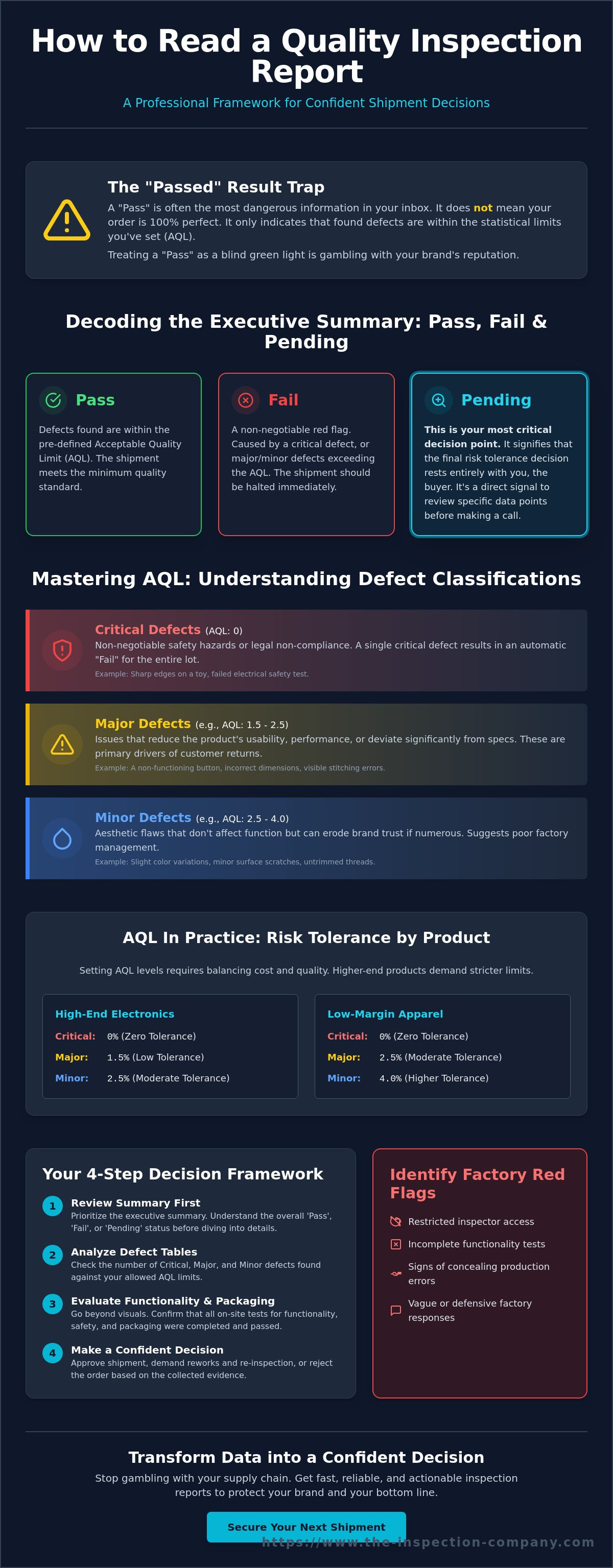
The executive summary is the first page of any professional document; it serves as your 60-second risk assessment. When you're learning how to read a quality inspection report, you must prioritize the data in this section before reviewing the detailed photo appendices. A "Pass" result is frequently misunderstood by novice importers. It doesn't mean your order is 100% perfect. Instead, it indicates that the defects identified remain within the statistical boundaries of the AQL standard. A "Fail" result is more direct. It signals that critical defects were found or that the quantity of major issues exceeded the allowed limit. These are non-negotiable red flags that should halt a shipment to prevent operational friction and financial loss.
Why a "Pending" Result is the Most Critical Decision Point
A "Pending" status is the most nuanced outcome you'll face. It doesn't mean the Inspection was incomplete or that the inspector was indecisive. It signifies that the final risk tolerance decision rests entirely with the buyer. Inspectors typically use this for borderline AQL cases, subjective aesthetic issues, or when a factory lacks the specialized equipment required for a specific functionality test. You shouldn't ignore a "Pending" result. It's a direct signal that you must review specific data points to determine if the product meets your unique quality standards.
The 24-Hour Rule: Why Reporting Speed Matters in 2026
In the logistics environment of 2026, a delayed report is a liability rather than an asset. The Inspection Company delivers finalized reports within 24 hours of the site visit to ensure you can act before port deadlines or container loading schedules. A report that arrives several days late loses its value as a preventative tool because it forces you to choose between an unverified shipment and costly storage fees. Speed and transparency are the only ways to maintain control over high-stakes international trade.
Mastering AQL: How to Read Defect Classifications and Sampling
The Acceptable Quality Limit (AQL) is the statistical backbone of modern quality control. It allows you to draw accurate conclusions about thousands of units by examining a specific sample size. Understanding this section is vital when learning how to read a quality inspection report, as it defines the boundary between a profitable shipment and a financial disaster. Defects are not treated equally; they are categorized based on their impact on safety, functionality, and brand reputation.
- Critical Defects: These are non-negotiable safety hazards or legal non-compliance issues. Examples include sharp edges on toys or failed hi-pot tests on electronics. A single critical defect typically results in an automatic "Fail" for the entire lot.
- Major Defects: These issues reduce the product's usability or significantly deviate from your specifications. These are the primary drivers of customer returns and negative reviews.
- Minor Defects: These are aesthetic flaws, such as slight color variations or surface scratches. While they don't affect function, a high volume of minor defects suggests poor factory management and can erode brand trust.
Decoding the AQL Table: Sample Size vs. Allowed Defects
Professional pre-shipment inspections utilize the ANSI/ASQ Z1.4 table to determine how many units to pull from your mass production. Most consumer goods rely on General Inspection Level II. If your risk tolerance is lower, you might move to Level III for a larger, more stringent sample. The table dictates the exact number of allowed defects before the shipment is rejected. If you find the statistical logic complex, you can review our detailed guide on AQL Explained for a deeper dive into sampling mathematics.
Calculating Your Risk: When to Accept a Shipment with Defects
Setting your defect thresholds requires a balance between cost and quality. For high-end electronics, common AQL levels are 0 for critical, 1.5 for major, and 2.5 for minor defects. For lower-margin apparel, you might accept a 4.0 limit for minor flaws. The key is to define these limits before production begins. If you're unsure which levels suit your specific product category, it's best to consult with a quality expert to establish a robust risk-mitigation strategy. Knowing how to read a quality inspection report effectively means knowing exactly where your line in the sand is before the first unit is even packed.
Beyond Visuals: Evaluating Functionality Tests and Packaging
A common mistake when learning how to read a quality inspection report is over-indexing on the photo gallery. While visual consistency matters, it only accounts for approximately 30% of a professional assessment. A product that looks perfect can still fail during its first hour of use if the internal construction is flawed or the electrical components are substandard. You must look past the surface to the data gathered during on-site testing to truly mitigate your risk.
Professional reports detail specific functionality tests that verify the integrity of your goods. These include battery discharge rates, tension tests for textiles, and hi-pot tests for electrical safety. Internal construction checks are equally vital. They ensure the factory hasn't substituted specified components with inferior alternatives to save on costs. If these tests aren't documented, you're essentially shipping blind.
Your goods must also survive the journey from Ningbo or Shenzhen to your destination warehouse. Verification of export cartons, inner boxes, and pallets is essential for preventing transit damage. Additionally, strict labeling and marking checks prevent expensive customs delays. Missing country-of-origin marks or incorrect weight declarations can result in seized shipments and significant financial loss.
The Carton Drop Test: Your Defense Against Transit Damage
The ISTA 1A drop test is a standard inclusion in TIC reports and serves as your primary defense against mechanical stress during shipping. An inspector drops a loaded carton from a specific height on its corners, edges, and faces. If the packaging fails, the shipment is a high risk. Even if the units inside appear undamaged at the factory, a failed drop test indicates the packaging won't withstand the rigors of international logistics.
Specialized Requirements for Amazon FBA Sellers
Amazon sellers face unique compliance hurdles that must be reflected in the inspection data. A quality report should verify barcode scannability for FNSKU or UPC labels and the presence of polybag suffocation warnings. Failure to meet these platform-specific standards often leads to rejected shipments at the fulfillment center. Our Amazon FBA Service provides the tailored compliance support needed to avoid these operational setbacks. To ensure your next shipment meets these rigorous standards, contact our regional experts for a professional consultation.
The Action Phase: Handling Red Flags and Negotiating Reworks
Once you understand how to read a quality inspection report, the focus shifts from analysis to action. A report is not a static document; it is a strategic tool for negotiation. You must watch for factory red flags that suggest the data might be compromised. For example, restricted inspector access or "cherry-picking" samples are common tactics used to hide systemic issues. If the factory attempted to provide a pre-selected sample rather than letting the inspector pull from mass production, the entire report's validity is in question. These behaviors indicate a lack of transparency that often leads to significant financial loss.
Documented defects provide the objective evidence required for financial claims. If a shipment contains major defects exceeding the AQL, you have the leverage to demand price credits or a full rework. However, some failures are too deep for a simple fix. If a factory audit reveals fundamental management or safety failures, no amount of pre-shipment inspection can secure your supply chain. In these high-stakes scenarios, walking away is often the most cost-effective decision to prevent long-term brand damage.
How to Demand a Professional Rework
If you decide to proceed with corrections, don't accept vague promises. You must issue a formal Corrective Action Plan (CAP). This plan should specify how the factory will address the root cause of the defects rather than just fixing individual units. Utilizing product sorting is essential during this phase. This process isolates defective units from the compliant stock, ensuring that only approved items are packed for shipping. A professional re-inspection is mandatory after any rework to verify that the issues have actually been resolved.
The Final Decision: Approving the Shipment with Confidence
Before signing the release order, perform a final review of the data. Verify that all critical defects are at zero and that the factory has signed off on your CAP. Ensure that the packaging test results align with your logistics requirements. "A quality report is your last point of leverage; once the container is sealed, the data is your only protection." By mastering how to read a quality inspection report and acting on its findings, you transform a risky transaction into a controlled, professional operation.
Transforming Inspection Data into Decisive Action
Mastering how to read a quality inspection report is the single most important skill for any professional importer. You've learned to look past the surface-level "Pass" result and scrutinize the AQL data and functionality tests. You now have a framework to identify factory red flags and the leverage to demand reworks when quality falls short of your standards. This knowledge transforms a simple document into a powerful risk-mitigation tool that protects your brand and your bottom line.
Effective risk management requires a partner you can trust on the ground. We combine European management standards with a localized operational presence in Asia to provide the transparency you need. With over 700 certified inspectors and a commitment to delivering reports within 24 hours, we ensure your shipment decisions are both fast and fact-based. Don't leave your supply chain to chance; use the data to maintain absolute control over your production.
Secure your next shipment with a professional inspection report from TIC
Your supply chain is only as strong as your last inspection. Take control of your quality today and ship with confidence.
Frequently Asked Questions
What is the difference between a Pre-Shipment Inspection and a Factory Audit?
A Pre-Shipment Inspection focuses on the physical goods after production to verify they meet your specific requirements. In contrast, a Factory Audit evaluates the manufacturer's management systems, international certifications, and production capacity. Think of the audit as qualifying the partner and the inspection as qualifying the product. Both are essential components of a robust risk-mitigation strategy.
Can I trust a 'Pass' result if the inspector only checked a small sample?
Statistical sampling is the industry standard for a reason. When you learn how to read a quality inspection report, you'll see that the sample size is determined by ISO 2859-1:2026 AQL tables. This provides a mathematically valid representation of the entire lot. While it's not a 100% check, it identifies systemic issues with high confidence while remaining cost-effective for mass production.
What should I do if my inspection report comes back as 'Pending'?
A 'Pending' status requires you to review the specific findings that the inspector could not definitively pass or fail. This often occurs when a factory lacks specialized testing equipment or when aesthetic flaws fall into a subjective grey area. You must examine the provided data and photos to make a final "Go/No-Go" decision based on your unique risk tolerance and market standards.
How many major defects are considered acceptable in a standard shipment?
The acceptable number of defects is dictated by your chosen AQL level and the total sample size. For instance, in a common AQL 2.5 limit for major defects, the report will specify a maximum number of allowed failures based on the sample pulled. If the count exceeds this number, the shipment fails. You must define these thresholds before production begins to ensure clear expectations with your supplier.
Why do I need a third-party inspection company instead of using the factory's own QC?
Internal factory inspections have an inherent conflict of interest. A supplier is naturally incentivized to ship goods to meet delivery deadlines and secure final payment, even if quality is marginal. Third-party inspectors provide independent, unbiased verification of your order. This transparency is your only protection against receiving a shipment of hidden defects that could lead to expensive product recalls or financial loss.