What if your factory reopens after Chinese New Year but can’t yet produce at its usual capacity or quality level? The Chinese New Year impact on production 2026 can extend beyond the holiday itself. Lunar New Year falls on February 17, and production may slow in the weeks beforehand. Changes in staffing and backlogs can also delay a return to normal output after factories reopen.
Planning around factory closure dates is important, but uneven production before and after the break can pose a greater risk. Rushed orders may face quality-control shortcuts, while returning or replacement workers may need time to regain production consistency. A planned shipment date alone doesn’t confirm that goods are ready.
This guide explains how to set realistic production milestones, identify quality risks, and choose checks that match your order’s timing and readiness. It also covers how During Production Inspection and Pre-Shipment Inspection can provide evidence before you approve production or shipment, helping you make decisions with greater visibility.
Key Takeaways
- Use supplier-specific closure dates and production milestones to build a schedule that accounts for changing capacity, not just the official holiday.
- The chinese new year impact on production 2026 can include quality risks during team handovers and restart. Document acceptance criteria before work resumes.
- Prioritize unfinished orders and critical production steps so you can spot readiness gaps before they affect shipment decisions.
- Match inspection timing to the decision you need to make: check production progress with During Production Inspection or assess finished goods with Pre-Shipment Inspection, using AQL sampling and photo-backed reporting.
Chinese New Year 2026 and its impact on factory production
Chinese New Year, also called the Spring Festival, is the main traditional holiday in China. “Lunar New Year” is a broader term for New Year celebrations based on a lunisolar calendar. Chinese New Year, also known as the Spring Festival, is a significant traditional Chinese holiday. In 2026, it falls on Tuesday, February 17. That date marks the holiday, not a universal factory closure schedule. Each supplier sets its own last production day and restart plan.
The chinese new year impact on production 2026 can begin before the holiday, as workers travel and staffing or output changes. It can continue after reopening while teams return and production resumes. Treat any estimate of a multi-week disruption as a planning range, not a fixed rule. The effect depends on the factory, workforce, order status, and manufacturing location.
Why the official holiday dates do not define the full production impact
A factory may reduce shifts or slow selected production steps before its formal closure, while another may operate closer to the holiday. Restart can also be gradual rather than immediate. Separate the public holiday date from the supplier’s operating calendar: confirm the final production day, closure period, planned restart, and expected return to normal capacity for your order. These details make a more useful schedule than the holiday date alone.
Which production orders are most exposed?
Orders are more schedule-sensitive when production is unfinished, delivery windows are tight, or several stages must happen in sequence. A delay at one stage can leave later work waiting, even if the factory reopens on schedule. Product category alone doesn’t determine exposure. The specific process and factory circumstances matter.
- Identify orders with incomplete production or pending approvals.
- Allow extra time for orders that depend on sequential production stages.
- Compare delivery commitments with the supplier’s closure and restart dates.
How Chinese New Year production slowdowns can affect quality
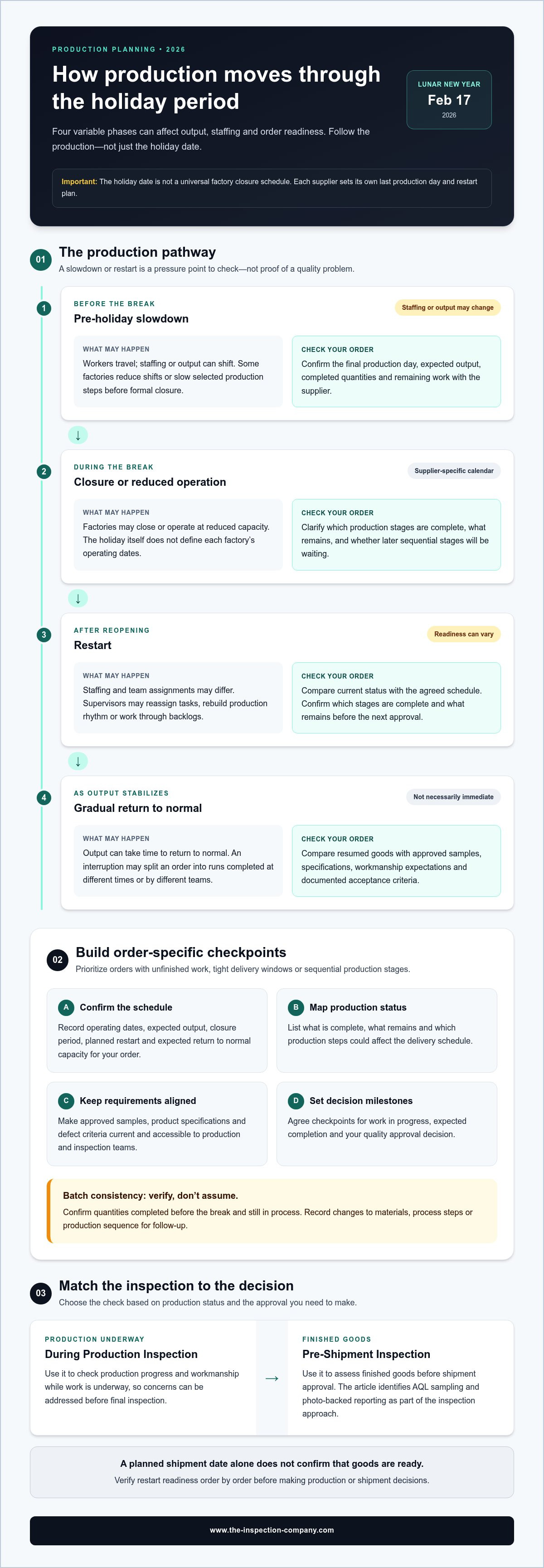
The chinese new year impact on production 2026 isn’t limited to the days when a factory is closed. Production may pass through four variable phases: a pre-holiday slowdown, a closure or reduced-operation period, a restart, and a gradual return to normal. Not every factory experiences each phase in the same way, and a slowdown or restart doesn’t automatically mean lower-quality goods. The key question is whether changes to staffing, handovers, or work sequencing affect your specific order.
What can change during a production restart?
After a break, staffing levels and team assignments may differ from those before the holiday. Supervisors may need to reassign tasks, re-establish production rhythm, or work through backlogged orders. These are potential pressure points, not proof of a problem. For an order in progress, compare its current status with the agreed schedule and requirements. If work has paused or teams have changed, clarify which stages are complete and what remains before the next approval.
How can interruptions affect batch consistency?
An interruption can divide an order into production runs completed at different times or by different teams. Check that resumed goods still meet the approved specifications, workmanship expectations, and acceptance criteria. Don’t assume there is a difference. Use checks to establish whether the batch conforms.
Focus your review on the actual order:
- Confirm which quantities were completed before the break and which are still in process.
- Compare resumed production with approved samples and documented requirements.
- Record changes to materials, process steps, or production sequence for follow-up.
Verify restart readiness order by order. A factory reopening doesn’t confirm that a specific batch is complete or consistent. A During Production Inspection can provide evidence of progress and workmanship while production is underway, helping you address concerns before the order reaches final inspection.
How importers can protect production quality around Chinese New Year
Reduce uncertainty by turning the holiday schedule into order-specific checkpoints. The chinese new year impact on production 2026 depends on where each order stands, so prioritize work that is unfinished, has a tight delivery window, or depends on several production stages. Allow for pauses and restart rather than assuming output will immediately return to its previous pace.
A production-focused checklist before the holiday
Before production changes, get a clear status for each order and agree on what counts as acceptable goods. Keep the information together so that progress updates, inspection findings, and shipment decisions all refer to the same requirements.
- Confirm the factory’s operating dates, expected output, completion status, and restart expectations for your order.
- Record what is complete, what remains, and which production steps could affect the delivery schedule.
- Ensure approved samples, product specifications, and defect criteria are current and accessible to the people responsible for production and inspection.
- Set milestones for work in progress, expected completion, and your quality approval decision.
Set checkpoints around restart and shipment approval
Choose checks according to the decision you need to make. If production is underway and you need visibility into progress or workmanship, a During Production Inspection can provide a view of that milestone. If goods are complete, a Pre-Shipment Inspection can help you assess whether they meet the agreed acceptance criteria before shipment approval. A Pre-Production Inspection can help establish requirements before manufacturing starts.
Schedule a finished-goods inspection for when the required quantity is ready. If that quantity isn’t available on the inspection date, The Inspection Company cancels the inspection and reports that the vendor couldn’t provide the required quantity. Align the inspection timing with actual completion, not an estimated date alone.
Verify actual production readiness before making shipment approval decisions. Use inspection evidence alongside the order status and documented criteria, not the calendar alone. To plan quality checks around your production milestones, discuss your inspection requirements.
Use independent inspections to manage Chinese New Year production risk
Independent inspection provides evidence at key production milestones, helping importers make decisions based on an order’s actual condition rather than its planned schedule. The chinese new year impact on production 2026 may make timing less predictable, so match each check to the question you need answered: Is production ready to begin? Is work progressing as expected? Are finished goods ready for approval?
Choose an inspection stage that matches the order's status
Before manufacturing starts, a Pre-Production Inspection can assess readiness against agreed requirements. During production, an in-process check provides visibility into work underway and can flag issues while there’s still time to respond. Once the required quantity of finished goods is available, Pre-Shipment Inspection can support your decision to approve the order. Each stage serves a different purpose. One check doesn’t replace other quality controls.
What importers can expect from The Inspection Company
The Inspection Company’s inspectors use AQL sampling. You receive a same-day Quick Report, followed by a detailed, photo-backed report within the next 24 hours. This gives you a timely summary and documented findings to review against your requirements before deciding on the next step.
The Inspection Company has 700+ inspectors across 25+ countries. Its quality credentials include ISO 9001:2015 certification and ISO/IEC 17020 accreditation as a Type A Inspection Body. This coverage supports inspections across Asian manufacturing hubs.
Inspection is billed in man-days, and pricing varies by product type, quantity, and location. Request a free quote for pricing tailored to your order and inspection needs.
Independent quality evidence helps you make informed shipment approval decisions, but it doesn’t guarantee that every defect will be found or that a shipment will be on time. Request a free inspection quote.
Turn seasonal disruption into a stronger quality plan
Use the chinese new year impact on production 2026 as a prompt to build clearer decision points into future orders. Set expectations with suppliers before production starts: which progress updates you need, which changes require approval, and what evidence your team needs before accepting finished goods. When these expectations are documented, it’s easier to assess schedule changes and avoid leaving critical quality decisions until the last moment.
For your current order, identify the next decision that depends on reliable production information. Then align the quality check with that point, whether you need visibility into work in progress or evidence before approving finished goods. A clear plan won’t prevent every disruption, but it can help you respond with more control and avoid relying on assumptions.
Request a free inspection quote to plan a quality check around your order’s production stage. With the right evidence at the right decision point, you can move forward with greater confidence.
Frequently Asked Questions
Is Chinese New Year the same as Lunar New Year?
Not exactly. Chinese New Year is the common English name for the Spring Festival celebrated in China, while Lunar New Year refers more broadly to celebrations in several cultures. The date follows a lunisolar calendar, so it shifts on the Gregorian calendar each year. When discussing supplier schedules, use the holiday name and calendar relevant to the factory’s location to avoid making assumptions about closure dates.
Does Chinese New Year affect factories outside mainland China?
It can, but the scale and timing depend on the country and the supplier’s operations. A factory outside mainland China may follow its own local holiday calendar, employ workers who travel for Lunar New Year, or rely on business links with mainland China. For the chinese new year impact on production 2026, confirm each supplier’s planned operating dates and whether any production inputs or processes depend on mainland China.
What is Chunyun, and why is it relevant to production?
Chunyun is the major annual travel period associated with people returning home around Lunar New Year. It matters to importers because workforce travel may affect staffing and available factory capacity. The impact isn’t uniform: a supplier’s location, workforce arrangements, and production plan all influence exposure. Treat Chunyun as a reason to discuss staffing and output plans with the supplier, not as proof that production will stop.
What happens if the required finished quantity is not available on the inspection date?
The Inspection Company cancels the inspection and reports that the vendor couldn’t provide the required quantity of finished products. If only part of an order is complete, for example, the scheduled inspection can’t establish readiness of the full required quantity. Coordinate the inspection date with the supplier’s actual completion status. A booking alone doesn’t confirm that goods are ready or authorize shipment.
Can an inspection confirm that a factory will restart on schedule after Chinese New Year?
No. An inspection provides evidence about the products and conditions observed at the time of the check. It can’t verify future factory capacity or guarantee a restart date. For example, an inspection of goods completed before the holiday says nothing conclusive about a later production run. Use supplier restart updates and order milestones to decide when additional quality checks are appropriate.