

What if the first time you check industrial equipment against its requirements is just before shipment? By then, a mismatch with the specification or approved sample may be difficult to correct without delays and rework. Quality assurance for industrial equipment works best as a series of evidence gates, not a single final check.
Buyers need clear evidence that an order is ready before accepting it. A final inspection can help assess finished goods, but it can’t replace checks earlier in production, when issues may be easier to identify and address. The right timing and acceptance criteria depend on the equipment, the order requirements, and the risks involved.
This 2026 guide explains how to set useful checks before, during, and after production, and how to define acceptance criteria that support evidence-based shipment decisions. You’ll also learn how to match inspection activities to sourcing risks, use factory audits to assess supplier capability, and reduce the chance of receiving nonconforming goods.
Key Takeaways
- Build quality assurance for industrial equipment around clear requirements and checks at key production stages, rather than relying on a single final inspection.
- Set acceptance criteria from approved specifications, drawings, and purchase-order requirements so inspection findings support a consistent shipment decision.
- Match inspection coverage to equipment complexity, supplier history, order impact, and production stage to focus attention where risks are greatest.
- Use product inspections to assess the goods and factory audits to evaluate supplier capability and quality systems. Each provides different evidence for managing risk.
Why quality assurance for industrial equipment must start before shipment
Quality assurance for industrial equipment is a planned system of checks against agreed specifications, drawings, purchase-order requirements, and approved samples throughout procurement and production. It helps buyers identify where requirements could be missed instead of waiting until equipment arrives. These Principles of Quality Assurance distinguish preventive planning from product-focused quality control. Supplier checks are important, but they don’t give the buyer independent evidence of what was produced and whether it matches the order.
What can go wrong when industrial equipment is accepted without verification?
A unit may arrive with the wrong configuration, missing accessories, visible damage, or specifications that don’t match the approved requirements. If the issue is found only after delivery, the buyer may need to arrange rework, resolve a dispute, or wait for a correction before deployment. Equipment that can’t be installed or used as planned may also disrupt operations and delay a project. Checks before shipment give the buyer more opportunity to identify discrepancies while there is still time to respond.
Quality assurance versus final product inspection
An assurance plan defines what should be checked, against which requirements, and at which production stages. An inspection records findings at a particular time and within an agreed scope. For example, a pre-shipment inspection can provide evidence about finished goods before a shipment decision. That evidence helps the buyer assess readiness, but it doesn’t replace contract terms or the supplier’s responsibility to deliver as agreed.
Staged checks can identify issues earlier, but no inspection can guarantee defect-free goods. Treat inspection findings as practical evidence for managing risk, not as a promise that every fault has been found. Pair supplier quality control with buyer-side verification so decisions rely on documented requirements and observed results, not assumptions alone.
How staged equipment inspections create quality gates during production
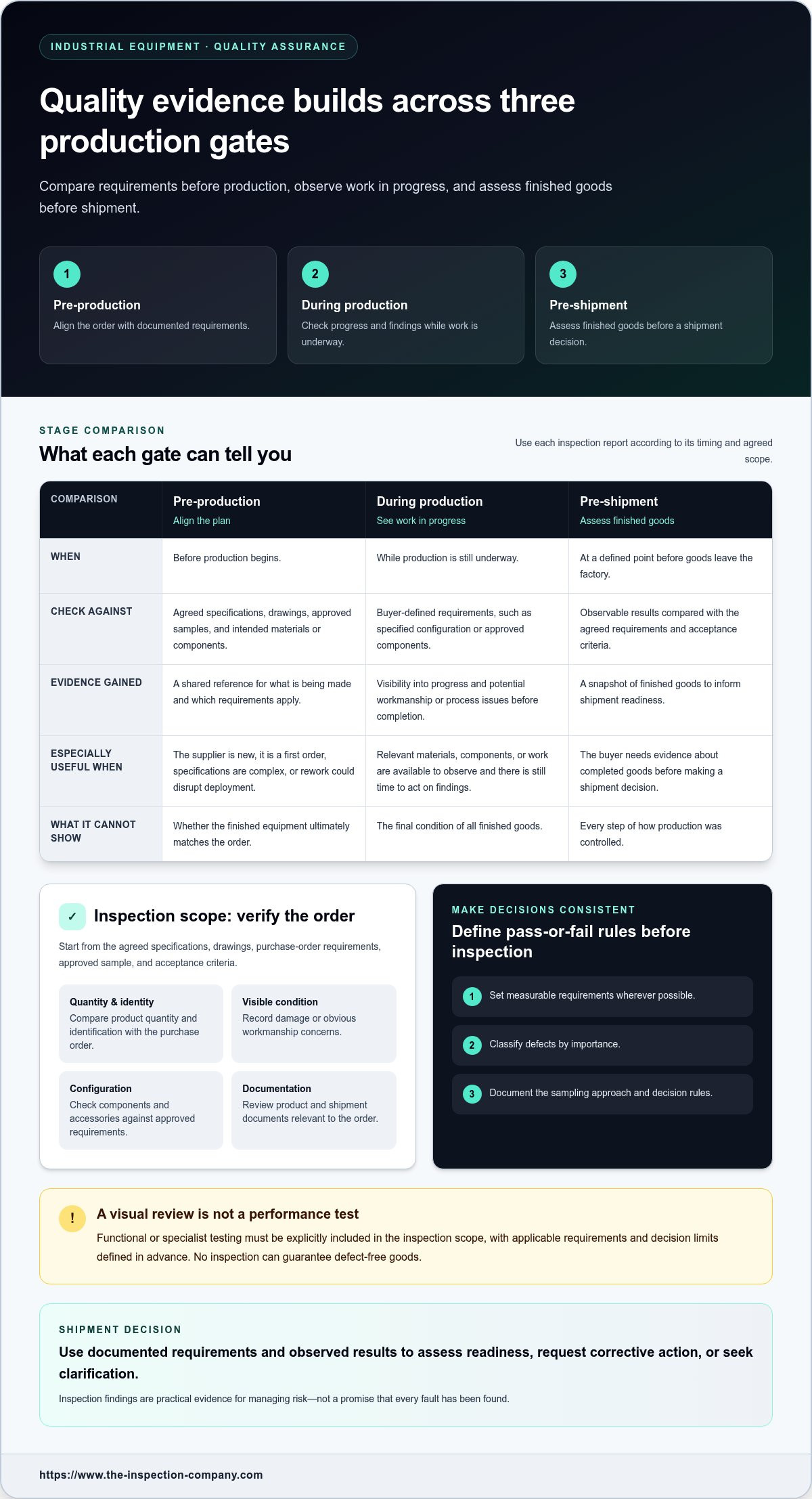
Buyer-side checks work best when they follow production rather than wait for a finished unit. Use a clear sequence: review the requirements, check production status, inspect finished goods, then decide whether the evidence supports shipment readiness. At each gate, compare what is being made or delivered with the relevant requirements. This gives the buyer a defined point to identify gaps and respond before the next production stage makes correction harder.
Before production, review the agreed specifications, drawings, approved samples, and materials or components intended for the order. This pre-production check helps align the supplier and buyer on what is being made. During production, an inspection can surface workmanship or process issues while work is still underway. A during-production inspection gives buyers a view of progress and findings before the goods are complete.
When should buyers use pre-production and during-production checks?
Earlier checks can be especially useful for a new supplier, a first order, complex specifications, or equipment where rework could disrupt deployment. Time the check to when the relevant materials, components, or work are available to observe and there is still time to act on findings. Set the scope against buyer-defined requirements, such as the specified configuration or approved components, rather than using a generic checklist.
What does a pre-shipment inspection add?
A pre-shipment inspection assesses finished goods at a defined point before they leave the factory. It can compare observable results with agreed requirements and provide evidence for the buyer’s shipment decision. It complements earlier checks, but doesn’t show every step of how production was controlled.
A final inspection is a snapshot of finished goods; process checks provide visibility while production is still underway. Use both where the order’s risks justify staged coverage, and interpret each report according to its timing and scope. Findings can inform whether to approve shipment, request corrective action, or seek clarification against the order requirements. They are not a guarantee of defect-free equipment.
What should an industrial equipment quality inspection verify?
Start with the agreed specifications, drawings, purchase-order requirements, approved sample, and acceptance criteria. These documents define the reference point for quality assurance for industrial equipment. A practical inspection scope can cover:
- Order quantity and product identification against the purchase order.
- Visible condition, including damage or obvious workmanship issues.
- Configuration, components, and accessories against the approved requirements.
- Available product and shipment documentation relevant to the order.
For example, confirm that the model or configuration and the included accessories match the order documents, and record any visible damage or workmanship concerns. Functional or specialist testing should be explicitly included in the inspection scope, with applicable requirements and decision limits defined in advance. A visual review alone can’t establish how equipment performs. Inspection findings are meaningful only when compared with documented acceptance criteria.
How should buyers define pass-or-fail criteria?
Before inspection, set measurable requirements wherever possible, classify defects by importance, and document the sampling approach and decision rules. This helps prevent inconsistent judgments, such as treating a minor cosmetic issue like a configuration mismatch. If laboratory or sample-based evidence is relevant, sample testing can support evaluation against defined requirements. Keep the method and limits tied to the equipment and order.
What inspection cannot establish on its own
A visual or otherwise scoped inspection records what was observed at a particular time. It can’t prove long-term reliability or replace required certification. Nor should observed findings be treated as a compliance determination or specialized engineering validation. Keep these evidence types distinct: inspection supports a buyer’s decision within its agreed scope, while certification and technical validation address their own requirements.
Clear criteria make reports more useful and shipment decisions more defensible. To discuss inspection coverage for your equipment and requirements, contact our team.
How to apply an equipment QA plan with an independent inspection partner
Choose inspection coverage by weighing four factors: equipment complexity, supplier history, order impact, and production stage. A new supplier or first order may call for earlier checks. Complex specifications can make a pre-production review useful, while a high-impact order may justify checks at more than one stage. Match the scope to the risks and the evidence you need for a shipment decision. Quality assurance for industrial equipment is more useful when checks respond to these specific risk factors instead of following a one-size-fits-all checklist.
Inspection service or factory audit: which addresses the risk?
Product inspection focuses on a particular order, checking quantity and quality against agreed requirements at a defined production stage. A factory audit addresses a different question: whether the supplier’s capabilities, management systems, or social compliance meet the buyer’s assessment needs. An audit doesn’t verify every item in an order, and an inspection isn’t a broad assessment of supplier systems. Use each to assess the risk it is designed to address.
Prepare a clear inspection brief
Give the inspection partner the product specifications, drawings, purchase-order details, reference samples, and acceptance criteria. Identify which requirements matter most, where production stands, and what evidence would help resolve a discrepancy. The Inspection Company supports businesses purchasing goods from Asia, with more than 700 inspectors across key Asian manufacturing hubs. Its inspection reports include photos and are delivered within 24 hours of the inspection. Review the available quality inspection services to understand how checks at different production stages can fit your plan.
A well-defined brief makes the scope clearer and findings more useful. Inspection provides evidence within that scope, not a guarantee that every defect will be found or that goods are defect-free. Use the report alongside the purchase requirements and supplier responsibilities when deciding next steps. To discuss an equipment inspection plan, contact our team.
Make the next order easier to control
Before your next equipment order moves forward, decide who will review inspection findings and what happens if results fall short of the agreed criteria. A clear escalation path helps your team respond consistently instead of making urgent decisions under shipment pressure. Record who can request corrective action, who evaluates the evidence, and who has authority to approve shipment.
That preparation turns quality assurance for industrial equipment into a practical part of procurement planning. It also aligns your internal team and inspection partner on the purpose of each check before production begins.
Discuss your industrial equipment inspection requirements and plan checks around your order’s risks. With a clear process in place, you can approach the next shipment decision with greater confidence.
Frequently Asked Questions
How quickly can I receive an industrial equipment inspection report?
The Inspection Company delivers a detailed inspection report with photos within 24 hours of the inspection. Use it to compare recorded findings with the order requirements and share discrepancies with the person responsible for shipment approval. The report reflects the inspection’s defined scope and timing, so treat it as evidence for a decision, not a guarantee of every unit’s condition.
What happens if an inspection finds nonconforming industrial equipment?
Compare the finding with the agreed requirement, document which item or feature is affected, and notify the supplier before making a shipment decision. Then agree on a response, such as correction, replacement, or further review, based on the contract and the issue’s impact. If the finding changes the condition of the goods, an additional inspection may help establish whether the corrective action addressed it.
Can industrial equipment quality assurance prevent every defect?
No. Quality assurance for industrial equipment can reduce risk by planning checks and identifying issues within their scope, but no inspection can establish that every item is free of defects. A check is limited to what was observable, the sample or units reviewed, and the criteria applied. Keep controls proportionate to the consequences of failure, and use supplier corrective actions to address recurring problems.
Is a factory audit the same as an industrial equipment inspection?
No. A factory audit examines a supplier’s broader capabilities, quality management systems, and, where relevant, social compliance. An equipment inspection focuses on specific goods or an order at an agreed stage. For example, an audit may review how a supplier manages quality records, while an inspection checks whether the order’s configuration matches the buyer’s documented requirements.
What information should I provide before an equipment inspection?
Provide the current specification, relevant drawings, purchase-order details, acceptance criteria, and any approved reference sample. Also identify the production stage, goods or components in scope, known concerns, and the findings your team needs to make a decision. Clear priorities keep attention on order-critical requirements, such as a required configuration or accessory, rather than details that don’t affect acceptance.