

What good is a supplier rating if it cannot show what happened or what to do next? A practical supplier score card template turns scattered order, inspection, and communication records into a consistent view of supplier performance. It replaces vague impressions with measurable criteria, clear scoring rules, and evidence linked to each rating.
A supplier review can reveal a concern without making the next step clear. The score should start a decision, not end the review. This guide shows how to choose criteria for quality, delivery, responsiveness, and risk; set weights that reflect business priorities; and record evidence sources and dates. You’ll also learn how to compare suppliers fairly, interpret low scores, and assign corrective actions with owners and review dates. On-site inspections and factory audits can add documented observations to the record. The Inspection Company provides a Quick Report on the inspection day and a detailed, photo-backed report within the next 24 hours, helping ground ratings in evidence.
Key Takeaways
- Use a supplier score card template with clear measures and evidence fields to make reviews easier to compare.
- Separate ongoing performance tracking from one-time supplier selection and factory audits.
- Set rating anchors before scoring, then link low ratings to specific corrective actions, owners, and review dates.
- Use product inspection findings to assess quality and factory audit evidence to understand supplier capability.
What a Supplier Score Card Template Should Help You Decide
A supplier scorecard is a structured way to assess performance against defined criteria over time. A practical supplier score card template helps buyers turn order records, inspection findings, and communications into comparable ratings, so purchasing decisions rely on documented patterns rather than memory or isolated impressions. It can show where closer monitoring is needed, whether performance is improving, and which issues need follow-up.
This is part of broader supplier evaluation, but it serves a specific purpose: ongoing performance monitoring. Supplier selection assesses a potential business relationship; a factory audit examines capability and conditions at a particular point in time. Neither replaces a recurring scorecard review, and a scorecard doesn’t replace either form of due diligence.
When a supplier scorecard is useful
Importers, retailers, wholesalers, and procurement teams can use consistent criteria to compare suppliers or review one supplier across periods. For example, track delivery reliability and inspection findings for each review cycle, then investigate a downward trend before it affects future orders. Set the criteria, rating definitions, and review periods in advance. This makes comparisons more consistent and helps explain why a rating changed. A factory audit can provide a separate view of operational capability to inform the assessment.
What a scorecard cannot establish by itself
A rating is only as reliable as its supporting evidence. Supplier-reported figures can be useful inputs, but they don’t independently verify factory conditions. A single low score may flag a concern without explaining its cause; a high score may conceal a gap if the measure is vague or evidence is missing. Record the source and date for each finding, and distinguish reported data from observed results.
Performance monitoring also isn’t compliance certification or product testing. A scorecard can organize concerns and guide follow-up, but it doesn’t prove that a supplier meets a certification requirement or that a product passes inspection. Use it as a decision aid, supported by appropriate checks and evidence, not as a substitute for them.
Supplier Score Card Template: Criteria, Evidence, and Rating Fields
Build the scorecard around risks that matter for your product, market, and supply chain. A useful supplier score card template makes each rating traceable: record what was measured, where the evidence came from, and the period it covers. Scorecards are part of supplier management, but the criteria should reflect your operation rather than a universal checklist.
Choose measurable supplier performance indicators
Choose indicators that can be observed and reviewed consistently. Defect findings, on-time delivery, response completion, document accuracy, and corrective-action closure are possible measures, not universal requirements or benchmarks. For each measure, state exactly what counts, which records support it, and the review period. For example, define whether delivery performance is based on the agreed delivery date or a revised date, and use that definition consistently. Set weights according to business priorities and apply the same rating scale when comparing suppliers.
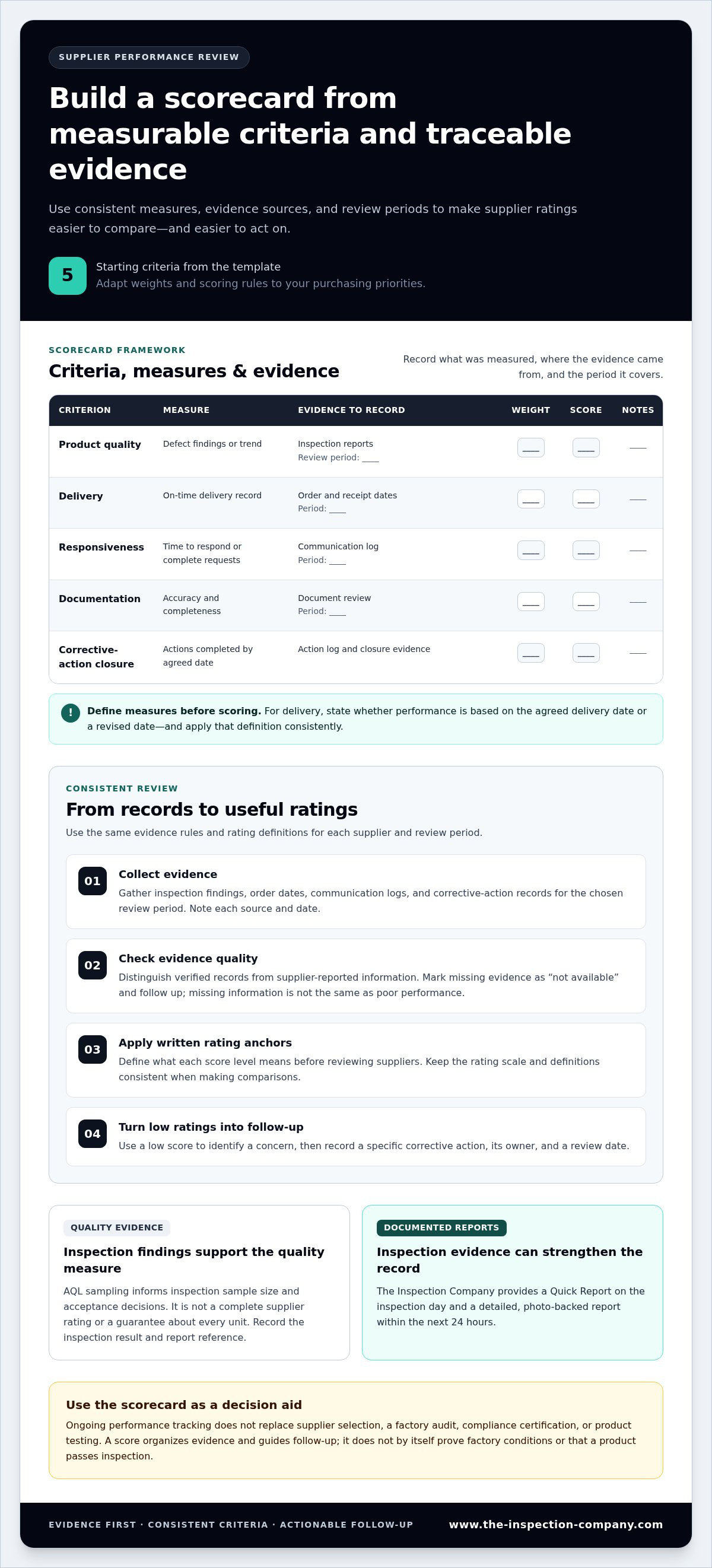
Copy and adapt this starting table. Set weights and scoring rules for your own purchasing decisions.
| Criterion | Measure | Evidence | Weight | Score | Notes |
|---|---|---|---|---|---|
| Product quality | Defect findings or trend | Inspection reports, review period: ____ | ____ | ____ | ____ |
| Delivery | On-time delivery record | Order and receipt dates, period: ____ | ____ | ____ | ____ |
| Responsiveness | Time to respond or complete requests | Communication log, period: ____ | ____ | ____ | ____ |
| Documentation | Accuracy and completeness | Document review, period: ____ | ____ | ____ | ____ |
| Corrective-action closure | Actions completed by agreed date | Action log and closure evidence | ____ | ____ | ____ |
Match the criteria to product quality evidence
AQL sampling uses the international Acceptable Quality Limit standard to inform inspection sample size and acceptance decisions. It can support a quality measure, but it isn’t a complete supplier rating or a guarantee about every unit. See the AQL sampling guide for context, then record the inspection result and report reference in the evidence field. The Inspection Company’s quality inspection services provide documented findings that can support your scorecard. Discuss how inspection evidence can support your supplier quality reviews.
How to Score Suppliers Fairly and Turn Ratings into Actions
A consistent process keeps ratings comparable and makes a low score useful. Before using your supplier score card template, agree on rating definitions, evidence rules, and who will review the results. Then follow the same steps for each supplier and review period.
- Collect evidence. Gather records for the chosen review period, such as inspection findings, order dates, communication logs, and corrective-action records. Note each source and date so reviewers can trace a rating.
- Check evidence quality. Separate verified records from supplier-reported information. If evidence is missing, mark it as “not available” and follow up. Don’t automatically assign a poor score, since missing information and poor performance are different findings.
- Apply written rating anchors. Define what each score level means before reviewing suppliers. For example, a top rating might require complete evidence that the agreed measure was met, while a lower rating reflects documented shortfalls. Keep definitions specific enough that two reviewers can reach similar conclusions.
- Apply weights and thresholds. Give greater weight to criteria with more impact on your business, such as product quality for a high-risk item. There’s no universal weighting formula. Set internal review thresholds around your priorities, and treat any example threshold as illustrative, not an industry standard.
- Assign and review actions. For each concern, record the issue, agreed corrective action, responsible owner, deadline, and evidence needed to verify completion. Review the evidence on the scheduled date and update the score only when the findings support a change.
A low score identifies a concern; it doesn’t prove the cause or confirm that a problem has been corrected. If on-site capability or management-system evidence is relevant, a factory audit can add documented observations to the review. The Inspection Company conducts factory audits to assess supplier capabilities, quality management systems, and social compliance. Keep audit findings distinct from ongoing performance ratings, then use follow-up evidence to assess corrective action. Discuss inspection evidence for your supplier reviews.
Strengthen Your Supplier Scorecard with Independent Quality Evidence
Internal records show what your team experienced. Inspection and audit findings can add documented observations to those records, making scorecard ratings easier to review and discuss. Match the evidence to the question: a product check can inform a quality rating, while a factory audit provides a different view of site capability and systems.
Choose evidence that matches the scorecard question
A supplier survey can provide background information relevant to supplier evaluation. For product quality, use inspection findings tied to a defined production stage, order, and sample. Pre-shipment inspection, for example, provides shipment-stage context; the Pre-Shipment Inspection overview explains how this check fits into quality control. AQL can guide sample size and acceptance, but an inspection result isn’t a complete rating of the supplier.
Use factory audit findings when the scorecard question concerns production capability, quality systems, or factory conditions. These observations shouldn’t be treated as product test results. Likewise, product inspection evidence alone can’t establish broader factory capability or social-compliance status. Keep each type of evidence attached to the criterion it actually supports.
Keep supplier reviews traceable and current
For every report or record, capture the evidence date, product or order scope, source, and reviewer. This helps reviewers distinguish a current observation from an older finding or a document that covers a different product. The Inspection Company provides a Quick Report on the inspection day and a detailed, photo-backed report within the next 24 hours. These records can inform a scorecard review and guide follow-up discussions, but they don’t guarantee a particular supplier outcome.
Use inspection findings alongside order, delivery, and communication records, then document any decision or follow-up arising from the review. Contact The Inspection Company to discuss inspection and audit services for your supplier reviews.
Put Your Supplier Review Process into Practice
A scorecard becomes useful when it shapes the next review, not when it sits untouched in a spreadsheet. Start with a manageable group of suppliers, establish a review cadence, and refine the measures as your purchasing risks change. Keep decisions tied to recorded evidence, and use recurring gaps to decide where closer quality checks or follow-up may be warranted.
A practical supplier score card template gives your team a consistent foundation, while inspection and audit evidence can support informed review discussions. The Inspection Company has more than 700 inspectors across 25+ countries and is ISO 9001:2015 certified and an ISO/IEC 17020 Accredited Type A Inspection Body.
Build a process that makes issues visible early and assigns clear next steps. Contact The Inspection Company to discuss supplier inspection and audit services for your supply chain, and put a more evidence-led review process into practice.
Frequently Asked Questions
How many KPIs should a supplier scorecard include?
There’s no fixed number; include only KPIs that help answer a purchasing or risk question. If a team is deciding whether to increase order volume, for example, it may focus on measures tied to product consistency and delivery reliability. Avoid metrics that nobody uses to make decisions. After a review cycle, remove indicators that add effort but don’t change the team’s understanding or next steps.
How do you weight supplier scorecard criteria?
Weight each criterion according to its impact on your business and the risks associated with the product. In a supplier score card template, add a short rationale beside each weight so reviewers can see why a measure matters. For example, a product with strict quality requirements may call for greater emphasis on quality evidence than response speed. There’s no universal formula, so review the model against actual decisions and revise it when priorities change.
Can one supplier scorecard template work for every product category?
A shared template can standardize basic fields, but it shouldn’t force identical criteria onto unlike products. Keep common measures where they support meaningful comparison, and add category-specific measures for different specifications or handling risks. Label each scorecard with its product category, order scope, and applicable requirements. That way, a reviewer can distinguish a genuine performance difference from a difference in what each supplier was asked to provide.
What should you do if a supplier score is low?
Check the evidence and scoring rule first, then determine whether the result reflects a confirmed gap, incomplete information, or a one-off event. For example, a missed delivery may have a different cause and response from repeated late shipments. Record the issue and the decision made, including any corrective action, owner, and review date. Don’t treat a changed score alone as proof that the underlying issue has been resolved.
Can inspection results be included in a supplier scorecard?
Yes. Inspection findings can support a product-quality measure when the record identifies what was inspected, the order or product covered, and the inspection date. Note the sampling basis and interpret the result within that scope. One inspection is a snapshot, not a complete history of supplier performance. For a broader assessment, compare it with other relevant records, such as findings from a different production stage or delivery history.