

What if consistent quality control doesn’t mean inspecting every supplier in exactly the same way? When products, factories, and production risks differ, identical checks can miss important problems. But without a shared standard, suppliers may interpret specifications and defect limits differently, while inspection reports become difficult to compare. Effective quality control when sourcing from multiple suppliers starts with one measurable quality bar, then adapts the checks to each supplier’s risks.
You can get consistent results without treating every factory as identical. This guide explains how to define clear product requirements and defect criteria, prioritize inspection points according to product and production risks, and standardize reporting so findings can be compared. It also covers checks at different production stages, including During Production Inspection and Pre-Shipment Inspection, to help identify issues before they disrupt delivery or customer confidence. The goal is practical: use documented evidence to make informed decisions about each shipment.
Key Takeaways
- Make quality control when sourcing from multiple suppliers consistent by setting one shared, measurable standard for every supplier.
- Separate core product requirements from supplier-specific risks so inspections focus on what matters at each factory.
- Use repeatable checks at key production stages and document findings to support clearer shipment decisions.
- Independent inspection can provide comparable evidence across supplier sites, helping you act on issues before they affect delivery or customer confidence.
Why quality control across multiple suppliers needs one shared standard
Quality control across separate supplier relationships needs a common reference point. Multi-supplier quality control is the use of one shared product-quality standard to assess goods made by different suppliers. This gives buyers a consistent acceptance bar while allowing inspection priorities to reflect each factory’s products, processes, and risks. The Quality control principles of monitoring and correcting production processes apply across sites, but the checks need not be identical.
Without a shared bar, one supplier may treat a small surface mark as acceptable while another rejects the same defect. That can create uneven products within one order and make shipment decisions harder: a pass from one factory may not mean the same thing as a pass from another.
What becomes harder when suppliers work to different standards?
Ambiguous specifications invite interpretation. A phrase such as “smooth finish” could mean no visible scratches to one factory and no rough edges to another. Clarify requirements with measurable criteria, reference images, or approved samples where appropriate. Apply the same discipline to records. If one report lists defects by type and another gives only a general pass, it is difficult to compare supplier performance or spot recurring issues. Consistent evidence helps you distinguish a one-off finding from a pattern.
What should remain consistent across every supplier?
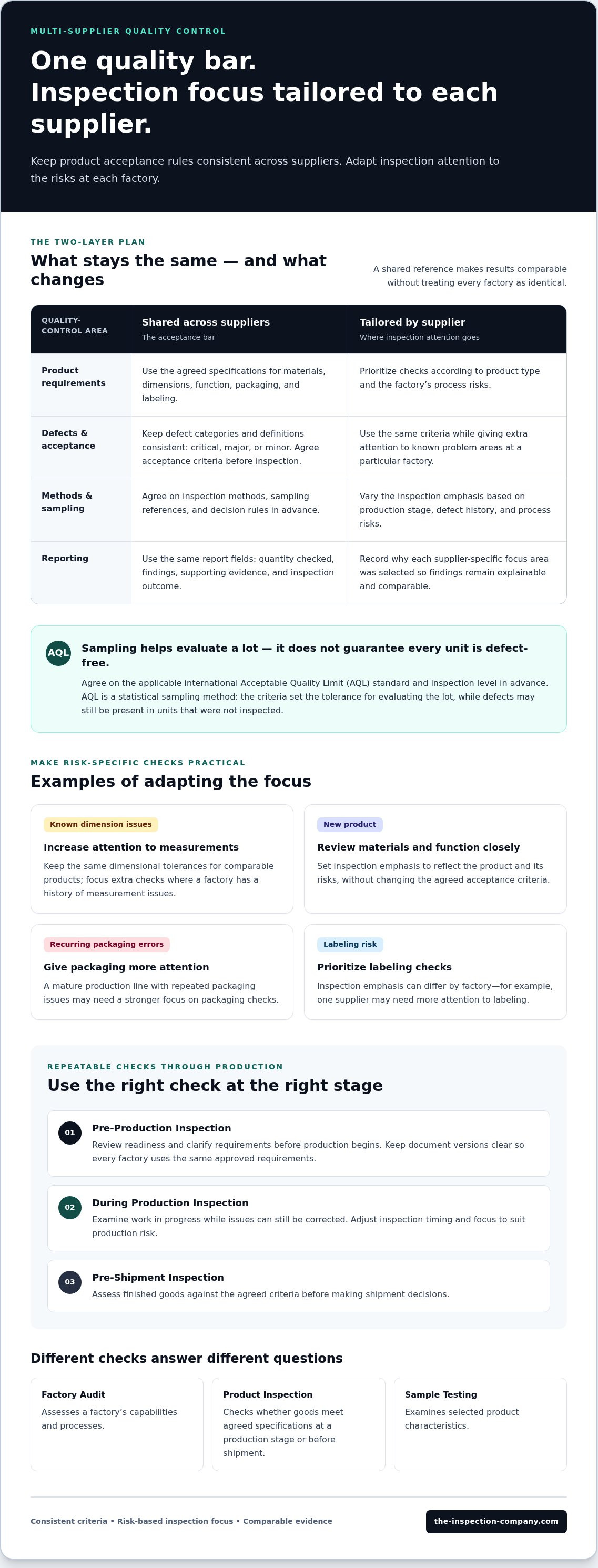
Keep the rules that define product acceptance uniform, while tailoring attention to supplier-specific risks. Align these elements across supplier relationships:
- Product specifications, including relevant materials, dimensions, function, packaging, and labeling requirements.
- Defect categories and clear definitions of what counts as critical, major, or minor.
- Inspection methods, sampling references, and decision criteria agreed before inspection.
- Reporting fields, such as quantity checked, findings, supporting evidence, and inspection outcome.
Then adjust the inspection focus. A supplier with a history of dimension issues may need closer measurement checks; another may require more attention to labeling. For broader supplier governance beyond product checks, use a documented supplier management process guide to align responsibilities and follow-up.
How to set inspection standards that fit each supplier’s risk
Build a plan with two layers: requirements every supplier must meet and checks tailored to each supplier’s risks. This keeps the acceptance bar stable without treating factories as interchangeable. The NIST Supply Chain Quality resource also highlights the value of supplier quality systems and performance metrics.
Shared requirement: Measurable product specifications, defect definitions, acceptance criteria, and consistent reporting fields.
Supplier-specific focus: Checks prioritized by product type, production stage, defect history, and process risks.
Example: Apply the same dimensional tolerances to comparable products, but focus extra checks on dimensions at a factory with a history of measurement issues.
Define relevant criteria for appearance, function, materials, dimensions, packaging, and labeling. Use the same defect categories and decision rules across suppliers producing comparable goods. For sampling, agree on the applicable international Acceptable Quality Limit (AQL) standard and inspection level in advance. AQL is a statistical sampling method, not proof that every unit is defect-free. Your criteria set the tolerance for evaluating the lot; they do not remove the possibility of defects in units that were not inspected.
How should buyers adapt checks without changing the quality bar?
Keep the acceptance criteria fixed, then vary inspection emphasis. A new product may call for close review of materials and function; a mature production line with recurring packaging errors may need more attention there. Record why each focus area was selected. This makes supplier-specific controls explainable and keeps findings comparable, rather than letting different inspection priorities become different quality standards.
When do audits, testing, and inspections answer different questions?
A Factory Audit assesses a factory’s capabilities and processes. Product inspections check whether goods meet agreed specifications at a production stage or before shipment. Sample Testing examines selected product characteristics. These methods answer different questions, so match each to the risk you need to assess. The Inspection Company provides Factory Audits, product inspections, and Sample Testing. Explore an inspection plan for your suppliers.
How to run a repeatable quality-control workflow across suppliers
A repeatable workflow turns quality control when sourcing from multiple suppliers into a series of documented actions, not a last-minute shipment check. Apply the same sequence to each supplier, while setting inspection timing and focus to suit the production risk.
- Align specifications. Give each supplier the current product requirements, approved references, defect definitions, and acceptance criteria before production begins. Keep document versions clear so every factory works to the same approved requirements.
- Schedule stage checks. Use Pre-Production Inspection to review readiness and clarify requirements. During production, examine work in progress while issues can still be corrected. Use Pre-Shipment Inspection to assess finished goods against the agreed criteria before making shipment decisions.
- Record findings consistently. Use a shared report format with supplier, product, lot, inspection stage, findings, photos, and decision fields. Keep records traceable to the relevant order and specification version.
- Decide against agreed criteria. Record whether the lot meets the acceptance requirements or needs corrective action, reinspection, or another disposition.
- Follow up. Assign each corrective action to a responsible party, set a completion target, and retain evidence that the issue was addressed.
How can buyers catch issues before goods are ready to ship?
Production-stage checks can reveal repeated process problems, such as inconsistent assembly or recurring finish defects, before the full order is complete. A During Production Inspection provides a checkpoint while work is underway. Log each issue by supplier, defect type, action owner, and follow-up evidence so a correction can be verified and recurring problems remain visible.
How should teams compare inspection results?
Compare like-for-like products at the same inspection stage, using the same defect categories and agreed acceptance criteria. A finished-goods report should not be compared directly with an in-process check as if both assessed the same condition. Comparable supplier decisions depend on consistent criteria and traceable inspection evidence. A shared workflow across supplier sites makes that evidence easier to review. See how an inspection workflow can support your suppliers.
How independent inspection helps turn supplier findings into decisions
Independent inspection gives buyers documented, comparable evidence from different supplier sites. Inspectors assess products against the buyer’s specifications and agreed criteria; their findings support decisions but do not replace the buyer’s quality requirements. A report shows what was checked and found, while the buyer decides whether the results meet business needs.
The Inspection Company Ltd (TIC) has a team of 700+ inspectors operating across 25+ countries. TIC provides a Quick Report on the inspection day, followed by a detailed photo-backed report within the next 24 hours. For a final review of finished goods before shipment, Pre-Shipment Inspection findings help buyers assess the lot against agreed acceptance criteria and determine next steps.
What should a buyer expect from a multi-supplier inspection partner?
Look for impartial, traceable records that make findings easier to review across suppliers. TIC is ISO 9001:2015 certified and an ISO/IEC 17020 Accredited Type A Inspection Body. Inspectors sign an anti-bribery contract after each inspection. Together with consistent documentation, these measures support an evidence trail from observed defects and supporting photos to the reported inspection outcome.
What are the next steps for building a workable plan?
Prepare the information needed to align checks across sites: supplier locations, product details, order quantities, current specifications, and target inspection dates. Include known quality concerns and the production stage you want assessed. Inspection costs are charged per man-day, defined as an eight-hour work period, and vary by product type, quantity, and location. With these details, you can structure quality control when sourcing from multiple suppliers around a shared standard and supplier-specific risks, then use documented findings to guide shipment decisions and follow-up.
Request a tailored inspection plan for your supplier network.
Make your next supplier decision with confidence
A strong quality system should keep working as your supplier network changes. Treat each new factory, product, or production process as a reason to review where evidence is needed, not to lower or redefine the acceptance bar. That way, quality control when sourcing from multiple suppliers can support informed decisions and give your team a clear basis for responding to future production risks.
Choose one upcoming order as a starting point. Align the specification, set the inspection milestones, and decide how findings will guide shipment approval or corrective action. A practical plan turns those steps into a repeatable process suited to your suppliers and products.
Request a tailored inspection plan to build a more consistent approach to supplier oversight.
Frequently Asked Questions
Can one quality-control standard work across multiple suppliers?
Yes. A shared baseline lets teams apply quality control when sourcing from multiple suppliers without requiring every factory to follow an identical inspection plan. For example, suppliers making the same product can share core acceptance criteria, while a version with a different component may need an additional check. Document approved product variations separately so inspectors and buyers can distinguish a valid difference from a defect.
Does AQL sampling guarantee that every product in a shipment is defect-free?
No. AQL sampling assesses a lot using a sample; it does not mean every unit is inspected or guarantee that the lot contains no defects. Before inspection, buyers should set the applicable sampling approach, defect classifications, and acceptance criteria. If findings approach a decision threshold, use the report to assess the lot against those pre-agreed rules rather than assuming that a passing result proves every item is perfect.
Can third-party inspectors check products from suppliers in different countries?
Yes. The Inspection Company has 700+ inspectors operating across 25+ countries. Share the product, factory location, order quantity, and requested timing when arranging checks across sites. Aligning those details helps coordinate the inspection scope and keeps the resulting records useful for comparing suppliers.
What information should I prepare before arranging inspections at several factories?
Prepare each supplier and factory location, product specifications, order quantities, current production status, target inspection dates, packaging requirements, and agreed defect criteria. For example, note whether products are still being assembled or are packed and ready for a final check. This information helps define a workable scope and consistent reporting fields across suppliers, while allowing checks to reflect each order’s actual stage and risks.
How quickly are quality-control inspection reports available?
The Inspection Company provides a Quick Report on the inspection day and a detailed, photo-backed report within the next 24 hours. The initial findings give your team an early view of issues, while the detailed report provides visual evidence to review against specifications. Timely documentation supports a shipment decision before goods leave the factory, including follow-up on defects that need clarification or corrective action.