What if the most dangerous defect in your shipment isn't a broken screen, but a hidden battery instability that triggers a global recall? High DOA rates and Amazon account suspensions are enough to keep any electronics importer awake at night. You've worked hard to build your brand. A single batch of faulty hardware can dismantle years of consumer trust in days. By implementing a rigorous consumer electronics inspection checklist, you identify these silent killers before they ever leave the factory floor.
This guide details how to categorize and prevent the most common electronics defects in 2026. We'll cover critical updates like the July 2026 FCC rules on logic-bearing hardware and the latest CPSC mandatory eFiling requirements. You'll gain the technical clarity needed to secure your supply chain, ensure RoHS compliance, and achieve peace of mind before you release that final payment. Protecting your reputation starts with knowing exactly what to look for during a pre-shipment inspection.
Key Takeaways
- Identify why the inherent complexity of hardware manufacturing leads to high DOA rates and how these defects specifically jeopardize your Amazon seller status.
- Utilize the Acceptable Quality Limit (AQL) framework to develop a high-performance consumer electronics inspection checklist that isolates critical safety risks from minor cosmetic issues.
- Discover the strategic balance between visual and functional testing necessary to comply with evolving 2026 regulatory standards and hardware specifications.
- Calculate the true Return on Investment (ROI) of quality control by identifying the "Cost of Poor Quality" and preventing long-term legal and financial friction.
The High Stakes of Consumer Electronics Defects
Electronics aren't like textiles or furniture. Precision is non-negotiable in hardware. A single microscopic solder bridge or a faulty capacitor can render an entire shipment useless. This inherent complexity creates a volatile manufacturing environment where small errors lead to catastrophic financial loss. For Amazon sellers, Dead on Arrival (DOA) units don't just represent lost inventory; they trigger high return rates that damage account health and suppress search rankings. Hidden defects cause long-term brand erosion as negative marketplace reviews accumulate, making recovery nearly impossible. Importers must implement a robust quality management system (QMS) that prioritizes early detection. Utilizing a comprehensive consumer electronics inspection checklist is the only way to safeguard your capital before it leaves the factory.
The Anatomy of a Hardware Recall
Recalls are often triggered by safety failures like battery overheating or short circuits. Beyond safety, non-compliance with RoHS standards can lead to legal seizures. The cost of managing a post-shipment return is astronomical compared to the investment in detection. A thorough Pre-Shipment Inspection identifies these "silent killers" while you still have the leverage of the final payment.
Why Factory QC Often Fails
Many importers mistakenly rely on a factory's internal quality control. However, a factory's primary goal is shipping on time, creating a natural conflict of interest. This "self-policing" often overlooks "production-line drift," where the 10,000th unit differs from the approved Golden Sample. Without a third-party consumer electronics inspection checklist, you're essentially trusting the fox to guard the henhouse. Independent oversight ensures your complex technical specifications remain the top priority.
Categorizing Electronics Defects: Critical, Major, and Minor
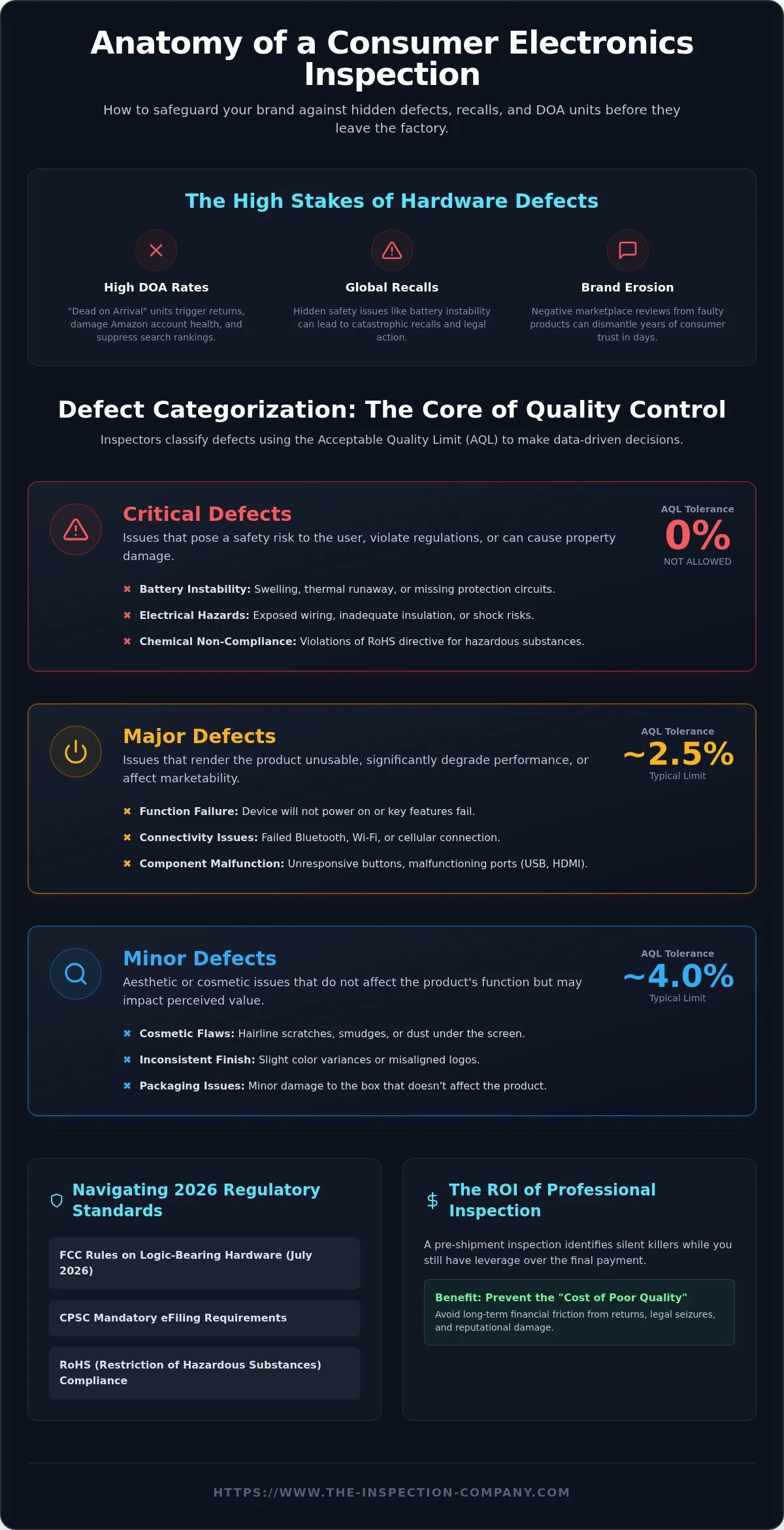
Precision in categorization is the foundation of a reliable consumer electronics inspection checklist. You can't treat a scratched case the same as a short-circuiting PCB. Professional inspectors use the Acceptable Quality Limit (AQL) to statistically determine if a batch meets your standards. In 2026, market expectations for hardware reliability are higher than ever; AQL allows you to set specific tolerances for each category, ensuring you don't reject good batches for minor cosmetic issues while catching dangerous safety failures. For a broader perspective on how these categories apply across various industries, see our guide on understanding product defects. A Critical Defect is any issue that could cause user harm or fire.
Critical Defects: Safety and Liability
Safety is the absolute priority for any hardware brand. Issues in this category often lead to mandatory recalls or investigations by the U.S. Consumer Product Safety Commission (CPSC). These defects represent a total failure of the quality process and require immediate action. Common examples include:
- Battery Instability: Lithium-ion battery swelling, thermal runaway, or missing protection circuits.
- Electrical Hazards: Exposed wiring, inadequate insulation, or poor grounding that risks electric shock.
- Chemical Compliance: Violations of the RoHS directive regarding restricted hazardous substances.
Major and Minor Defects: Function vs. Aesthetics
Major defects render the device unusable or significantly degrade its performance. These include units that won't power on, failed Bluetooth or Wi-Fi connectivity, and malfunctioning USB ports. Minor defects are typically aesthetic. While they don't affect safety or core utility, they impact perceived value and brand prestige. Examples include slight color variances, misaligned logos, or hairline scratches on the housing. If you're unsure how to set your tolerance levels for a specific SKU, consult with a QC expert to refine your consumer electronics inspection checklist before production begins.
Essential Detection Strategies: How QC Identifies Defects
A generic approach fails in hardware manufacturing. You need a customized consumer electronics inspection checklist tailored to your specific SKU. For high-complexity items, a During Production Inspection provides essential visibility into internal components before they're sealed. Modern QC balances visual checks for assembly precision with functional stress tests. Once the inspection is complete, our 24-hour reporting cycle allows you to make data-driven go/no-go decisions immediately. This speed prevents production delays while ensuring you don't release payment for substandard goods.
Core Technical Tests for Electronics
Reliability depends on rigorous technical validation. Inspectors perform Hi-pot (High Potential) tests to verify electrical insulation safety and detect leakage current. Power consumption analysis and battery cycle testing confirm your longevity claims are accurate. Finally, standardized drop tests and vibration testing simulate the harsh realities of international shipping. These tests ensure your hardware survives the journey from factory to doorstep without functional failure.
Packaging and Labeling Verification
Technical excellence is wasted if your shipment is rejected at the warehouse. We verify compliance with Amazon FBA labeling requirements to prevent costly re-labeling fees or account health warnings. This process includes checking for correct user manuals, regional power adapters, and mandatory safety warnings. Ensuring your consumer electronics inspection checklist includes these logistical requirements is essential for a frictionless launch. Ready to secure your next production run? Contact our technical team today to develop your custom inspection protocol.
The ROI of Professional Electronics Inspection
Quality control isn't an expense; it's a preventative investment. To understand the true ROI, you must calculate the Cost of Poor Quality (COPQ). This includes the price of the units, shipping, customs duties, Amazon disposal fees, and the permanent loss of customer lifetime value. A single day of inspection prevents months of logistical friction and potential legal liability. By utilizing a comprehensive consumer electronics inspection checklist, you're securing your bottom line against the volatility of hardware manufacturing. Third-party inspections provide unbiased, technical evidence that's essential for resolving supplier disputes or enforcing contract penalties.
Leveraging the TIC Quality Platform allows you to move beyond individual shipments. You can track long-term supplier performance, identifying trends in defect rates before they become systemic failures. This data-driven approach transforms quality from a reactive task into a strategic advantage.
Selecting a Partner for Asian Manufacturing
Accountability requires a localized presence. Our network of 700+ specialized inspectors across major Asian manufacturing hubs ensures we're on-site when you need us. We combine this geographic reach with European management standards to provide the transparency international trade demands. You don't just get a report; you get a partner who understands the high stakes of your operation and speaks the language of technical precision.
Next Steps: Securing Your Next Shipment
Don't leave quality to chance. Integrate a third-party consumer electronics inspection checklist into your purchase order (PO) as a non-negotiable condition for final payment. This simple clause provides the leverage needed to ensure factory compliance and protects your capital. Ready to protect your brand reputation? You can book a Pre-Shipment Inspection today to ensure your next production run meets the highest standards of excellence.
Future-Proofing Your Hardware Brand Through Proactive Quality Control
In the high-stakes world of consumer electronics, "good enough" is a recipe for financial disaster. You've seen how categorizing defects into critical, major, and minor categories allows for precise risk management. You also understand that technical validation, from Hi-pot testing to battery cycle analysis, is the only way to prevent costly DOA units and account-damaging recalls. By implementing a comprehensive consumer electronics inspection checklist, you're not just checking boxes; you're protecting your bottom line and your brand's future. The cost of a single day of professional oversight is negligible compared to the astronomical expense of a post-shipment failure.
The Inspection Company (TIC) acts as your eyes and ears on the ground. We provide European management standards across Asia, supported by over 700 expert inspectors who understand the nuances of hardware manufacturing. With reports delivered within 24 hours, you gain the transparency needed to make confident payment decisions. Don't leave your reputation to chance. Secure your next electronics shipment with a professional inspection and ensure every unit meets your exacting standards. Your path to a resilient, high-performing supply chain begins with a commitment to technical excellence.
Frequently Asked Questions
What are the most common defects found in consumer electronics?
The most frequent defects include functional failures like units failing to power on, connectivity drops in Bluetooth or Wi-Fi modules, and battery instability. Structural issues such as poor solder joints on the PCB or loose internal components are also prevalent. Your consumer electronics inspection checklist should prioritize these high-risk areas to prevent Dead on Arrival (DOA) units from reaching customers and damaging your brand's reputation.
How do I know if my electronics are RoHS compliant in 2026?
Verification requires technical lab testing and reviewing the supplier's Declaration of Conformity. As of July 1, 2026, new delegated directives regarding lead-related exemptions take effect, requiring updated compliance documentation. It's essential to confirm your products meet these specific 2026 standards through sample testing. Professional inspectors verify that the CE marking is supported by valid test reports from accredited laboratories before you authorize the final shipment payment.
Can a Pre-Shipment Inspection catch battery safety issues before they reach customers?
A Pre-Shipment Inspection (PSI) effectively identifies visible battery defects like swelling or inadequate insulation. However, for complex electronics, we recommend functional tests such as power consumption analysis and thermal stability checks. These protocols detect internal protection circuit failures that lead to overheating. Catching these "silent killers" at the factory stage prevents catastrophic recalls and protects your liability as an importer in increasingly regulated global markets.
What is the difference between a major and a minor defect in hardware manufacturing?
A major defect represents a functional failure that reduces the product's usability, such as a malfunctioning USB port or a non-responsive touchscreen. These issues typically lead to customer returns. Conversely, a minor defect is an aesthetic flaw, like a slight color variance or a small scratch on the casing, that doesn't impact the device's utility. Distinguishing between these helps you set realistic quality thresholds using the AQL framework.
Is a 100% inspection necessary for consumer electronics or is AQL sufficient?
For most high-volume shipments, an Acceptable Quality Limit (AQL) inspection is statistically sufficient to identify batch-wide trends and systemic failures. However, a 100% inspection may be necessary for high-risk components or after a previous batch has failed. Integrating these standards into your consumer electronics inspection checklist ensures you maintain a balance between cost-efficiency and risk mitigation, providing the necessary oversight to secure your supply chain.