

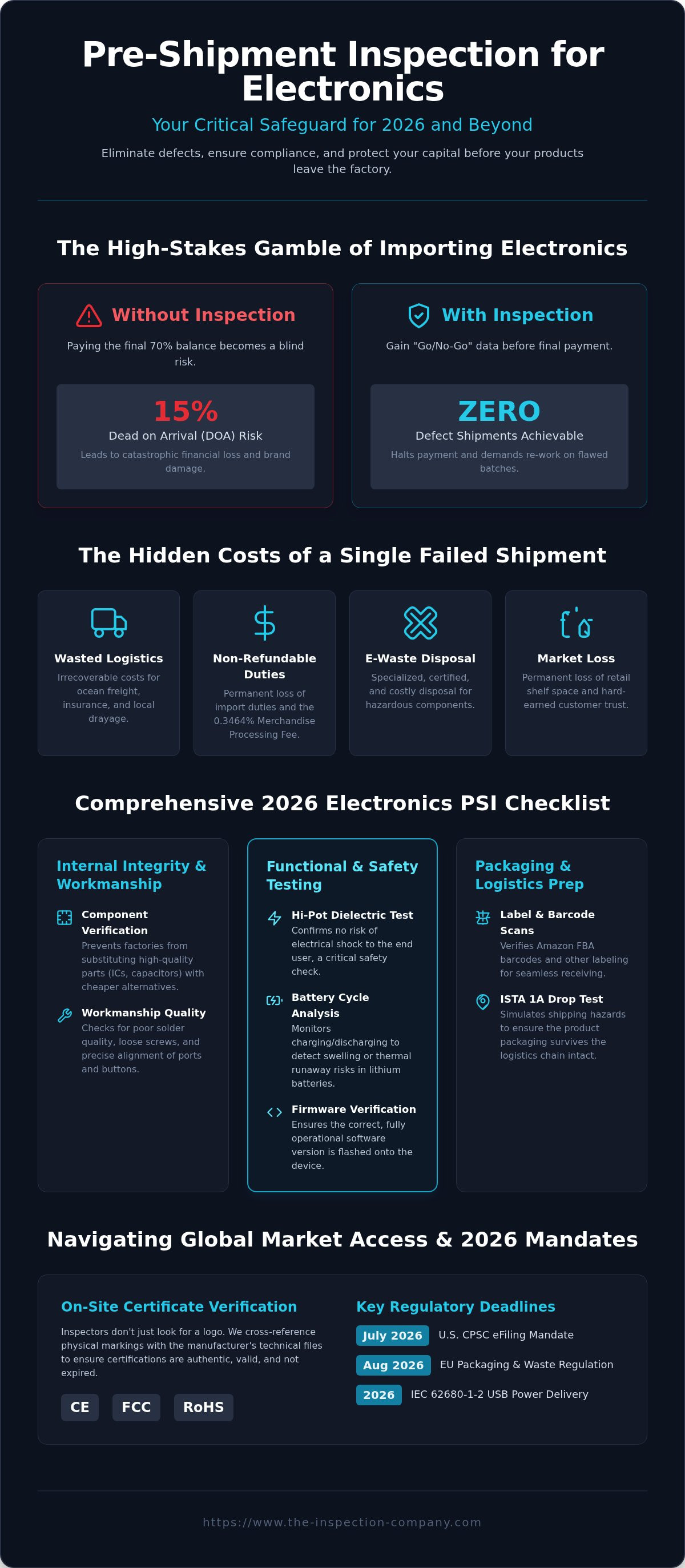
Would you pay the final 70% balance on a container of electronics if you knew 15% of the units would be Dead on Arrival once they reached your warehouse? Most importers live with the constant anxiety of lithium battery hazards or customs delays due to the 2026 CPSC eFiling mandates. It's a high-stakes gamble where a single technical defect or a missing certificate can lead to catastrophic financial loss. This is why a rigorous pre-shipment inspection for electronics is no longer optional; it's a critical safeguard for your capital and your brand reputation.
In this guide, you'll learn how to eliminate technical defects, verify the latest IEC 62680-1-2:2026 standards for USB power delivery, and ensure your shipments meet the August 2026 EU Packaging and Packaging Waste Regulation requirements. We'll examine the specific testing protocols and visual evidence needed to guarantee your products are functional and compliant before they leave the factory floor. By the end, you'll have a clear roadmap for achieving zero-defect shipments and total regulatory certainty.
Key Takeaways
- Eliminate the risk of "Dead on Arrival" shipments by identifying internal defects and battery safety hazards before final payment is made.
- Implement a rigorous pre-shipment inspection for electronics using AQL sampling to verify that factories haven't substituted high-quality components for cheaper alternatives.
- Ensure total compliance with 2026 mandates, including CPSC eFiling and EU packaging regulations, through on-site verification of CE, FCC, and RoHS certifications.
- Leverage 24-hour reporting to maintain your supply chain velocity while securing the "Go/No-Go" data required to protect your capital.
The High Stakes of Pre-Shipment Inspection for Electronics
Electronics aren't just consumer goods; they're complex assemblies of circuits, batteries, and firmware. This inherent complexity is why the electronics sector suffers from some of the highest return rates in global trade. A single batch of "Dead on Arrival" (DOA) units can effectively bankrupt an importer. Beyond the immediate financial loss, technical failures like lithium battery overheating or safety hazards present a catastrophic risk to your brand's reputation and legal standing.
The pre-shipment inspection for electronics serves as your final, critical gatekeeper. Typically performed when at least 80% of the production is finished and packed, this technical audit ensures that what you ordered is exactly what's inside the cartons. Once the container leaves the factory floor in Asia, you've reached the point of no return. Attempting to ship defective electronics back to the manufacturer for repair is rarely viable. The combination of high logistics costs, re-export duties, and complex customs regulations makes post-shipment corrections a financial disaster.
The True Cost of a Failed Electronics Shipment
A failed shipment's real price tag extends far beyond the manufacturer's invoice. Professional importers must account for several hidden layers of loss that erode profit margins:
- Wasted ocean freight, insurance, and local drayage fees.
- Non-refundable import duties and the 0.3464% Merchandise Processing Fee.
- The specialized cost of certified e-waste disposal for hazardous components.
- Permanent loss of retail shelf space and hard-earned customer trust.
It's vital to prioritize understanding product defects before they reach your warehouse. Identifying a critical safety flaw during a pre-shipment inspection for electronics allows you to halt the final balance payment and demand an immediate re-work. This proactive approach transforms a potential logistics nightmare into a managed operational risk, securing your capital and your brand's future.
Technical Checklist: What a 2026 Electronics PSI Covers
A professional pre-shipment inspection for electronics goes far beyond a surface-level visual check. It's a technical audit of the product's internal integrity. We verify that the factory hasn't swapped high-quality capacitors or integrated circuits for cheaper, unbranded alternatives. This "part-swapping" is a common method used to recover margins, yet it directly leads to premature product failure and high return rates.
To manage this process efficiently, we utilize the Acceptable Quality Limit (AQL) to determine a statistically valid sample size. This ensures that technical testing is representative of the entire production run. Beyond internal components, our inspectors evaluate workmanship by checking solder quality, identifying loose screws, and ensuring the precise alignment of ports and buttons.
Packaging and labeling are equally vital. We verify Amazon FBA barcodes and perform ISTA 1A drop tests to ensure the product survives the logistics chain. If you need a customized protocol for your specific SKU, reach out to our technical experts for guidance.
Essential Functional and Safety Testing
Safety testing is non-negotiable for modern electronics. We conduct "Hi-Pot" dielectric strength tests to confirm there's no risk of electrical shock to the end user. For battery-powered devices, we monitor charging and discharging cycles to detect swelling or thermal runaway risks. Firmware verification is also standard; we ensure the correct software version is flashed and fully operational. The Function Test is the most critical step for any electronic device.
Navigating Regulatory Compliance and Market Access
Compliance is a moving target. With the U.S. CPSC eFiling mandate in effect as of July 8, 2026, importers now face strict electronic filing requirements at the time of entry. A pre-shipment inspection for electronics ensures your product's physical markings match the digital certificates you're filing. Our inspectors verify the presence of CE markings and FCC certifications directly on the device. We don't just look for a logo; we cross-reference certifications with the manufacturer's technical files to ensure they aren't forged or expired.
We also confirm RoHS compliance by checking that hazardous substances are restricted as per destination market laws. For e-commerce brands, our Amazon FBA service acts as a preventative shield. We verify that barcodes and packaging meet the latest 2026 requirements, including the EU Packaging and Packaging Waste Regulation (PPWR) standards applicable since August 12, 2026. This prevents "refused" shipments and inventory holds that cripple cash flow.
Managing the Lithium Battery Safety Risk
Lithium batteries represent the highest liability in modern electronics logistics. During a pre-shipment inspection for electronics, we verify the mandatory UN38.3 test reports for transport. We go beyond the paper by checking battery cell authenticity and matching date codes against factory logs to prevent the use of "B-grade" or recycled cells. Inspectors physically examine samples for signs of swelling, inadequate thermal insulation, or poor soldering on the Protection Circuit Module (PCM). This meticulous verification prevents fire hazards and ensures your shipment isn't grounded by carriers or seized by customs. Ensure your electronics meet all 2026 safety standards by booking a compliance audit today.
Securing Your Supply Chain with The Inspection Company
Managing production across oceans often leads to a "transparency gap" where factories promise compliance while cutting corners on technical specifications. The Inspection Company (TIC) bridges this gap by combining European management standards with a localized operational presence. With over 700 inspectors positioned across major Asian manufacturing hubs, we provide an immediate "boots on the ground" solution. This extensive network eliminates client travel costs and ensures that a professional pre-shipment inspection for electronics is conducted by experts who understand both regional factory culture and international quality expectations.
Speed is the most critical asset in modern electronics logistics. A delay in quality reporting can miss a shipping window or stall a critical product launch. We deliver comprehensive, fact-based inspection reports within 24 hours of the site visit. This rapid turnaround provides the data required for an immediate "Go/No-Go" decision, ensuring you never release final payment for defective goods. For a deeper look at our technical methodology and multi-stage verification process, visit our Pre-Shipment Inspection service page.
How to Book Your Electronics Inspection
Securing your shipment is a methodical process designed to eliminate ambiguity and risk. First, provide our team with your technical spec sheet and a "golden sample" for reference. These documents act as the absolute benchmark for our inspectors during their on-site audit. Following the initial briefing, we coordinate directly with your factory to schedule the visit, ensuring the 80% production threshold has been met.
Throughout the process, you can track real-time data and historical quality trends via the TIC Quality Platform. This digital ecosystem centralizes your compliance documents, high-resolution inspection photos, and functional test videos in one secure location. Don't leave your brand reputation to chance. Contact our experts to secure your next electronics shipment and ensure your products reach your customers in perfect working order.
Securing Your Competitive Edge in the 2026 Market
The landscape of international electronics trade is more complex than ever. Importers can't afford to treat quality control as a secondary consideration. By implementing a rigorous pre-shipment inspection for electronics, you effectively eliminate the risk of part-swapping and ensure your products meet the latest safety standards before final payment. This proactive investment protects your capital from the financial disaster of "Dead on Arrival" shipments and regulatory seizures at customs.
With over 700 specialized inspectors across Asian manufacturing hubs and European management standards, The Inspection Company provides the transparency you need. You'll receive detailed reports within 24 hours; this allows you to make informed shipping decisions without compromising your supply chain velocity. Reliability in your supply chain isn't a luxury; it's the foundation of your business's longevity.
Secure Your Electronics Shipment: Get an Instant Inspection Quote
Take control of your product quality today and build a resilient brand that customers can trust.
Frequently Asked Questions
When should I schedule a pre-shipment inspection for electronics?
You should schedule your inspection once 80% to 100% of the production is finished and packed. This timing allows the inspector to pull random samples from the final, retail-ready stock to ensure the results are statistically valid. It's critical to leave enough buffer time before your shipping deadline to address any defects or compliance issues identified during the audit.
What happens if the electronics fail the pre-shipment inspection?
If the shipment fails, you should immediately withhold the final balance payment and request a formal Corrective Action Plan from the factory. A failed report provides the necessary leverage to demand a full re-work or detailed product sorting. Once the manufacturer claims the issues are resolved, a follow-up inspection is required to verify that the goods now meet your quality standards.
Can a PSI detect firmware bugs or software issues?
Yes, a pre-shipment inspection for electronics includes functional testing to verify that the correct firmware version is installed and operational. Inspectors test core features to ensure the software interacts correctly with the internal hardware. While it isn't a deep-dive code audit, it identifies critical glitches or "bricked" units that would result in high return rates if shipped to customers.
Is a pre-shipment inspection enough to ensure battery safety?
A PSI is a vital final safeguard, but it's most effective when paired with earlier audits. During the inspection, we verify UN38.3 test reports and physically check for signs of swelling or overheating in sample units. Because battery safety depends on internal chemistry and PCM quality, this inspection acts as your last line of defense against shipping units that could cause fire hazards.
How much does a pre-shipment inspection for electronics cost in 2026?
Costs are determined by the factory's geographic location and the technical complexity of the required testing protocols. Your final investment depends on the man-days needed to complete the AQL sampling and specialized safety tests for your specific SKUs. A pre-shipment inspection for electronics remains a cost-effective preventative measure compared to the catastrophic expenses of product recalls, customs penalties, and cargo disposal.