Is your "tier-one" supplier in Ho Chi Minh City actually a licensed facility, or is it a "ghost factory" subcontracting your order to an unverified workshop? In a market where exports reached nearly $40 billion in the first half of 2026, the intense pressure to produce often leads to hidden risks that can derail your entire supply chain. You've likely felt the stress of managing a partner from afar, wondering if they're truly compliant with the latest labor laws or the new Decree 110/2026 regarding environmental responsibility. It's a valid concern because the high stakes of international trade leave no room for unexpected operational errors.
Rigorous factory audits in ho chi minh city transform these anxieties into a position of control. By treating an audit as a preventative investment rather than an administrative hurdle, you protect your brand from costly quality failures and regulatory penalties. This article outlines how to verify your manufacturing partners through localized expertise and on-the-ground technical assessments. You'll discover how to navigate the 2026 regulatory landscape, evaluate real-time production capacity, and secure the detailed reports needed to scale your operations in Vietnam with total confidence.
Key Takeaways
- Understand the strategic importance of the "China+1" surge and why verifying supplier capability is the only way to prevent costly operational friction.
- Identify the critical technical and quality benchmarks, including machinery maintenance and ISO 9001 protocols, that define a reliable manufacturing partner.
- Secure your investment by performing factory audits in ho chi minh city to assess how local infrastructure and industrial zone locations affect your lead times.
- Learn to bridge the gap between a successful audit and final delivery by integrating comprehensive inspection services into your quality management strategy.
Why Factory Audits in Ho Chi Minh City are Critical in 2026
The manufacturing landscape in Southern Vietnam has reached a tipping point. As global brands accelerate their "China+1" diversification, factory audits in ho chi minh city have evolved from a simple checkbox into a primary defense against operational failure. An audit is a comprehensive, on-site evaluation of a supplier’s technical capability, legal standing, and management systems. Without this physical verification, you're essentially gambling on a factory’s self-reported data, which often masks deep-seated inefficiencies.
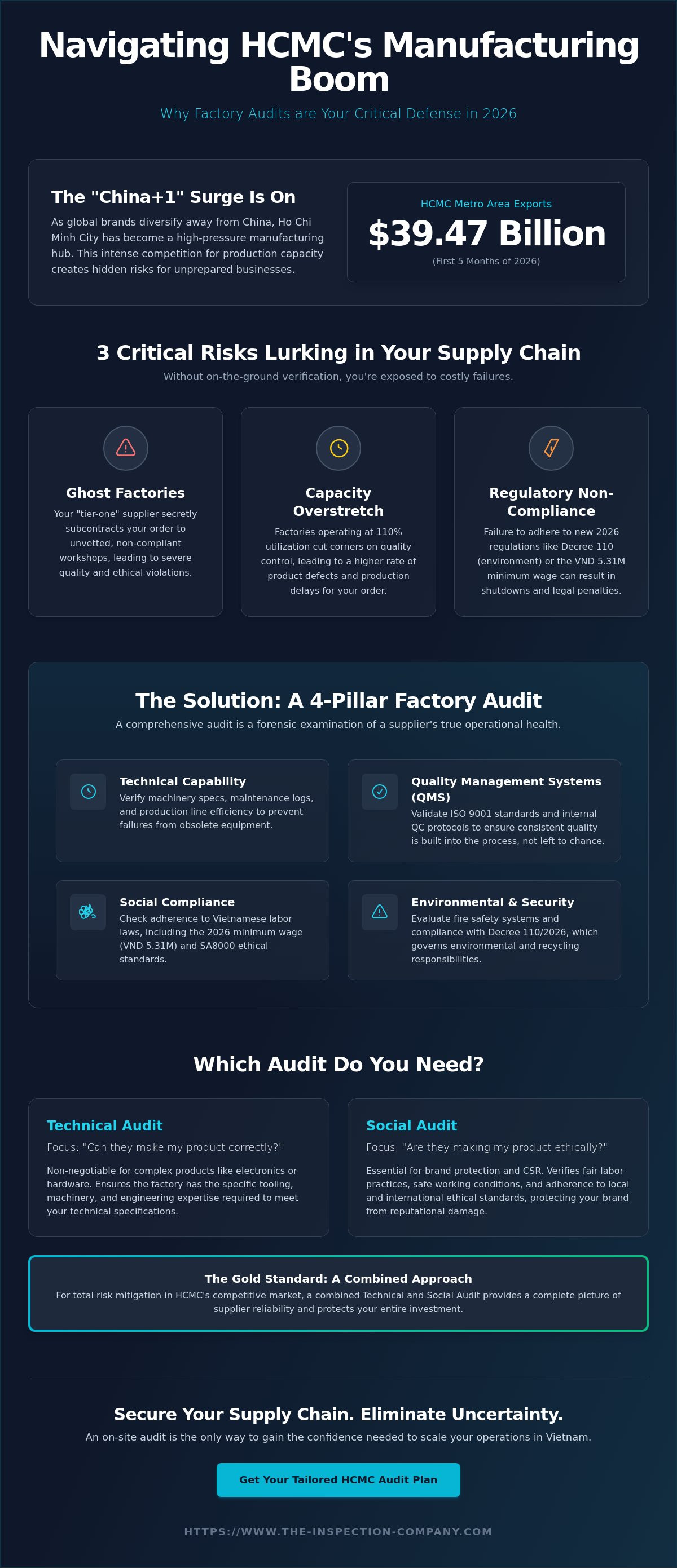
Ho Chi Minh City remains the logistical heart of the region, evidenced by exports reaching approximately $39.47 billion in the first five months of 2026. This massive volume creates a high-pressure environment where "capacity overstretch" is common. When a factory’s floor is at 110% utilization, quality is the first thing to suffer. Identifying these bottlenecks through an audit helps you prevent product defects before the first unit ever enters production.
The "China+1" Strategy and Vietnam’s Hub
While emerging hubs like Da Nang offer lower entry costs, they lack the manufacturing maturity and deep-tier supplier networks found in the HCMC metro area. HCMC offers unparalleled proximity to Cat Lai Port and established industrial zones, but this convenience attracts intense competition. You need to know if your supplier is prioritizing your order or if they're struggling to keep up with a sudden influx of global contracts. An audit reveals the truth about their current workload and machinery health.
Preventing Hidden Sub-contracting
One of the most damaging risks in the current market is the "ghost factory" phenomenon. A supplier might show you a pristine showroom but move your actual production to an unvetted third-party workshop in the suburbs to meet tight deadlines. This practice leads to inconsistent quality and severe compliance violations. A professional audit verifies that your goods are produced in the approved facility by authorized personnel. It also provides a baseline for understanding what a social audit covers, ensuring the facility adheres to the regional minimum wage of VND 5.31 million and avoids the legal pitfalls of unapproved labor practices.
What Does a Comprehensive HCMC Factory Audit Cover?
A factory audit isn't a surface-level walkthrough. In a high-stakes market, factory audits in ho chi minh city serve as a forensic examination of a supplier's operational health. We don't just look at the finished products; we scrutinize the systems that create them. A comprehensive audit in 2026 focuses on four critical pillars to ensure your manufacturing partner can actually deliver on their promises.
- Technical Capability: We verify machinery specifications, maintenance logs, and production line efficiency to ensure the factory isn't operating with obsolete or failing equipment.
- Quality Management Systems (QMS): Our inspectors validate ISO 9001 standards and internal QC protocols to confirm that quality isn't left to chance.
- Social Compliance: We check adherence to Vietnamese labor laws, ensuring workers receive the 2026 regional minimum wage of VND 5.31 million and that the facility meets SA8000 standards.
- Environmental and Security: With the 2026 Decree 110/2026 now in effect, we evaluate the factory's recycling contributions and fire safety systems, which are vital in HCMC's dense industrial zones.
These checks mitigate HCMC-specific manufacturing risks such as infrastructure-related delays or sudden regulatory shutdowns. If you're unsure which specific criteria apply to your product category, you can consult with our technical team for a tailored audit plan.
Technical vs. Social Audits: Which Do You Need?
A Social Audit focuses on ethical manufacturing and protecting your brand from the fallout of labor violations. While these are essential for corporate social responsibility, a Technical Audit is non-negotiable for complex electronics or hardware. It ensures the factory possesses the specific tooling and engineering expertise required for your technical drawings. For most HCMC suppliers, a combined approach is the only way to achieve total risk mitigation.
Amazon FBA and Retail-Specific Requirements
Amazon FBA Inspections differ from standard retail audits because they prioritize strict adherence to Amazon's proprietary labeling, carton marking, and packaging dimensions. During the audit stage, we verify that the factory's packaging department understands these granular requirements. This prevents your inventory from being rejected at an FBA warehouse, saving you from expensive return shipping and lost sales velocity.
Overcoming HCMC-Specific Manufacturing Risks and Logistics
Managing production in Vietnam requires more than just a signed contract. Professional factory audits in ho chi minh city must account for the city's complex geographic layout and industrial clustering. HCMC is a sprawling hub. Proximity to specialized zones like Tan Thuan, Linh Trung, or the Saigon Hi-Tech Park (SHTP) dictates your supplier's logistical efficiency. While being close to Cat Lai Port is an advantage for shipping, it also exposes your supply chain to severe traffic congestion. We schedule our audits around these local variables to ensure our inspectors provide an accurate picture of a factory's true lead-time capability.
Labor dynamics in Southern Vietnam present another layer of risk. The garment and footwear sectors often face high turnover rates, which can lead to sudden drops in quality. Our auditors verify that factories are paying the 2026 regional minimum wage of VND 5.31 million and adhering to overtime limits. This ensures your partner isn't cutting corners that could lead to labor strikes or regulatory shutdowns. You can schedule a logistical assessment to evaluate how your supplier's location impacts their operational stability.
Logistics of Auditing in South Vietnam
Performing factory audits in ho chi minh city through our local team means we don't lose time in traffic. TIC manages the complexities of HCMC's infrastructure through a decentralized network of inspectors stationed near major industrial clusters. This proximity allows us to maintain a 24-hour reporting turnaround. You receive your data quickly, allowing for immediate corrective actions before the first container is even scheduled for loading.
Vietnam vs. China: Regional Audit Nuances
While Vietnam is the primary alternative for brands diversifying from China, the quality maturity varies significantly. Referencing a Vietnam vs. China Sourcing comparison reveals that Vietnamese factories often require more hands-on QMS oversight. Fire safety is a prime example. Vietnamese regulations in 2026 are exceptionally rigorous. Under Decree No. 48/2026/NĐ-CP, authorities now conduct unscheduled environmental and safety inspections without prior notice. A thorough audit ensures your factory is always compliant, preventing a sudden total production halt.
Securing Your Investment with The Inspection Company’s Local Expertise
The success of your Vietnam supply chain depends on the quality of the data you receive. The Inspection Company (TIC) provides a unique advantage by combining European management oversight with a network of over 700 local inspectors across Asia. When you commission factory audits in ho chi minh city, you aren't just hiring a pair of eyes on the ground. You're deploying a methodical risk-mitigation system designed to prevent financial loss and brand damage. Our inspectors understand the local nuances of HCMC's industrial zones while adhering to strict international quality standards.
An audit is the foundation, but total control requires a full-cycle approach. Once your supplier is verified, the next logical step is integrating a Pre-Shipment Inspection. This transition ensures the quality standards identified during the audit stage are maintained throughout the actual production run. By closing the gap between "capable" and "delivered," you eliminate the friction that often plagues international manufacturing in high-pressure hubs.
The Audit-to-Shipment Workflow
Managing a supplier in HCMC requires a clear "approve or reject" framework. We guide you through Mastering the Supplier Management Process, providing the technical evidence needed to make critical decisions. If an audit reveals non-compliance in machinery maintenance or labor laws, we provide the corrective action plans necessary to bring the facility up to standard before you commit your capital. This methodical approach turns a potential operational crisis into a manageable process.
Requesting Your HCMC Factory Audit
Transparency is the core of our service. Through the TIC Quality Platform, you gain real-time access to your audit data and factory performance history. You don't have to wait days for a manual report; the information is available as soon as the inspector finishes the site visit. Booking factory audits in ho chi minh city is straightforward. Simply log into the platform for an instant quote. Our team can typically be on-site within 48 hours to begin the verification process. Professional Factory Audits are the most effective preventative investment you can make for your 2026 production goals.
Secure Your Manufacturing Future in Vietnam
Navigating the complexities of a high-growth market requires more than just trust; it requires verifiable data. The surge in "China+1" manufacturing makes factory audits in ho chi minh city an essential preventative investment to avoid sub-contracting risks and ensure adherence to the 2026 regional minimum wage. By verifying technical capabilities and social compliance now, you prevent the operational friction that leads to delayed shipments and financial loss. It's the difference between reactive crisis management and proactive supply chain control.
The Inspection Company offers a unique blend of European management standards and local HCMC expertise. With over 700 certified inspectors across Asia, we provide detailed audit reports delivered within 24 hours of the site visit. This speed and precision give you the transparency needed to scale your production safely. Don't leave your quality to chance in Vietnam's busiest industrial hub. Secure your Vietnam supply chain with a professional Factory Audit today and gain the confidence to lead your sector with a reliable manufacturing partner.
Frequently Asked Questions
How much does a factory audit in Ho Chi Minh City typically cost in 2026?
Costs for professional factory audits in ho chi minh city are determined by the audit's scope and the technical complexity of the facility. These rates reflect the man-days needed to conduct a thorough on-site verification of systems and labor practices. Factors like the factory's location relative to HCMC's central districts also influence the final investment. We suggest requesting a specific quote to ensure the audit covers your unique product requirements.
How long does it take to receive the final audit report for a Vietnam supplier?
We deliver your final audit report within 24 hours of the inspector's site visit. This rapid turnaround is a core part of our service, ensuring you don't lose time in a fast-moving market. You'll have real-time access to the data through our Quality Platform, allowing you to make "go or no-go" decisions immediately. Speed in reporting is vital for preventing production delays or securing a slot with a high-demand supplier.
What is the difference between a factory audit and a pre-shipment inspection?
A factory audit evaluates the supplier's capability and management systems before production begins. In contrast, a pre-shipment inspection focuses on the actual quality and specifications of the finished goods. Think of an audit as verifying the "chef and the kitchen," while an inspection verifies the "meal" itself. Performing factory audits in ho chi minh city is your first step in building a secure, capability-based manufacturing partnership.
Can a factory audit guarantee that my products will be 100% defect-free?
No, an audit doesn't guarantee zero defects in your final product. Its purpose is to verify that a factory has the machinery, workforce, and quality systems necessary to meet your requirements. It identifies systemic risks before they become physical errors. To catch specific product defects, you must combine your initial audit with regular inspections during and after the production process.
Is a social compliance audit mandatory for importing from Vietnam to the US or EU?
Social compliance audits are essential for meeting the strict supply chain transparency laws in the US and EU. While specific customs codes vary, regulations like the US Uyghur Forced Labor Prevention Act (UFLPA) require proof of ethical labor practices. In 2026, verifying that your HCMC supplier pays the regional minimum wage and adheres to local labor laws is critical for brand protection and avoiding costly shipment seizures at the border.