

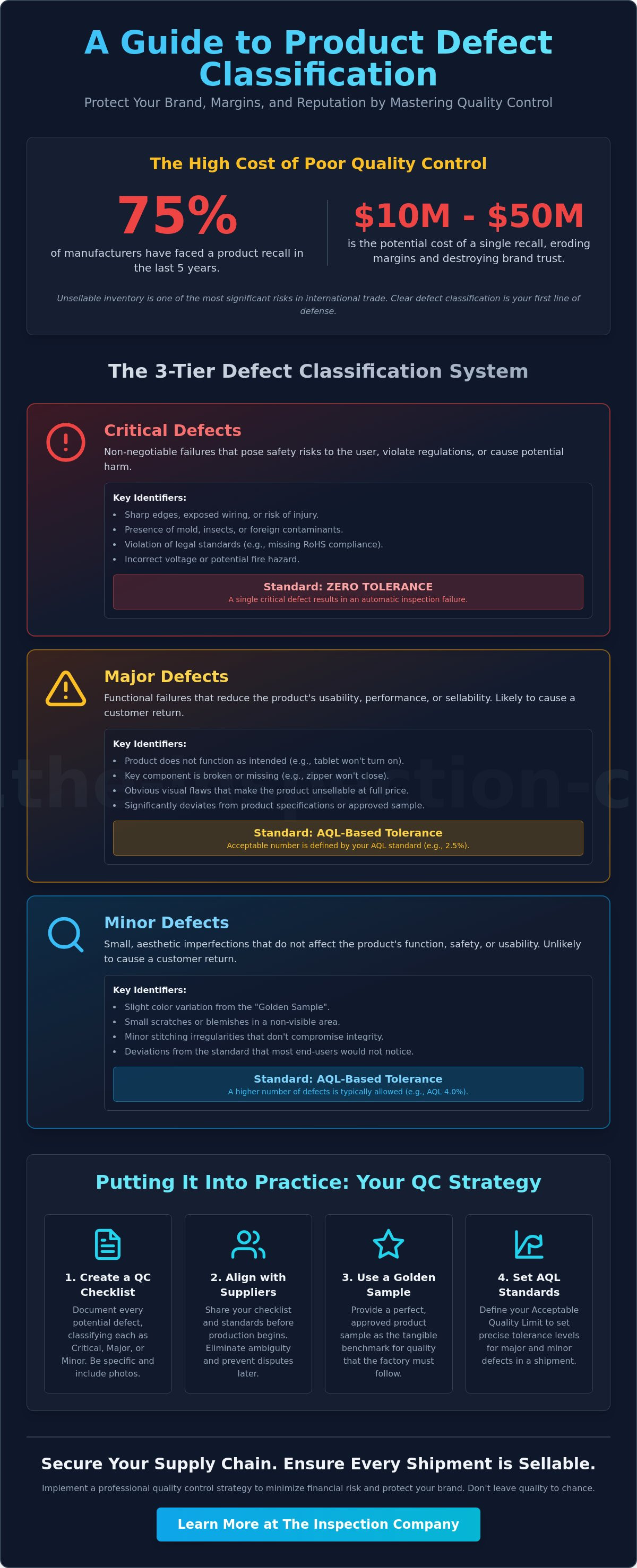
Did you know that 75% of manufacturers have faced a product recall in the last five years? For an importer, this isn't just a statistic. It's a potential $10 million to $49.9 million catastrophe that can erode margins and destroy brand reputation overnight. You know that receiving a shipment of unsellable inventory is one of the most significant risks in international trade. When you're creating a quality control checklist for manufacturing, the difference between a minor cosmetic flaw and a major functional failure determines whether your shipment is a success or a total loss.
By mastering the industry-standard defect classification system, you can eliminate the ambiguity in inspection reports and protect your brand from costly errors. This guide provides a clear framework for defining major and minor defects. We'll show you how to standardize communication with your suppliers and implement a proactive strategy to minimize financial risk before your goods ever reach the container. You'll gain the tools needed to maintain control over your supply chain and ensure every product meets your exact safety and quality standards.
Key Takeaways
- Identify the three-tier defect classification system to reduce operational friction and establish clear quality expectations with your global suppliers.
- Master the essential steps for creating a quality control checklist for manufacturing to effectively separate minor cosmetic flaws from major functional failures.
- Apply Acceptable Quality Limit (AQL) industry standards to set precise tolerance levels that protect your brand while managing inspection costs.
- Utilize Golden Samples and pre-production inspections to provide factories with a definitive, tangible boundary for acceptable product quality.
- Secure your supply chain by standardizing communication, ensuring every shipment remains sellable and compliant with international safety regulations.
Defining Quality: The Three-Tier Defect Classification System
Defect classification is the methodical process of sorting imperfections based on their direct impact on the end-user. It serves as the backbone of Quality control in international trade. When you're creating a quality control checklist for manufacturing, you aren't just identifying mistakes. You're building a precise communication bridge between your brand's expectations and the factory's output. Without this structure, quality becomes subjective, and subjectivity is the primary driver of operational friction in global sourcing.
The industry utilizes a three-tier system to categorize product defects, providing a global benchmark for inspectors and manufacturers alike. These tiers include:
- Critical: Issues that pose safety risks or violate regulations.
- Major: Failures that reduce the product's usability or sellability.
- Minor: Aesthetic variances that don't affect function.
The financial stakes of misclassification are high. If a major defect is incorrectly labeled as minor, you risk high return rates and margin erosion. Even worse, failing to identify a critical defect can lead to dangerous product recalls that threaten your company's survival. Accurate classification ensures that your resources are focused on the risks that matter most.
The Role of Classification in Risk Mitigation
Clear definitions prevent heated disputes between importers and factories in Asia. When everyone agrees on what constitutes a failure, there's no room for "negotiating" quality after the goods are finished. It's vital to establish these standards during the pre-production inspection phase. This proactive approach ensures the factory understands your requirements before mass production begins. A quality standard is the documented baseline for acceptable manufacturing variance that a product must meet to be considered conforming for sale. Setting this baseline early allows you to maintain control over the pre-shipment inspection results and avoid last-minute logistics nightmares.
Creating a Quality Control Checklist: Categorizing Defects
The effectiveness of creating a quality control checklist for manufacturing depends entirely on your ability to define what constitutes a failure. You must move beyond vague descriptions like "good" or "bad." Professional 3rd party inspection company teams use a rigorous "total defect count" logic to evaluate shipments. This approach aggregates findings across specific categories to determine if a batch meets the U.S. Standards for Sampling Plans. Every imperfection is not equal; your checklist must reflect this hierarchy to avoid unnecessary rejections while catching high-risk errors.
Critical Defects: Safety and Compliance First
Critical defects are non-negotiable failures that jeopardize user safety or violate legal requirements. These include hazards like mold, sharp metal edges, or exposed wiring. If you're importing electronics, a missing RoHS compliance marking or an incorrect voltage setting is a critical failure. Industry standards dictate a "Zero Tolerance" rule for this category. Finding even one critical defect typically results in an automatic inspection failure. It's a binary outcome because the risk of litigation or a total product recall is too high to ignore.
Major vs. Minor: Functionality vs. Appearance
The distinction between major and minor defects often determines your profit margin. A major defect involves a functional failure that prevents the product from working as intended. Think of a suitcase zipper that won't close or a tablet that refuses to power on. A major defect typically results in a product being unsellable at full price, forcing deep discounts or costly repairs. These issues directly cause customer returns and damage your brand's credibility on platforms like Amazon.
Minor defects are aesthetic imperfections that deviate from your "Golden Sample" but don't affect performance. Examples include a small scratch on the underside of a chair or a slight color variation in a hidden fabric lining. While these don't necessarily make the product unsellable, a high concentration of minor issues indicates poor factory discipline. By creating a quality control checklist for manufacturing that clearly separates these tiers, you provide your factory with an unambiguous roadmap for success. If you're unsure how to categorize your specific product features, you can consult with a quality expert to refine your standards.
Linking Defect Tiers to AQL Sampling Standards
Inspecting every single unit in a production run is rarely feasible. It's time-consuming, cost-prohibitive, and often unnecessary for mass-produced goods. This is why AQL (Acceptable Quality Limit) has become the global industry standard for importers. AQL provides a statistical framework that balances inspection costs with risk mitigation. When creating a quality control checklist for manufacturing, you must link your defect tiers to specific AQL tolerance levels to define what a "passing" shipment looks like.
Typical AQL settings for consumer goods are 0 for Critical, 2.5 for Major, and 4.0 for Minor defects. These numbers represent the maximum percentage of defects that can be considered acceptable in a batch. Based on your total order quantity, an AQL table determines the sample size and the specific "Accept" and "Reject" thresholds. For example, in a sample of 200 units, the limit might allow for 10 major defects. If the inspector finds 11, the entire shipment fails. This mathematical approach removes emotion from the decision and provides a clear, defensible result for both the factory and the buyer.
Hardlines and Electronics Examples
In hardlines like furniture, a major defect might be structural instability that risks a tip-over. A minor defect would be an inconsistency in the wood grain that doesn't impact the item's safety. For electronics, a battery that fails to hold a charge is categorized as major because it renders the device useless. Conversely, minor scuffs on the internal packaging are aesthetic issues that don't compromise the device's performance or longevity.
Softlines and Textiles Examples
Softline inspections focus heavily on construction and fabric integrity. A hole in a garment or a broken stitch that compromises a seam is a major defect. These issues lead to immediate customer dissatisfaction and returns. Minor defects include loose threads that can be easily trimmed or slight shading differences between fabric rolls. While these variances are imperfections, they don't render the garment unwearable or unsellable. If you need assistance determining the right sampling levels for your specific product category, you can request an AQL consultation to secure your next shipment.
Implementing Your QC Checklist with Asian Factories
The most detailed document is worthless if your manufacturer hasn't formally agreed to its terms. Successfully creating a quality control checklist for manufacturing requires a proactive approach to supplier alignment. You must move from the planning phase to execution by embedding your standards into the factory's daily workflow. This transition begins long before the first unit rolls off the assembly line. It's about mastering the supplier management process through clear, contractually binding expectations.
Follow these steps to ensure your quality standards are respected:
- Step 1: Communicate early. Share your defect definitions during the pre-production inspection phase. This ensures the factory management understands your "Zero Tolerance" for critical issues before they invest in raw materials.
- Step 2: Establish physical references. Approve "Golden Samples" that represent the exact quality level required. These samples serve as the final word in any quality dispute.
- Step 3: Formalize the agreement. Integrate your defect tiers and AQL limits directly into your Purchase Order (PO) terms. This gives you the legal and financial leverage to reject non-conforming shipments.
- Step 4: Verify independently. Use a professional China inspection service to provide an objective report. Never rely on the factory's internal QC team for final approval.
Negotiating Standards and 'Golden Samples'
Factories often push for wider tolerances to simplify their production. You must stand firm on your "Golden Samples" to define the boundary between acceptable aesthetic variance and a major defect. These samples should be signed and kept by both you and the inspector. They provide a tangible yardstick that prevents "quality fade" over time.
Address "borderline" cases during your negotiations. A single minor defect, such as a slightly misaligned logo, might be acceptable in isolation. However, if that same minor defect appears in 30% of the sample, it indicates a systemic process failure. Your checklist should specify that high-frequency minor defects can be elevated to a Major status. This prevents the factory from shipping goods that, while technically meeting individual minor limits, collectively damage your brand's premium feel. By creating a quality control checklist for manufacturing that accounts for frequency, you protect your margins from death by a thousand cuts.
Securing Your Supply Chain Through Standardized Quality
Mastering defect classification transforms your supply chain from a source of constant anxiety into a predictable competitive advantage. By creating a quality control checklist for manufacturing that clearly defines critical, major, and minor tiers, you remove the guesswork from global sourcing. This structured approach ensures safety hazards are eliminated and functional failures are caught before they ever reach your customers. Precise AQL sampling and rigorous adherence to Golden Samples provide the transparency needed to mitigate financial risk and prevent margin erosion.
Don't leave your brand reputation to chance or factory self-reporting. Secure your supply chain with a professional Pre-Shipment Inspection from The Inspection Company. Our team provides European management with localized expertise and utilizes over 700 inspectors across Asia to protect your interests. You'll receive detailed reports delivered within 24 hours, giving you the definitive data required to make informed shipping decisions. Take control of your product quality today and build a more resilient, profitable business.
Frequently Asked Questions
What is the difference between a critical and a major defect?
A critical defect involves a safety hazard or regulatory violation that could lead to dangerous product recalls. In contrast, a major defect is a functional failure that makes the product unusable or prevents it from being sold at full price. While both are serious, critical issues carry significantly higher liability risks. Identifying these early is essential for effective risk mitigation and brand protection.
Can a product with minor defects still be sold?
Yes, products with minor defects are generally considered sellable because the flaw is purely aesthetic and doesn't impact the item's performance. These imperfections deviate from the approved sample but aren't significant enough to cause customer returns. However, if the frequency of minor defects exceeds your AQL limit, the overall shipment quality may be compromised. Maintaining this balance is key to protecting your profit margins.
How many minor defects are allowed in a typical AQL inspection?
The number of allowable minor defects is determined by your sample size and chosen AQL level, typically set at 4.0. For instance, in a sample of 200 units, a 4.0 AQL might allow up to 14 minor defects. Exceeding this number results in a rejected shipment, signaling a breakdown in factory discipline. This statistical framework removes subjectivity from the quality management process and ensures consistency.
What happens if an inspection finds a critical defect?
Finding a single critical defect results in an automatic inspection failure due to the "Zero Tolerance" rule. You shouldn't accept the shipment until the factory performs a 100% sorting and rectification process to remove all hazardous items. Allowing even one safety hazard into your inventory risks catastrophic financial loss. It's a non-negotiable standard that protects both the consumer and your long-term business interests.
How do I create a defect classification list for my specific product?
Start by creating a quality control checklist for manufacturing that lists every possible failure mode for your specific item. Group these into safety, function, and appearance categories to align with the three-tier classification system. Consulting with an experienced inspection partner helps ensure your list accounts for common manufacturing errors in your specific sector. This proactive step prevents operational friction and establishes clear expectations with your Asian suppliers.