
What if the 'Pass' status on your desk is actually masking a 15% major defect rate that will trigger a total recall once the goods hit your warehouse? You've likely felt that knot in your stomach while staring at a 40-page PDF, wondering if you're missing a detail that could cost you $25,000 in lost inventory. It's a common anxiety for importers who understand that once a container leaves a port in Ningbo or Hanoi, their leverage over the supplier effectively disappears.
Learning how to read a product inspection report is your only line of defense against factory manipulation and shipping errors. Drawing on our experience since 2007 in Asian quality management, this guide will show you how to master the art of decoding quality control data. You'll learn to interpret AQL statistical sampling with ease and identify the subtle red flags that suggest a supplier is hiding critical flaws.
We'll walk through the exact steps to evaluate risk levels and provide the vocabulary you need to demand rework with professional authority. By the end of this article, you'll have the confidence to approve or reject any shipment based on hard facts rather than guesswork.
Key Takeaways
- Gain a clear understanding of the report's anatomy and why a 24-hour turnaround is essential to prevent costly delays in your logistics chain.
- Learn how to read a product inspection report by decoding AQL sampling tables to ensure your order quantity is accurately represented and evaluated.
- Move beyond visual checks by identifying critical on-site functionality tests and packaging standards required to safeguard your shipment against transit damage.
- Protect your investment by spotting factory "red flags," such as sample cherry-picking and deviations from your approved golden sample.
- Establish a professional response protocol to effectively communicate findings to your supplier and decide whether to approve, reject, or request a re-work.
The Anatomy of a Professional Product Inspection Report
A professional product inspection report serves as an objective, third-party snapshot of a specific production lot. It isn't just a collection of data; it's a risk management tool that prevents you from paying for defective goods. In the high-speed world of global logistics, receiving this report within a 24-hour window is critical. If your shipment is scheduled for a Tuesday pickup, waiting three days for quality data is a luxury you don't have. Our reports follow ISO 9001:2015 standards to ensure every check is repeatable and accurate. Having European management on the ground in Asia provides a layer of transparency that's often missing in local-only operations. They enforce a strict code of ethics that stops "factory-friendly" reporting in its tracks. Learning how to read a product inspection report effectively is the difference between a profitable quarter and a logistical nightmare.
The General Information and Executive Summary
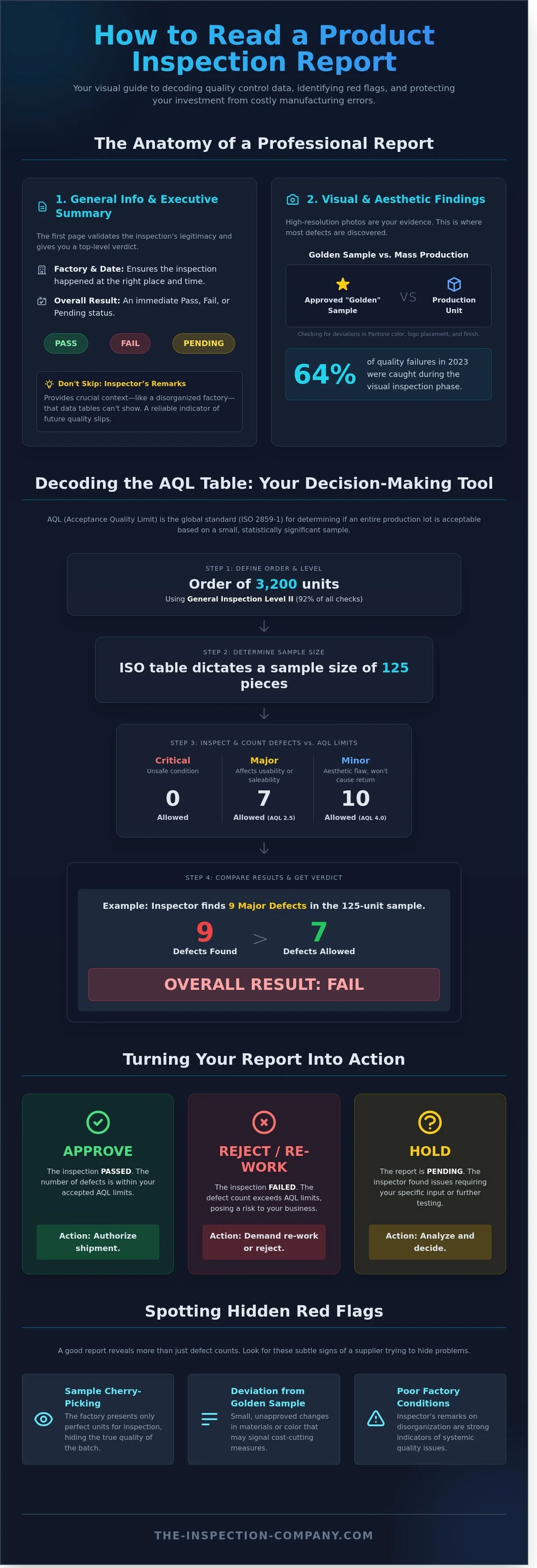
The first page of the report validates the legitimacy of the entire process. You'll find the specific factory location, the date of the visit, and the inspector’s credentials. Verifying these details ensures the inspection actually happened at the intended facility. The "Overall Result" gives you an immediate status: Pass, Fail, or Pending. A "Pending" result usually means the inspector found issues that require your specific decision or additional lab testing. This decision-making process is rooted in Acceptance Sampling, which uses statistical math to determine if the entire lot is acceptable based on a smaller sample size. Don't skip the "Inspector’s Remarks" section. While the data tables show numbers, the remarks provide context. An inspector might note that the factory was disorganized or poorly lit. These are 100% reliable indicators of potential quality slips in future orders.
Visual and Aesthetic Findings
Visual documentation is where the report comes to life. A professional inspector doesn't just take "product shots"; they document the "Golden Sample" comparison. This is your approved prototype placed side-by-side with a unit from the current mass production. In 2023, 64% of our quality failures were caught during this visual phase. We look for deviations in pantone colors, logo placement, and finishing. The report distinguishes between product-specific defects, such as a cracked casing, and general craftsmanship issues like messy glue lines or uneven seams. High-resolution photos are mandatory for every defect found. These photos serve as your evidence if you need to negotiate a re-work or a discount with the supplier. Seeing the defect through the lens of a trained expert allows you to judge if the issue is a one-off error or a systemic problem across the 5,000 units in your shipment. Knowing how to read a product inspection report helps you identify these patterns early.
Our goal is to stop problems before your shipment sails. Reliable data leads to reliable business. By dissecting these visual and summary sections, you gain total control over your supply chain from thousands of miles away. It's the only way to avoid costly surprises at the port of entry.
Decoding the AQL Table: Understanding Pass, Fail, and Pending
Learning how to read a product inspection report starts with the AQL table. AQL is a statistical measurement of the maximum number of defects considered acceptable in a sample. Since its formalization in the ISO 2859-1 standard in 1974, this system has become the global language of quality control. It allows importers to make informed decisions without checking every single unit in an order, which is often physically and financially impossible.
The inspection process relies on statistical sampling. Most consumer goods inspections utilize "General Inspection Level II," which is the industry benchmark for 92% of all pre-shipment checks. For example, if you order 3,200 units, the ISO table dictates a sample size of 125 pieces. This isn't a random guess. It's a mathematically proven method to ensure the sample accurately represents the entire lot. If the number of defects found in those 125 pieces exceeds the pre-defined limit, the entire lot fails. This threshold provides the objective data you need to hold your supplier accountable.
The mathematical result of an inspection is usually expressed as a Pass, Fail, or Pending. A "Pass" means the defects found were within the allowed limit. A "Fail" means the defects exceeded the limit, signaling a high risk of customer returns or safety issues. When you know how to read a product inspection report, you can quickly identify whether your shipment meets the 0.65, 2.5, or 4.0 limits typically set for different defect categories.
To check the verdict yourself, first compare the sample size the inspector actually pulled with the sample size the ISO table requires for your lot size. If fewer units were checked, the result loses its statistical value. Next, compare the defects found in each category with the Accept (Ac) and Reject (Re) numbers in the table. A lot fails as soon as any category reaches its Re figure. Also look for borderline passes. A count that sits one defect below the reject point is technically a Pass, but it shows the lot is close to your limit. That is a reason to tighten checks on the next order.
Critical, Major, and Minor Defects Explained
Inspectors categorize findings into three levels to help you prioritize risks. Critical defects are safety hazards or legal violations, such as a sharp edge on a toy or a missing country-of-origin label. These have a 0% tolerance; a single critical defect results in an automatic failure. Major defects, usually capped at a 2.5 AQL, are functional failures that make the product unsellable, like a blender that won't turn on. Minor defects are aesthetic issues, such as a small scratch or a color shade variation. These typically have a 4.0 AQL limit because they don't impact the product's use but do affect the perceived value.
Choosing the Right AQL Levels for Your Product
You should set your AQL limits and inspection level before production begins, so the report is measured against thresholds your supplier has already accepted. Higher-value products such as consumer electronics often use 0 for critical, 1.5 for major and 2.5 for minor defects. Lower-margin items such as basic apparel may accept 4.0 for minor flaws. If your risk tolerance is low, you can move from General Inspection Level II to Level III. This pulls a larger sample and gives a stricter verdict on the same lot. When you read the AQL table, check that the level and limits shown match what you agreed with the factory. If they don't, the Pass or Fail result is being judged against the wrong standard.
The "Pending" Result: When the Decision is Yours
A "Pending" result occurs when the inspector cannot provide a definitive pass or fail based on the standard criteria. This often happens when 15% or more of the required documentation is missing or when the factory refuses to provide specific testing equipment. In other cases, a result is pending because the findings fall into a "gray area" of your specific requirements that weren't part of the standard AQL plan.
If you receive a pending report, you must review the "Inspector's Remarks" section immediately. You might find that the product is technically sound but the packaging didn't meet a specific, non-critical branding guideline. In these moments, your expertise as an importer is required to waive the requirement or demand a re-inspection. Utilizing professional quality control services ensures that even a "Pending" result includes enough detailed photography and data for you to make a confident decision. Don't let a factory pressure you into shipping until you've cleared the pending status with written confirmation of a solution.
Analyzing On-Site Tests, Functionality, and Packaging
Visual inspection alone is never enough to guarantee a secure shipment. While a product might look perfect in a high-resolution photo, aesthetics don't reveal if the internal components are soldered correctly or if the box will survive a 12,000-mile journey. Understanding how to read a product inspection report requires a deep dive into the "On-Site Tests" section, where the inspector records the results of physical stress and performance benchmarks. These tests act as your final defense against high return rates and brand damage.
The ASTM D5276 Carton Drop Test is a non-negotiable requirement for most consumer goods. During this test, the inspector drops a packed master carton from a specific height, usually 30 inches for a 21lb box, across a sequence of 10 drops. These include the most vulnerable corner, three edges, and all six faces. If the inner products break or the retail packaging sustains a tear longer than 1 inch, the test fails. Transit damage accounts for roughly 11% of total product loss in international trade; skipping this check is a gamble you can't afford to take.
Functional testing ensures the product actually works as intended under real-world conditions. It's common for a factory to produce 5,000 units that look identical, yet 3% might have faulty power switches or software glitches. The inspector will power on a sample size based on the AQL (Acceptable Quality Level) table and run a full cycle of the product's primary functions. If a coffee maker fails to reach 195 degrees Fahrenheit or a remote control loses connection at 10 feet, it's flagged as a major defect.
Amazon sellers face an additional layer of complexity regarding FBA requirements. The report must verify that every unit has a scannable FNSKU barcode and that polybags over 5 inches in diameter include a printed suffocation warning. Failure to comply leads to "unplanned service fees" of $0.30 per unit or, in severe cases, the total rejection of the shipment at the fulfillment center. A professional report will include clear photos of these labels to prove they meet Amazon's 1D and 2D barcode standards.
Packaging and Labelling Verification
Shipping marks must match your Purchase Order (PO) exactly to avoid customs delays. The inspector verifies the side marks, SKU numbers, and "Made in" country of origin statements on 100% of the sampled cartons. We also measure the outer carton dimensions and weight. If a carton is 2kg heavier than the specification, your air freight costs could spike by 14% unexpectedly. Retail packaging is also checked to ensure the printing is crisp and free of the common "ghosting" errors seen in 8% of mass-produced lithographic boxes.
Specialised Testing for Different Product Categories
Different goods require unique safety protocols. For electronics, the report should show Hi-Pot and earth continuity tests at 1500V to prevent electric shocks. In textiles, we perform a GSM (grams per square meter) check to ensure the fabric density matches the contract, allowing for a maximum 5% tolerance. For products destined for the EU, we often verify RoHS compliance during the inspection to ensure no restricted hazardous materials are present. Mastering how to read a product inspection report means knowing which of these specific tests are critical for your niche.
Red Flags and Manufacturer Tactics: What the Data Might Be Hiding
A "Pass" result on a summary page doesn't always tell the full story. Factories often use sophisticated tactics to mask quality issues, making it vital to understand how to read a product inspection report with a critical eye. One common risk is "cherry picking." This happens when factory staff attempt to steer an inspector toward specific cartons they've pre-screened for perfection. In roughly 15% of initial inspections, our teams observe factory workers trying to present "ready" goods while hiding the rest of the batch. If the inspector doesn't personally pull cartons from the back of the warehouse, the data is compromised.
Discrepancies between your "Golden Sample" and mass-produced goods are another major red flag. Manufacturers might use high-grade components for the prototype but switch to cheaper, 20% less durable materials during the main run to increase their margins. You should also watch for the "broken machine" excuse. If a factory claims their on-site testing equipment, such as a hi-pot tester or a tension gauge, is suddenly unavailable, it's rarely an accident. This is a deliberate tactic to avoid failing a critical safety or functional test. A professional report will document these refusals clearly.
Analyzing raw photo data is your best defense against hidden defects. Don't just look at the product; look at the background. If the photos show a cluttered, dimly lit workspace instead of a clean production line, the risk of contamination or assembly errors increases significantly. Meticulous photo review can reveal 10% more defects than the written summary alone, as shadows or slight discolorations often hint at deeper structural issues that an untrained eye might miss.
Spotting Inconsistencies in the Report
When learning how to read a product inspection report, the first thing you should verify is the "Total Quantity Finished." If your purchase order is for 5,000 units but the inspector only found 3,500 units packed, the factory is rushing the process. A report showing "Zero Defects" in a large batch is actually a cause for concern. Statistically, in a lot of 3,200 pieces, finding zero minor defects is nearly impossible under ISO 2859-1 standards. This often suggests the inspector was rushed or the sampling wasn't truly random.
European Management vs. Local Pressure
Integrity is the foundation of quality control. Local inspectors can face immense pressure or "red envelope" bribery attempts from factory owners desperate to ship goods. We mitigate this risk through a European-managed structure that enforces strict ethical protocols. Having an independent team overseen by European leadership ensures that the inspector has full, unhindered access to the warehouse and production line. This oversight prevents the factory from cordoning off "problem zones" and ensures every data point in your report is accurate and unbiased.
Don't let factory tactics jeopardize your brand reputation. Ensure your goods meet global standards by choosing reliable third-party inspection services that stop problems before they leave the port.
Turning Your Report into Action: Approve, Reject, or Re-work?
Receiving the final PDF is only half the battle. Knowing how to read a product inspection report effectively means translating raw data into a firm business decision. You typically face three choices: accept the goods, reject the lot, or demand a rework. Your decision should follow a logical progression to mitigate financial risk.
Step 1: Review AQL results against your specific business risk tolerance. If your report shows a "Fail" because Major defects hit 3.8% against a 2.5% limit, you must evaluate the impact on your customers. A 1.3% deviation might be acceptable for low-margin promotional items. It's often a deal-breaker for high-end consumer electronics where a single failure triggers a costly return. Don't just look at the pass/fail result; look at the trend of the defects.
Step 2: Communicate the findings to your supplier with clear photo evidence. Never argue with a factory using vague descriptions. Send them the specific pages from the report. Use the high-resolution photos provided by our inspectors to highlight exactly where the stitching failed or where the logo placement deviated by 5mm. Digital evidence removes the possibility of the factory claiming the issues are "within tolerance."
Step 3: Negotiate Rework or Sorting for failed lots. If the lot fails, insist that the factory performs a 100% sorting of the production. They must remove all defective units and replace them with sound ones. This process generally takes 4 to 6 days depending on the batch size. You should never accept a verbal promise of quality improvement for the next order as a solution for a current failure.
Step 4: Schedule a Re-Inspection or Container Loading Inspection (CLI) to verify fixes. Once the factory claims the issues are corrected, you need independent verification. A Re-Inspection focuses on the previously failed points to ensure the rework was successful. Alternatively, a CLI ensures the factory doesn't swap the inspected "good" goods with uninspected stock during the final loading process.
A failed lot should not cost you a second time. It is a standard industry expectation that the factory pays for any re-inspection after a "Fail" result, so agree on this in your purchase terms. Only authorise the factory to book the shipment once the re-inspection confirms that every non-conformity is resolved. If the report or a factory audit points to fundamental management or safety failures rather than isolated defects, rework rarely fixes the root cause. In that situation, walking away from the supplier is often the cheaper long-term decision.
The Negotiation Phase: Using the Report as Leverage
A report showing a high rate of Minor defects is a powerful bargaining tool. While these flaws might not justify a full rejection, they reduce the retail value of your shipment. Demand a 2% to 4% discount or a credit on your next invoice to offset potential losses. Require a formal Corrective Action Plan (CAP) that identifies the root cause of the error. Most importantly, keep your leverage. Don't pay the final 70% balance until the inspection report is approved and the CAP is signed by the factory manager.
The report can also protect you at the payment stage. If you pay by Letter of Credit (L/C), you can list a passed inspection report from a named third-party inspector as one of the documents the bank needs before it releases funds. Set this up in the L/C terms together with the agreed AQL levels. A failed lot then cannot be paid for automatically.
Conclusion: Secure Your Shipment with Confidence
Risk management is the backbone of successful international trade. One day of inspection saves months of trouble and heavy financial loss. It prevents the nightmare of receiving 10,000 defective units that you can't sell but still have to pay to store. The Inspection Company acts as your independent eyes and ears on the factory floor. We provide the transparency you need to manage suppliers across Asia with total certainty. With experience since 2007 and European management standards, we stop problems before your shipment sails. Don't leave your brand reputation to chance.
Ready to protect your investment? Book your Pre-Shipment Inspection with The Inspection Company today.
Secure Your Shipment with Data-Driven Decisions
Mastering how to read a product inspection report is the final barrier between a successful product launch and a logistics nightmare. You've learned to decode complex AQL tables, identify subtle manufacturer tactics, and analyze critical functionality tests. These insights allow you to stop defective goods before they leave the factory floor. One day of inspection can save months of trouble. Don't leave your brand's reputation to chance when 700+ local inspectors are ready to verify your order against European management standards.
The Inspection Company brings experience since 2007 in Asian quality management to your supply chain. We provide detailed reports featuring high-resolution photos so you see exactly what our team sees. You'll receive your results within 24 hours. This speed allows you to approve, reject, or demand a re-work without missing your shipping window. Avoid costly surprises; get your professional inspection report within 24 hours. Taking control of your quality assurance today ensures your customers receive exactly what they paid for.
Frequently Asked Questions
What is the most important section of a product inspection report?
The most important section is the Executive Summary, which provides an immediate "Pass," "Fail," or "Pending" result based on AQL (Acceptable Quality Level) limits. This overview lets you see if the shipment meets your 100% quality requirements at a glance. It summarizes critical, major, and minor defects found during the 8-hour inspection day. You'll also find the inspector's overall recommendation here, which is the foundation of your decision to ship or hold.
Can I still ship my goods if the report says "Fail"?
You can legally ship your goods, but doing so with a "Fail" result means you're accepting 100% of the financial risk for defective units. In 85% of failed inspections, importers choose to hold the shipment and demand the factory perform a 100% re-sorting or rework. Once the factory claims the issues are fixed, you should book a re-inspection. Shipping failed goods often leads to customer returns that cost 3 times the original production price.
How long does it take to receive the inspection report after the visit?
You'll receive your comprehensive report on the same day as the inspection or within 24 hours of the site visit. Learning how to read a product inspection report quickly is vital because your shipping window might close in less than 48 hours. Our digital reporting system ensures you get data-backed evidence and high-resolution photos immediately. This speed prevents 10-day delays in your supply chain and allows for rapid decision-making.
How do I know if the inspector actually checked my products?
You can confirm the inspector was on site by checking the time-stamped photos of the sampling, testing and packaging stages included in the report. Each recorded defect should come with a clear image and a written description. Cross-check these photos against the reported defect counts and carton numbers. If the evidence doesn't match the figures, ask for clarification before you approve the shipment.
Can I rely on an inspection report from the factory's own QC team?
No, you shouldn't rely on a report produced by the factory's own QC staff when deciding whether to ship. Internal teams have a clear conflict of interest and are often under pressure to approve goods so the factory meets production quotas and shipping deadlines. An independent third-party report gives you unbiased data and evidence you can use with the supplier.
What is the difference between an inspection report and a factory audit?
An inspection report focuses on the physical quality of a specific batch of goods, while a factory audit evaluates the manufacturer’s 12-month operational capacity and ISO 9001 compliance. Inspections occur at the beginning, middle, or end of production to catch defects. Audits are typically conducted once a year to verify that a supplier has the 50+ machines and 200+ workers required to handle your volume. Both are essential for mitigating long-term sourcing risks.
Does a "Pass" result guarantee that 100% of my products are perfect?
A "Pass" result doesn't guarantee that 100% of your products are perfect; it means the number of defects found in the random sample is below the AQL limit. For example, in a 200-unit sample from a 5,000-piece lot, a "Pass" might still allow for 0 critical, 7 major, and 10 minor defects. Understanding how to read a product inspection report helps you identify if the remaining 96% of the lot likely meets your standards.
What should I do if the factory disagrees with the inspector’s findings?
If a factory disputes the findings, you should immediately review the timestamped photo and video evidence provided in the report. Factories disagree with findings in approximately 12% of cases, usually regarding "minor" aesthetic defects. Since our inspectors are independent third parties with experience since 2007, their data-driven reports serve as objective evidence. You can use these facts to negotiate a 5% discount or insist on a supervised rework before final payment.
How much does a professional product inspection report cost?
A professional inspection report typically costs between $250 and $350 per man-day in major Asian manufacturing hubs. This flat fee covers the inspector's travel, the 8-hour on-site evaluation, and the final documentation. When you consider that a single defective container can result in a $50,000 loss, this $300 investment is a small price for total peace of mind. It's the most cost-effective way to stop problems before your shipment sails.