

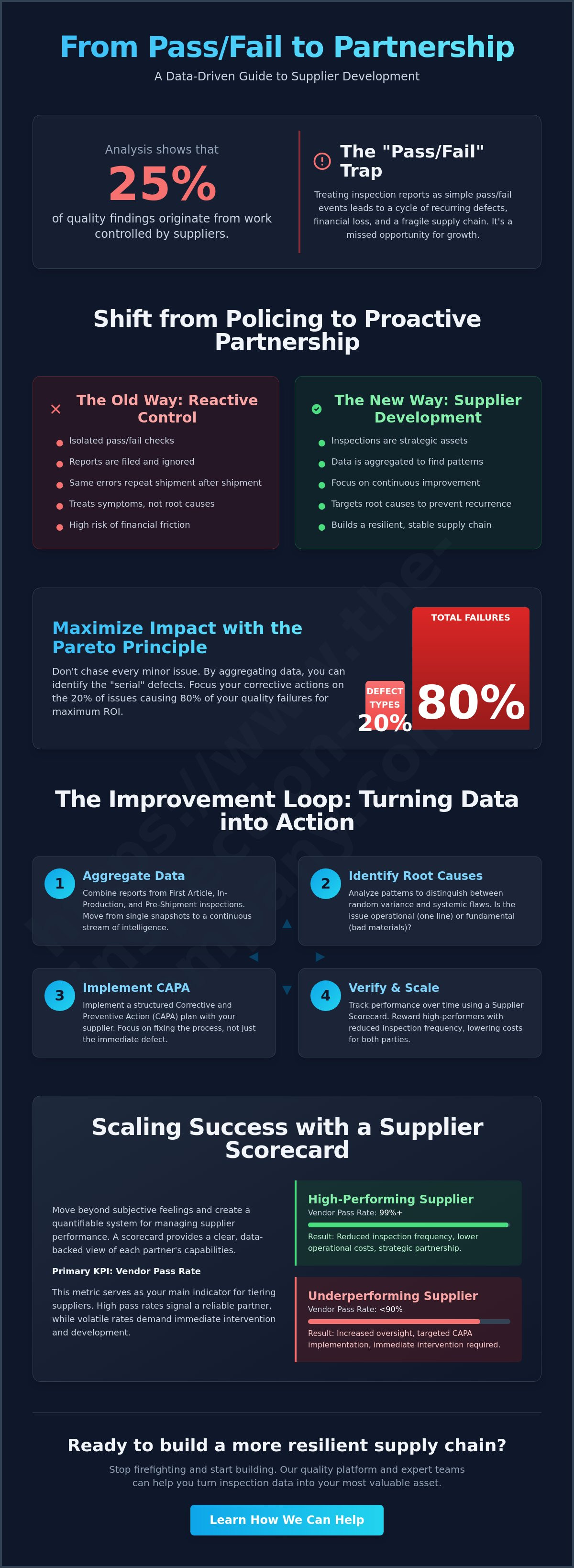
Analysis of pharmaceutical quality data indicates that approximately 25% of quality findings originate from work controlled by suppliers. If you're managing international manufacturing, you've likely felt the weight of this statistic through recurring defects and the financial losses that follow. It's common to feel stuck in a cycle where inspection reports are treated as mere gatekeepers rather than tools for growth. You've probably seen reports filed away in silos while the same production errors happen shipment after shipment.
You already know that treating a Pre-Shipment Inspection as a simple pass or fail event is a missed opportunity to stabilize your supply chain. This guide teaches you how to use inspection data for supplier development so you can turn technical findings into a proactive roadmap for improvement. By shifting from a policing mindset to a collaborative one, you'll learn to lower defect rates over time and reduce the frequency of costly interventions. We'll examine how to leverage data to build trust, align with the upcoming ISO 9001:2026 standards, and create a more resilient operation with far fewer surprises.
Key Takeaways
- Move beyond the 'Pass/Fail Trap' by treating inspection reports as strategic assets for manufacturer growth rather than isolated compliance checks.
- Identify 'serial' defects by aggregating data across multiple shipments, allowing you to prioritize the 20% of issues causing 80% of your quality failures.
- Learn how to use inspection data for supplier development by implementing a structured Corrective and Preventive Action (CAPA) loop that targets root causes instead of surface-level symptoms.
- Establish a quantifiable Supplier Scorecard to reward high-performing partners with reduced inspection frequency and lower operational costs.
The Shift from Quality Control to Supplier Development
Many businesses treat quality control as a series of isolated hurdles. You wait for the report, see the result, and react. This is the "Pass/Fail Trap." It creates a cycle of recurring defects and financial friction. To break this, you must understand how to use inspection data for supplier development. In a 2026 sourcing environment, where supply chains are increasingly fragile, relying on reactive firefighting is a significant operational risk.
Supplier development is a structured, long-term process designed to upgrade a manufacturer’s capabilities. It moves your operations away from emergency rework and toward a proactive partnership. Instead of viewing inspection costs as a sunk expense, think of them as a preventative investment. This approach aligns with Total Quality Management principles, where continuous improvement is the standard, not the exception. By analyzing data across shipments, you identify the root causes of friction before they lead to total project failure.
Why Single-Point Inspections Fail Long-Term
Detecting a defect during a Pre-Shipment Inspection protects your immediate shipment. It doesn't, however, fix the broken process that caused the defect. If you don't analyze the data behind that failure, the manufacturer will likely repeat the same error in the next run. You're treating the symptom while the disease remains in the factory's workflow. This leads to a reliable supply chain becoming an expensive game of chance.
Leveraging the Full Production Timeline
Strategic development requires data from every stage of manufacturing. Utilizing During Production Inspections provides early warning signals before an entire batch is compromised. This real-time data allows for immediate course correction. Additionally, a First Article Inspection acts as the quality ceiling. It confirms the factory understands your specifications before mass production begins. When you aggregate this data, you gain a clear view of where the supplier struggles and where they excel, providing the raw material for meaningful growth.
Analyzing the Data: Identifying Patterns in Inspection Reports
A single inspection report is a snapshot. To understand the health of your supply chain, you must view these snapshots as a continuous stream of intelligence. Aggregating data across multiple shipments allows you to identify "serial" defects that a one-off review would miss. This bird's-eye view is essential for anyone learning how to use inspection data for supplier development. Without aggregation, you're merely reacting to symptoms rather than curing the process.
Utilizing the Pareto Principle is a highly effective strategy for risk mitigation. In most manufacturing environments, 20% of defect types cause 80% of your total rejections. By focusing your development efforts on these "vital few" issues, you maximize the impact of your corrective actions. Categorizing these defects into functional, aesthetic, and packaging groups further pinpoints factory department weaknesses. For instance, a high rate of aesthetic flaws suggests issues in the finishing department, while packaging failures may indicate poor final handling or substandard materials.
Tracking the "Vendor Pass Rate" serves as your primary KPI for supplier tiering. High-performing suppliers deserve lower oversight, while those with volatile pass rates require immediate intervention. If you're struggling to organize this information, you can contact our team to discuss a structured data strategy.
Understanding Defect Trends vs. Random Variance
Stability is the goal of any quality program. Using AQL (Acceptable Quality Limit) data helps you distinguish between random variance and systemic instability. If defects are localized to a specific production line or a night shift, the problem is likely operational. If they appear across all lines, the issue is likely a fundamental flaw in the technical specifications or raw material sourcing.
The Role of Digital Quality Platforms
Legacy systems rely on static PDF reports that are difficult to search and easy to ignore. Modern sourcing requires a transition to a centralized Quality Platform for real-time analytics. This shift improves manufacturing inspections by providing instant visibility into supplier performance history. Centralized data also acts as a safeguard against information loss during supplier turnover, ensuring your quality standards remain consistent even if your manufacturer changes their internal staff.
The Improvement Loop: Turning Data into Corrective Action
Raw data is useless without a mechanism for change. In Asian manufacturing, the Corrective and Preventive Action (CAPA) process is the engine that drives progress. This is the practical application of how to use inspection data for supplier development. It requires moving beyond the standard factory excuse of "human error" and demanding a rigorous Root Cause Analysis (RCA). If a supplier simply promises to "be more careful," they aren't fixing the system. Effective supplier quality management systems depend on identifying whether a failure stems from poor equipment, inadequate training, or flawed material inputs.
Presenting this data to a factory manager requires a diplomatic but firm approach. Instead of assigning blame, frame the discussion around operational efficiency. Show them how reducing defect rates through data-driven changes lowers their own rework costs and improves their standing in your supply chain. This collaborative approach secures buy-in and ensures that improvements are sustainable. You must set clear timelines for these changes and schedule follow-up inspections to verify that the factory actually implemented the agreed-upon fixes.
Step-by-Step: The Corrective Action Process
- Step 1: Identify the trend. Use your aggregated data to find recurring failures that indicate a systemic issue.
- Step 2: Request a Root Cause Analysis. Force the factory to explain why the defect occurred, looking at the "5 Whys" of the production failure.
- Step 3: Implement a Preventive Action. This might involve creating a new assembly jig, improving lighting on the QC line, or specific worker retraining.
- Step 4: Verify through inspection. Use a During Production Inspection to confirm the fix is working while the line is still active.
When to Move from Inspection to Audit
If defects persist despite multiple CAPA attempts, the problem is likely deeper than a single production line. It usually indicates a fundamental failure in the factory's overarching Quality Management System (QMS). At this point, you must transition from product-level inspections to a comprehensive Factory Audit. Understanding the broader context of Mastering the Supplier Management Process helps you decide when a partner is worth developing and when the risk is too high. If you need help implementing a formal CAPA loop with your manufacturers, contact our experts today to secure your production.
Scaling Success: Long-term Supplier Performance Management
Success in international sourcing isn't defined by a single clean shipment. It's defined by the stability of your entire network over years. To achieve this, you must integrate your findings into a Supplier Scorecard. This scorecard should weigh inspection accuracy, production timeliness, and the speed of CAPA responsiveness. Understanding how to use inspection data for supplier development at this scale allows you to move from micromanaging orders to managing a high-performance portfolio.
Strategic buyers implement "Quality Incentives" to drive manufacturer behavior. When a partner maintains a consistently high pass rate, you can justify reducing inspection levels. This reward reduces their operational friction and lowers your costs. However, you must remain vigilant against "Quality Fade." This is the gradual, often invisible, reduction in material quality or process rigor that occurs when a supplier feels the relationship has become routine. Continuous data monitoring is the only way to catch these subtle shifts before they result in a major recall.
Brand safety extends beyond physical specifications. Integrating a Social Audit into your evaluation process ensures your suppliers meet ethical and environmental standards. This is especially critical as the ISO 9001:2026 revision introduces a stronger focus on sustainability and ethical behavior. A supplier who fails on social grounds is just as risky as one who fails on product quality.
Building a Tiered Supplier Network
Data-driven tiering helps you decide where to allocate your resources. You should funnel more business to "Tier 1" partners who demonstrate proactive problem-solving. Conversely, "Tier 3" suppliers who show no improvement despite CAPA loops should be phased out to mitigate risk. Maintaining these standards across multiple countries is challenging; TIC's global presence ensures that your quality benchmarks remain uniform regardless of the factory's geographic location.
Future-Proofing Your Supply Chain
The manufacturing landscape in 2026 is defined by rapid automation and evolving compliance. Historical inspection data is a powerful predictive tool. It helps you anticipate how a factory will perform during peak seasons or high-stress production surges. By analyzing past performance during the Q4 rush, you can proactively adjust your oversight levels. This forward-looking approach ensures your supply chain remains resilient against geopolitical tensions and climate-related disruptions.
Securing Your Supply Chain Through Data-Driven Partnership
Transforming your manufacturing relationships starts with a fundamental shift in perspective. By aggregating technical findings and implementing structured CAPA loops, you move from reactive firefighting to strategic growth. You've now seen how to use inspection data for supplier development to lower defect rates and reward high-performing partners. This proactive approach doesn't just protect your current shipment; it builds a resilient foundation for future expansion as standards like ISO 9001:2026 begin to emphasize quality culture and ethical behavior.
The Inspection Company provides the specialized tools you need to master this transition. With European management and more than 700 inspectors across Asia, we deliver detailed reports within 24 hours. Our centralized Quality Platform ensures your data is never lost in silos, turning every inspection into actionable intelligence for your procurement team. Start turning your quality data into a competitive advantage with The Inspection Company today. You have the power to eliminate operational surprises and take full control of your international quality standards.
Frequently Asked Questions
What is the difference between quality control and supplier development?
Quality control is a reactive process focused on identifying defects in a specific batch of finished goods. Supplier development is a proactive investment in the manufacturer’s long-term capabilities. Learning how to use inspection data for supplier development allows you to move beyond simple gatekeeping and start fixing the underlying production errors that cause recurring financial loss.
How many inspection reports do I need before I can see a trend?
You generally require a minimum of three to five consecutive reports to distinguish between random production variance and a systemic trend. This volume of data allows you to apply the Pareto Principle effectively. It ensures your corrective actions target the specific factory departments responsible for the majority of your quality issues rather than reacting to isolated incidents.
What should I do if a supplier refuses to implement a corrective action plan?
A supplier’s refusal to implement a Corrective Action Plan (CAPA) indicates a critical level of operational risk. You should immediately increase oversight to protect your brand and begin the process of qualifying a backup manufacturer. Persistence in a non-collaborative relationship often leads to catastrophic quality failures; it’s better to transition early than to wait for a total production failure.
Can inspection data help me negotiate better pricing with my factory?
Data provides the factual leverage needed to discuss the hidden costs of production friction. When you know how to use inspection data for supplier development, you can present documented proof of rework and delays. This evidence allows you to negotiate for the supplier to absorb inspection fees or provide credits for substandard output based on their recorded failure rates.
Is it worth investing in supplier development for small orders?
Investing in development is essential if the small order is a trial for a larger partnership. It’s much cheaper to correct a factory’s technical misunderstandings during a small run than during mass production. Early intervention establishes a high quality ceiling and prevents the expensive rework associated with "Quality Fade" as your volumes grow and the stakes become higher.