

A packing list is merely a claim until it is physically verified against the cargo; treating it as a final document without on-site oversight is a gamble your bottom line cannot afford. You understand the professional headache of cargo sitting idle at a port of entry due to a minor clerical error or the financial impact of discovering a short-shipment after the container is already at your warehouse. These discrepancies don't just cause delays. They create operational friction that erodes your profit margins and damages your reputation with customers.
This guide provides a professional framework on how to verify packing list before shipment to ensure your documentation is accurate and compliant with the latest 2026 maritime safety regulations. You'll learn a methodical audit process to identify SKU mismatches and weight variations before the goods leave the factory floor. We will explain how to move from reactive troubleshooting to proactive risk mitigation, securing zero-discrepancy shipments and maintaining complete confidence in your supplier's transparency.
Key Takeaways
- Identify the dangers of "Ghost Cargo" where listed items are physically missing from a container, leading to unexpected financial losses.
- Discover the critical cross-referencing steps between your Packing List and Commercial Invoice to eliminate SKU and weight discrepancies.
- Master a methodical process on how to verify packing list before shipment through physical carton counts and random AQL sampling.
- Understand why independent oversight during container loading is the only way to prevent factory errors from reaching your warehouse.
- Learn how to mitigate the risk of costly customs delays and operational friction by ensuring paperwork is an honest reflection of the cargo.
What is Packing List Verification and Why Does it Matter?
Verification is the methodical process of auditing a supplier's documentation against the actual physical inventory prepared for transport. Many importers mistake a signed document for a guarantee of contents. However, a packing list is merely a declaration. To understand the foundational role of this document, one might ask: What is a Packing List? At its core, it's a detailed roadmap of your shipment. Verification ensures that this roadmap accurately reflects reality before the container doors are sealed.
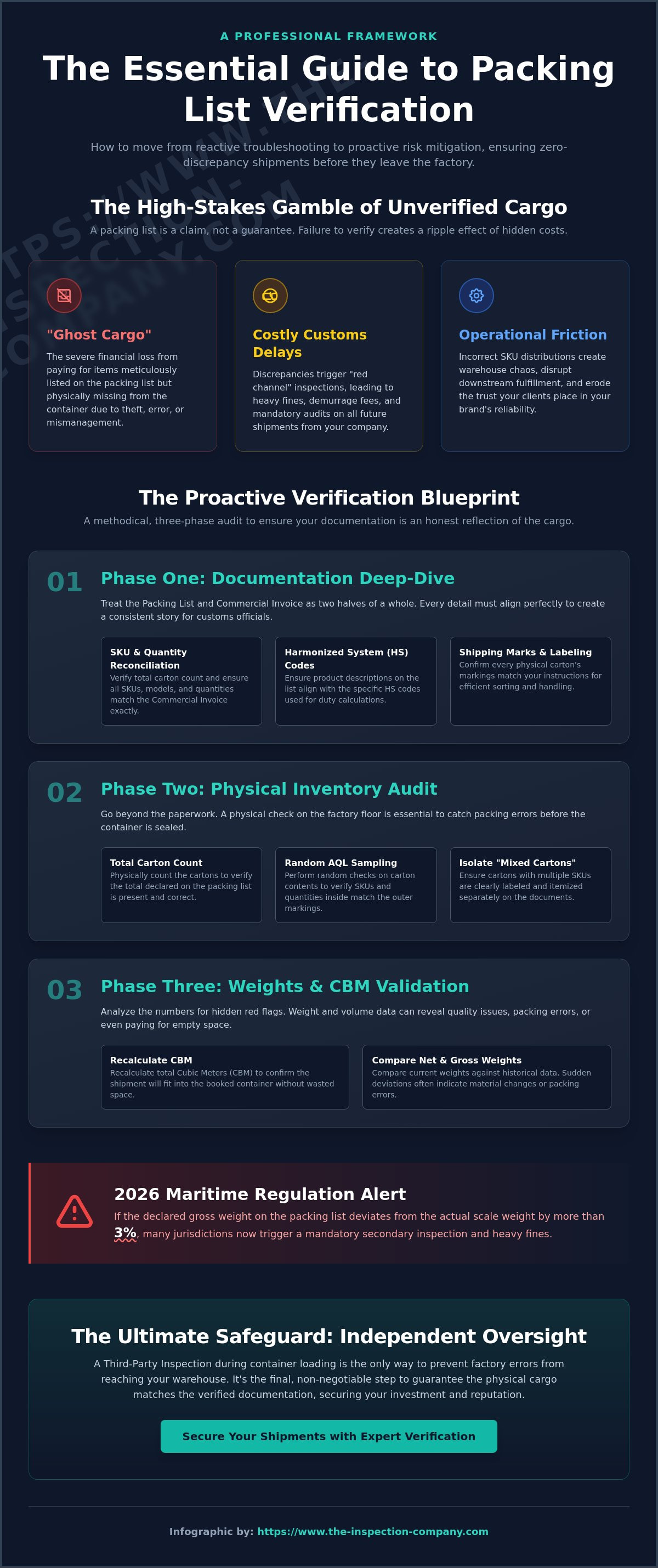
The primary risk of failing to perform this audit is "Ghost Cargo." This occurs when items are meticulously listed on the paperwork but are physically absent from the container. Whether due to factory theft, packing errors, or simple mismanagement, Ghost Cargo results in you paying for goods that never arrive. Learning how to verify packing list before shipment is your first line of defense against these invisible financial leaks. It transforms the document from a passive piece of paper into a verified record of value.
Customs authorities in 2026 have increased their reliance on automated risk-scoring algorithms. Any discrepancy between your digital filings and the physical cargo can trigger a "red channel" inspection. These intensive examinations lead to heavy fines and can flag your company for mandatory audits on all future shipments. Integrating a Pre-Shipment Inspection into your workflow ensures that these errors are caught and corrected at the source, long before they reach a port of entry.
The Hidden Costs of Inaccurate Documentation
Documentation errors create a ripple effect of operational friction. When customs officials hold a container due to packing list discrepancies, you'll face immediate demurrage and detention fees. These daily charges accumulate rapidly, often exceeding the value of the missing goods themselves. Beyond the immediate financial loss, inaccurate shipments damage your professional reputation. If your warehouse receives incorrect SKU distributions, it creates chaos for your downstream fulfillment and erodes the trust your clients place in your brand's reliability.
In 2026, international customs protocols have tightened, and many jurisdictions now trigger a mandatory secondary inspection if the declared gross weight on the packing list deviates from the actual scale weight by more than 3 percent.
Essential Elements to Cross-Reference on Your Packing List
A packing list shouldn't exist in a vacuum. To understand how to verify packing list before shipment, you must treat it as one half of a pair, with the Commercial Invoice (CI) being the other. Any inconsistency between these two documents is an immediate red flag for customs. Every SKU, model number, and quantity must match perfectly. Discrepancies here often suggest either a clerical error or an intentional attempt to bypass trade restrictions, both of which lead to costly delays.
Beyond SKU counts, you must audit your Harmonized System (HS) codes. Ensure the product descriptions on your list align with the specific codes used for duty calculations. Aligning your documentation with official U.S. government guidance ensures that customs officials see a consistent story across all filings. Additionally, check your 'Shipping Marks.' Every physical carton must feature markings that match your instructions exactly. This allows for efficient sorting and prevents warehouse chaos upon arrival.
SKU and Quantity Reconciliation
Accuracy begins with basic math. Verify that the 'Total Cartons' listed at the bottom is the actual sum of every individual line item. Factories frequently overlook 'Mixed Cartons' where different SKUs are packed together. These must be clearly labeled and itemized separately on the document to avoid short-shipment claims. If you identify persistent discrepancies, it may be time to consult with a quality control expert to tighten your supplier requirements and oversight protocols.
Weights and Measurements (CBM)
Calculating Cubic Meters (CBM) is a critical step in risk mitigation. Recalculate the total volume to confirm the shipment will actually fit into the booked container. If the CBM on paper is significantly lower than the container capacity but the factory claims it's full, you're likely paying for empty space. Compare the net and gross weights against historical data for the same products. A sudden spike or drop in weight often indicates a change in material quality or a packing error that requires immediate investigation before the ship sails.
How to Physically Verify the Packing List: A Step-by-Step Guide
Paperwork verification is meaningless without a physical "Carton Count" at the factory. While creating an effective packing list is a necessary first step, the physical reality often differs from the supplier's initial declaration. You must verify that the total number of boxes entering the container matches the sum recorded on the document. Use random sampling based on Acceptable Quality Levels (AQL) to open a subset of these cartons. This process allows you to confirm that the internal piece counts and SKU distributions align with the supplier's claims. It is the only way to catch "short-shipments" before the goods leave your control.
Perform a "Scale Check" on these sampled cartons. If the actual weight deviates from the "Gross Weight" listed on the document, it indicates a packing error or a material discrepancy. This is a critical component of how to verify packing list before shipment. Document every step of this audit. Capture high-resolution photos of carton labels, open boxes, and the loading sequence. This visual evidence serves as your insurance if a dispute arises once the shipment reaches its destination. It provides the transparency needed to hold suppliers accountable for their packing accuracy.
On-Site Inspection Techniques
Before loading begins, perform an "Empty Container" check. Verify the unit is structurally sound and free of odors, holes, or moisture that could damage your cargo. Once the container is full and the doors are shut, conduct a "Seal Verification." The physical seal number must match the number recorded on your final shipping documents exactly. For high-volume orders, a professional Container Loading Inspection provides the necessary oversight to prevent these common factory oversights. This proactive step ensures the cargo is secured and the paperwork is an honest reflection of the load.
Digital Verification Tools
Modern logistics relies on speed and transparency. Utilizing a Quality Platform allows you to receive real-time updates and photos of the goods as they are being packed. In 2026, digital signatures are rapidly replacing manual stamps to provide a tamper-proof audit trail for all shipping documents. These tools ensure you have a verified, digital record of your cargo before the vessel departs. Contact our inspection experts to implement these safeguards for your next shipment.
Why Third-Party Inspection is the Final Safeguard
Factories often operate under intense production deadlines. In this high-pressure environment, clerical errors like SKU mix-ups or incorrect carton counts aren't just possible; they're inevitable. While software solutions help manage data, they can't physically confirm if a box contains your premium electronics or just filler material. This is where an independent third-party acts as your essential safeguard. By having a professional representative on-site, you ensure that the final documentation is an honest reflection of the cargo. This is the most reliable way to master how to verify packing list before shipment and prevent financial leaks.
Professional inspection reports provide the objective evidence you need to dispute short-shipments before the final payment is released. If the report shows a discrepancy, you can demand a re-pack or a credit note immediately. For businesses sourcing from Asia, a China Inspection Service remains the gold standard for maintaining high quality and documentation standards. It replaces the uncertainty of long-distance sourcing with the security of local, expert oversight.
Moving Beyond Trust to Transparency
Relying on a supplier's word is a significant operational risk. Integrating comprehensive PSI reports into your Supplier Management Process shifts the dynamic from blind trust to verified transparency. Our European management structure ensures that reporting in Asian manufacturing hubs meets strict international integrity standards. You receive a clear, unbiased view of your shipment's accuracy without the linguistic or cultural filters that often obscure factory errors. This data-driven approach allows you to hold suppliers accountable for every unit they pack.
Final Checklist Before You Approve the Shipment
Before you give the green light for the vessel to depart, perform one last check. Does the PSI report confirm the Packing List 100 percent? If there's even a minor mismatch in weight or carton count, address it now. A small delay at the factory is always cheaper than a customs hold at the port. Ensuring your documentation is perfect before the container is sealed is the only way to maintain a friction-free supply chain. Protect your investment—book a Pre-Shipment Inspection today.
Secure Your Global Supply Chain with Verified Data
Accuracy in international trade isn't achieved through trust; it's built through methodical oversight. You've seen that a packing list is only as reliable as the physical audit behind it. By reconciling SKUs, verifying gross weights, and conducting on-site carton counts, you eliminate the threat of "Ghost Cargo" and the financial friction of customs delays. Mastering how to verify packing list before shipment means transforming a simple administrative task into a robust risk-mitigation strategy that protects your profit margins.
The Inspection Company provides the local expertise required to execute these audits with precision. With over 700 inspectors positioned across Asia and a management team operating under European standards, we deliver detailed reports within 24 hours of inspection. This speed and transparency allow you to make informed decisions before your capital is committed to the sea. Don't leave your shipment's accuracy to chance when you can have a verified record of your cargo. Take control of your logistics today and ensure every container is an honest reflection of your order. Secure your shipment with a professional Pre-Shipment Inspection and trade with total confidence.
Frequently Asked Questions
What is the difference between a packing list and a commercial invoice?
The commercial invoice is a financial document used to determine the transaction value and duty rates, while the packing list is a logistical document detailing the physical contents of the shipment. Customs officials use the invoice to assess taxes and the packing list to verify the exact quantity, weight, and dimensions of the goods. Both documents must align perfectly to prevent "red channel" inspections and cargo holds.
Can a shipment be cleared by customs without a packing list?
No, a packing list is a mandatory requirement for international freight in nearly every global jurisdiction. Without this document, customs authorities cannot verify the specific contents of individual cartons within a container. Missing paperwork inevitably leads to the shipment being held at the port of entry, which results in daily demurrage fees and potential financial penalties for the importer.
How do I handle a discrepancy found after the shipment has departed?
You must immediately issue an amended packing list to your freight forwarder and customs broker before the vessel reaches the destination port. Proactive disclosure is always better than waiting for an inspector to discover the error. However, this is a reactive and costly fix. Understanding how to verify packing list before shipment through on-site inspections is the only reliable way to prevent these stressful logistical corrections.
Is a digital packing list acceptable for international shipping in 2026?
Yes, digital documentation is now the industry standard following the 2026 updates to international maritime codes and China's amended Maritime Code. Electronic documents and digital signatures are widely accepted by customs authorities to increase transparency and speed up the clearance process. These digital tools provide a tamper-proof audit trail that reduces the risk of document fraud and clerical errors during transit.
What are the most common errors factories make on packing lists?
The most frequent errors include mathematical mistakes in total carton counts, incorrect net versus gross weight calculations, and failing to itemize SKUs within mixed cartons. Factories often rely on outdated templates that don't reflect the actual cargo loaded. These errors lead to "Ghost Cargo" issues where you pay for items that were never shipped or face customs delays due to weight variances exceeding the 3 percent threshold.